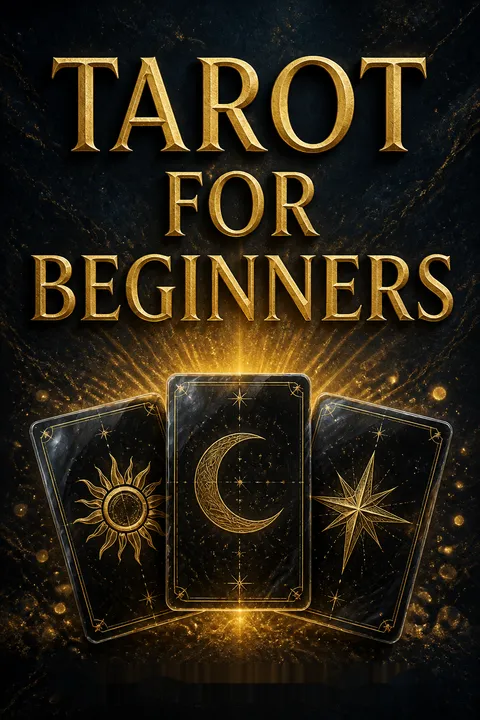


Key Takeaways
Treat tarot as a prompt for agency, not a sentence from fate
A tool for reflection. Chamberlain distinguishes fortune-telling, which treats the future as fixed and the seeker as passive, from divination, which she presents as a way to seek guidance from an unseen or divine source. In practical terms, cards can help clarify a confusing situation, suggest another perspective, and prompt consideration of how present choices may affect what comes next. Readers may explain the experience through spirituality, intuition, or personal belief; the book does not prescribe one account of how the cards work.
Keep choice in view. A reading is not a command or an unchangeable forecast. Even an unfavorable card can be treated as a reason to examine options and adjust course. The book's central promise is not certainty, but a more considered response to uncertainty.
What's valuable here is the shift from prediction to participation. A symbolic prompt can make a person articulate concerns that were hard to name, even if the source of the prompt is understood psychologically rather than supernaturally. That distinction also sets a useful boundary: a card cannot establish what another person will do or guarantee an outcome. Used as a reflective aid, tarot can support deliberation; used as unquestionable authority, it risks replacing judgment with ritualized certainty.
Understand tarot as a layered invention, not an ancient Egyptian relic
A changing tradition. The modern deck developed from European playing cards, not from a single known author or original pack. Italian decks included four suits, then a distinctive group of illustrated trump cards; printing helped standardize decks, especially in Marseille. Eighteenth-century French writers connected tarot to esoteric teachings and divination, while later British occultists developed additional correspondences.
History has disputed chapters. The book describes early claims of Egyptian origins and Roma transmission as historically mistaken, while noting that Roma diviners did adopt cards into existing practices. The influential Waite-Smith deck, created by Arthur Edward Waite and artist Pamela Colman Smith, added illustrated scenes to the numbered Minor Arcana cards. Tarot's history is therefore a history of adaptation, not an intact ancient system handed down unchanged.
The history makes the deck more interesting, not less. Its symbolic authority comes partly from accumulated interpretation: playing-card structures, artistic choices, and occult systems layered over time. That history also cautions against treating every correspondence as timeless fact. When readers know a symbol has a history, they can ask whose assumptions it carries and whether a modern deck is revising them. The book's account is appropriately cautious about origins, though its suggestion of hidden esoteric meaning in early cards remains a possibility, not settled proof.
Separate life turning points from the practical details around them
Two scales of meaning. A standard tarot deck has 78 cards: 22 Major Arcana and 56 Minor Arcana. The Major Arcana often point to major transitions, inner development, or defining themes; the Minor Arcana tend to describe the everyday circumstances in which those larger themes play out. Neither level is inherently more useful. A significant life question can still depend on small practical details, and an ordinary decision can reveal a deeper pattern.
A cyclical map. The Major Arcana are often read through the Fool's Journey, a sequence in which the Fool encounters archetypes, challenges, and lessons before reaching the World. It is a map for recognizing themes, not a timetable. People revisit beginnings and lessons in different parts of life, rather than progressing through the cards in a single fixed order.
This two-scale model offers a simple way to prevent a reading from becoming either melodramatic or trivial. Major Arcana cards invite attention to broad patterns, while Minor Arcana cards bring interpretation back to relationships, work, emotions, and material conditions. The Fool's Journey works best as a narrative lens rather than a claim that every life follows the same developmental sequence. Its usefulness lies in helping a reader ask what kind of challenge is present, not in assigning a person a permanent stage.
Read suits and numbers as grammar, then let the card image speak
Four everyday arenas. The Minor Arcana suits give a first organizing clue: Wands concern inspiration and initiative, Cups concern emotion and connection, Swords concern thought, action, and conflict, and Pentacles concern material life and resources. Numbered cards add another layer. In the book's system, an Ace suggests potential, five introduces disruption, and ten signals completion and a new cycle. These are interpretive patterns, not a universal code shared by every deck.
Images add texture. The Waite-Smith Three of Cups, for instance, depicts figures raising cups together, which can suggest celebration or mutual support beyond the suit's general emotional emphasis. Elemental assignments and card names can vary across traditions, so a reader should use these patterns as starting points rather than rigid answers.
The grammar analogy is useful because it lets beginners reason from parts instead of memorizing 78 unrelated definitions. Suit, number, and image supply different kinds of evidence, and the reader can compare them for a coherent interpretation. The limitation is that symbolic systems can appear more exact than they are. A number's meaning depends on the tradition being used, and a vivid picture can invite projection. Naming the interpretive system being applied makes the reading clearer and more honest.
Let question, position, and neighboring cards shape each meaning
Context changes the card. A card's guidebook meaning is only a baseline. Its position in a spread may place it in the past, near future, or advice role, and the surrounding cards can emphasize a different aspect of its symbolism. The Three of Pentacles, for example, can point toward skill, recognition, or collaborative effort. Its position and nearby cards help show which theme best fits the question.
Read the whole spread. After considering each card, look for patterns: repeated suits, recurring numbers, or several Major Arcana cards. Such patterns can suggest that a reading is concentrated on one realm of experience or on a broad turning point. They do not remove ambiguity, but they give the reader a way to connect individual cards into a coherent account rather than reciting disconnected keywords.
This approach resembles interpretation in literature: a symbol matters partly because of where it appears and what surrounds it. The spread prevents a card dictionary from functioning as a verdict, while patterns help keep the reading organized. Still, coherence is not the same as confirmation. Readers can often construct a persuasive story from ambiguous signs, especially when a question matters deeply. Recording alternative interpretations, and asking what evidence would distinguish them, can preserve curiosity without forcing every card to fit one preferred narrative.
Ask open questions that return insight and choices, not fake yes-or-no certainty
Frame for exploration. The book advises against relying on literal yes-or-no questions because the cards do not provide a standard yes or no. Questions beginning with how, what, or why invite a wider interpretation: rather than demanding a prediction about getting a job, a reader might ask what to understand about the career situation or how to approach a search.
Choose a useful spread. A spread is a layout whose positions assign each card a role. A three-card spread can represent past, present, and future, or compare two possible choices with a central advice card. The ten-card Celtic Cross adds positions for influences such as recent history, hopes and fears, outside forces, advice, and a potential outcome. Choose the smallest layout that gives the question enough context.
Question design quietly determines what kind of answer a reading can produce. Open questions direct attention toward interpretation and action, while fixed yes-or-no questions encourage a false sense of precision. The spread also makes the reader's assumptions visible: naming a card's position defines what it is being asked to represent. That structure is useful, but it can still channel attention selectively. A practical check is to ask whether the resulting interpretation identifies a choice, observation, or next step that can be examined outside the reading.
Learn one deck by observation before collecting more systems
Start with the pictures. Chamberlain recommends choosing a deck whose artwork feels engaging, checking as many card images as possible before buying, and considering whether the numbered cards are illustrated. Illustrated scenes can give beginners more visual clues; a deck booklet can explain how its creator interprets particular cards. Starting with one deck makes it easier to notice recurring imagery and build familiarity.
Practice in small sessions. The book suggests studying five to ten cards at a time rather than attempting to master all 78 at once. For a one-card exercise, notice the first detail that stands out, inspect the image, record an initial impression, and then compare it with the card's customary meaning. A journal can preserve readings for later review. Clearing rituals and special storage are offered as personal preferences, not requirements for learning.
The strongest learning advice is the sequence: notice first, consult meanings second. It helps distinguish a reader's immediate associations from inherited interpretations, creating room to learn both without confusing them. Keeping a consistent deck also makes practice comparable from one session to another. The book's energetic care rituals may help some readers create focus, but their value need not depend on claims about transferred forces. A quiet, repeatable routine can serve the same practical purpose by marking time for attention.
Treat a reading as conditional advice, especially when reading yourself
Notice attachment. Self-readers may bend a card's meaning toward the answer they want, or redraw cards until a more comforting result appears. The opposite reaction is possible too: an unsettling card can be treated as a prediction of disaster. The book recommends practicing first with questions that do not carry intense emotional stakes, and taking a break when fear or wishful thinking overwhelms interpretation.
Reversals are optional. A reversed card is upside down from the reader's perspective. Some traditions read it as the opposite of its upright meaning; others treat it as an intensified or narrower expression of the same theme. Readers can also omit reversals and use card position and surrounding cards for nuance. Either way, the book treats outcomes as conditional on current circumstances and choices, not fixed fate.
This is the book's most important safeguard against overconfidence. Emotional investment changes how people interpret ambiguous information, and tarot's flexibility can make that bias hard to detect. Treating a reading as conditional advice keeps the cards from becoming an external authority over major decisions. The same flexibility that makes the practice adaptable can also produce contradictory readings, so consequential choices deserve independent reasoning and relevant expertise. Tarot can open a question; it cannot settle every question responsibly.
Analysis
Chamberlain presents tarot as both a spiritual practice and a learnable interpretive craft. Its structure gives the beginner a route into a large symbolic system: the Major Arcana suggest broad life themes, the Minor Arcana sort everyday experience into four suits, and numbers and images refine the reading. Spreads organize these meanings around questions, while practice is meant to develop familiarity and intuition.
The book's central conceptual move is to distinguish reflection from fixed prediction. That move gives tarot a more empowering role, because a reading can prompt a person to consider choices rather than submit to fate. It also creates a useful standard for judging a reading: does it clarify the situation or suggest an actionable perspective, or does it merely claim certainty? The book is most persuasive when it emphasizes agency, context, and the possibility of changing course.
Its historical account supports this flexible view. Tarot is not presented as a pristine relic with one authoritative origin, but as a European card tradition altered by artists, occult writers, and later readers. The result is a system with multiple, sometimes competing correspondences. That diversity invites creative interpretation, but makes it important to distinguish a tradition's symbolism from a verified account of supernatural communication. The book acknowledges that readers differ about the source of a reading, though it generally speaks from within a spiritual worldview.
The practical advice is strongest when it guards against the reader's own desires: ask open questions, use a spread deliberately, compare meanings with visual details, and beware of reshaping a card to fit a hoped-for answer. Those cautions could be extended to the whole method. Symbolic readings can feel compelling precisely because their meanings are adaptable. Treating them as prompts for reflection, rather than evidence about hidden facts or guaranteed futures, preserves their imaginative and personal value while keeping decisions grounded in the world beyond the cards.
Review Summary
Tarot for Beginners is highly praised as an excellent introduction to tarot, with an average rating of 4.18/5 from 1195 reviews. Readers appreciate its clear explanations, historical context, and practical approach. Many found it helpful for learning card meanings and basic spreads. The book is commended for being concise yet comprehensive, suitable for absolute beginners while still offering value to more experienced readers. Some reviewers noted its usefulness as a reference guide and appreciated the author's emphasis on intuition and personal interpretation.
People Also Read
Glossary
Divination
Seeking symbolic guidanceIn this book, divination means seeking information, insight, or advice through a symbolic practice such as tarot. Chamberlain distinguishes it from fortune-telling understood as passive submission to a fixed future. The reader may attribute a reading to divine guidance, a higher self, or another personal belief, and the book does not claim one explanation fits everyone.
Major Arcana
Twenty-two larger themesThe 22 cards that form one of the two main divisions of a standard 78-card tarot deck. They commonly represent archetypal figures, major transitions, and psychological or spiritual themes. In the Fool's Journey interpretation, their sequence describes a recurring path of development, but it is a flexible map rather than a fixed order for real life.
Minor Arcana
Fifty-six everyday-life cardsThe 56 cards in the four suits of a standard tarot deck: Wands, Cups, Swords, and Pentacles. Each suit contains an Ace, cards numbered two through ten, and four Court cards. These cards tend to describe ordinary circumstances and experiences, offering the setting in which the broader themes of the Major Arcana may appear.
Fool's Journey
A cyclical archetypal pathA way of interpreting the Major Arcana as the Fool's passage through experiences, challenges, and lessons, ending with the World. The Fool represents a beginning or unformed potential, not stupidity. The journey can help readers recognize a theme in a situation, but it is not a prescribed sequence that every person follows in order.
spread
A layout assigning card rolesA spread is an arrangement of cards in which each position represents a particular aspect of the question. A three-card spread might cover past, present, and future, or compare choices and advice. The Celtic Cross is a more detailed layout that includes positions for influences, hopes and fears, guidance, and a potential outcome.
reversed cards
Upside-down card interpretationsReversed cards appear upside down from the querent's perspective. Depending on the reader's tradition, a reversal may suggest an opposite meaning, a more intense version of the upright meaning, or a particular facet of the card's theme. The book treats reversals as optional, since spread position and neighboring cards can also provide interpretive nuance.
About the Author
Other books by Lisa Chamberlain
Download PDF
Download EPUB
.epub digital book format is ideal for reading ebooks on phones, tablets, and e-readers.








