

Key Takeaways
Use tarot to turn unspoken feelings into a story you can act on.
A mirror for experience. Hayertz’s first tarot reading helped her see the anger and longing in a long-distance relationship as part of a larger life story. The cards did not simply predict what would happen. They gave her feelings a shape, making room for perspective and hope. She came to see tarot as a way to connect private emotions with the larger patterns of a life, then translate that understanding into choices and creative work.
The book’s central claim is practical: tarot is most useful when it helps people notice, name, and work with their experience. Its 78 illustrated cards offer images and themes that can prompt reflection, but the meaning becomes personal through the reader’s connection to real events, relationships, and decisions.
What's useful here is the shift from asking whether the cards are objectively right to asking what they help a person notice. A symbol can act like a prompt in a writing exercise: it gives form to material that felt shapeless. That can make reflection less intimidating and more memorable. The limitation is equally important. A vivid interpretation can feel true because it resonates, not because it has been independently verified. Treating a reading as a hypothesis about experience, rather than proof about the world, preserves its reflective power without granting it undue authority.
Ask what shapes your choices, not what fate has already decided.
Questions that open options. Hayertz advises against asking tarot for a fixed yes or no, such as whether to quit a job. Instead, ask what forces are influencing the situation, what a choice might change, what you may be overlooking, or what quality could help you respond. These questions make a reading a way to examine decisions, rather than outsource them.
The future in this approach is conditional: a spread may suggest what is likely if a person continues on the current path, but choices can alter that path. In the book’s example of Zak, an unhappy musician weighs three career options. The cards do not make the decision for him. They expose the underlying issue, his need to break from a job and a mindset that are no longer working, and prompt him to consider more possibilities.
This approach keeps agency with the person asking the question. Instead of searching for a prediction that relieves uncertainty, the reader looks for assumptions, tradeoffs, and possible next steps. That resembles good decision analysis: clarify the question before comparing options. It also exposes a risk in the method. If someone reads every outcome as confirmation of a preferred choice, the cards can reinforce bias. Recording the question and the interpretation, then checking them against what actually happens, can help distinguish useful reflection from hindsight.
Look at the image first, then let meanings test your intuition.
Begin with what you notice. Hayertz recommends studying a card’s figures, objects, mood, and setting before consulting a guide. Ask what catches the eye, what memory or emotion it evokes, and what might be happening in the scene. If nothing comes immediately, describe the image or imagine entering it. The point is not to force a mystical answer, but to give associations time to emerge.
Then compare those associations with the card’s established meanings. The book’s method moves from intuitive response to interpretation, then to matching the abstract card with specific experience. Memorized meanings matter, but relying on them too soon can narrow what the image brings up. A card’s meaning is neither only personal nor only fixed: the reader tests one against the other.
The sequence protects two useful forms of attention. Looking closely invites personal association, while consulting a shared symbolic vocabulary prevents the reading from becoming an entirely private invention. That balance resembles interpretation in art: details in the work constrain what can reasonably be said, even as viewers bring different histories to it. The tension cannot be eliminated. Personal resonance may illuminate a situation, but it can also encourage projection. Naming the visible detail separately from the inference helps keep the two in view.
Make insight real by expressing it, then choosing one aligned action.
Reflection needs a next step. Hayertz’s growth practice begins with noticing an inner response and connecting it to a card’s meaning. The next move is to give that insight form through journaling, conversation, a poem, a drawing, or another creative act. A person might redraw a card using images from their own life or write a dialogue between figures in the spread. Expression helps turn a vague realization into something the person can examine.
Finally, return to the card and ask what action fits the insight. The options might include setting a boundary, asking for support, changing course, or conserving energy. Choose one or two specific ways to embody the card’s constructive qualities. Hayertz’s artist clients often left readings eager to write, paint, or make music. Their creative work became a bridge between understanding an issue and living differently.
This is the book’s strongest safeguard against endless interpretation. Making something or taking a small action gives insight a consequence, and the result can then be assessed in ordinary life. Creative expression is not a magical guarantee of change; it is a way to rehearse, clarify, and communicate a meaning. The practical test is whether the chosen action is specific and proportionate. A reading that produces a dramatic revelation but no workable response may feel powerful while leaving the underlying situation untouched.
Read a spread as a plot, not a stack of isolated definitions.
Position creates meaning. A spread is an arrangement in which each card has a role, such as past influence, present condition, or likely outcome. The same card can mean something different depending on its position and the question. Other cards add emphasis or tension: repeated suits or themes strengthen a pattern, while contrasting cards can reveal competing needs.
In the book’s example, Imani wonders how to build stronger community ties. A Past/Present/Future spread links a past reliance on close partnerships, her present gatherings with friends and neighbors, and a possible future of standing up for shared beliefs. Read as a sequence, the cards suggest that continuing to host people could deepen both connection and conviction. Reversed cards do not automatically mean the opposite of upright ones. They may indicate resistance, excess, emphasis, or a situation that has ended.
The narrative approach helps prevent a common interpretive mistake: treating each symbol as a separate verdict. A spread makes relationships among events visible, much as a timeline or case formulation can reveal how one condition affects another. But a coherent story is not necessarily the only story. Readers should notice when a narrative depends on assumptions that the cards themselves do not establish. Considering an alternative interpretation can make the reading more reflective and less like a story built to justify a conclusion already chosen.
Let suits and numbers give unfamiliar cards a usable grammar.
A compact reading system. The 78-card deck divides into 22 Major Arcana cards and 56 Minor Arcana cards. The Major Arcana concerns significant transitions and deeper developmental themes. The Minor Arcana deals more often with everyday circumstances. Its four suits offer a first clue to the area involved: Cups concern emotion and relationships, Pentacles material life and resources, Swords thought and conflict, and Wands creativity, action, and social roles.
Numbers and court cards add another layer. The book associates numbers across suits with recurring themes, such as beginnings for aces, choices for twos, and challenge for fives. Pages suggest learning, Knights energetic but unfinished pursuit, Queens inner mastery, and Kings outward leadership. For instance, a Four of Wands combines structure and stability with the social and creative sphere of Wands, pointing toward a settled role in a group or community.
This system makes the deck learnable without requiring a reader to memorize 78 unrelated definitions. It works like a vocabulary: suit indicates a domain, number suggests a dynamic, and the spread position supplies context. Its simplicity is also a constraint. A compact grammar cannot capture every detail in an image or every reader’s cultural associations. The most reliable use is as a starting map, not an automatic decoding machine. The card’s scene and the actual circumstances of the question still matter.
Remember tarot began as a European card game, not ancient Egyptian scripture.
History complicates the mystique. The book describes tarot’s early use as a card game, with the oldest known deck, the Visconti-Sforza, created in fifteenth-century Italy. Divination came later, amid European interest in occult traditions. Writers proposed ancient Egyptian origins and links to Jewish mysticism, but Hayertz identifies these origin stories as invented rather than established history. The Rider-Waite-Smith deck, published in 1910, helped set the familiar modern format.
The deck’s imagery also has a human author. Pamela Colman Smith illustrated the Rider-Waite-Smith cards, drawing on Waite’s research and her own artistic vision. Her name was often omitted from the deck’s title, and her contribution received little recognition during her lifetime. The symbols themselves draw on many religious and mythological traditions, sometimes stripped of their original context. Their meanings should therefore be approached with curiosity, not treated as culturally universal facts.
Historical context makes the cards more interesting, not less. It reveals tarot as a changing cultural object shaped by artists, occultists, and the societies that used it. Recognizing Smith also corrects a familiar form of erasure: the visual language associated with a deck can outlast public memory of its maker. The book’s own account invites a further caution. When symbols travel across traditions, familiarity can be mistaken for shared meaning. Readers can value what an image evokes while remaining attentive to where its imagery came from.
Use ritual to focus attention, but let practice build trust.
Make the reading deliberate. Hayertz suggests choosing a deck that draws the reader’s interest, finding a quiet place, preparing a question, and taking time to settle before drawing cards. Some readers may keep a journal, use a cloth, or create a small personal altar. The book also describes ways to cleanse or attune a new deck, including sorting the cards, shuffling them, or spending several days becoming familiar with their images.
These actions are presented as ways to establish care and concentration, not as a single mandatory procedure. A reading can happen wherever the reader can focus. Hayertz recommends regular practice because confidence grows through repeatedly connecting card meanings with lived experience. She also advises studying definitions while staying open to an unexpected association. Ritual supports attention; it does not replace judgment or guarantee an answer.
Ritual can give an ordinary reflective activity a clear beginning and end. That boundary may help someone slow down, set aside distractions, and approach a difficult question with care. The book is strongest when it treats these practices as personal choices rather than proof that the deck contains external forces. A useful ritual should make attention steadier, not make the reader afraid of using the cards incorrectly. If a practice becomes burdensome or compulsive, its purpose has been lost.
Let frightening cards name a challenge, not dictate your future.
Difficult does not mean doomed. Cards such as Death, The Tower, and The Devil can sound alarming when read literally. In Hayertz’s interpretations, Death points to endings, grief, and transformation; The Tower to the collapse of an untenable arrangement; and The Devil to constraints, temptation, or power dynamics that deserve closer attention. Their difficult imagery is a prompt to investigate what is happening, not a prediction of catastrophe.
The author also treats each card as capable of more than one reading. A reversed card may indicate resistance, an intensified quality, or release from an old condition. Readers should ask what the card brings into focus and what response could help, rather than surrendering decision-making to a frightening symbol. Tarot is not a substitute for medical, legal, or other professional advice, a boundary the book explicitly acknowledges.
This framing reduces the chance that symbolic language will become a source of unnecessary fear. A troubling image can help a person examine a problem they have avoided, but interpretation should not escalate distress or substitute for practical support. The distinction between metaphor and fact is especially important when the subject is health, safety, or abuse. A card may prompt a question; it cannot establish what happened, diagnose a condition, or determine what another person intends.
Analysis
Hayertz’s distinctive contribution is less a claim that tarot can foretell events than a method for moving between image, intuition, interpretation, expression, and action. The deck functions as an imaginative instrument: its archetypes give readers a vocabulary for linking feelings to relationships, projects, and choices. The book’s autobiographical opening establishes why that matters. A young reader’s painful romantic feelings become easier to hold when placed in a larger story, and the author later sees the same process energize artists who can turn reflection into work.
The method is compelling partly because it makes room for forms of knowledge that are not purely analytical. Images can evoke memories and associations before a person has a clear verbal account of them. Yet the same openness creates an epistemic vulnerability. A reader may confuse resonance with evidence, or construct a persuasive narrative from ambiguous symbols. The book gestures toward a balance between intuition and card meanings, but readers benefit from an additional discipline: distinguish what the card literally depicts, what it evokes personally, and what is being inferred about the situation. Keeping those layers separate makes interpretation more honest without flattening it.
The book’s historical account also strengthens its practical argument. Tarot is not presented as an untouched ancient authority. Its imagery and meanings have been assembled across time, through games, occult systems, religious borrowings, and Pamela Colman Smith’s artistic choices. That history suggests that interpretation is itself creative and culturally situated. It also makes the recognition of Smith more than a biographical detail: the deck’s apparent symbolic universality was shaped by a particular artist whose contribution was often obscured.
At its best, the practice does not ask readers to obey the cards. It asks them to use symbolic prompts to become more attentive, then test insight through conversation, creative work, and deliberate choices. The value lies in that reflective process, not in treating a draw as independent proof of fate.
Review Summary
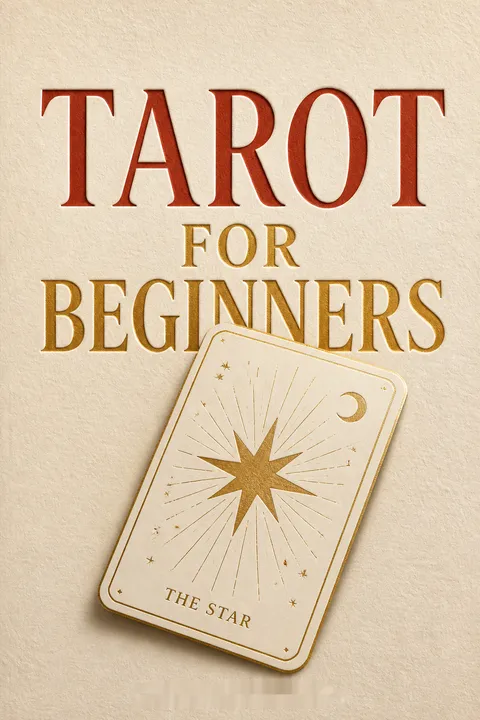
Tarot for Beginners receives mostly positive reviews, praised for its accessibility, comprehensive explanations, and practical approach. Readers appreciate the author's inclusive perspective and emphasis on self-reflection. Many find it helpful for learning card meanings and basic spreads. Some reviewers note it's an excellent resource for beginners but may lack depth for advanced practitioners. The book is commended for its clear writing, diverse examples, and historical context. Overall, it's considered a valuable guide for those new to tarot or seeking to refresh their knowledge.
People Also Read


Glossary
Major Arcana
Cards of major life themesThe 22 cards that form one part of a standard 78-card tarot deck. Hayertz treats them as symbols of consequential transitions, powerful influences, and deeper developmental experiences. Their sequence is often understood as the Fool’s Journey, a passage through archetypal stages of life.
Minor Arcana
Cards of everyday situationsThe 56 cards divided among Cups, Pentacles, Swords, and Wands. In Hayertz’s approach, they tend to describe the more immediate and specific parts of life, including relationships, resources, thought, creativity, and social roles. Each suit contains numbered cards and four court cards.
Fool’s Journey
A sequence of life lessonsA way of understanding the Major Arcana as a developmental path. The Fool represents the seeker or adventure-seeking part of a person, and the remaining Major Arcana cards represent experiences and lessons encountered along the way. The journey frames the cards as connected stages rather than isolated symbols.
spread
Cards arranged by questionA planned arrangement of tarot cards in which each position has a specific role. A position might represent the past, a current obstacle, an ability, or a likely outcome. The spread gives each drawn card context and helps the reader examine several connected aspects of a question or situation.
reversal
An upside-down cardA card that appears upside down in a spread. Hayertz cautions that a reversal does not usually mean the exact opposite of the upright card. Depending on the card and context, it can signal resistance, an exaggerated quality, emphasis, a latent possibility, or the ending of a situation.
significator
A card representing the seekerA card chosen in advance to represent the person asking for a reading. It may be placed before the rest of a spread to personalize the interpretation. Hayertz does not consider it necessary, since leaving it out allows different facets of a person’s experience to appear among the drawn cards.
Life Path spread
A Major Arcana life overviewA spread using Major Arcana cards to explore a person’s broad life themes. Hayertz’s version includes positions for a Life Path card, a Shadow card, and cards representing the previous, current, and coming year. The spread uses birth-date calculations and card associations to prompt reflection, rather than to establish a fixed destiny.
Download PDF
Download EPUB
.epub digital book format is ideal for reading ebooks on phones, tablets, and e-readers.








