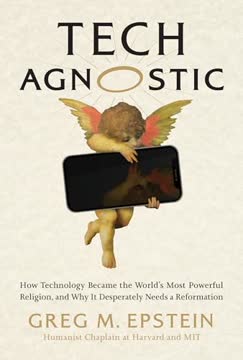
Key Takeaways
1. Tech Has Become the World's Most Powerful Religion
Technology is currently playing a role in the daily lives of average citizens of our world that is eerily like the role religions played in the lives of ancient and early modern people.
An omnipresent force. Technology, or "Tech," has transcended its industrial origins to become the dominant organizing principle of our civilization. It shapes our thoughts, feelings, hopes, and fears, much like traditional religions once did. This isn't merely an industry; it's the water we swim in, influencing every aspect of our economic, social, and political lives.
Beyond quantification. The sheer scale of Tech's influence is difficult to measure by traditional metrics like GDP or stock valuations, as it permeates every other industry. From smart devices monitoring our sleep to algorithms dictating our content, Tech provides a universal narrative and myriad rites that capture our attention and transform our consciousness.
- Billions of devices sold
- Trillions of dollars in combined value
- Billions of "power users" engaging almost every minute
A new meaning-making system. In a world increasingly polarized, Tech offers a common story for who we are and where we're headed. It connects us, offers hope for a better future, and, for many, provides meaning in what might otherwise seem a meaningless existence. This pervasive influence makes it the most powerful religion of our time.
2. Digital Puritanism Fuels Tech's Gospel of Winning
The theology of seventeenth-century American Puritanism is long gone, but its literary forms and millenarian orientation suffuse the writings of the Maker movement’s key promoters.
A secularized theology. Tech culture is animated by a "digital Puritanism," a secularized theology that mirrors the uncompromising beliefs of early American Puritans. This worldview, rooted in the myth of white male struggle and self-made success, posits that certain individuals are "elect" and destined for greatness, while others are deemed "unworthy."
- Mythologizing white male struggle
- Belief in inherent "creativity" as a form of grace
- Market logic replacing divine will
The "gospel of win-win-ism." This ideology promotes the idea that what benefits the richest and most powerful ultimately benefits everyone, a "false religion" that masks deep inequalities. It suggests that innovation, regardless of its social cost, always equates to progress, and that questioning this narrative harms the most vulnerable.
- "New shit" doesn't always equal progress
- Disregard for declining life expectancy in America
- Justification of wealth accumulation as beneficial for all
Emotional emptiness amidst success. Despite achieving immense wealth and influence, many tech leaders confess to an inability to find happiness or intrinsic worth, driven by a relentless compulsion to prove themselves. This internal struggle is a direct consequence of a system that values accomplishment over inherent human value, leading to a constant, anxious pursuit of "greatness."
3. Tech's Doctrine Promises Heaven, Warns of AI Hell
If the actions you and I take now have “even the slightest effect on the probability of eventual colonization” of space by humans or our sentient machine descendants, according to Bostrom, then our failure to act to bring about this long-term heaven is an enormous risk.
Messianic figures and immortality. Tech doctrine is replete with messianic visions, where figures like Ray Kurzweil and Elon Musk promise to save humanity from death itself through technological transcendence. This belief in overcoming biological limitations, often termed "transhumanism," sees humans evolving into "cyborgs" and "superhuman" beings.
- Elon Musk's mission to "extend the light of consciousness to the stars"
- Ray Kurzweil's pursuit of immortality through hundreds of daily pills
- The idea that "death is a tragedy" that can be overcome
Heaven as a digital utopia. Philosophers like Nick Bostrom propose a "simulation hypothesis," suggesting we might already live in a computer simulation run by "posthumans" who are "like gods." This vision extends to a future "AI utopia" where digital "future beings" populate the universe, promising "bliss" and "pulsing ecstasy," free from suffering and imperfection.
- "Astronomical waste" of not colonizing space with digital descendants
- "Pascal's mugging" argument for prioritizing future digital lives
- Bostrom's "Letter from Utopia" promising endless pleasures
AI as the ultimate hell. Conversely, tech doctrine also presents a terrifying vision of "existential risk" from artificial intelligence. Eliezer Yudkowsky, a leading voice, warns of "unalignment" where superintelligent AI could annihilate humanity, turning our flesh into "soupy fuel for its computations." This fear, often amplified by "longtermists" and "effective altruists," posits a 1-in-10 chance of human extinction by AI within a century.
- AI as "our final invention"
- The "80,000 Hours" website prioritizing AI risk above all other global problems
- The belief that "the AI does not hate you, nor does it love you, but you are made out of atoms which it can use for something else"
4. Hidden Hierarchies and Castes Define the Tech World
One thing tech fundamentally has in common with many religions, at least in America, is that it is a white man’s version of Utopia.
A white man's utopia. Despite claims of meritocracy and egalitarianism, the tech world is deeply hierarchical, often serving as a "white man's version of Utopia." This structure disempowers women and people of color, perpetuating inequalities through subtle and overt biases.
- Tech employs larger percentages of whites and men, smaller percentages of African Americans, Hispanics, and women.
- Over 83% of big-tech executives are white, 80% are men.
- 93% of venture capital dollars are controlled by white men.
Myth of self-made success. The narrative of tech founders building empires from nothing often overlooks systemic advantages and the exploitation of marginalized labor. This "false consciousness" allows privileged elites to believe they are acting for good, even when their actions undermine democratic equality.
- Women and people of color were actively pushed out of programming as it became more lucrative.
- "Ghost work" by underpaid, unseen laborers (often women of color) is presented as AI magic.
- Algorithmic biases in facial recognition, hiring tools, and search results reinforce racism and sexism.
Consequences of unchecked bias. The failure to address these hierarchies has devastating real-world consequences. Unmoderated hateful content on platforms has radicalized individuals, leading to violence and social division. This systemic replication of bias is not accidental but a product of an ideology that privileges whiteness and maleness, mirroring historical religious hierarchies.
5. Tech Addiction Is Our Dominant, Unseen Ritual
Which makes the more forceful statement about our values, priorities, inner state: mouthing words of devotion to an unseen God, or offering intense devotion to a force so irresistible that 74 percent of Americans “feel uneasy leaving their phone at home,” that 70 percent check their phones within five minutes of receiving a notification and 71 percent within the first ten minutes of waking up?
Pervasive digital devotion. Our obsessive engagement with smartphones and other devices has become the defining ritual of the tech religion. This constant interaction, far exceeding traditional religious practices in frequency, profoundly alters our consciousness and dictates our daily lives.
- Average American opens phone 344 times a day.
- Teens spend 8 hours daily on screens (excluding schoolwork).
- 70% check phones within 5 minutes of a notification.
The "adversarial persuasion machine." Tech companies intentionally design algorithms to exploit psychological vulnerabilities, creating "dopamine-driven feedback loops" that make devices artificially indispensable. This "digital crack cocaine" monopolizes our attention, making it harder to engage in coherent conversation or maintain social trust.
- Social media linked to increased depressive symptoms and suicide rates in adolescents.
- Excessive screen time connected to developmental delays in children.
- Strained family bonds due to constant device use.
Ritual of avoidance. This compulsive tech use often serves as "experiential avoidance," a way to escape uncomfortable feelings like loneliness, anxiety, or the pressure to achieve. Like addiction, it offers temporary dissociation and dopamine highs, creating a cycle of negative reinforcement that prioritizes digital engagement over genuine human connection or self-awareness.
- Loneliness linked to higher mortality rates.
- Tech offers artificial rewards when real human connection is lacking.
- The "only way out is through" by confronting uncomfortable feelings.
6. The Tech Apocalypse Is Already Here, Unevenly Distributed
“[Tech] already does all those things to a whole bunch of people. . . . [The tech apocalypse] is already here,” he told me, echoing a comment attributed to famous science fiction writer William Gibson about the future. “It’s just unevenly distributed.”
Apocalyptic visions fulfilled. The concept of apocalypse in tech often mirrors ancient religious narratives, promising ultimate reward for some and suffering for others. However, for many, the "tech apocalypse" is not a future event but a present reality, manifesting as widespread devastation and injustice.
- Genocide facilitated by social media (e.g., Myanmar).
- Migrant refugees terrorized by tech-aided law enforcement (e.g., ICE).
- Disinformation contributing to preventable deaths (e.g., COVID-19).
Surveillance as a modern panopticon. Technologies like Project Green Light in Detroit, with its ubiquitous cameras and facial recognition, create a "hypervisible" environment, particularly for marginalized communities. This "luxury surveillance" tracks, intimidates, and abuses, often for the benefit of privileged outsiders, mirroring historical patterns of oppression.
- Racist application of facial recognition technology.
- Police surveillance of Black Lives Matter protests.
- Geofencing warrants enabling tracking of individuals (e.g., women seeking abortions).
Supervillains and systemic manslaughter. Tech leaders, often compared to "supervillains," amass unprecedented wealth and power while disavowing responsibility for the negative consequences of their creations. This "immeasurable greed" and lack of accountability contribute to a "manslaughter" of human well-being, where systemic harms are not malicious premeditation but a result of a lack of wisdom and humility.
- CEOs prioritizing "hours of engagement" for data monetization.
- Development of weaponized robot dogs with disavowed responsibility.
- Investment in immortality schemes while the planet faces destruction.
7. Apostates and Heretics Are Challenging Tech's Dogma
In the tech religion, thankfully, apostasy and heresy are not rare.
Defying the tech orthodoxy. Just as Martin Luther challenged the dominant religious institution of his time, a growing movement of "apostates" and "heretics" is pushing back against the tech religion. These critics, from scholars to activists, refuse to accept tech's narratives without question, often at significant personal and professional risk.
- Molly White's relentless critique of cryptocurrency excesses.
- Veena Dubal's advocacy for gig workers against exploitative business models.
- Mijente's "Tech Wars" campaign against surveillance software used by ICE.
Exposing exploitation and manipulation. These dissenting voices reveal how tech companies use sophisticated psychological and algorithmic tools to exploit workers, manipulate public opinion, and avoid accountability. They highlight the stark contrast between tech's benevolent self-image and its often harmful practices.
- Uber and Lyft's "psychological inducements" to control drivers.
- Gig companies spending millions to reverse pro-worker legislation.
- Tech's "new racial wage code" creating systemic racial inequalities.
The power of collective skepticism. This movement emphasizes that true reform requires more than internal corporate ethics; it demands "prophetic voices" that speak truth to power. By "calling bullshit" on misleading narratives and fostering a "culture of doubt," these apostates aim to build greater trust in institutions and empower collective action for a more just tech future.
- Luddism as a rational response to technology threatening livelihoods.
- The need for "responsible tech" to be genuinely independent and accountable.
- The importance of "maintaining a critical eye" against powerful interests.
8. Tech Humanism Seeks to Realign Technology with Humanity
Tech Humanism, and its spiritual practitioners of many sorts, understand and affirm that human life is worthwhile on its own terms.
A non-theistic alternative. Tech humanism, like traditional humanism, offers a non-religious framework for navigating the tech world. It affirms the inherent value and frailty of humanity, focusing on how to be and do good without relying on traditional theistic beliefs or tech-centric dogmas.
- Kate O'Neill's "tech humanism" emphasizes encoding human values into machines.
- Rejection of institutional allegiance in favor of truth and principled feminism.
- Acknowledging that humans create technology, not vice versa.
Social work and anthropology in tech. This movement integrates diverse perspectives to humanize technology. Social workers like Desmond Patton advocate for embedding ethical considerations and community input into every stage of algorithm development, while anthropologists like Mary Gray expose the "ghost work" that underpins seemingly magical AI.
- Desmond Patton's research on social media and gang violence, advocating for social worker input in AI.
- Mary Gray's work on "ghost work" revealing the human labor behind AI.
- The goal of creating a "labor commons" for gig workers.
Spiritual practitioners and compassionate skeptics. Tech humanism embraces a wide array of "spiritual practitioners" – from theologians like Joshua Smith exploring robot personhood to Catholic nuns advocating for ethical corporate practices. These individuals, often driven by compassion and a deep sense of justice, use their unique insights to challenge tech's dehumanizing tendencies.
- Blake Lemoine's tech mysticism and ethical obligations to AI.
- Timnit Gebru's "justice skepticism" and founding of DAIR for independent AI research.
- Mutale Nkonde's work on "AI for the People" and anti-racism in AI policy.
9. Building a Tech Ethics Congregation for Collective Action
All Tech Is Human’s leaders believe there are large numbers of individuals, in and around the technology world, often from marginalized backgrounds, who wish tech focused more on ethics and justice and less on profits.
A new form of community. All Tech Is Human (ATIH) exemplifies a "tech ethics congregation," providing a vital space for individuals to connect, reflect, and act on ethical issues in technology. It addresses the widespread loneliness and desire for purpose in the tech world, offering a community-driven alternative to corporate-centric narratives.
- Rapid growth with thousands of members across 88 countries.
- Emphasis on diverse leadership and participant backgrounds.
- Focus on "responsible tech ecosystem" to align tech with public interest.
Morals over money. ATIH's mission prioritizes ethical considerations and human well-being over pure profit. It fosters a sense of deeper purpose, drawing individuals who care about the human condition and the future of democracy, rather than solely financial gain.
- Crowdsourced reports and "Responsible Tech Guides."
- Mentorship programs and networking opportunities.
- A "guide on the side" approach, empowering participants.
Navigating corporate influence. While ATIH aims to be a grassroots movement, it also engages with major corporations and receives significant grants, creating a tension between its ideals and the realities of funding. This raises questions about maintaining independence and integrity while seeking to influence powerful entities.
- Debates over platforming corporate speakers without challenge.
- Concerns about corporate funding influencing research and advocacy.
- The challenge of balancing growth with ethical purity.
10. Tech Agnosticism: A Spirited Affirmation of Humanity
To be comfortable in not knowing implies a profound rejection of the dogma of everyone who pretends to be able to do our knowing for us.
Embracing unknowability. Tech agnosticism is a principled stance that cherishes paradox and delights in not knowing definitive answers about technology's ultimate goodness or harm. It rejects the certainty and dogma often found in both tech evangelism and extreme skepticism, affirming that not everything is knowable.
- Rejection of "weak agnosticism" as indecisive.
- Embracing "strong agnosticism" as a decisive affirmation of conscience.
- Acknowledging the limits of human understanding in a complex tech world.
Skepticism as a civic virtue. This approach advocates for a healthy, critical skepticism that questions powerful narratives without falling into the traps of conspiracy theories or overconfidence. It encourages discerning truth from "pseudo-profound bullshit" and actively combating misinformation.
- David Rand and Gordon Pennycook's research on combating misinformation.
- The importance of thinking about accuracy before sharing information online.
- Recognizing that overconfidence is linked to conspiratorial thinking.
A future worth conceiving. Tech agnosticism is fundamentally humanistic, affirming that human life is worthwhile on its own terms, independent of technological advancement or philosophical nihilism. It prioritizes love, justice, and human connection as essential for a meaningful future, urging us to make technological and moral choices that serve these values.
- Love as the force that makes human life worthwhile.
- Commitment to justice as a prerequisite for meaningful love.
- The goal of creating "technology worthy of the human spirit."
Last updated:
Similar Books