

Key Takeaways
Treat clashing explanations as competitors, not merely different personal viewpoints.
A wall starts the dispute. Bob’s garden wall collapses onto his leg. Sarah points to damaged masonry and ordinary physical causes; Bob blames a neighbor’s spell. Their conflict is not just about how each person makes sense of misfortune. They offer incompatible explanations of the same event, so both cannot be right in the same way at once.
Meaning is not evidence. Zac tries to calm them by treating science and witchcraft as equally valid perspectives. That may acknowledge Bob’s need for an explanation, but it does not establish that witchcraft caused the collapse. The play’s central question is whether respect for people requires treating their claims as equally true. It does not.
The opening scene separates two questions that often get tangled: what explains an event, and what helps someone bear it. Bob’s story gives his injury an agent and a purpose, while Sarah’s account treats it as a coincidence with a physical history. A belief can be emotionally useful without being evidentially supported. Conversely, a true explanation can feel unsatisfying. Keeping those roles distinct makes disagreement less personal: challenging a claim need not mean dismissing the speaker’s pain.
Relativism cannot promise tolerance without smuggling in a moral standard.
Zac’s peace has a price. He argues that nobody should judge another person’s viewpoint as right or wrong. But when he recommends tolerance, he appears to rank it above intolerance. Sarah points out that relativism by itself cannot explain why tolerance is preferable: a person could adopt an intolerant viewpoint and impose it on others.
Respect can become evasive. Zac says he respects Bob’s witchcraft beliefs, yet refuses to try Bob’s healer when his own doctors cannot cure his diabetes. Bob notices that equal respect does not amount to equal trust. Zac’s repeated qualification that a claim is only his viewpoint also avoids clearly standing behind it. His attempted neutrality can shield beliefs from serious comparison rather than resolve conflict.
The tension resembles a familiar problem in political theory: a commitment to pluralism still needs an account of why pluralism deserves protection. Otherwise, it offers no answer when a viewpoint seeks to silence its rivals. Zac’s position is strongest as a warning against certainty becoming coercion, not as a complete theory of truth or ethics. The distinction matters: people can oppose forceful enforcement of beliefs while still arguing that some claims are better supported than others.
Truth does not require certainty, and uncertainty does not make every claim equal.
Truth is not a confidence level. Roxana explains truth as a matter of whether a statement matches how things are. If Samarkand is in Uzbekistan, the claim is true whether or not a particular speaker knows it. Sarah’s scientific confidence can be strong without being absolute; lack of certainty does not make a claim false or unknowable.
The train’s coins make the point. Nobody has counted every coin aboard, so nobody knows whether their total is odd or even. Still, the total must be one or the other. One statement is true, though the passengers cannot identify which. Probability describes how strongly evidence supports a claim. It does not replace the distinction between a claim being true and being false.
This distinction prevents two opposite mistakes. Dogmatists treat confidence as if it guaranteed truth; skeptics treat the absence of certainty as if it erased truth. The coin example shows how a fact can be settled even when inquiry has not settled it for anyone. In practice, probability is indispensable for deciding what to believe under uncertainty, but it answers a different question from whether the claim itself is correct.
Let fallibility temper confidence, not erase knowledge or force endless disclaimers.
Sarah’s caution starts to spiral. She admits that people can be mistaken, then tries to qualify each claim by saying it is only probable. But probability estimates can also be mistaken, which seems to invite another qualification, and then another. Adding a disclaimer to every assertion does not automatically make the reasoning more careful.
Knowledge uses human standards. Roxana challenges the idea that a person must rule out every imaginable error before knowing something. Sarah accepts that ordinary, competent calculation can establish that 5 plus 7 equals 12, even though people can miscalculate. Fallibilism is the view that human beliefs can be wrong; it need not mean that humans never know anything. The point is to correct errors without making knowledge impossible by definition.
This section distinguishes intellectual humility from performative self-doubt. Acknowledging that error is possible can encourage checking, but repeated caveats do not improve a claim unless they change how evidence is assessed. The useful question is not whether a person can imagine being wrong, but whether the method used is reliable enough for the circumstances. That standard should rise for consequential decisions, while remaining reachable for ordinary knowledge.
Trust scientific claims for their correction machinery, not their prestige alone.
Science is a process, not a guarantee. Sarah points to experiments, instruments, statistical tests, peer review, and repeat studies as ways science can reduce error. Scientists and editors remain fallible, and fraud or mistakes can occur. The case for scientific inquiry is that claims face organized checks and can be revised, not that every published result is automatically correct.
Authority still needs scrutiny. Bob asks who gets to count as a competent judge. Sarah answers that scientific communities develop expertise, but Zac notices the danger of a circle in which insiders certify other insiders. The book does not treat every objection as equally informed, nor does it make consensus infallible. It asks how public trust can be earned while admitting that expertise and institutions are human arrangements.
The contrast is between a method that exposes claims to correction and a prestige system that asks for deference. The two can overlap, but they are not identical. Expertise matters because some questions require training to evaluate; transparency and replication matter because experts can also be mistaken or self-protective. A healthy account of scientific authority therefore needs both competence and contestability, without pretending that every critic has equal command of the evidence.
Knowledge is entangled with power, but that does not make it merely power.
Zac challenges the status quo. He argues that claims about truth and knowledge can authorize institutions to classify some people as informed and others as ignorant. He connects scientific authority to the history of powerful societies presenting their own standards as universal, sometimes with coercive consequences. Sarah does not deny that knowledge can be abused, but rejects the conclusion that knowledge is nothing more than political force.
The distinction matters. A court may rely on evidence that its society recognizes as credible, yet a verdict can still be wrong. Likewise, scientific expertise can influence policy without every policy being justified. The dialogue asks readers to examine who sets standards and who benefits, while preserving the possibility that evidence can support one conclusion better than another.
The strongest version of Zac’s critique is institutional, not conspiratorial: methods of deciding what counts as knowledge can distribute credibility and influence. That insight is valuable even when the claim itself is not reducible to power. If every appeal to evidence is dismissed as domination, however, the critique loses the tools to distinguish a self-serving claim from a well-tested one. Scrutiny must apply to institutions and to the arguments used against them.
Cultural variation explains etiquette; it does not settle moral right and wrong.
A burp can change with context. In one culture, burping after a meal is polite; in another, it is rude. People can state these local rules without contradicting each other, much as laws differ by jurisdiction. The apparent disagreement may disappear once the context is made explicit. That is not the same as saying every judgment is true merely for whoever holds it.
Morality resists the easy analogy. Sarah tries to extend relativism from manners to morals, but the question of slavery exposes the difficulty. If slavery is wrong only relative to one society’s preferences, it becomes hard to explain why outsiders should intervene or why the enslaved should not have to wait for agreement. The dialogue shows that cultural differences alone do not prove that moral claims lack truth.
Context-sensitive language can dissolve some disputes without making truth relative to each speaker. The book’s etiquette example clarifies this: the relevant facts include where an act occurs and which social convention applies. Moral disagreements are harder because they concern harm, authority, and what people owe one another. A theory of moral variation must therefore explain not only why judgments differ, but how criticism across societies can be justified.
Moral doubt reaches every decision because values and practical facts work together.
Moral judgment is not just measurement. Sarah argues that health and happiness can be studied scientifically, but science alone cannot determine that they are what people ought to maximize. She also worries that moral judgments guide action: calling an act wrong is meant to stop it. If moral judgment is unreliable, the problem may affect more than ethics in theory.
Decisions mix considerations. Bob’s choice not to prune someone else’s roses depends on practical facts and a moral constraint. The two cannot be kept in separate compartments when action is required. Sarah compares decision-making to science: outcomes can expose errors, and a system that routinely produced disastrous choices would be suspect. Yet survival and social cooperation do not prove every moral belief true. The book leaves the grounds of moral knowledge unsettled while showing why the question matters.
The important move is from asking whether moral values are measurable to asking what role they play in practical reasoning. If values help determine action, radical skepticism about them threatens confidence in decisions as a whole. Still, successful survival is only a rough test: a society can persist while treating some people unjustly. The argument supports taking moral knowledge seriously, without treating a species’ continued existence as proof of moral correctness.
Judge explanations by what they account for, not by who wins the argument.
Debate can reward endurance. Bob explains the wall’s collapse through witchcraft; Sarah invokes decay, coincidence, and science. Each challenges the other, but ordinary argument can stall when one side repeatedly rejects proposed evidence or demands further proof. Roxana observes that simply avoiding defeat in conversation is not a reliable test of which theory is better.
Explanatory reach is a harder test. The characters appeal to inference to the best explanation, meaning a comparison of how well rival accounts explain the available evidence. Bob says witchcraft makes sense of his experiences; Sarah argues that science explains more and has stronger support. But they also disagree about what the evidence includes. There is no easy referee in the carriage, and the book does not manufacture a tidy verdict from an unresolved dispute.
The distinction between winning an exchange and explaining the evidence is central to rational disagreement. A clever speaker can keep a debate alive by raising fresh doubts, while a persuasive story can feel explanatory without making risky predictions. Comparing explanations demands attention to evidence, scope, and how claims could be checked. Those standards do not guarantee consensus, especially when participants dispute the evidence itself, but they make the disagreement more substantive.
Keep friendships through disagreement without pretending incompatible claims are both true.
The passengers do not reach consensus. Sarah remains convinced that science is right about the wall; Bob retains his belief in witchcraft. Zac wants a peaceful accommodation, but his language of equally valid viewpoints does not resolve their contradiction. Roxana’s logical point is blunt: if witchcraft either caused the injury or did not, both explanations cannot be correct in the same sense.
Disagreement need not become hostility. By the end, Sarah and Bob still like each other despite their opposing beliefs. Their relationship does not require them to pretend that the disagreement is only about personal taste. The book’s alternative to false harmony is direct argument, fallible judgment, and the possibility of living alongside someone whose claim one believes is mistaken.
This ending offers a more durable form of coexistence than polite evasion. Relationships can survive when people separate respect for a person from endorsement of that person’s beliefs. The qualification is that open disagreement works best when criticism does not become contempt and when the parties remain willing to hear reasons. The play does not promise agreement; it suggests that friendship and intellectual seriousness are compatible even when the central question remains unsettled.
Analysis
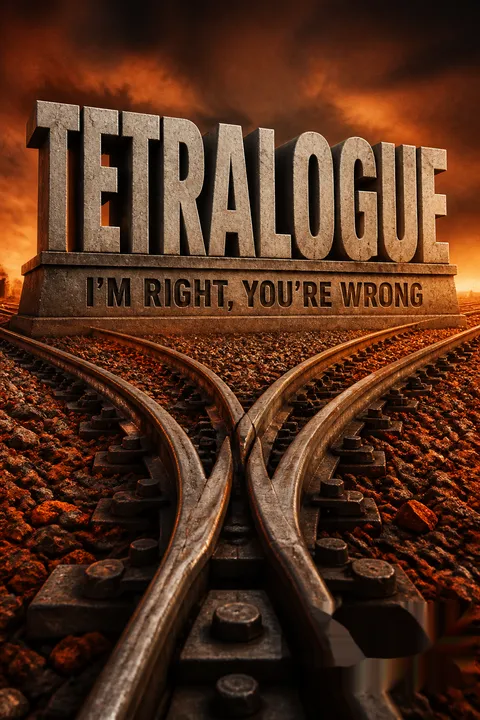
Tetralogue uses a train-carriage debate as a miniature of public life. Bob, Sarah, Zac, and Roxana each embody a recognizable response to disagreement: personal experience, scientific inquiry, relativist accommodation, and logical analysis. The device prevents the book from reducing its subject to a lecture. Each position gains force by exposing a weakness in another, and each also reveals its own limits.
The deepest distinction is among truth, evidence, knowledge, and authority. A claim can be true without being known, evidence can support a claim without making it certain, and a socially powerful institution can still make mistakes. These distinctions block both easy dogmatism and easy relativism. They also explain why the argument about science is not simply science versus superstition: the characters are disputing how evidence is assessed, who has standing to assess it, and whether disagreement itself changes what is true.
The book is especially effective against relativism when it asks what tolerance means if no moral standard can rank tolerance above coercion. Its treatment of fallibilism is similarly useful: the possibility of error should encourage correction, not make ordinary knowledge impossible. Yet the play leaves a real institutional challenge unresolved. Scientific communities need expertise and standards, but their authority can become circular or exclusionary. Bob’s witchcraft claim is not thereby strengthened, but the concern about who controls credibility deserves more than a simple appeal to scientific prestige.
The final moral discussion extends the epistemic problem into action. If moral judgments guide decisions, skepticism about their truth threatens practical reasoning beyond ethics. Sarah’s comparison of moral learning with scientific correction is suggestive, but the book does not fully establish how moral progress is recognized without relying on values already in dispute. That incompleteness is productive: the train reaches its station, but the passengers do not arrive at a shared philosophy. The reader is left with a disciplined task, distinguish disagreement from mere difference, and assess claims without confusing confidence, power, or peace with truth.
Review Summary
Tetralogue receives mixed reviews, with an average rating of 3.33/5. Readers appreciate its accessible introduction to philosophical concepts through dialogue, praising its thought-provoking nature and ability to challenge preconceptions. However, some find the characters irritating and the discussions disjointed. The book is commended for its exploration of epistemology, relativism, and logic, but criticized for its lack of resolution and occasionally tedious arguments. Many readers recommend it as an introductory text for philosophy students or those new to the subject.
People Also Read



Glossary
relativism
Truth depends on viewpointsIn the dialogue, relativism treats claims or standards as valid only from a particular point of view, rather than as absolutely right or wrong. Zac presents it as a way to avoid imposing one viewpoint on others. The other passengers challenge whether it can justify tolerance, explain disagreement, or avoid weakening its own claims.
absolutism
Claims can be objectively rightThe book uses absolutism for the stance that claims can be classified as true or false, right or wrong, independently of a speaker’s personal viewpoint. Zac associates this stance with dogmatism and coercion. Sarah and Roxana argue that objective standards do not require certainty, infallibility, or the right to force others to agree.
fallibilism
Beliefs can be mistakenFallibilism is the view that human thinkers can be wrong, including about matters they currently believe or know. Sarah uses it to support intellectual caution and openness to correction. The dialogue distinguishes fallibilism from the stronger claim that nothing can be known: ordinary perception and reasoning can still provide knowledge under normal conditions.
inference to the best explanation
Choose the strongest explanationInference to the best explanation is a way of reasoning that compares competing accounts and favors the one that best explains the available evidence. Bob and Sarah both appeal to it when defending witchcraft and science. Their dispute shows that the method depends on judgments about which evidence is relevant and how much explanatory support each account provides.
About the Author
Other books by Timothy Williamson
Download PDF
Download EPUB
.epub digital book format is ideal for reading ebooks on phones, tablets, and e-readers.








