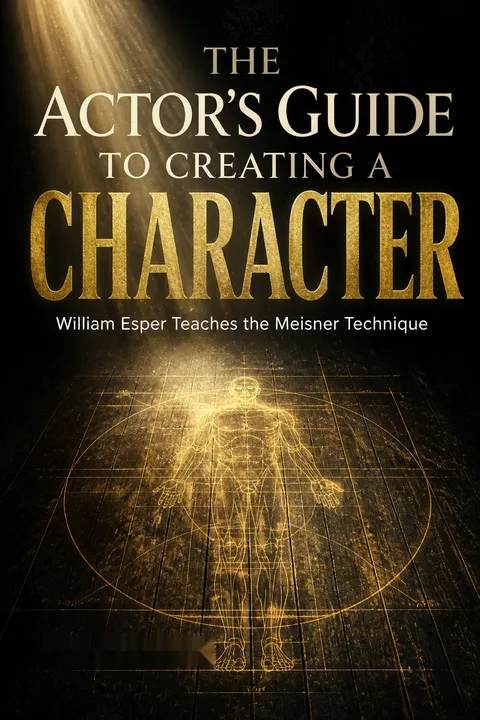


Key Takeaways
Let the other actor's behavior, not your planned emotion, drive the scene
Listen before performing. Actress Patricia Heaton recalls trying to force herself to cry on cue, then learning that the effort made her watch herself instead of hearing her scene partner. Esper’s foundation is truthful behavior under imagined circumstances: actors do real things, respond to what happens, and let emotion arise rather than manufacture a result. The first year develops listening, personal response, and the ability to stay open to another person.
Character work extends the craft. In the second year, those skills remain essential, but the actor also learns to alter how they behave. The goal is not to imitate a feeling or display a costume of traits. It is to create a distinct person through specific, practiced choices while remaining responsive in the moment.
The shift from self-monitoring to attention is useful well beyond acting. In conversation, people often rehearse their next line while appearing to listen, which weakens both understanding and connection. The book’s emphasis on responding to actual cues resembles improvisational problem-solving: a plan gives structure, but the next move depends on new information. That said, listening alone cannot solve every performance problem. Text, blocking, and production constraints matter. The strongest version of the principle is not passive spontaneity, but preparation that leaves enough attention available for genuine response.
Build character through precise physical choices, not a vague mask
Research the body. A Physical Impediment is a specific physical alteration, such as a limp, lisp, or restricted movement, used to change an actor’s ordinary behavior. Esper insists that actors investigate its cause and rehearse its mechanics until they no longer need to think about them. A vague limp is merely a signal; a carefully understood injury changes how someone stands, crosses a room, and handles an interruption.
Keep contact alive. One student’s blind character became more convincing when he stopped trying to look blind and built concrete routines around hearing, touch, and movement. The physical choice should change behavior without consuming all the actor’s attention. If the actor is busy displaying the impairment, the scene partner disappears.
This is a practical example of embodied cognition: physical patterns can influence attention, feeling, and interpretation, rather than simply illustrating an inner state. Rehearsing a movement until it becomes automatic also frees working memory for interaction. The approach needs care, however. Disability is not a theatrical shortcut, and a simplified imitation can reproduce stereotypes instead of lived experience. Research, consultation, and attention to the character’s individuality help keep a useful exercise from becoming a caricature.
Make pain and intoxication readable through researched symptoms, never real harm
Create a credible illusion. For pain, drugs, or alcohol, actors do not need to injure or intoxicate themselves. They research observable symptoms and select a small number to play clearly. A migraine might involve a one-sided throb, dizziness, and sensitivity to light and sound. A hangover might include a pounding head, dry mouth, and sluggish movement. Esper recommends limiting the symptoms to three or four so the performance stays focused.
Play through the obstacle. A drunk is trying to walk straight, not trying to stagger for effect. That effort to seem normal can make the impairment more believable. The actor also stays physically loose enough to respond to a partner. The audience must recognize the condition and believe the behavior, not merely see a collection of familiar gestures.
The distinction between symptoms and display is a powerful lesson in realism: audiences believe effort, resistance, and consequence more readily than a catalogue of signs. It also resembles simulation in medicine, where a role-play is useful because it reproduces relevant cues without reproducing the danger. Familiar symptoms can make a scene legible, but they can also narrow complex experiences into stock behavior. Specific research and restraint are therefore not just aesthetic virtues; they reduce the risk of turning illness or addiction into a punch line.
Borrow another person's physical habits to unlock behavior beyond your default
Start outside yourself. An Imitation is a close study of a real person’s observable behavior, used as a starting point for creating a role. The purpose is not parody or exact impersonation. One student noticed a woman repeatedly shifting her hips into a confrontational stance. When the student practiced that posture, she found herself feeling more aggressive, then built a character around the behavior.
Let the choice develop. Another student repeated a nervous hand gesture he had observed in a stranger. Over time, the gesture began to generate anxiety and a new way of dealing with people. Esper’s method works from the body inward as well as from imagined feeling outward. The external detail becomes useful when it sparks an individual response, not when it remains a decorative trick.
This technique makes an actor’s research concrete: attention to gait, posture, or gesture can reveal social strategies that broad personality labels miss. It also reflects a wider principle in behavioral science, where repeated actions can shape felt identity and expectation. Still, observation is not access to another person’s inner life. A posture may suggest a story, but it does not prove one. The actor’s imaginative interpretation should remain a creative proposal, not a claim that the observed person has been psychologically explained.
Find a personal reason for your character's beliefs, even when you reject them
Make values playable. A Point of View is the character’s particular stance toward a subject, relationship, or event. It matters because two people can face the same facts and assign them different meanings. One actor, personally uninterested in helping animal shelters, played a character who donated to them by imagining the gift as a way of saving a beloved sister. That association supplied a genuine emotional reason for behavior unlike her own.
Empathy is not agreement. A student who would retaliate if slapped struggled to imagine a believer who would turn the other cheek. The work is to find what makes that choice meaningful to the character, not to endorse the belief in ordinary life. Actors may need to explore several possible reasons before finding the one that activates the scene.
This is close to perspective-taking in social psychology: understanding another person improves when a situation is reconstructed from that person’s incentives and attachments, rather than judged from the outside. The distinction between empathy and agreement is especially valuable in polarized settings. An actor can make a position emotionally intelligible without declaring it correct. There is a limit, though: personal analogy can illuminate a motive while obscuring cultural or historical differences. It works best as an entry point, supported by attention to the character’s actual circumstances.
Reduce the role to one defining pressure before adding biography
Find the essential idea. The Essence of the Character is a short phrase that captures the role’s dominant quality or pressure. It prevents an actor from drowning in background details. When Esper once gave actors pages of imagined biography, their performances grew lifeless. Sanford Meisner revived them by replacing those histories with simple behavioral ideas, such as a person who tries to keep everyone happy.
Let the text support the choice. In The Rainmaker, one character’s buoyant optimism and another’s settled pessimism clarified their conflict. Their histories still mattered, but the actors could organize them around a playable center. A concise essence is not a complete psychological account. It is a useful lens for selecting behavior and interpreting the writer’s clues.
This resembles cognitive chunking: a compact organizing idea lets a performer hold complex information without tracking every fact separately. In writing and design, a clear central premise also helps many details cohere. The danger is reduction. A person is rarely only a pessimist, optimist, or people-pleaser, and a single label can flatten a role if treated as a verdict. The phrase should function as a temporary organizing hypothesis, tested against the text and the actor’s moment-to-moment experience.
Give each moment an action, then align actions with a life's central want
Name what happens. Actions are specific things a character does, such as questioning someone, offering comfort, or trying to recall a fact. Esper asks actors to make these choices concrete enough to perform, rather than rely on broad verbs that do not suggest behavior. In a scene from Two for the Seesaw, a lawyer enters to confront his partner. His profession and circumstances make cross-examining her more useful than merely saying he wants answers.
Connect the moments. A Super Objective is the character’s overriding life goal, which explains why separate actions belong to the same larger pursuit. Hamlet’s encounters, deceptions, and plans become coherent when understood as efforts to avenge his father. The goal itself is usually too broad to act directly. It guides the actor’s choices; playable actions do the work.
The distinction between a long-range aim and an immediate tactic resembles the difference between strategy and action in organizational planning. A goal can organize effort, but progress appears through observable moves, each shaped by the response it receives. This framework is useful because it links dramatic behavior to cause and consequence. It can become mechanical if the actor treats every line as a preassigned tactic. A stronger use leaves the action prepared in advance while allowing the partner’s response to alter how it is carried out.
Break scenes into beats, and let one emotional current connect them
Work in sections. Beats are manageable units within a scene, usually organized around one subject or task. A conversation may begin with a welcome, then shift when someone raises a family crisis. Naming the shifts helps actors rehearse cause and effect without trying to solve an entire scene at once. Esper advises working one section until it is clear before moving to the next.
Give the scene continuity. The Inner Emotional Line is the feeling or emotional condition that carries through a scene until an event changes it. In a classroom exercise, Esper delivered the same breakfast exchange first as an anxious commander and then as a relieved one. The identical words took on different meanings. Emotional Preparation means using imagined circumstances to arrive at the scene with a starting feeling, then allowing the interaction to change it.
Breaking a complex task into units is a familiar learning strategy: smaller sections make errors easier to locate and correction more manageable. The emotional thread adds continuity, preventing a scene from becoming a string of disconnected reactions. Together, the tools balance analysis with flow. Their limitation is that a rehearsal map can be mistaken for a fixed route. A beat boundary should clarify a change in attention or subject, not force a performer to announce every transition with a visible emotional gear shift.
Paraphrase difficult text until its meaning becomes personally playable
Translate before reciting. In his work on Spoon River poems, Esper asks actors to explain each thought in plain language, identify whom they are addressing, and determine what they are trying to do. The Acting Object is the person or thing the actor is addressing, whether present or imagined. A student working on a poem about a dying woman first needed to understand that she was explaining her suicide to the husband she loved.
Build a personal bridge. An actor’s paraphrase means expressing the speech’s essential purpose in words and associations that feel personally meaningful. Particularizations are specific personal connections used to clarify a moment the actor does not yet understand. Once the underlying behavior is alive, the playwright’s language can be restored gradually. Nursery rhymes serve the same practice: actors invent circumstances that make simple words carry a story.
Paraphrase is a powerful comprehension test. If a performer cannot restate what a speech is doing, elegant language can hide a gap in understanding. The process also resembles translation: meaning is carried across forms, not preserved by word-for-word substitution. Personal associations can make abstract writing vivid, but they should not replace attention to the writer’s structure or language. The aim is not to make every text autobiographical. It is to find a credible bridge between the text’s meaning and the actor’s capacity to respond.
Treat historical style as a lived value system, not decorative costume
Research the logic. Period refers to the era of a play; style also includes the writer’s language and the characters’ way of life. Esper urges actors to investigate the values and social rules that shape behavior, rather than imitate a generalized old-fashioned manner. At Versailles, courtiers used elaborate bows partly to display status and attract the king’s favor. Understanding that purpose turns a gesture into an attempt to get something.
Train the instrument. A character’s clothing, posture, dance, accent, and speech can all reveal the culture. Actors should study them, then rehearse them until they no longer compete with listening. Shaw’s long speeches, for example, need to emerge from a character’s genuine urge to persuade, not from formal recitation. Historical detail becomes useful when it gives the actor a concrete way to behave.
This approach parallels cultural anthropology: customs become intelligible when treated as meaningful within a social system, rather than as quaint oddities. It also guards against period pieces becoming museum displays. Research can show why a gesture matters to someone who lives by its rules. Yet research has diminishing returns. An actor who accumulates facts without converting them into behavior may become less spontaneous, not more. The useful test is whether a historical detail changes what the character does, wants, or notices.
Scale truthful behavior to the camera's intimate frame
Adjust the size, not the craft. Esper argues that truthful acting remains truthful across stage and screen. The camera changes the scale: a small shift in the eyes may carry what needs a larger gesture onstage, and a microphone can capture a quiet voice. Actors should avoid pushing for an audience that is not physically present.
Arrive prepared. Film and television may offer little rehearsal, and scenes are often shot out of story order. Actors must know what their character understands at that point and what has already happened. Sets can involve long waits, technical distractions, and brief takes. Preparation makes it possible to focus on a scene partner when filming begins, while leaving room for unplanned moments.
The camera changes the audience’s distance, so proportionality becomes a technical form of empathy: the performance must meet viewers where the image places them. Close framing also makes small hesitations and shifts of attention highly legible. Preparation matters because production conditions rarely protect an actor’s ideal working environment. Still, screen performance is not solely an actor’s achievement. Editing, sound, lighting, and shot choice shape the result, so actors need both craft and realistic expectations about control.
Build a durable acting life around craft, not fame or guaranteed income
Separate art from the market. Esper reports that only about 2.5 percent of actors find work, and warns students not to mistake training for a promise of employment. The business may favor actors who resemble a role before it trusts their ability to transform. One student who wanted leading roles rejected the character parts repeatedly offered to him, then left the profession.
Choose what success means. The book distinguishes a career built around commercial visibility from one built around challenging work. It does not treat either path as automatically superior, but urges actors to understand their own ambition, accept the realities of the profession, and keep improving their craft. Auditions, setbacks, and uncertain income are part of the landscape. Passion alone does not pay rent, so practical choices matter too.
The book is strongest when it treats artistic commitment as a decision rather than a guarantee of reward. That distinction protects actors from interpreting rejection as proof that their work has no value. At the same time, the reported employment figure is presented as a warning, not a current labor-market measurement, and passion cannot erase financial constraints. A sustainable artistic life may require income from other work, clear boundaries, and a definition of success broad enough to include craft, community, and paid opportunities.
Analysis
The book’s central argument is that character is neither an emotional result to manufacture nor a disguise placed over the actor. It is a way of behaving, built from specific choices, personal associations, and sustained attention to another person. The classroom narrative makes that argument unusually concrete. Students do not receive a formula and then demonstrate it; they stumble, overplay, lose contact, and revise. The method’s credibility comes from showing how an idea changes behavior in practice.
The progression is also carefully designed. First, actors learn to trust their own responses. Then they alter those responses through physical impediments, imitation, point of view, and researched conditions. Script analysis adds a new layer: actions and a central objective organize the role, while beats, emotional continuity, and personal associations connect analysis back to lived experience. Historical style and screen work test whether the craft can survive changes in language, scale, and production conditions.
Its most valuable tension is between preparation and spontaneity. A performer needs enough structure to know what the scene means, yet enough openness to be surprised by a partner. That resembles expert practice in other fields: deliberate rehearsal builds reliable capacity, while attention in the moment prevents the performance from becoming mechanical. The instruction to simplify a character to one defining idea is useful for reducing cognitive overload, but it should remain a working hypothesis, not a substitute for contradiction or complexity.
Some of the teaching relies on broad claims about cultural behavior, disability, addiction, and acting traditions. Contemporary practice benefits from treating those claims as prompts for research rather than settled facts. A convincing performance should be specific to the role, not built from a stereotype. The larger lesson remains robust: technical detail is valuable when it deepens human connection. Craft does not suppress truth. At its best, craft creates the conditions in which truth can be repeated, shaped, and shared with an audience.
Review Summary
The Actor's Guide to Creating a Character receives overwhelmingly positive reviews, with readers praising its practical insights and inspiring content. Many consider it a must-read for actors, appreciating its format of following an acting class through the Meisner technique. Readers find the book dense with information yet easily readable, likening it to a novel. Some highlight its value for students and working actors alike. A few critics note anxiety-inducing perfectionism in student portrayals and occasional dull chapters, but overall, the book is highly recommended for its comprehensive approach to character creation.
People Also Read








Glossary
Meisner Technique
Responsive acting trainingAn approach to actor training associated with Sanford Meisner and taught here by William Esper. It develops listening, spontaneous response, personal emotional life, and truthful behavior under imagined circumstances. In this book, second-year character work builds on those foundations by teaching actors to alter their behavior while remaining responsive to a scene partner.
Physical Impediment
A rehearsed physical alterationA concrete physical change an actor adds to ordinary behavior, such as a limp, lisp, or restricted movement. The actor researches its cause and effects, then rehearses it until it can be sustained without distracting from the scene. It is used to explore how altered physical behavior can contribute to a character.
Imitations
Observed behavior as a starting pointExercises in which actors closely study and reproduce the behavior of a real person they have observed. The aim is not to mock or impersonate that person for its own sake. Specific details such as posture, gesture, or walking can spark new behavior and help an actor explore a character from the outside in.
Point of View
A character's interpretive stanceA character’s particular way of understanding a person, event, or subject. The same facts can mean different things to characters with different points of view. Actors use this concept to find the beliefs and personal reasons that make a character’s choices emotionally credible, including beliefs that differ from their own.
Essence of the Character
A role's defining qualityA concise word or phrase that captures the central quality shaping a character’s behavior. It helps actors organize the play’s many details without becoming overwhelmed by biography or interpretation. The essence is a practical starting point for choices, not a complete account of everything the character can be.
Actions
Specific playable behaviorsConcrete things a character does in a scene, physically, internally, or toward another person. Actions are more precise than broad intentions because they suggest behavior an actor can rehearse and perform. Examples include questioning someone, sharing a secret, or trying to remember a fact. Text helps the actor carry out the Action.
Super Objective
A character's overarching goalThe major life goal that gives coherence to a character’s individual Actions across a play. It helps explain why different choices belong to one larger pursuit, such as seeking a loving relationship or avenging a death. It is generally too broad to perform directly, so it guides the actor’s selection of specific Actions.
Beats
Manageable scene sectionsUnits within a scene organized around a continuing subject or task. A Beat changes when the focus shifts, such as when a welcoming exchange gives way to a dispute about a family problem. Actors use Beats to rehearse a scene in workable sections and clarify how its events and responses develop.
Inner Emotional Line
A scene's emotional continuityThe emotional condition that carries through a scene until an event changes it. It connects separate moments so the performance feels like an unfolding experience rather than a set of isolated reactions. The actor begins from prepared circumstances but remains available for new events to redirect the emotional line.
Emotional Preparation
A prepared emotional starting pointAn actor’s private imaginative work before a scene, used to create a specific emotional condition at its beginning. The preparation is grounded in circumstances that matter personally to the actor. Once the scene begins, the actor responds to the partner and allows the feeling to change rather than forcing it to persist.
Particularizations
Personal associations for unclear momentsSpecific personal associations actors use to make an unclear part of a script emotionally understandable. A memory, imagined circumstance, or comparison can connect the text to something the actor knows deeply. Particularizations are used where needed, not mechanically for every line, and their value lies in the behavior and feeling they help generate.
Acting Object
The person or thing addressedThe person, group, or object an actor is communicating with during a speech or scene. It may be present, imagined, or inanimate, such as a portrait or a remembered loved one. Defining the Acting Object gives the actor a concrete relationship to address instead of reciting text without a recipient.
FAQ
What is The Actor's Guide to Creating a Character by William Esper about?
- Comprehensive acting manual: The book is a detailed guide to advanced acting techniques, focusing on the Meisner Technique and the process of character creation.
- Classroom-based narrative: It follows a second-year acting class, using real classroom examples and exercises to illustrate key concepts.
- Emphasis on authenticity: The text explores how actors can develop truthful, compelling characters through emotional connection, physical transformation, and moment-to-moment work.
- Industry insights included: Beyond technique, it addresses the realities of an acting career, including working in film and TV and sustaining a lifelong commitment to the craft.
Why should I read The Actor's Guide to Creating a Character by William Esper?
- Expertise of William Esper: Esper is a renowned acting teacher and master of the Meisner Technique, offering decades of practical, insightful experience.
- Bridges theory and practice: The book provides actionable exercises, real classroom examples, and clear explanations, making complex acting concepts accessible.
- Holistic and realistic: It covers not only technique but also the emotional, intellectual, and professional challenges actors face, preparing readers for the realities of the profession.
- Inspirational guidance: Esper’s candid discussions about the struggles and rewards of acting offer motivation and help actors develop resilience and a clear artistic philosophy.
What are the key takeaways from The Actor's Guide to Creating a Character by William Esper?
- Truthful acting foundation: Acting is about "doing things truthfully under imaginary circumstances," with a focus on authentic, spontaneous behavior.
- Character transformation: The book details how to move from playing oneself to embodying characters with distinct physicality, voice, and emotional life.
- Practical tools and exercises: It offers step-by-step exercises for developing character, handling scripts, and working with physical impediments, pain, and imitation.
- Professional preparation: Esper provides advice on adapting technique for film and TV, navigating the business, and sustaining a fulfilling acting career.
What are the core principles of the Meisner Technique as taught in The Actor's Guide to Creating a Character by William Esper?
- Truthful doing: The Meisner Technique centers on responding truthfully and spontaneously to imaginary circumstances, rather than relying on pre-planned emotions.
- Moment-to-moment focus: Actors are trained to listen and react in the present, building scenes through improvisation and repetition exercises.
- Emotional preparation: The technique emphasizes preparing emotionally before a scene, allowing an inner emotional line to guide performance.
- Integration of personal experience: Actors use personal memories and associations (particularizations) to connect with the text and create authentic behavior.
How does William Esper define and approach character acting in The Actor's Guide to Creating a Character?
- Altered behavior: Character acting involves changing one’s natural behavior to become unrecognizable while remaining truthful, adopting new physical, vocal, and emotional patterns.
- Physical and emotional transformation: Actors use researched physical impediments and emotional preparation to step away from their own habits and inhabit the character.
- Empathy and point of view: Esper stresses the importance of deeply empathizing with characters, even those with values or behaviors different from the actor’s own.
- Pinnacle of the craft: Character acting is presented as the highest achievement in acting, requiring both technical skill and deep personal investment.
What is the "Inner Emotional Line" in William Esper’s method, and why is it important?
- Continuous emotional thread: The Inner Emotional Line is the ongoing emotional current that connects all of a character’s moments, ensuring a unified, truthful performance.
- Guides behavior: It shapes how an actor plays each moment, making actions and reactions consistent with the character’s emotional state and objectives.
- Enables transformation: Adjusting the Inner Emotional Line can completely change a character’s portrayal, even with the same dialogue.
- Prevents disconnected acting: Without this emotional continuity, performances risk becoming a series of isolated moments rather than a living, breathing character.
How does The Actor's Guide to Creating a Character by William Esper use Physical Impediments in character work?
- Gateway to transformation: Physical impediments (like limps, lisps, or blindness) are used to help actors move beyond their natural behavior and explore new ways of being.
- Research and specificity: Each impediment must be carefully researched and practiced until it becomes second nature, enhancing believability.
- Sensory awareness: Playing impediments like blindness requires heightened use of other senses, deepening the actor’s connection to the scene.
- Maintaining truthfulness: Actors must stay relaxed and responsive, ensuring the impediment does not block authentic interaction with scene partners.
What are "Particularizations" in William Esper’s approach, and how do they help actors?
- Personal associations: Particularizations are specific memories or images actors use to connect emotionally with the text and clarify ambiguous lines.
- Authentic behavior: They help generate truthful, emotionally real responses, making performances more compelling.
- Selective use: Actors are advised to use particularizations only when needed to clarify or enliven the text, avoiding overuse.
- Transformative examples: The book provides vivid classroom examples showing how particularizations can change the meaning and impact of a scene.
How does William Esper recommend actors work with scripts and scenes in The Actor's Guide to Creating a Character?
- Read the whole script: Actors should read the entire script multiple times to fully understand the story and their character’s journey.
- Script as a tool: The text provides the words, but actors must bring it to life through actions, emotional connection, and improvisation.
- Beat-by-beat rehearsal: Scenes are broken into smaller units called Beats, each with a clear objective, making rehearsal more manageable and performances more nuanced.
- Spontaneity and authenticity: Even when holding scripts, actors are encouraged to maintain contact with partners and keep performances fresh and truthful.
How does The Actor's Guide to Creating a Character by William Esper address working with classic texts and period styles?
- Research and empathy: Actors are encouraged to study the historical era and cultural values of the period, as well as the specific style and behavior patterns of the characters.
- Avoiding caricature: The focus is on grounding performances in truthful behavior, not just imitating period mannerisms.
- Physicality and language: Mastery of period-specific gestures, speech, and even dances is recommended for authentic embodiment.
- Historical context: The book uses detailed examples from history to show how understanding social and political backgrounds informs character choices.
What advice does William Esper give for adapting the Meisner Technique to film and television acting?
- Truthful acting remains core: The main adjustment is in scale and proportion, as the camera captures subtlety and intimacy.
- Modulate expression: Actors should avoid theatrical exaggeration, using only as much physical and vocal expression as the camera requires.
- Professional preparation: Film and TV often involve little rehearsal and shooting out of sequence, so actors must be prepared and able to maintain continuity.
- Set environment challenges: The book highlights the need for focus and spontaneity amid the distractions of a busy set.
What career and philosophical advice does William Esper offer in The Actor's Guide to Creating a Character?
- Commitment to craft: Success depends on a lifelong dedication to acting, not on fame or financial gain.
- Realistic expectations: The profession is highly competitive, requiring perseverance and resilience.
- Self-awareness: Actors should understand and market their unique qualities, rather than trying to fit roles that don’t suit them.
- Artistic philosophy: Maintaining a philosophy that values art for its own sake helps actors endure hardships and find fulfillment beyond commercial success.
Download PDF
Download EPUB
.epub digital book format is ideal for reading ebooks on phones, tablets, and e-readers.








