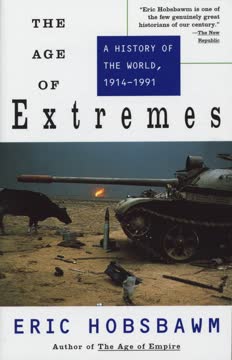
Key Takeaways
1. The Age of Catastrophe: Total War and Ideological Upheaval (1914-1945)
The First World War involved all major powers and indeed all European states except Spain, the Netherlands, the three Scandinavian countries and Switzerland.
Unprecedented global conflict. The period from 1914 to 1945 was defined by a "Thirty-one Years' World War," a continuous era of conflict far exceeding anything previously known. The First World War, initially a European struggle, quickly drew in global powers and colonial troops, transforming warfare into a mass phenomenon. This brutalization of conflict, particularly on the Western Front, led to millions of casualties and profoundly altered societal norms, paving the way for even greater atrocities in the Second World War.
Rise of radical ideologies. The immense strains of total war shattered the existing political and social order, creating a vacuum filled by revolutionary and counter-revolutionary movements. The Russian Revolution of 1917, driven by war-weariness and social discontent, established the first communist state, inspiring similar movements globally. Simultaneously, the collapse of liberal institutions and the fear of social revolution fueled the rise of fascism and authoritarian regimes, particularly in Germany and Italy, which glorified violence and rejected Enlightenment values.
A world in disarray. The peace settlements after World War I, notably the Treaty of Versailles, proved inherently unstable, failing to integrate defeated powers or address underlying tensions. This instability, exacerbated by the subsequent economic collapse, propelled the world towards another, even more devastating conflict. The Second World War, fought as an ideological "war of religion" against the Axis powers, further brutalized warfare, leading to unprecedented civilian casualties and mass displacement, fundamentally reshaping the global landscape.
2. The Great Depression: Capitalism's Near Collapse and the Rise of State Intervention
In a single sentence: the Great Slump destroyed economic liberalism for half a century.
Global economic paralysis. The period between the World Wars witnessed the most severe economic crisis in capitalist history, the Great Depression, which originated in the United States but quickly spread worldwide. This crisis was characterized by a vicious cycle of falling prices, collapsing trade, and unprecedented mass unemployment, leading to widespread social misery and political instability across continents. The global economy, which had previously shown continuous growth, stagnated or regressed, with international trade and migration flows drying up.
Failure of liberal orthodoxy. The traditional tenets of economic liberalism, such as the gold standard and free markets, proved utterly inadequate to address the crisis. Governments, initially adhering to fiscal orthodoxy, found their policies exacerbating the depression. This led to a widespread loss of faith in laissez-faire economics and a desperate search for alternatives, including:
- Abandonment of the gold standard by major economies.
- Rise of protectionism and trade barriers.
- Increased government intervention and planning (e.g., Roosevelt's New Deal).
Rise of state management. The perceived immunity of the Soviet Union to the Depression, coupled with the visible failures of capitalism, made state planning and economic management attractive even in Western democracies. The crisis forced governments to prioritize social considerations, such as full employment and welfare provisions, over purely economic ones. This shift laid the groundwork for the "mixed economy" model that would dominate the post-World War II era, fundamentally altering the relationship between state and market.
3. The Soviet Experiment: Forced Modernization and Its Human Cost
The Short Twentieth Century, as defined in this book, virtually coincides with the lifetime of the state born of the October revolution.
Revolution in isolation. The October Revolution of 1917 established the Soviet Union as the first state dedicated to building socialism, but contrary to Marxist expectations, it remained isolated. Faced with economic backwardness and international hostility, the Bolsheviks embarked on a program of ultra-rapid industrialization and technological modernization, transforming a largely agrarian society into a major industrial power. This "socialism in one country" became a model for other developing nations.
Stalin's brutal command economy. Under Joseph Stalin, the Soviet system became a centralized command economy, driven by Five-Year Plans and enforced through ruthless coercion and terror. This period, marked by forced collectivization of agriculture and the Gulag system, resulted in immense human suffering and millions of deaths. Despite its inefficiencies and human cost, this system achieved impressive industrial growth, enabling the USSR to withstand and ultimately defeat Nazi Germany in World War II.
Paradox of stability and decline. The Soviet system, while providing a guaranteed livelihood, social security, and education, also fostered a pervasive bureaucracy and lacked mechanisms for innovation and consumer responsiveness. After Stalin, the "era of stagnation" under Brezhnev saw economic growth slow and social indicators decline, even as the population enjoyed improved living standards. This inherent inflexibility, coupled with increasing integration into the global economy, ultimately set the stage for its collapse.
4. The Golden Age: Unprecedented Prosperity and Social Transformation (1945-1973)
It is now evident that the Golden Age essentially belonged to the developed capitalist countries, which, throughout these decades, represented about three quarters of the world’s production and over 80 per cent of its manufacturing exports.
Post-war economic miracle. The period from 1945 to the early 1970s witnessed an extraordinary and unprecedented economic boom in the developed capitalist world, dubbed the "Golden Age." This era saw rapid growth, full employment, and a dramatic rise in living standards, particularly in Western Europe and Japan, which rapidly caught up with the United States. This prosperity was fueled by:
- Technological revolution (plastics, electronics, computing).
- Cheap energy (low oil prices).
- Mass consumption driven by rising real incomes.
The "mixed economy" consensus. Capitalism was fundamentally reformed, moving away from pure laissez-faire towards a "mixed economy" model. Governments, influenced by Keynesian economics and the trauma of the Great Depression, actively managed their economies, prioritizing full employment and social welfare. This consensus between capital and labor, often mediated by the state, ensured stability and allowed for the expansion of comprehensive welfare states, providing citizens with unprecedented protection against life's hazards.
Profound social shifts. The Golden Age brought about the most rapid and universal social transformation in human history. Key changes included:
- Death of the peasantry: Millions migrated from rural areas to cities, fundamentally altering demographic landscapes.
- Educational explosion: Mass access to secondary and higher education created a new, influential social stratum.
- Women in the workforce: Married women entered paid labor in unprecedented numbers, challenging traditional gender roles.
- Rise of youth culture: Adolescents emerged as an independent social and economic force, shaping popular culture globally.
5. The Cold War: A Bipolar World's Paradoxical Stability
The peculiarity of the Cold War was that, speaking objectively, no imminent danger of world war existed.
Ideological confrontation. The post-1945 world was dominated by the Cold War, a prolonged ideological and geopolitical struggle between the capitalist bloc led by the USA and the communist bloc led by the USSR. Despite apocalyptic rhetoric and an escalating nuclear arms race, both superpowers tacitly accepted a global distribution of power, avoiding direct military conflict that could lead to mutual annihilation. This "Cold Peace" paradoxically provided a framework for international stability.
Proxy conflicts and spheres of influence. While direct confrontation was avoided, the Cold War manifested through proxy wars, espionage, and intense competition for influence, particularly in the newly decolonized "Third World." Both superpowers established clear spheres of influence, with the US dominating the capitalist West and the USSR controlling Eastern Europe. Any internal challenge to these spheres, such as the Hungarian Revolution in 1956 or the Cuban Missile Crisis in 1962, was met with decisive action by the respective superpower, reinforcing the established boundaries.
Military-industrial complexes. The constant threat of war fostered the growth of powerful military-industrial complexes in both blocs, diverting immense resources into arms production. This sustained arms race, while economically distorting, also served political purposes, allowing leaders to mobilize public opinion and justify global interventions. The Cold War's end, however, revealed the economic unsustainability of this model for the USSR and highlighted the US's growing economic weakness despite its military might.
6. Decolonization and the Rise of the Third World
The most dramatic and far-reaching social change of the second half of this century, and the one which cuts us off for ever from the world of the past, is the death of the peasantry.
End of empires. The post-World War II era saw the rapid and almost complete dissolution of colonial empires, giving rise to dozens of new independent states across Asia and Africa. This decolonization process was often fueled by nationalist movements, many of which adopted socialist or anti-imperialist ideologies, viewing the Soviet model of state-led development as a viable alternative to Western capitalism. The weakness of former colonial powers after the war, coupled with superpower rivalry, accelerated this process.
Demographic explosion and urbanization. The Third World experienced an unprecedented population boom, driven by high birthrates and a dramatic drop in mortality due to modern medicine and technology. This led to massive rural-to-urban migration, transforming societies from predominantly agrarian to increasingly urbanized. Cities swelled with millions, creating new social dynamics and challenges, as traditional community structures strained under the pressure of rapid change.
Persistent instability and development challenges. Despite formal independence, many Third World nations faced persistent political instability, often characterized by military coups and internal conflicts. The pursuit of economic "development" through state planning or import substitution yielded mixed results, with some "Newly Industrializing Countries" (NICs) achieving rapid growth, while others, particularly in sub-Saharan Africa, struggled with poverty, corruption, and mounting debt. The widening gap between rich and poor nations became a defining feature of this era.
7. The Cultural Revolution: Shifting Norms and Individualism
In the film, Carmen Maura plays a man who’s had a transsexual operation and, due to an unhappy love-affair with his/her father, has given up men to have a lesbian (I guess) relationship with a woman, who is played by a famous Madrid transvestite.
Revolution in personal life. The second half of the 20th century, particularly from the 1960s onwards, witnessed a profound cultural revolution in developed Western countries, fundamentally altering relations between sexes and generations. Traditional family structures weakened, evidenced by soaring divorce rates and the rise of single-parent households. Public standards governing sexual behavior liberalized dramatically, with increased acceptance of diverse sexual orientations and practices, challenging long-standing moral conventions.
Rise of youth culture. Youth emerged as an independent and powerful social agent, with its own distinct culture, largely driven by mass consumption and popular music (rock-and-roll). This generation, growing up in unprecedented prosperity, often rejected parental values and traditional authority, finding common identity in international trends like blue jeans and rock music. This cultural autonomy was amplified by extended education and increased disposable income, making youth a significant force in shaping societal norms.
Triumph of individualism. At its core, this cultural revolution represented the triumph of the individual over society, or the erosion of traditional social bonds and collective norms. The emphasis shifted towards individual desire and self-expression, often justified by libertarian ideals. While this brought greater personal freedoms, it also led to a sense of anomie and insecurity, as old guides to behavior dissolved without clear replacements. This radical individualism, paradoxically, aligned with the consumer society's focus on satisfying personal wants, further blurring the lines between personal liberation and market-driven desires.
8. The Crisis Decades: Global Disorientation and the End of Grand Narratives
The Short Twentieth Century ended in problems, for which nobody had, or even claimed to have, solutions.
End of the Golden Age. The period after 1973 marked the end of the post-war Golden Age, ushering in decades of economic instability, slower growth, and the return of mass unemployment and rising inequality in developed capitalist countries. This era, often termed the "Crisis Decades," saw governments struggle with new phenomena like "stagflation" and a growing sense of economic uncontrollability, as the globalized economy increasingly transcended national management.
Collapse of "real socialism." Simultaneously, the Soviet system, plagued by internal inefficiencies, economic stagnation, and the strain of the arms race, entered its terminal crisis. Gorbachev's reforms of glasnost (openness) and perestroika (restructuring), intended to revitalize socialism, inadvertently dismantled the command structures without providing viable alternatives, leading to the sudden and unexpected collapse of the USSR and its Eastern European satellites between 1989 and 1991. This left a vast zone of disorder and economic devastation.
An uncharted future. The century concluded with a world devoid of a clear international system or dominant ideological framework. The disappearance of the bipolar Cold War order unleashed new forms of conflict, often localized and ethnically driven, and highlighted the weakening of the nation-state against global economic forces and the "democratization of destruction." Humanity faced unprecedented demographic and ecological challenges, for which neither the discredited grand ideologies of the past nor the prevailing neoliberal faith offered convincing solutions, leaving a pervasive sense of uncertainty and disorientation as the new millennium approached.
Last updated:
Review Summary
The Age of Extremes receives praise for Hobsbawm's comprehensive analysis of 1914-1991, combining economic, social, cultural, and political history with exceptional prose. Readers appreciate his balanced critique of communism, capitalism, and fascism, though some note his Marxist bias occasionally shows. The book's division into catastrophe, golden age, and crisis periods resonates strongly. Critics highlight dense writing, statistical heavy-handedness, and inadequate coverage of genocides like the Holocaust. Despite length and complexity, most find it invaluable for understanding the 20th century's transformations, though requiring prior historical knowledge to fully appreciate its analytical depth and prophetic insights.
Modern History: The Four Ages Series
Similar Books