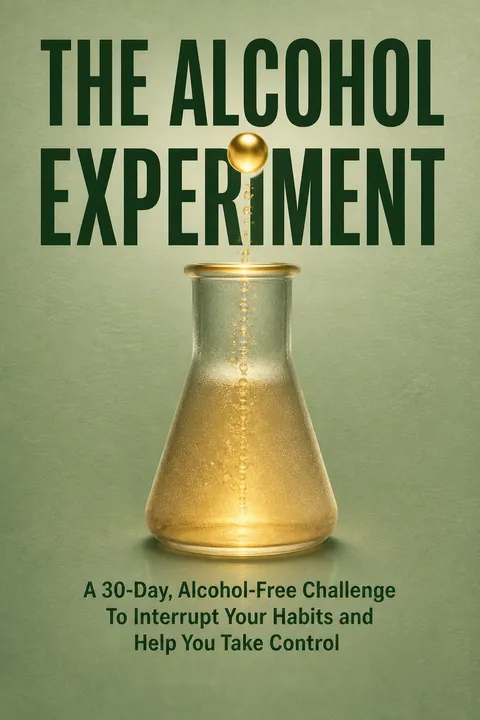


Key Takeaways
Use 30 alcohol-free days to gather evidence, not to swear a lifetime oath.
Make it an experiment. Annie Grace frames the month as a chance to observe what drinking does in a real life, rather than a test of character or a permanent verdict. Before starting, list what alcohol seems to provide and what it costs, then keep notes on sleep, mood, cravings, relationships, and energy. Grace recalls that drinking blurred her memory of her young son’s birthday, a loss she only fully grasped when she looked back. The point is to notice your own trade-offs, not borrow someone else’s conclusion.
Protect your safety. The book is not a detox plan for people who may be physically dependent. Severe withdrawal can be dangerous, so someone with a history of serious symptoms should seek medical care before stopping. The 30-day experiment is most useful when it is safe to undertake.
The experiment’s strength is its change of scale: a permanent identity decision becomes a defined period of observation. That makes room for curiosity and concrete comparison, much like a personal health diary or a small behavioral trial. The approach also acknowledges that the same choice may produce different results for different people. Its limit is important: self-observation can reveal patterns, but it cannot diagnose dependence or make withdrawal safe. Treating medical risk as a separate question preserves the book’s nonjudgmental spirit without asking curiosity to substitute for care.
Resolve the conflict beneath drinking instead of exhausting yourself resisting it.
Two motives can collide. Grace uses cognitive dissonance to describe the discomfort of holding conflicting beliefs or intentions. Someone may consciously want fewer hangovers while also having learned to expect alcohol to ease stress, reward effort, or make socializing easier. Those learned expectations can make abstaining feel like a loss, even when drinking has become costly. Grace describes replacing healthy ways to unwind, such as running, with alcohol during demanding work years. The problem, in her account, is not simply insufficient resolve. It is that one part of the mind still anticipates a benefit.
Willpower has a narrow job. Trying to override that expectation again and again takes effort, especially when tired or stressed. The book therefore asks readers to examine what they believe alcohol does, and whether their experience supports it, rather than relying only on rules and self-reproach.
This is a useful shift from moral judgment to learned expectation. In behavioral science, cues and anticipated rewards can keep a behavior compelling even when its later consequences are unwelcome. That lens makes a lapse informative rather than proof of a defective personality. Still, the book sometimes presents conscious and subconscious motives as more neatly divided than real mental processes are. The practical insight survives that simplification: identify the expected payoff, then compare it with the full sequence of consequences. Better understanding can reduce the inner argument, though it does not guarantee that effort or outside support will never be needed.
Test alcohol beliefs with evidence, not slogans or inherited assumptions.
Use a three-part inquiry. Grace calls her method ACT, for Awareness, Clarity, and Turnaround. First, name a belief, such as the idea that a drink relaxes you. Then investigate where it came from and compare personal experience with outside evidence. Finally, consider the reverse: what would support the possibility that alcohol increases stress instead? The exercise is not meant to force a predetermined answer. It is meant to make a familiar belief visible enough to examine.
Bring your own data. A journal can track what happens before, during, and after drinking or abstaining. For example, note whether the apparent calm lasts, whether sleep is restorative, and whether the original problem is easier to handle the next day. Grace recommends using the same questions for beliefs about taste, happiness, sleep, and social confidence.
ACT’s most transferable feature is its invitation to separate a belief from the person holding it. That resembles cognitive reappraisal, where people inspect interpretations and generate alternatives rather than treating a first impression as fact. The reverse-test is especially useful because it counters selective attention: people often remember the immediate relief more vividly than the delayed cost. However, questioning a belief is not the same as testing a medical claim. Personal journals can reveal patterns, but they cannot establish causation or replace reliable clinical evidence. Used with that distinction, the method supports both self-understanding and intellectual humility.
Judge the whole drinking cycle, not the first pleasant minutes.
Track the rise and fall. Grace argues that alcohol can briefly feel rewarding or numbing, while its effects shift as the body processes it. Her account emphasizes a rebound: the initial ease may give way to unease, poor sleep, anxiety, or low mood, prompting another drink to recover the earlier feeling. The same pattern can appear in sleep. Alcohol may make falling asleep seem easier, yet the book describes disrupted sleep cycles and early waking as common costs. A short-lived effect can therefore be mistaken for a lasting benefit.
Tolerance changes the bargain. With repeated drinking, the body adapts, and the same amount may feel less powerful. Grace links that adaptation not only to needing more alcohol for a familiar effect, but also to ordinary activities seeming less rewarding. Her challenge is to count the entire evening and the next morning, not just the first drink.
The book’s focus on delayed consequences is a strong antidote to the human tendency to overweight immediate rewards. It also offers a practical measurement rule: record how an experience unfolds over hours, not only how it feels at the outset. The neurochemical account is more simplified than the biology of alcohol and reward actually is; no single chemical explains a person’s mood, craving, or tolerance. That caveat does not erase the central observation. For many drinkers, the immediate lift and the later cost form a pattern worth examining directly, especially when memory and expectation privilege the lift.
Meet a craving with curiosity and time before deciding what to do.
An urge is an experience. Grace distinguishes early physical discomfort from later emotional or situational cravings. A stressful workday, a familiar evening routine, or seeing friends drink can prompt a desire because alcohol has been linked to that context. She recommends observing the urge rather than trying to suppress it: notice the bodily sensations, thoughts, and situation, and let the intensity change before acting.
Ride the urge. The book describes Surfing the Urge, a mindfulness exercise associated with researchers Sarah Bowen and Gordon Marlatt. In a smoking study cited by Grace, participants slowly attended to each step of handling a cigarette before smoking. The participants still smoked, but their cigarette use was lower 48 hours later. The lesson is not that observation instantly ends cravings. It is that putting space between urge and response can interrupt automatic behavior and produce useful information.
This approach turns a craving from a command into something that can be watched. That is consistent with mindfulness-based methods, which train attention toward sensations and thoughts without immediately obeying or suppressing them. A pause can also reveal whether the urge follows hunger, stress, loneliness, or a repeated cue. The cited smoking result is encouraging, but it should not be treated as proof that the same effect or size of effect applies to every person or substance. Nor does mindfulness address dangerous withdrawal. It is a coping skill, not a substitute for medical support when physical dependence is a concern.
Replace the job alcohol performs with a healthier way to meet that need.
Look beneath the drink. The book asks what a person is seeking when they reach for alcohol: relief from stress, a sense of belonging, stimulation when bored, or temporary distance from sadness. Grace describes replacing her end-of-day run with drinking after work events became routine. The drink did not remove the work pressure; it became the default way to change how she felt about it. Naming the need makes alternatives easier to find.
Make room for discomfort. Boredom, in particular, may feel like a problem to eliminate, but Grace presents it as a prompt to seek meaningful stimulation. She suggests trying an activity that offers progress or curiosity, rather than numbing the feeling. For stress, the book proposes options such as movement, conversation, or addressing the source of the pressure. A replacement should fit the need, not merely occupy the hands.
This is more precise than telling someone to remove a habit and leave an empty space behind. A behavior often persists because it serves a function, even if it creates collateral damage. Matching the alternative to that function is a practical application of behavioral design: connection calls for contact, stress may call for recovery or problem-solving, and boredom may call for engagement. The caution is that not every unmet need has a quick lifestyle fix. Persistent depression, trauma, or severe stress may call for professional support. The book’s useful starting question is not what is wrong with the person, but what the drink has been asked to do.
Separate friendship and celebration from the assumption that alcohol creates them.
Culture teaches the pairing. Grace describes alcohol as woven into parties, meals, work events, and family rituals. Advertising and jokes often portray drinking as the route to being relaxed, attractive, funny, or included. That can make a temporary break feel like a social threat. Friends may also react defensively because the choice prompts them to think about their own drinking, or because they fear a shared ritual is disappearing.
Run a social test. Rather than withdrawing from friends, Grace encourages readers to attend ordinary events and notice what actually makes them enjoyable. She suggests keeping an explanation brief, choosing a nonalcoholic drink, and focusing on the people or activity. One of her stories describes reconnecting with a longtime friend without their usual margarita ritual. They spent the visit talking and laughing, discovering the relationship had more substance than the shared drink.
The book correctly treats drinking as a social practice, not just an individual chemical choice. Rituals help groups coordinate, and a familiar drink can become a symbol of hospitality or belonging. That makes changing the behavior socially awkward even when friends are supportive. Testing an event without alcohol can distinguish the value of the gathering from the value assigned to the drink. At the same time, not every group will respond kindly, and some friendships may rely heavily on drinking. A low-pressure experiment is useful, but the reader should not interpret every difficult interaction as a personal failure.
Include health costs, memory, and tomorrow morning in the drinking calculation.
Look beyond the glass. Grace reviews alcohol’s effects on sleep, judgment, coordination, mood, and the body. She also highlights longer-term concerns involving the liver, heart, immune function, and cancer risk. The book cites a 2018 global analysis that concluded no level of alcohol minimized health loss at the population level. This is why Grace challenges familiar claims that a drink is automatically beneficial because it is moderate or contains an ingredient associated with health.
Count what disappears. Alcohol can impair attention and memory, so its cost may include experiences that are never clearly stored. Grace’s account of missing memories from her son’s birthday gives this risk a personal scale: the problem was not only a hangover, but an occasion she could not later recall. The experiment asks readers to consider what they value enough not to trade away.
The strongest health message here is not a dramatic statistic but a broader accounting principle: include consequences that are delayed, cumulative, or invisible in the moment. Population-level risk findings can inform a decision without predicting exactly what will happen to any one drinker. The book sometimes presents scientific findings with more certainty than a short summary can responsibly verify, and individual risk varies with pattern, health, and context. Readers should consult current medical guidance for personal questions. Still, memory, sleep, and impaired judgment are immediate experiences many people can track without waiting for a diagnosis.
Use fixation, not a drink limit alone, to judge whether moderation works.
Watch the mental space. Grace contrasts Liberation vs. Fixation as a way to assess how much control a person experiences. In her framing, liberation means alcohol can be accepted or declined without much mental negotiation. Fixation shows up as waiting for a drink, thinking about the next one, bargaining with oneself, or feeling unable to keep alcohol at home. These signs may reveal more than a stated rule about a weekly number of drinks.
Decide while clearheaded. Grace does not claim moderation is impossible for everyone. She argues that it can demand repeated decisions, while alcohol can impair judgment after consumption begins. If someone chooses to moderate, the book recommends defining what moderation means before an event and noticing whether the plan is repeatedly broken. It also supports choosing abstinence if moderation becomes a persistent mental struggle.
This framework usefully shifts attention from an abstract label to observable behavior: how much attention, negotiation, and anticipation alcohol occupies. That can help a reader notice a problem before a dramatic crisis. It is not, however, a validated diagnostic instrument, and the book’s categories should not replace a clinical assessment for alcohol use disorder. Moderation also depends on health and circumstances, not only subjective control. The most valuable question is whether a chosen pattern is sustainable and consistent with the person’s priorities, rather than whether it meets someone else’s definition of normal.
Treat setbacks as data, then make the next commitment small and explicit.
A slip is information. Grace urges readers not to turn one drink or one difficult day into a verdict about their character. A lapse can expose a trigger, a belief that still feels convincing, or a situation that needs a different plan. The book reframes a month with one drinking day as roughly 97 percent alcohol-free, rather than as total failure. Its aim is to keep a person learning instead of letting shame trigger an all-or-nothing spiral.
Set boundaries in advance. Grace calls personal red lines non-negotiables: conditions such as losing memories or drinking to cope with distress that signal it is time to pause and reassess. Her lengthening strategy means taking a longer alcohol-free interval after crossing a boundary. The final choice may be another month, moderation, or continued abstinence. The important part is to decide deliberately, while clearheaded, and return to the evidence gathered.
The emphasis on recovery after a lapse counters the all-or-nothing thinking that can turn a small setback into a prolonged return to old behavior. Concrete boundaries also make intentions easier to evaluate than vague promises to be careful. This resembles relapse-prevention planning, where people identify high-risk situations and decide responses in advance. The limitation is that longer breaks alone may not be sufficient for someone with severe dependence or repeated loss of control. Compassion and accountability work best together: reduce shame, examine the pattern, and seek appropriate professional help when self-management is not enough.
Analysis
The book’s central move is to replace the question of whether a person is weak with a more useful inquiry: what has alcohol come to mean, what does it seem to deliver, and what is the full cost? The 30-day format supports that reframing by giving the reader a bounded period to collect observations. Its daily lessons repeatedly challenge expected benefits such as relaxation, social ease, sleep, pleasure, and relief from difficult emotions. The narrative works because these claims are attached to ordinary life, including work stress, parenting, friendship, and the painful discovery of missing memories.
The strongest practical elements are the structured reflection, attention to cravings, and insistence that behavior has functions worth understanding. ACT makes beliefs inspectable; the craving exercise creates a pause; and the moderation framework asks readers to notice mental preoccupation rather than relying only on a numerical limit. The book also treats lapses as information rather than proof of personal failure, which can keep a reader engaged with change after an imperfect attempt.
Its scientific explanations require more caution than its behavioral advice. The book often describes complex processes through simplified conscious and subconscious divisions, chemical cycles, and claims about willpower or recovery timelines. These can be memorable teaching devices, but they should not be mistaken for complete scientific accounts or individualized medical guidance. Population-level health risks do not predict an individual outcome, and a month without alcohol is not safe self-detox for every person. The opening warning about potentially dangerous withdrawal is therefore essential, not incidental.
The most balanced reading is to use the experiment as a tool for observation, not as a medical treatment or a universal prescription. Readers can test their assumptions, clarify what matters to them, and choose a next step with better information. When cravings, withdrawal, or repeated loss of control exceed what self-guided reflection can manage, professional care belongs in the plan. The book is most persuasive when it expands agency without implying that agency alone solves every form of dependence.
Review Summary
Readers found The Alcohol Experiment insightful and helpful in reframing their relationship with alcohol. Many appreciated the non-judgmental approach and scientific information provided. Some experienced significant benefits like improved sleep and energy levels. The book's daily format and mindfulness exercises were praised. While some found it repetitive or not applicable to their situation, most reviewers reported positive outcomes, ranging from temporary abstinence to long-term lifestyle changes. The book's impact varied, but it generally helped readers become more aware of their drinking habits and motivations.
People Also Read

Glossary
ACT
Belief-examination exerciseA three-part method Grace uses to investigate beliefs linked to drinking. The reader first identifies a belief, then examines its origins and evidence, and finally considers whether its opposite may also be true. The method is intended to make assumptions conscious and support a more considered choice, rather than demand a particular conclusion.
Cognitive dissonance
Conflict between beliefsThe discomfort that arises when a person holds conflicting beliefs, intentions, or actions. In the book’s example, someone may want to avoid hangovers while also believing alcohol is necessary for relaxation or social ease. Grace argues that this conflict can sustain drinking and make willpower feel like an ongoing struggle.
Surfing the Urge
Mindful craving observationA technique for noticing a craving as it develops, without immediately suppressing it or acting on it. The person observes thoughts, bodily sensations, and changes in urge intensity, creating space between desire and response. Grace presents it as a way to interrupt automatic behavior and learn about triggers, not as a guarantee that cravings disappear.
Liberation vs. Fixation
Control and preoccupation scaleGrace’s informal framework for assessing a person’s relationship with alcohol. Liberation describes being able to accept or decline a drink without much preoccupation. Fixation describes patterns such as anticipating the next drink, bargaining internally, or struggling around alcohol in the home. It is a reflective guide, not a clinical diagnostic tool.
non-negotiables
Personal boundary conditionsSpecific boundaries a person sets in advance to protect what matters more than drinking. Examples in the book include avoiding memory loss or refusing to use alcohol as a response to stress. Crossing a boundary is treated as a prompt to pause, review the pattern, and choose a new period of abstinence or another deliberate response.
lengthening
Extending alcohol-free intervalsA strategy Grace proposes for people who choose to return to drinking after a break. They define personal boundaries beforehand and extend the next alcohol-free period if they cross one. The method is framed as a planned reset rather than punishment, though it is not a substitute for treatment when dependence or withdrawal risk is present.
FAQ
What's The Alcohol Experiment about?
- 30-Day Challenge: The Alcohol Experiment by Annie Grace is a 30-day program designed to help individuals explore their relationship with alcohol by abstaining for a month. The goal is to gain insights into how alcohol affects their lives and to assess whether they want to continue drinking.
- Self-Discovery and Mindfulness: The book encourages readers to become "detached reporters" of their experiences, documenting their feelings and observations. It emphasizes mindfulness, urging readers to become aware of their cravings and the underlying emotions associated with drinking.
- Empowerment and Choice: The experiment aims to empower individuals to make informed choices about alcohol, whether that means quitting entirely or moderating their intake. It promotes self-discovery and personal growth throughout the process.
Why should I read The Alcohol Experiment?
- Transformative Experience: Many readers report life-changing experiences after completing the experiment, such as improved mental clarity, better relationships, and enhanced self-esteem.
- Educational Insights: The book provides scientific insights into how alcohol affects the brain and body, debunking common myths about drinking. Understanding these effects can empower readers to make healthier choices.
- Supportive Community: By participating in the experiment, readers join a global community of individuals seeking to change their drinking habits. This support can be invaluable in maintaining motivation and accountability.
What are the key takeaways of The Alcohol Experiment?
- Awareness and Reflection: The importance of self-awareness and reflection is emphasized throughout the book. Readers are encouraged to journal their thoughts and feelings to better understand their relationship with alcohol.
- Cultural Conditioning: The book discusses how societal norms and cultural conditioning influence drinking behaviors. Recognizing these influences can help individuals break free from unhealthy patterns.
- Healthier Alternatives: Readers learn about healthier coping mechanisms for stress and anxiety, such as exercise and mindfulness, which can replace the need for alcohol.
What specific methods does Annie Grace recommend in The Alcohol Experiment?
- ACT Technique: The book introduces the ACT technique—Awareness, Clarity, and Turnaround—to help readers examine their beliefs about alcohol. This method encourages individuals to question their assumptions and reframe their thinking.
- Daily Journaling: Grace emphasizes the importance of daily journaling to track thoughts, cravings, and emotions. This practice helps readers identify triggers and patterns in their drinking behavior.
- Mindful Observation: Readers are encouraged to observe their cravings and self-talk without judgment. By recognizing these thoughts as separate from their true selves, they can reduce their power and influence.
What are some common challenges faced during the 30-day experiment in The Alcohol Experiment?
- Cravings and Discomfort: Many participants experience cravings for alcohol, especially in social situations or during stressful times. Understanding that these cravings are temporary can help individuals cope.
- Social Pressure: Readers may face pressure from friends or family to drink, which can be challenging. The book provides strategies for navigating these situations while maintaining personal boundaries.
- Emotional Turmoil: As individuals abstain from alcohol, they may confront underlying emotions and stressors that they previously numbed. This emotional discomfort is a natural part of the healing process.
What are the best quotes from The Alcohol Experiment and what do they mean?
- "It’s YOUR body . . . It’s YOUR mind . . . It’s YOUR choice.": This quote emphasizes personal empowerment and the importance of making informed choices about alcohol consumption.
- "If the only thing that people learned was not to be afraid of their experience, that alone would change the world.": This quote highlights the significance of embracing discomfort and facing challenges head-on.
- "You are the person you will be spending the most time with for the rest of your life.": This quote serves as a reminder to treat oneself with kindness and respect, underscoring the importance of self-care.
How does The Alcohol Experiment address the relationship between alcohol and happiness?
- Illusion of Happiness: The book argues that while alcohol may provide temporary feelings of happiness, it ultimately leads to negative consequences and unhappiness.
- Cultural Conditioning: Grace discusses how societal norms equate drinking with happiness, creating a false narrative. By challenging this belief, individuals can redefine what happiness means to them.
- Sober Joy: Many participants report discovering a deeper sense of joy and fulfillment in their lives after abstaining from alcohol.
What is the significance of journaling in The Alcohol Experiment?
- Self-Reflection Tool: Journaling serves as a powerful tool for self-reflection, allowing readers to document their thoughts, feelings, and experiences throughout the experiment.
- Tracking Progress: By keeping a journal, participants can track their progress and identify patterns in their drinking behavior.
- Emotional Processing: Writing about emotions and cravings helps individuals process their feelings in a healthy way, providing an outlet for expressing discomfort.
How does The Alcohol Experiment suggest dealing with cravings?
- Mindful Observation: The book encourages readers to observe their cravings without judgment, recognizing them as temporary feelings.
- Distraction Techniques: Grace suggests using distraction techniques, such as engaging in physical activity or pursuing hobbies, to manage cravings.
- Understanding Triggers: Identifying triggers for cravings is crucial for managing them effectively. The book provides strategies for recognizing these triggers.
What are some common misconceptions about alcohol addressed in The Alcohol Experiment?
- Alcohol as a Stress Reliever: Many believe that alcohol helps relieve stress, but the book explains that it actually exacerbates anxiety and depression over time.
- Moderation is Easy: The idea that one can easily moderate their drinking is challenged. The book illustrates how alcohol creates cravings and tolerance.
- Social Acceptance of Drinking: The book discusses how societal norms often glorify drinking, leading individuals to believe that it is necessary for socializing.
How can I apply the lessons from The Alcohol Experiment in my daily life?
- Practice Mindfulness: Incorporate mindfulness techniques to become more aware of cravings and emotional triggers.
- Set Non-Negotiables: Establish clear boundaries regarding alcohol consumption and commit to avoiding unacceptable behaviors.
- Engage with Community: Join support groups or online communities related to the experiment for motivation and accountability.
What are the long-term benefits of completing The Alcohol Experiment?
- Improved Mental Clarity: Many participants report enhanced mental clarity and focus after completing the experiment.
- Healthier Relationships: Abstaining from alcohol often leads to improved relationships with friends and family.
- Empowerment and Confidence: Completing the experiment can foster a sense of empowerment and confidence in one's ability to make positive changes.
About the Author
Other books by Annie Grace

Download PDF
Download EPUB
.epub digital book format is ideal for reading ebooks on phones, tablets, and e-readers.








