

Key Takeaways
The world's best investors are wrong half the time and still get rich
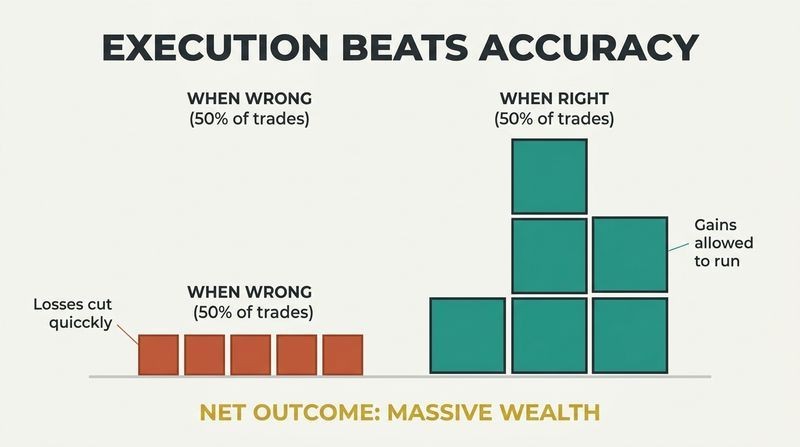
Being right is overrated. The author handed 45 elite investors between $20M and $150M each, with one rule: buy only their ten highest-conviction ideas. Across seven years he tracked 1,866 investments and 30,874 trades. The shock: only 49% of these best ideas made money. Some legends were right just 30% of the time. Yet almost none of them lost money overall, and most made fortunes.
So what separated success from failure? Not stock-picking genius or a Midas touch. It was execution: how much they staked, and what they did once a position moved against or for them. As the author puts it, if property is location, location, location, equity investing is execution, execution, execution. George Soros said it plainly: what matters is how much you make when right and lose when wrong.
What's striking is how this reframes an entire industry built on forecasting. Philip Tetlock's research on expert political judgment reached a parallel verdict: credentialed forecasters barely beat chance, yet confidence rises with expertise. The finding also echoes poker and venture capital, where returns are dominated by a handful of outliers and the discipline of folding losing hands. One caveat worth holding: a 49% hit rate among pre-selected best ideas may partly reflect the brutal 2006 to 2013 window, spanning the financial crisis. Still, the deeper claim, that process beats prediction, is one of the most durable findings in behavioral finance.
Doing nothing while losing is the one truly unforgivable habit

Meet the Rabbits. These prestigious, decorated investors froze when positions cratered, refusing to sell or buy more. One held a communications stock down 99%, needing a 9,900% return just to break even. The brutal arithmetic: a 50% loss demands a 100% gain to recover, a 90% loss demands 900%. Permanent capital impairment (destroying money so thoroughly it cannot realistically be earned back) is what actually ruins wealth.
The data is damning. Of 941 losing investments, only 3% were rescued by trading activity while held. In one case a stock rebounded 1,129% after the investor sold, yet had he held from purchase he would still have lost 32%. The Rabbits mistook inaction for patience. The author now pressures managers the moment a stock drops past 20%.
The Rabbit is the loss-aversion experiment made flesh. Kahneman and Tversky showed losses hurt roughly twice as much as equivalent gains feel good, which perversely paralyzes people precisely when action is urgent. There is a useful cousin here from military and medical thinking: a bias toward action under uncertainty often beats waiting for certainty that never comes. The takeaway inverts conventional buy-and-hold wisdom, which works for index funds but not concentrated single-stock bets. The distinction matters: holding a diversified basket forever is prudent; holding a broken individual thesis and hoping is the road to zero.
When a stock sinks, ask: would I buy this today?

One question cuts through the fog. The author's rescue test for any losing position: with a blank sheet of paper and everything you now know, would you buy this stock today? If the honest answer is no, or maybe but, sell immediately. If you cannot press the button despite that answer, blame endowment bias (overvaluing something simply because you already own it) rather than logic.
Then there are only two valid moves: sell out, or significantly buy more. Never freeze. A falling price is the market's feedback that your timing, if not your thesis, was wrong. Peter Lynch re-examined each holding as if hearing the story fresh, dumping deteriorating names and loading up on cheapened winners. The essential discipline is to draw up this action plan before you invest, while calm.
This is precommitment strategy, the same logic Ulysses used lashing himself to the mast against the Sirens. Behavioral economists call decisions made in a calm state cold-state planning, designed to bind your future hot-state self. The blank-sheet question is quietly brilliant because it neutralizes sunk-cost reasoning: it forces a forward-looking judgment where the purchase price is irrelevant. Financial advisers use a mirror version for winners. The one friction: honestly answering the question requires the very self-awareness that stress erodes, which is why the author pairs it with mechanical rules rather than trusting willpower alone.
Kill losers automatically at 20 to 33% before they kill you
The Assassins never negotiate with a loss. These investors, many of them hedge fund managers, attached a stop-loss (an automatic sell order triggered at a preset price) the moment they bought. When a stock fell 20 to 33%, it sold itself, removing the temptation to wait and hope. One Assassin took a painful 32% hit on a biotech, which then fell another 49%. Another exited a bank at a 16% loss before it dropped a further 82%.
The data backs the range. Roughly two-thirds of the time, cutting a losing position leaves you better off. Assassins also imposed a time stop, selling stocks that showed no life after about six months, because lost compounding years are nearly impossible to recover. Crucially, they did not overreact: cutting at 5 or 10% just gets you whipsawed.
The stop-loss is emotion-proofing through automation, the financial equivalent of not keeping cookies in the house. Andrew Frazzini's research on the disposition effect, cited by the author, found investors who most readily cut losers earned the highest returns. There is genuine tension in the literature, though: some studies show naive stop-losses underperform in choppy, mean-reverting markets. The author's calibrated 20 to 33% band is a thoughtful compromise, wide enough to avoid noise, tight enough to prevent catastrophe. The time stop is the underrated half: capital trapped in a flatlining position bleeds opportunity cost invisibly, which is far harder to feel than a price drop.
Buy more of a falling stock only if the thesis still holds
The Hunters do the opposite of Assassins. When a well-chosen stock fell, they bought significantly more, lowering their average cost, then waited for recovery. They never went all in on day one, keeping cash dry precisely to exploit lower prices, a disciplined form of dollar-cost averaging. One Hunter's oil-services stake was down 40% on paper; by buying more at the bottom he sold at a 24% profit, turning a loser into a winner.
But this is not blind averaging down. The Hunters were contrarian value investors who first passed the would-I-buy-today test. A bad Hunter who refuses to sell a genuinely broken thesis is just a Rabbit. Done right, this exploits compounding: if odds improve as price falls while fundamentals hold, you should stake more, echoing Buffett putting 42% of Berkshire into American Express in 1974.
The author is careful to distinguish this from the Martingale gambling system of doubling down on pure chance, which reliably leads to ruin. The difference is edge: averaging into a mispriced asset with an intact thesis raises expected value, while averaging into a fair coin does not. The Kelly Criterion formalizes exactly this, bet bigger when your edge grows. The psychological demand is steep, though. Adding to a position that has already hurt you triggers maximum regret aversion, and the strategy fails catastrophically if you misjudge a value trap for a bargain. It suits patient temperaments comfortable holding through multi-year pain.
Selling a winner for a quick 20% is picking pennies before a train
Beware the Raiders. One had a phenomenal 70% hit rate yet made almost no money, because he grabbed profits the instant a stock rose 10 to 15%. He sold an infrastructure stock after a 15% pop; it then rose another 147%. He sold a tobacco giant after 9%; it climbed 74% more. By bagging small gains he was surrendering years of compounding.
Why we all become Raiders. Prospect theory shows humans turn risk-averse when winning: the certainty of a small gain feels safer than the uncertainty of a bigger one, like a Deal or No Deal contestant taking the banker's cash. Add the dopamine hit of banking a profit and hyperbolic discounting (overvaluing rewards now versus later). The data: 66% of winning trades were sold for under 20%, and 61% of those kept rising.
The Raider paradox, high accuracy with poor returns, is one of finance's cruelest lessons: a great batting average with tiny hits loses to a mediocre one with occasional grand slams. Nassim Taleb's distinction between frequency of being right and magnitude of being right captures it exactly. There is a fascinating wrinkle the author surfaces: the same investor was superb at short-selling, where the payoff profile inverts (capped upside, unlimited downside), so cutting winners fast and riding losers became correct. This reveals that no habit is universally virtuous; it must match the asymmetry of the instrument. Behavior that ruins a stock-picker can make a short-seller.
Trim your winners like fine wine; never drink the whole bottle
The Connoisseurs were the most successful tribe, yet had a worse hit rate than average, losing on six of ten ideas. They won because when right, they won enormously, riding positions up 200% or more. Their trick for beating the urge to sell: take small sips of profit along the way (trimming) while keeping the core position intact. One held an African retailer that rose 231%; by trimming rather than dumping he still captured 104%, roughly five times what a typical seller would have banked.
Their playbook: buy low-surprise, predictable compounders they would hold ten-plus years, use no price targets, size positions large, and cultivate a high boredom threshold. The author invokes the Forbes list: Bezos, Blakely, and Jobs got rich not by founding companies but by refusing to sell their stakes.
Trimming is a behaviorally ingenious solution to the marshmallow test. Rather than fighting the impulse to realize gains, the Connoisseur satisfies it in miniature, preserving the fat tail. This maps onto research showing partial goal-satisfaction sustains long-term restraint better than white-knuckle abstinence. The Pareto insight, that a few winners carry the whole portfolio, is well documented: studies of the broad market find a tiny fraction of stocks account for nearly all wealth creation above Treasury bills. The honest risk the author names is real, though: momentum can reverse violently, and buying a stock already up big means the easy gains may be gone. Trimming hedges precisely this.
Concentrate in a handful of best ideas; diversification hides ignorance
Over-diversification quietly murders returns. Because you need your rare winners to move the needle, spreading capital across 100 low-conviction names dilutes them into irrelevance. A Harvard and LSE study of US funds from 1991 to 2005 found each manager's single highest-conviction stock beat the market handsomely, and their top ideas far outran their portfolios as a whole. Notably, over 70% of best ideas did not overlap between managers, so this was skill, not a crowded hot trade.
Why professionals still over-diversify: career risk and regulation. Managers minimize the chance of getting fired rather than maximize returns, and rules born of 1970s theory cap concentration. But diversification does not remove risk, it swaps company-specific risk for market risk. The author lets his managers put up to 25% in a single idea.
This directly challenges the Markowitz orthodoxy that diversification is the only free lunch in finance. The steelman for concentration is that diversification protects the ignorant, whereas deep knowledge of a few businesses lets you concentrate rationally, the Buffett and Munger position. Yet the counter-evidence deserves weight: the same Harvard study relies on top holdings that survivors chose, and most retail investors lack the research depth to earn concentration's higher variance. The reconciliation is the author's own middle path, concentrated but never all-in. Kelly betting says the same: size to your edge, but never so large that one bad outcome ruins you.
Name the mental gremlins sabotaging you before they sabotage you
The Rabbits lost to their own wiring. The author catalogs the biases that trap us, worth memorizing as an early-warning list:
1. Narrative fallacy framing bias: endlessly rewriting the story so a losing stock always looks attractive.
2. Endowment bias: valuing a holding above its market price simply because you own it.
3. Anchoring: fixating on the price you paid and refusing to update.
4. Gambler's fallacy: believing you are due a win after losses.
5. Self-attribution bias: crediting skill for wins and blaming Mr Market for losses.
A vivid demonstration: show someone a stock chart on two different timeframes and the same stock looks like a must-buy winner or a shunned dog. Both cannot be true. The author also warns that seeking more research usually just manufactures reasons to justify the original mistake.
This section is essentially applied Kahneman for portfolio managers, and its power lies in specificity. Simply labeling a bias in the moment measurably weakens its grip, a technique clinical psychology calls affect labeling. The chart-timeframe trick is a compact masterpiece, exposing how framing alone, not fundamentals, drives conviction. One extension worth adding: the wisdom-of-crowds jelly-bean experiments the author cites cut against overconfidence, suggesting the market's aggregate guess often beats any individual expert. The humbling implication is that pounding the table that you are right and the market is wrong is statistically a losing posture, even for people with genius-level IQs who blew up famous funds.
Never buy anything you cannot sell in a hurry
Liquidity is the trap door no one checks. A stock is liquid when you can buy or sell meaningful size without moving the price or getting stuck. One Rabbit justified inaction by claiming his marine-electronics holding was too illiquid to add to, ignoring the terrifying corollary: it was also too illiquid to escape. He eventually sold down 96%. The author calls trading into something you cannot exit a schoolboy error.
It is the fifth winning habit and a standalone rule. Illiquidity compounds every other mistake: it prevents Assassins from cutting, stops Hunters from buying more, and locks Raiders and Connoisseurs out of trimming. During the 2008 crisis, small-cap stocks with thin trading collapsed further as everyone fled the exits at once. The whole edifice of execution assumes you can actually act on your decisions.
Liquidity risk is the quiet killer of the 2008 crisis and of Long-Term Capital Management before it: positions that look fine on paper become worthless when everyone needs the same exit simultaneously. The author's theater metaphor elsewhere applies, a crowded room panicking toward one door. What makes this rule easy to neglect is that liquidity is invisible in calm markets and only matters catastrophically in stressed ones, precisely when you most need to move. For ordinary investors the practical lesson is to distrust thinly traded micro-caps and exotic instruments whose bid-ask spreads widen brutally the moment sentiment turns.
Analysis
The Art of Execution succeeds because it inverts the question every investor obsesses over. Instead of asking what to buy, Freeman-Shor asks what to do after you have bought, and backs the inquiry with an unusually clean natural experiment: 45 elite managers, each forced to hold only their ten best ideas, tracked trade by trade. The finding that only 49% of best ideas worked, yet almost all managers profited, is the empirical spine of the entire book. It shifts the locus of skill from prediction to money management, aligning with the Soros and Tudor Jones dictum that magnitude beats frequency.
The five-tribe taxonomy is the book's pedagogical masterstroke. By turning abstract behavioral principles into memorable characters (Rabbits, Assassins, Hunters, Raiders, Connoisseurs), the author makes loss aversion, prospect theory, and the disposition effect stick in a way academic papers cannot. The framework's honesty is notable: he presents two legitimate ways to handle losses (Assassin and Hunter) that flatly contradict each other, refusing false certainty. The unifying rule, materially adapt when losing and stay faithful when winning, is genuinely actionable.
The book's limits deserve naming. The sample spans 2006 to 2013, dominated by a crisis and a recovery, which may inflate the payoff to averaging down and running winners. The best-ideas study and Forbes anecdotes suffer survivorship bias: we see Bezos who held, not the thousands who concentrated and lost everything. Concentration and no-stop conviction can just as easily produce ruin as riches, a tension the author acknowledges more than resolves. Finally, the retail reader lacks the research infrastructure that makes concentration rational for professionals. Yet the core discipline, precommit to an action plan, cut or add decisively when losing, trim rather than dump when winning, and never confuse being right with making money, is robust, transferable, and rare. That is why the book earns its shelf space among behavioral finance classics.
Review Summary
The Art of Execution receives mostly positive reviews for its insights on investment behavior and money management. Readers appreciate its concise, practical advice on handling winning and losing positions. The book categorizes investors into types based on their behaviors, offering strategies to improve execution. Some criticize repetitiveness and contradictions, while others find it eye-opening. The main takeaways are to cut losses, let winners run, and focus on best ideas. Many readers consider it valuable for both novice and experienced investors.
People Also Read


FAQ
What's "The Art of Execution" about?
- Investment Success Despite Failures: The book explores how top investors can be wrong most of the time yet still make significant profits through effective execution of their investment strategies.
- Focus on Execution: It emphasizes that successful investing is not just about having great ideas but executing them well, especially when facing losses or gains.
- Behavioral Insights: The book categorizes investors into tribes based on their behaviors and strategies, such as Rabbits, Assassins, Hunters, Raiders, and Connoisseurs.
- Practical Lessons: It provides practical lessons and strategies for both professional and private investors to improve their investment outcomes.
Why should I read "The Art of Execution"?
- Learn from the Best: Gain insights from the strategies and behaviors of some of the world's top investors.
- Improve Investment Execution: Understand the importance of execution in investing and how to apply it to your own strategies.
- Behavioral Finance Insights: Discover how psychological biases and behaviors impact investment decisions and outcomes.
- Actionable Strategies: The book offers actionable strategies and checklists to help investors adapt and succeed in various market conditions.
What are the key takeaways of "The Art of Execution"?
- Execution Over Ideas: Successful investing is more about how you execute your ideas than the ideas themselves.
- Adaptability is Crucial: Investors must be willing to materially adapt when losing and remain committed when winning.
- Behavioral Patterns: Recognizing and overcoming common behavioral biases can significantly improve investment performance.
- Focus on Best Ideas: Concentrating on a few high-conviction ideas rather than diversifying too broadly can lead to better outcomes.
What are the best quotes from "The Art of Execution" and what do they mean?
- "Vision without execution is hallucination." – Thomas Edison: Highlights the importance of executing ideas effectively to achieve success.
- "Never lose money. Never forget rule No.1." – Warren Buffett: Emphasizes the importance of capital preservation in investing.
- "It’s not whether you’re right or wrong that’s important, but how much money you make when you’re right and how much you lose when you’re wrong." – George Soros: Stresses the significance of managing gains and losses effectively.
- "Put all your eggs in one basket and then watch that basket." – Mark Twain: Advocates for focusing on a few high-conviction investments rather than over-diversifying.
How does Lee Freeman-Shor categorize investors in "The Art of Execution"?
- Rabbits: Investors who freeze in the face of losses and fail to adapt, often leading to significant capital impairment.
- Assassins: Investors who ruthlessly cut their losses at predetermined levels to preserve capital.
- Hunters: Investors who buy more of a losing stock if they believe in its long-term potential, effectively averaging down.
- Raiders: Investors who take profits too early, missing out on potential larger gains.
- Connoisseurs: Investors who ride their winners for the long term, taking small profits along the way to stay invested.
What is the "Rabbits" strategy in "The Art of Execution"?
- Caught in Inaction: Rabbits are investors who fail to act when facing losses, often due to psychological biases like fear and ego.
- Capital Impairment: Their inaction leads to significant capital impairment, making it difficult to recover losses.
- Common Mistakes: They often anchor to initial investment values and are influenced by crowd behavior, leading to poor decision-making.
- Avoidance Strategy: The book suggests having a clear plan and being willing to sell or buy more to avoid the pitfalls of being a Rabbit.
What is the "Assassins" strategy in "The Art of Execution"?
- Cutting Losses Quickly: Assassins are investors who use stop-losses to automatically sell losing positions at predetermined levels.
- Preserve Capital: Their primary focus is on preserving capital by avoiding large losses that are difficult to recover from.
- Time-Based Selling: They also sell stocks that don't recover within a set timeframe, ensuring capital is not tied up in underperforming investments.
- Emotional Discipline: Assassins rely on rules rather than emotions to make decisions, ensuring consistent execution.
What is the "Hunters" strategy in "The Art of Execution"?
- Averaging Down: Hunters buy more of a stock when its price falls, provided they still believe in its long-term potential.
- Contrarian Approach: They often go against the crowd, buying when others are selling, to exploit market irrationality.
- Patience and Discipline: Hunters require patience and discipline, as they may hold stocks for extended periods before seeing returns.
- Compounding Effect: By buying more at lower prices, Hunters benefit from the compounding effect when the stock eventually recovers.
What is the "Raiders" strategy in "The Art of Execution"?
- Premature Profit-Taking: Raiders tend to sell winning stocks too early, missing out on potential larger gains.
- Fear of Loss: Their actions are often driven by a fear of losing profits, leading to suboptimal investment outcomes.
- Short-Term Focus: They focus on short-term gains rather than long-term potential, often due to psychological biases.
- Avoiding Raider Pitfalls: The book advises against taking small profits and encourages running winners to maximize returns.
What is the "Connoisseurs" strategy in "The Art of Execution"?
- Riding Winners: Connoisseurs hold onto winning stocks for the long term, taking small profits along the way to stay invested.
- Focus on Quality: They invest in companies with predictable earnings growth and low negative surprise potential.
- Big Position Sizes: Connoisseurs are willing to invest large amounts in their best ideas, allowing them to benefit significantly from big winners.
- Patience and Boredom: They have a high tolerance for boredom, focusing on a few high-conviction ideas over many years.
How does "The Art of Execution" address behavioral finance?
- Bias Awareness: The book highlights common psychological biases that affect investment decisions, such as anchoring, ego, and fear.
- Behavioral Tribes: It categorizes investors into tribes based on their behaviors, providing insights into how these behaviors impact outcomes.
- Overcoming Biases: By understanding and overcoming these biases, investors can improve their decision-making and execution.
- Practical Strategies: The book offers practical strategies to counteract biases, such as using stop-losses and having a clear investment plan.
What are the "Winner's Checklist" and "Loser's Checklist" in "The Art of Execution"?
- Winner's Checklist: Focus on best ideas, invest significant amounts, run winners, adapt when losing, and ensure liquidity.
- Loser's Checklist: Avoid over-diversification, invest small amounts, take small profits, refuse to adapt when losing, and ignore liquidity.
- Execution Focus: Both checklists emphasize the importance of execution in achieving investment success.
- Guidance for Investors: They provide clear guidance for investors to develop successful habits and avoid common pitfalls.
Download PDF
Download EPUB
.epub digital book format is ideal for reading ebooks on phones, tablets, and e-readers.








