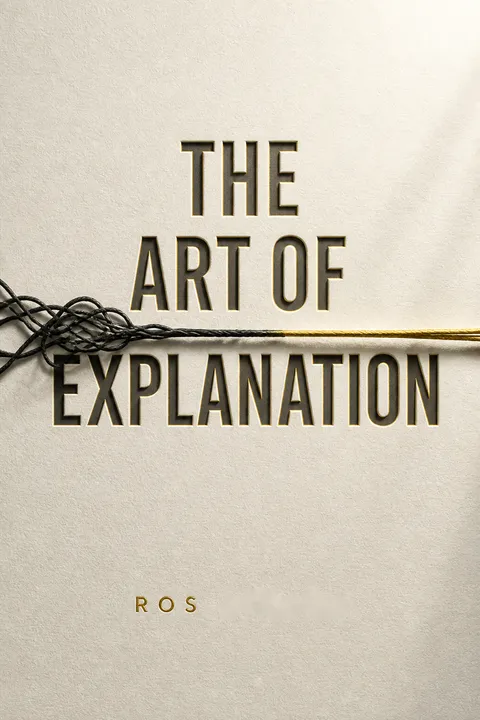


Key Takeaways
Practice explanation as a craft that shapes what others can understand and do.
A missed chance taught the lesson. Early in his career, Ros Atkins reached an interview at the Independent with a strong desire to work there, but no clear account of what he wanted or why he was right for the job. His answer wandered, and the opportunity disappeared. Years later, after developing a deliberate way to prepare, he interviewed successfully for a role at BBC Radio 5 Live.
Clarity starts before speaking. Explanation is not a final layer of polish applied to finished thinking. It is the work of deciding what matters, finding the information that supports it, and choosing how to make it understandable. It cannot guarantee agreement or success, but it removes avoidable obstacles between an idea and the people who need to grasp it.
The interview story captures a crucial distinction between having a good idea and making it legible to another person. In organizational life, decisions often depend on whether evidence, purpose, and relevance arrive together, not on the raw quality of an idea alone. Treating explanation as preparation also lowers the pressure to improvise brilliance in the moment. There is a limit: clarity cannot compensate for a weak proposal, unequal power, or an audience unwilling to listen. Its value is more practical and more honest. It gives sound ideas a fairer hearing.
Start with what your audience needs to understand, not what you know.
Knowledge is not the same as relevance. A good explanation is calibrated to the people receiving it: what they already know, what they want to know, and what they need to do with the information. When BBC presenter Owen Bennett-Jones explained the assassination of Pakistani politician Salman Taseer to a global audience, he spent little time recounting the attack and much more on the political and religious divisions that made it consequential. That background helped listeners understand why the news mattered beyond Pakistan.
Make the connection explicit. Ask who is listening and what questions they have. Then show why the subject matters in their circumstances. A useful explanation does not assume that an audience will supply missing context or recognize the importance of an event on its own.
This approach resembles user-centered design: begin with the user’s problem, rather than the maker’s preferred solution. In explanation, that means treating background knowledge as a variable, not a universal. Context can also support trust because it shows that the speaker understands the stakes, not merely the latest event. The difficulty is that audiences are rarely uniform. A message that is perfectly pitched to one group may leave another behind. Rather than aim for an imaginary average listener, communicators can name the assumptions they are making and offer brief explanations for people who need them.
Learn the hard parts before translating them into plain language.
Simplicity must not erase substance. Atkins argues that plain language should remove needless difficulty, not the essential detail or complexity of a subject. While reporting on Greece’s debt crisis, he listed what he understood, what confused him, and what he still needed to learn. He asked BBC business reporter Joe Lynam to explain difficult points, then tried to restate them in his own words until the account was both accurate and clear.
Use confusion as a signal. If a subject feels hard to explain, that may reveal a gap in the explainer’s own understanding. Seek help, test the explanation aloud, and correct it before presenting it. Mastery gives the speaker a stronger basis for deciding which complexities belong in the final account and which can safely be left out.
The method connects communication with learning science: retrieving an idea and explaining it in one’s own words can reveal gaps that passive reading conceals. It also treats uncertainty as useful diagnostic information instead of a reason for bluffing. The key distinction is between simplifying language and simplifying reality. The first can broaden access; the second can mislead. There are topics where no short version can preserve every qualification, so a clear explanation should sometimes state what remains uncertain rather than imply that every complication has been resolved.
Research broadly, verify carefully, then cut everything that misses your purpose.
Build a dependable foundation. Atkins recommends starting with direct sources, such as the organization or expert responsible for the information, and trusted secondary sources with a reliable record. For claims that need extra confidence, he describes the BBC World Service practice of checking two reliable sources. Keep track of where facts came from so they can be checked and attributed.
Then reduce the pile. Atkins began drafting this book in a document he called “Info Dump.” Collecting more than may be needed is useful at first; the next task is to judge each item against the explanation’s purpose. Keep the relevant fact, quotation, or argument, and remove surrounding material that does not help the audience understand. If an important point still lacks evidence, note the gap and research it rather than filling it with guesswork.
This sequence joins two kinds of discipline that are often separated: epistemic caution about whether information is true, and editorial judgment about whether it belongs. Both matter. A polished explanation built on weak sourcing can spread error efficiently, while a perfectly sourced information dump can still obscure its main point. The two-source practice is a useful safeguard, not a universal proof of truth. Sources can repeat the same original error or share an incentive. For disputed claims, independence and source quality matter as much as the number of confirmations.
Turn facts into a journey, so each point makes the next matter.
Structure creates meaning. Atkins calls the main sections of an explanation “strands”: groups of information organized around distinct aspects of a subject. Once the sections are identified, arrange them into a story with a clear purpose. A sequence might follow events over time, begin with an outcome and trace its causes, or start with a specific event and gradually reveal its wider context.
The structure should carry the audience. Atkins developed the BBC program Outside Source around the idea of assembling a story from different kinds of evidence in front of viewers. The goal was not to display every available item, but to make each piece help explain the next. A strong opening gives people a reason to follow the account; a conclusion shows what the assembled evidence means.
Narrative is a powerful aid to comprehension because it gives people relationships, sequence, and expectation, rather than isolated facts. The idea of organizing information into strands is especially practical: it lets the explainer see the parts before deciding how they connect. But narrative also carries risk. A tidy beginning, middle, and end can make a contested or unresolved situation look more inevitable than it was. The discipline is to use story as a route through evidence, not as permission to force evidence into a satisfying plot.
Remove every distraction competing with the one idea people need.
Edit for attention and understanding. Atkins uses the “dial test” as a question for editors: where might an audience lose interest or become confused? When he and his colleagues revised a video about the US withdrawal from Afghanistan, producer Andrew Bryson identified a middle section that was slow and overburdened with information. They reworked it, keeping what was essential. The video later received more than a million views on Twitter, though that result cannot be credited to one edit alone.
Check words and visuals. Explain unfamiliar names or terms when needed, or remove them if they do not matter. Images, charts, and slides should support the point being discussed, not sit behind it as decoration. Shorter sentences can make spoken explanations easier to follow, but efficiency means making the available time useful, not simply making every explanation brief.
The dial metaphor encourages revision from the audience’s point of view, a useful counterweight to the writer’s attachment to hard-won details. It also aligns with cognitive-load theory: competing signals demand attention that could otherwise go toward understanding the central message. Still, retention is not the only measure of value. A difficult subject may require a slower passage, and an audience may need information that is important even if it is not immediately entertaining. The better test is whether each element earns its cognitive cost by improving understanding, judgment, or action.
Rehearse ideas in flexible chunks, not as a brittle speech script.
Prepare for conversation, not just performance. Atkins’s method for unpredictable situations groups information into small units, each built around one main point and supporting facts or context. He recommends keeping each group manageable, then practising aloud: explain one section, connect it to another, and try different orders. This makes information easier to retrieve when an interview or meeting takes an unexpected turn.
Memory improves through use. The author noticed this while playing the electronic memory game Simon, whose expanding sequences became easier to recall when he mentally grouped them. In Athens, he later applied a similar approach to the complicated Greek debt crisis. For planned talks, bullet-point prompts can preserve key ideas while sounding more natural than reading every sentence. Rehearsal aloud also exposes awkward phrasing and timing problems.
The strongest insight is that preparation should reduce mental work in the moment, not produce a memorized performance that collapses when the question changes. Grouping information and retrieving it aloud resemble deliberate practice: the speaker rehearses both the knowledge and the transitions needed to use it. This approach is not a substitute for expertise, however, and fluency can be mistaken for command. A prepared speaker still needs to listen, update claims when facts change, and make room for information that was not anticipated.
Use questions to steer toward useful answers without evading the question.
Prepare for likely questions. Before an interview, meeting, or public discussion, list the questions that are predictable, the ones an especially curious person might ask, and the uncomfortable questions that are tempting to avoid. Match each to the information that would answer it. In the moment, a question’s key words can help the speaker identify which prepared points are relevant and in what order to present them.
Answer honestly and then move. A speaker may connect an answer to a related point with a short transition, but should still address the question asked. If the answer is unknown, say so plainly, explain what is known, and offer to check the missing detail when appropriate. This is more credible than bluffing or stretching a thin answer into a long one.
Questions are not merely interruptions. They reveal what an audience considers relevant and provide a structure for tailoring an answer. Preparing for difficult questions also reduces the incentive to evade them reflexively. The ethical boundary is important: a transition can clarify relationships between issues, but it can also become a polished way to dodge accountability. A useful self-check is whether the answer would satisfy a reasonable person who asked the original question. If not, the speaker should acknowledge the gap rather than disguise it with fluent redirection.
Write for the inbox people actually have: crowded, hurried, and skimming.
Put the point first. Atkins advises assuming that a work email may not be opened, read fully, or studied carefully. A subject line and first sentence should make the message’s purpose obvious. He adopts “Bottom Line Up Front,” a military-derived approach that puts the key point before supporting detail. Keep paragraphs short, use restrained headings or bullets, and make the requested action easy to spot.
Respect the reader’s time. In experiments discussed by Atkins, Todd Rogers and Jessica Lasky-Fink found that cutting a message by two-thirds increased its response rate by 80 percent. For group emails, separate information by recipient or role so people can find what applies to them. The goal is not to make every message sound cold. It is to make useful information easy to locate and easy to act on.
Email is a design problem as much as a writing problem. Clear formatting reduces the search effort imposed on the reader, while an explicit request helps convert information into action. The reported response-rate result is a striking illustration, though it should not be treated as a guaranteed effect in every workplace or message type. Directness also depends on relationship and culture. A concise opening can be efficient with a close colleague and abrupt with a stranger. Tone still matters, but courtesy works best when it does not bury the purpose.
Analysis
The book’s distinctive move is to treat explanation as a designed process rather than a gift possessed by naturally eloquent speakers. Atkins’s newsroom background gives the argument its central tension: audiences need enough context and complexity to understand a subject, but every added detail competes for attention. His response is a practical sequence of decisions about audience, evidence, structure, revision, and delivery. The autobiographical arc supports that claim. A failed job interview shows the cost of unorganized thought; reporting on crises and developing BBC formats show how deliberate preparation can make explanation useful across very different settings.
The strongest intellectual contribution is the combination of editorial restraint with respect for substance. “Keep it simple” often becomes an excuse to flatten difficult material. Atkins instead asks communicators to understand complexity before deciding what the audience needs. His emphasis on sources, uncertainty, and second opinions makes that demand more than a stylistic preference. The work also recognizes that communication is interactive: a listener’s knowledge, questions, and attention shape what a successful explanation must do.
There is an important tension in the method. Attention is necessary for understanding, but attention is not the same as truth or importance. A vivid narrative can make evidence memorable while hiding ambiguity, and an efficient message can omit inconvenient qualifications. Likewise, confident delivery may increase perceived credibility without increasing actual accuracy. The safeguard is not to abandon narrative or polish, but to keep them answerable to evidence and purpose. A communicator should be able to explain why each detail is included, what is known, and what remains unresolved.
The book is most useful when its procedures become adaptable habits rather than a checklist applied mechanically. A hospital briefing, a complex news story, and a two-line email do not need identical treatment. Their shared principle is more durable: make the audience’s route to understanding as direct as possible without concealing what makes the subject hard. That turns clarity from cosmetic smoothness into a form of intellectual responsibility.
Review Summary
The Art of Explanation receives mostly positive reviews, with readers praising its practical advice on improving communication skills. Many find it useful for presentations, writing, and professional contexts. Reviewers appreciate Atkins' personal anecdotes and step-by-step approach. Some criticism includes repetitiveness and density of information. The book is recommended for those looking to enhance their explanatory abilities, though experienced communicators may find some content obvious. Overall, readers value the insights on crafting clear, engaging explanations for various audiences.
People Also Read







Glossary
Seven-Step Explanation
Structured preparation for explanationAtkins’s process for preparing a substantial explanation. It begins by defining the aim and audience, then gathers and reduces information, organizes it into a coherent account, develops the wording, revises it, and prepares its delivery. The method is intended for presentations, essays, reports, speeches, and other explanations where there is time to prepare.
Seven-Step Dynamic Explanation
Preparation for unpredictable conversationsA variation of Atkins’s preparation method for situations where questions determine what the speaker must address, such as interviews, meetings, and live discussions. Information is grouped into compact units, practised aloud, and made easy to recall in different orders. The aim is to answer the actual question while still communicating the most relevant prepared information.
strands
Sections organized around key pointsAtkins’s term for the main sections within an explanation. Each strand groups information about one aspect of the subject, helping the explainer sort facts and decide how they fit into the overall account. In prepared conversation, a strand can be reduced to a main point supported by a few facts and relevant context.
dial test
Check for attention dipsAtkins’s metaphorical test for finding moments when an audience might lose interest or become confused. The name comes from radio audience research in which listeners used a dial to indicate approval as a program played. For an explanation, the test prompts a review of each section’s clarity, relevance, and value to the audience.
NATO rule
Explain or remove unfamiliar referencesAtkins’s reminder to consider whether an audience understands a name, acronym, or specialized reference. If a reference is not widely known, the explainer should briefly define it or remove it if it is not essential. Otherwise, listeners may pause to puzzle over it and miss the point that follows.
Outside Source rule
Match visuals to spoken pointsAtkins’s rule for visual material accompanying an explanation: show an image, graphic, map, or other item when it directly supports the words being spoken. Visuals used as generic background can distract or suggest that the speaker has nothing relevant to show. The rule encourages precise timing and a clear connection between what viewers see and hear.
chunking
Group information for recallA memory technique in which several related pieces of information are learned and recalled as one meaningful unit. Atkins applies it to conversations by organizing a subject into small, labelled groups that can be retrieved and arranged in response to questions. The method reduces the need to recall each isolated fact independently.
bridging phrases
Transitions between prepared topicsShort, reusable expressions that help a speaker move from one prepared strand of information to another during an unpredictable conversation. Unlike transitions written for a fixed sequence, these phrases can work across different topic orders. They signal a shift in focus while helping the answer remain coherent and conversational.
escape phrases
Redirect a conversation respectfullyBrief transitions used to move away from a question that is unhelpful, outside the speaker’s remit, or only partly related to a more useful subject. Atkins presents them as a way to acknowledge the question before redirecting the discussion. Used responsibly, they preserve relevance without pretending that the original question was answered when it was not.
Bottom Line Up Front
State the purpose immediatelyA communication principle, known by the abbreviation BLUF, that puts the main point or request at the start of a message. Atkins applies it to work emails, where readers may skim or see only the opening lines. Making the purpose immediately visible can help recipients decide whether the message is relevant and what action it requires.
FAQ
What's The Art of Explanation about?
- Focus on Communication: The book emphasizes the importance of clear and effective communication in various contexts, from presentations to everyday conversations.
- Art of Explanation: Ros Atkins shares insights and techniques developed over years as a BBC journalist to help readers articulate their thoughts clearly.
- Practical Framework: It provides a structured approach to explanation, including a seven-step method that guides readers through organizing and delivering their messages effectively.
Why should I read The Art of Explanation?
- Enhance Communication Skills: Ideal for anyone looking to improve their ability to explain complex ideas simply and engagingly.
- Applicable in Various Situations: Skills taught are beneficial in professional, academic, and personal interactions.
- Expert Insights: Offers proven strategies from Ros Atkins, known as the BBC's "Explainer-in-Chief."
What are the key takeaways of The Art of Explanation?
- Ten Attributes of Good Explanation: Includes qualities like simplicity, clarity of purpose, and engagement.
- Seven-Step Explanation Method: A systematic approach to crafting explanations, including steps like distilling information and organizing it into coherent strands.
- Know Your Audience: Understanding the audience's knowledge and preferences is crucial for tailoring explanations that resonate and engage.
What is the Seven-Step Explanation method in The Art of Explanation?
- Step One: Set-Up: Identify the purpose of your explanation and who it is for, ensuring clarity from the outset.
- Step Two: Find the Information: Gather relevant information from reliable sources, focusing on what is essential.
- Step Three: Distil the Information: Break down the information into its simplest form, removing unnecessary details.
- Step Four: Organise the Information: Structure the distilled information into strands that logically flow and support the overall narrative.
- Step Five: Link the Information: Create connections between the strands, using joining phrases and hooks to maintain engagement.
What are the ten attributes of a good explanation according to The Art of Explanation?
- Simplicity: Use clear and straightforward language to minimize obstacles to comprehension.
- Essential Detail: Include only the most relevant information that supports the explanation's purpose.
- Efficiency: Present information succinctly to respect the audience's time and attention.
- Engaging: Keep the audience's attention by making the explanation interesting and relevant.
- Clarity of Purpose: Maintain a clear focus on what the explanation aims to achieve throughout the communication.
How does Ros Atkins suggest knowing your audience in The Art of Explanation?
- Identify the Target: Understand who you are speaking to, including their demographics and interests.
- Assess Knowledge Levels: Gauge the audience's existing knowledge on the subject to determine necessary background information.
- Tailor Communication Style: Adapt your explanation style based on how the audience prefers to receive information.
What are some practical tips for distilling information in The Art of Explanation?
- First Sweep: Go through your gathered information and ask if each piece is relevant to your purpose.
- Second Sweep: Further refine the remaining information by identifying the core value of each piece.
- Use Simple Language: Break down complex ideas into simple, digestible nuggets for easy understanding.
What does Ros Atkins mean by "clarity of purpose" in The Art of Explanation?
- Define Your Goal: Clearly articulate what you want to achieve with your explanation.
- Avoid Irrelevant Information: Stay focused on the purpose to prevent including non-essential details.
- Guide Your Structure: Use the clarity of purpose to inform the organization of your explanation.
What are some common pitfalls to avoid when explaining something, as discussed in The Art of Explanation?
- Overcomplicating Language: Using jargon or complex vocabulary can alienate the audience.
- Ignoring Audience Needs: Failing to consider what the audience wants to know can lead to disengagement.
- Lack of Structure: Presenting information without clear organization can make it difficult for the audience to follow.
What are some effective techniques for engaging an audience in The Art of Explanation?
- Use Trailing and Joining Phrases: These techniques help maintain momentum and keep the audience engaged.
- Incorporate Stories: Narratives can make explanations more relatable and memorable.
- Ask Questions: Engaging the audience with questions can prompt them to think critically and maintain interest.
How does Ros Atkins suggest handling unexpected questions?
- Preparation is Key: Anticipate potential questions and prepare responses in advance.
- Use of Escape Phrases: Develop escape phrases to smoothly transition from uncomfortable questions.
- Finding Time in Questions: Recognize that questions provide time to organize thoughts before answering.
What are the best quotes from The Art of Explanation and what do they mean?
- “Good explanation gives us the best chance.”: Emphasizes that effective communication is crucial for understanding and engagement.
- “It’s like cleaning a window.”: Illustrates how clarity in communication allows for better understanding.
- “No one cares about my email as much I do.”: Highlights the importance of crafting engaging and relevant messages.
Download PDF
Download EPUB
.epub digital book format is ideal for reading ebooks on phones, tablets, and e-readers.








