Key Takeaways
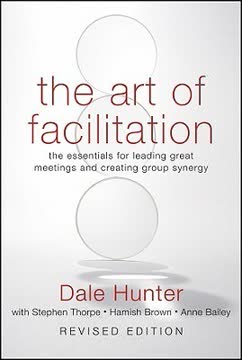
1. Facilitation is the art of making group processes easy, fostering cooperation and consensus.
Facilitation enables a group of people to achieve their own purpose in their own agreed way.
Process over content. Facilitation focuses on how a group works together, rather than what they are discussing. A facilitator acts as a process guide, making it easier and more convenient for a group to move from point A to point B towards an agreed destination. This distinction is crucial, as it allows the facilitator to remain impartial and focus solely on the group's dynamics and methods.
Cooperation and collaboration. At its core, facilitation is the expertise associated with enabling cooperation and collaboration among equals. It ensures that every person in a group can, if they wish, fully participate in all decisions that affect them. This approach is grounded in values such as the inherent worth of the individual, the collective wisdom of the group, and the power of choice.
Consensus as a differentiator. A key aspect distinguishing facilitation is its preference for consensus decision-making, where everyone has a right to be involved in decisions that affect them. Unlike majority voting, consensus aims for collective agreement, ensuring that minorities are not overruled and that decisions are fully owned and implemented by all members. This fosters deeper commitment and more sustainable outcomes.
2. The Zenergy Model: Effective facilitation balances self, others, and group within purpose and culture.
The primary role of the group facilitator is to focus the group on its purpose and act as guardian of the group culture.
Integrated framework. The Zenergy model provides a conceptual architecture for facilitation, illustrating the interconnectedness of self-facilitation, facilitating another, and facilitating a group. These three elements form a triangle, with the group's purpose as the apex, signifying its guiding direction. This framework emphasizes alignment between individual and group goals.
Purpose and culture as containers. The model highlights that a group's purpose defines "why we are here" and "what we want to achieve," providing clarity and direction. Complementing this, the group's culture defines "how we will be together," encompassing agreed-upon internal environment, values, and ground rules. These two elements act as a strong container, allowing for maximum flexibility within a defined structure.
Holding the group. The facilitator's subtle yet profound work involves "holding the group" by constantly referencing and guarding its purpose and culture. This embodied function requires deep listening, presence, and mindfulness, ensuring the group stays on track and operates within its agreed-upon boundaries. This foundational work, often done in silence, is critical for creating a safe and productive environment.
3. Self-Facilitation is the foundation: Cultivate deep self-awareness and continuous personal growth.
The most important work for any facilitator is developing one’s own capacity to be and become an embodied, grounded, self-aware and self-reflecting person — to facilitate yourself.
Lifelong journey. Self-facilitation is an ongoing, holistic journey of self-discovery across physical, emotional, mental, and spiritual dimensions. It involves accepting oneself completely, recognizing one's inherent magnificence, and being fully present. This continuous process of growth is not about "fixing up" perceived flaws, but about embracing and developing one's authentic self.
Empowerment through choice. Through proactive self-facilitation, individuals empower themselves by consciously choosing to alter their behavior and interrupt unhelpful patterns. This involves taking responsibility for one's thoughts, feelings, actions, and environment. Regularly asking "What am I choosing now?" helps develop self-awareness and strengthens one's will to expand, give, and contribute.
Healing upsets and projections. A crucial aspect of self-facilitation is addressing past "upsets" – unresolved emotional baggage that can be triggered in the present. Techniques like clearing sessions, vigorous physical activity, or deep self-exploration help release and transform these energies. Additionally, recognizing and dismantling personal "projections" onto others is vital for seeing people and situations clearly, rather than through a filter of past experiences.
4. Powerful Listening and Empowering Speaking are the facilitator's primary tools.
Listening is the primary skill of facilitation.
Distress-free listening. Listening is the most important skill for a facilitator, profoundly affecting the group's quality. It's an active, focused, and affirming process, where the facilitator listens for the whole group, each individual, and both spoken and unspoken conversations. This involves developing "distress-free listening," free from personal assessments and judgments, to truly hear the "gold" in what others say.
Speaking in the moment. Out of powerful listening emerges facilitative speaking, which empowers the listener. A facilitator's voice is used like a musical instrument, resonating with authenticity and intent, to direct, encourage, support, calm, and inspire. Interventions are made "in the moment," not pre-planned, to serve the group's purpose and foster synergy.
Empowering interventions. Facilitative speaking involves using questions and suggestions to encourage self-clarification and forward movement, rather than giving advice or interpretations. It also means interrupting disempowering conversations, such as blaming or self-deprecating language, and gently encouraging lightness and humor. The goal is to help individuals identify what they want to happen next and take responsibility for their actions.
5. Groups are multi-dimensional; effective facilitation shifts across physical, emotional, and energetic levels.
A group, like each individual in it, is multidimensional and operating on many different levels.
Beyond the surface. Effective facilitation recognizes that groups operate on multiple levels simultaneously: physical, thinking, emotional, intuitive, energy, and spiritual. A facilitator's "magic" often comes from their ability to perceive and work within and between these different dimensions, bringing submerged dynamics to the group's consciousness.
Noticing and intervening. The facilitator develops discernment to observe subtle cues—tone of voice, body language, silences, energy shifts—to understand what is truly happening in the group. Sharing these observations with the group, inviting their own insights, and modeling shifts between levels (e.g., moving from rational discussion to emotional sharing) empowers participants to engage more fully.
Synergistic transformation. When a group is aligned, congruent, and truthful across these levels, it can reach a synergistic state of heightened awareness. In this "zero point field," collective intelligence flourishes, and the group experiences a palpable sense of flow, clarity, and timelessness. This transformative level is where unexpected new possibilities arise, and individuals feel deeply connected and autonomous within the collective.
6. Consensus decision-making is central to collective wisdom, requiring proactive engagement and dismantling barriers.
Consensus is based on the belief that every person has a right to be involved in decisions that affect them.
Collective ownership. Consensus decision-making, or collective decision-making, is a core tenet of facilitation, drawing out the group's collective wisdom and ensuring every member owns the decisions made. It requires an underlying commitment from all involved to reach agreement, giving up the right of veto in favor of finding solutions that work for everyone.
Beyond majority rule. Unlike democratic majority voting, consensus aims for deeper alignment, even if it takes more time initially. Decisions made by consensus tend to "stick" better and are implemented more effectively because they have the full commitment of the group. This process also offers personal development opportunities, freeing individuals from the need to always be right or get their own way.
Dismantling barriers. Facilitators must be skilled at recognizing and dismantling common barriers to consensus:
- Making one another wrong: Reminding participants that all viewpoints are valid.
- Not being proactive: Encouraging alternative solutions and short breaks.
- Getting stuck on one outcome: Allowing full expression of a position, then brainstorming alternatives.
- Group think: Alerting the group to unconscious conformity and encouraging individual fresh thinking.
- Cheap closure: Actively checking for genuine agreement, not just silence.
7. Conflict is normal and inevitable; address it directly to foster growth and synergy.
Conflict in groups is normal and inevitable.
Dissonance and growth. Conflict is a natural part of group development, reflecting the "rattle of individual egos" as a group moves towards alignment and congruent action. A highly creative group is likely to experience significant conflict, and its absence may indicate apathy or a lack of safety. The facilitator's role is to embrace conflict as an opportunity for growth, not to avoid it.
The 3 H's: Held, Heard, Healed. Effective conflict resolution involves creating a safe space where people can be "held" energetically, "heard" through deep listening, and "healed" from within. The facilitator provides structure, encourages respectful expression of feelings, and trusts the group's capacity to work through issues. Early intervention is key, as unresolved conflict tends to escalate or go underground, leading to diminished energy and cooperation.
Interrupting unhelpful patterns. Facilitators intervene to interrupt sabotaging behaviors, blaming, and scapegoating, which often stem from individuals acting out past distress or feeling powerless. By encouraging assertive communication—owning feelings, describing behavior, and making clear requests—the facilitator helps the group move beyond destructive patterns. Challenges, whether within the group, to the group, or to the facilitator, are seen as valid and addressed immediately to foster maturity and trust.
8. Ethical facilitation prioritizes group autonomy, impartiality, and transparency.
Our effectiveness is based on our personal integrity and the trust developed between ourselves and those with whom we work.
Impartial process guide. Facilitators are called upon to fill an impartial role, acting as process guides to balance participation and results without influencing content. While pure objectivity may be impossible, striving for impartiality is crucial for maintaining trust and credibility. This means setting aside personal opinions and supporting the group's right to make its own choices.
Client clarity and accountability. A key ethical consideration is defining "who is the client." While a sponsor may hire the facilitator, the primary client is the group being facilitated. The facilitator is accountable to the entire group, ensuring their conscious agreement to the process and commitment to participate. This prevents manipulation or "manufacturing consent" for external agendas.
Transparency and conflict of interest. Facilitators must openly acknowledge any potential conflicts of interest, personal biases, or prior knowledge that could affect their impartiality. This transparent discussion, prior to contracting, allows all parties to make informed decisions and prevents misunderstandings. The IAF Code of Ethics emphasizes respecting the group's culture, rights, and autonomy, ensuring no imposition that risks welfare, dignity, or freedom of choice.
9. Facilitation extends beyond the room: Understand the wider context and strive for a sustainable society.
Facilitation is not value-neutral.
Value-driven practice. Facilitation is inherently value-laden, rooted in principles of individual worth, collective wisdom, cooperation, and consensus. These values align with peaceful social change and the development of a sustainable society. Facilitators make conscious choices about their work, clients, and methods based on their personal and professional values, ensuring alignment with the purpose and values of the groups they serve.
Context awareness. Effective facilitators understand that every group exists within a larger context—organizational, community, national, regional, and global. Using a "context awareness diagram" helps to expand perspective and recognize the intricate web of influences on a group. This holistic view, akin to social ecology, considers the interconnectedness of human society with the planetary ecosystem.
Co-creating a sustainable future. The ultimate purpose of facilitation can be seen as contributing to a sustainable, life-affirming society. This involves applying cooperative processes to address complex global challenges like climate change, resource allocation, and social justice. Facilitators have a responsibility to develop and disseminate cooperative technology, inspiring people to communicate, cooperate, and find peaceful solutions for future generations.
10. Continuous learning and embodied awareness are essential for the evolving facilitator.
Facilitator education, which is primarily learning a toolkit of techniques and processes, does not do justice to the ever-changing, organic, fluid nature and subtleties of the group dynamic and the work of a facilitator.
Whole person learning. Facilitator education goes beyond acquiring a toolkit of techniques; it's about developing "whole person" or embodied awareness. This integrated learning involves understanding concepts (head), experiencing them (belly), and integrating them (heart). It cultivates the ability to be centered, grounded, and self-reflective, connecting with others constructively.
Multisensory engagement. Learning and facilitating are enhanced through multisensory approaches, engaging sight, sound, smell, touch, taste, and movement. Creative methods like drawing, painting, movement, sound, and storytelling help access deeper understanding and expression within groups. This holistic engagement acknowledges that learning is an embodied phenomenon, reinforced by neuroscientific findings on the connection between thought and emotion.
Dimensions of education. Facilitator education encompasses technical skills, intentional practice grounded in theory, person-centered qualities (attitudes, presence), and critical awareness of political and ethical implications. Continuous learning, through practical experience, ongoing study, and personal development, is vital for facilitators to remain current, adapt to emerging needs, and access expanded consciousness for collective intelligence.
Last updated:
Similar Books