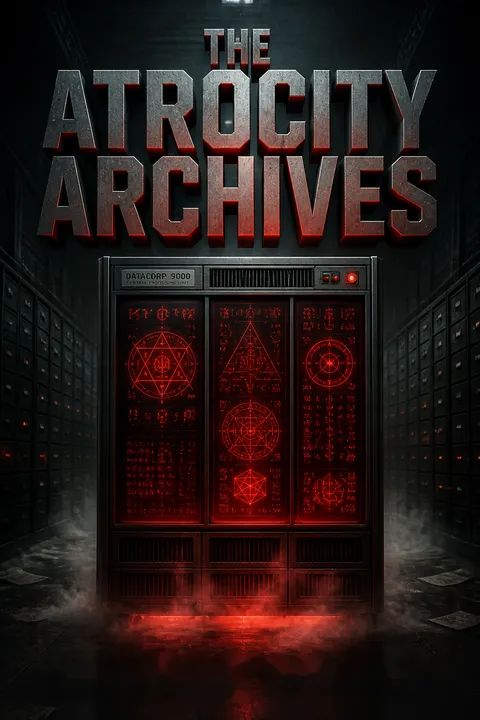


Plot Summary
The Theorem in the Server
Bob Howard, a technically gifted but underemployed civil servant, breaks into a software company to erase mathematician Malcolm Denver's proof of a dangerous theorem. He secretly copies it first.
The Laundry, Britain's concealed agency for supernatural threats, confirms that Denver has independently rediscovered a mathematical method that can crack encryption and open channels to other universes. Rather than silence him, Bob recommends recruiting him. His suggestion works, and Andy, Bob's supervisor, assigns Bob to a course in computational demonology so he can assess its other trainees.
Bob's burglary earns praise for its results and reprimand for his lateness. Beneath the office comedy, he learns the rule that governs his world: certain discoveries are not merely dangerous ideas, but working machinery.
The inciting event makes Bob's technical curiosity both his qualification and his liability. He is not recruited because he accepts the agency's worldview; he is useful because he can recognize a mathematical breakthrough before its author understands its consequences. His unauthorized copy also signals a recurring tension: Bob treats information as something to investigate, while the Laundry treats it as a hazardous material requiring custody. The office's recruitment decision is pragmatic rather than heroic. It converts a potential security breach into a personnel solution, showing that bureaucracy does not oppose danger so much as absorb it, classify it, and assign someone to manage it.
Fred Crosses the Circle
During the course, Bob recognizes Fred Ironsides, an accounting clerk who has been mistakenly enrolled and has no grasp of the occult mathematics being taught. When the instructor begins a controlled summoning, Fred reaches across the containment circle and grounds the active circuit.
A fast-thinking entity floods his nervous system and takes control before anyone can pull him away. Bob grabs the nearby fire extinguisher and strikes Fred, killing him before the possessing force can reach the other trainees.
The inquiry clears Bob of deliberate wrongdoing, but Fred's family and children make the official verdict feel inadequate. Suspended pending review, Bob drinks through his shock with his housemates. At Dunwich, a washed-up fossil makes the threat to humanity feel less theoretical, and Bob chooses active service.
Fred's death turns abstract risk into moral injury. The mistake is banal, a confused employee in the wrong training course, but the consequence is irreversible because the system depends on precise boundaries that ordinary workplace habits cannot teach. Bob's response is technically correct and emotionally devastating: competence saves lives without restoring the person it costs. The inquiry can determine procedure, not absolve grief. His decision to serve therefore emerges less from patriotic conviction than from recognition that the danger will persist whether he participates or not. The Laundry offers no clean choice, only different degrees of responsibility.
The Professor in California
Three months later, Bob travels unofficially to Santa Cruz to meet Dominique O'Brien, a British philosopher known as Mo. She is unable to leave the United States despite holding British citizenship, and believes the Pentagon has restricted her because of research begun at Miskatonic and continued at the University of California.
Her work attempts to quantify belief where ordinary evidence is absent. Bob recognizes that this could have occult applications, but does not yet know why the Laundry is interested.
After their meeting, a federal operative threatens Bob and is shot dead by an unseen attacker. Bob escapes the motel and prepares to leave, then receives Mo's panicked call. He traces her through a discarded shirt to a guarded house, detects a major summoning, and alerts American agents before someone knocks him unconscious.
Mo and Bob meet as professionals before they become emotionally entangled. Their shared interests create a sharper connection than simple attraction: each understands that apparently abstract research can acquire state-level consequences. Yet their agencies have already reduced Mo to an asset and Bob to an expendable intermediary. Bob's decision to turn back after the shooting breaks protocol, but it also establishes his ethical reflex. He acts on a distressed person's need before he has proof that doing so is strategically wise. The resulting danger shows how quickly private concern can collide with intelligence systems that regard human relationships as vulnerabilities to be managed.
A Rescue Without a Record
Bob wakes in hospital with a head injury and learns that American operatives have extracted Mo from the house. The Laundry sends him home, where supervisors question why he ignored the order to withdraw after his cover was compromised.
Bob explains that Mo called for help and that the kidnappers were preparing a dangerous ritual, but the official account erases the abduction and the dead federal operative. Back in London, he meets Mo again inside the Laundry. The United States has deported her, and the agency has recruited her to continue her research under supervision.
Bob is reassigned to Angleton, a powerful intelligence specialist, as a private secretary. Their new proximity gives him access to classified archives and makes him responsible for keeping Mo's work, and the threats around it, in view.
The rescue is materially successful but institutionally incomplete. Mo is alive and returned to Britain, yet the agencies protect themselves by denying the chain of events that made her vulnerable. Bob's debrief exposes a conflict between procedural compliance and moral accountability: the mission's formal rules would have left Mo behind, while his improvised choice helped bring her home. His new desk role places him near the archive of hidden causes, but it is also a form of containment. The institution rewards his usefulness while limiting his autonomy, turning his curiosity into a job description without curing his distrust of authority.
Tentacles at the Door
When Bob escorts Mo back to her flat, a mass of tentacles reaches through an interior doorway and drags her toward a breach in reality. Bob cuts at the creature with his multitool, then activates his Laundry palmtop's field to drive it away. Both survive, badly bruised.
Mo then tells Bob what she withheld from her American debrief: her captors spoke of an Opener of the Ways, a bridge, and a struggle, while one man had a German accent and luminous eyes. Bob connects the clues to occult work associated with Nazi Germany, which should have been eradicated after the war. Angleton directs Bob to investigate, and Bob decides Amsterdam's restricted Ahnenerbe archive may reveal what the Americans concealed.
The attack changes the relationship from guarded collaboration to shared danger. Mo's earlier silence was not a lack of intelligence but a rational response to institutions that had already treated her account as politically inconvenient. Bob earns her confidence by accepting the evidence of her experience and placing his own body between her and the creature. Their trust remains complicated by his superior's orders and by Bob's partial disclosures, but the danger makes evasion harder to sustain. The German voice and the Nazi reference widen the case beyond a contemporary kidnapping, suggesting that suppressed history can survive as an active technology.
The Archive of Bones
In Amsterdam, Bob and Mo search the Rijksmuseum's guarded collection of Ahnenerbe-SS evidence. The rooms preserve instruments built to extract pain and destroy consciousness, alongside a stolen Zuse computer once used to calculate mass murder as an occult operation. Mo searches thousands of ritual diagrams until she identifies a pattern like the one she saw in California.
Bob reads it as a route to a universe close to their own, one requiring human sacrifice to breach. A report of two deaths in Rotterdam suggests the same design has resurfaced nearby. That night, after Bob and Mo share a rare evening of intimacy, a gate tears open in her hotel room. A freezing wind pours through, and Mo vanishes beyond it.
The museum makes historical atrocity tangible as a technical inheritance. Its machinery is not a metaphor laid over violence; it is evidence that calculation, administration, and murder were deliberately integrated. Mo's expertise is essential because Bob can interpret the mathematical structure but cannot identify the pattern from memory. The partnership is therefore epistemic as well as emotional. Their moment of closeness briefly allows ordinary life to emerge, only for the gate to turn the hotel room into a battlefield. The transition links private intimacy to public risk without suggesting that affection itself caused the danger.
Hitler on the Moon
Angleton activates OCCULUS, a multinational occult-response force, and Captain Alan Barnes leads Bob and the Artists' Rifles through the stable gate. The world beyond is almost airless and colder than Pluto.
Near the entrance lie sacrificial bodies; farther on, a fortress resembles a militarized fairy-tale castle. Its moon bears an enormous carved image of Hitler. The team finds the compound empty of living defenders, but its corridors contain frozen SS corpses and traces of a final summoning.
In a basement cell, they discover Mo tied to an elaborate ritual apparatus. Bob studies the circuitry while soldiers work to free her. The apparatus activates, and Bob throws himself across her as a lethal structure crashes down, taking the electrical force through his protective suit.
The expedition turns the Nazi legacy from a historical conspiracy into a physical environment. The moon monument reveals the scale of the regime's ambition, while the silent fortress suggests that conquest has outlived the conquerors in a grotesque, frozen form. Bob's technical knowledge matters, but so does his readiness to accept bodily risk when Mo is threatened. His action is not a polished act of heroism; it is a hurried response made under pressure, with incomplete understanding. The soldiers' caution and Bob's improvised intervention expose different kinds of competence, both necessary once the mission leaves the familiar world.
The Bomb That Must Fizzle
Bob detects an entity moving between human bodies and realizes the dead universe is being drained of energy and information. When it takes Sergeant Chaitin, Bob uses a basilisk weapon to destroy the possessed body.
He then understands that the team's quarter-megaton demolition device could supply enough energy for the entity to force a gate into their world. Bob builds Hands of Glory from the severed hands collected in the fortress, allowing the surviving soldiers to evade other possessed figures.
With Alan remaining beside the bomb, Bob directs a basilisk beam at its explosive lenses so they detonate unevenly and the weapon fizzles instead of producing a nuclear blast. The team escapes. Alan survives, but radiation exposure leaves him gravely ill; back in London, Bob and Mo begin rebuilding their life together.
The apparent rescue mission becomes a trap because the enemy has shaped the team's predictable response into fuel. Bob's decisive insight comes from connecting physics, occult practice, and the practical consequences of military doctrine. The bomb is not simply a weapon to destroy the fortress; it is a potential offering to the invader. His solution depends on repurposing tools already introduced, from the basilisk to the folkloric Hand of Glory, rather than acquiring a miraculous new power. Alan's injury prevents the victory from becoming a clean triumph. Bob returns with deeper responsibility and a relationship grounded in shared survival, not fantasy about risk-free intimacy.
The Ninth Concrete Cow
In a later investigation, Angleton summons Bob before dawn to Milton Keynes after an animal has been found grotesquely burned among the town's concrete cow sculptures. Bob studies old classified reports on the Medusa effect, which turns carbon in a visible target into silicon, then confirms that the real cow was killed by a basilisk-like weapon.
Detective Inspector Josephine Sullivan helps trace the animal to a slaughterhouse and a stolen Range Rover. At the police pound, Bob scans the vehicle for occult traces.
A surveillance camera suddenly ignites the car's tires, then kills the attendant who runs toward it. Bob and Josephine survive by sharing a Hand of Glory's concealment. Inside the control hut, Bob finds evidence that someone uploaded lethal software through the police camera network.
The case begins with a deliberately absurd image, a cooked cow beside its concrete likenesses, but the absurdity masks a public infrastructure failure. Bob's archived knowledge lets him recognize that the event is not a prank with an unusual weapon; it is a field test of a surveillance system that can turn observation into violence. Josephine's conventional police work supplies the trail the occult agency would not have found alone. Their cooperation contrasts two investigative cultures: one grounded in evidence and jurisdiction, the other in classified pattern recognition. The dead attendant makes the stakes immediate and strips away the comfort of treating the incident as a technical anomaly.
The Camera Kill Zone
Andy arrives at the pound with news that an anonymous attacker has threatened to expose the Laundry's secret surveillance project unless it is shut down. Bob's camera trace points toward Q Division's development team at Site Able, so he and Josephine go there.
The reception desk is guarded by a bound lamia disguised as a clerk. Inside, Dr. Voss is caught in a lethal geas that will activate the camera network when he dies. Bob sprays over optical equipment and reaches the building's main breaker, cutting power before the trigger can spread.
A search of Voss's office uncovers messages linking Mark McLuhan to a meeting arranged by Harriet. Bob realizes that the supposed whistleblower may be part of a broader internal struggle, and that the danger now extends to Laundry headquarters.
The attack exposes the moral hazard of a defensive system built with offensive capacity. SCORPION STARE is presented as protection against future catastrophe, yet its distributed cameras make every ordinary space a potential weapon. The site itself literalizes the agency's institutional split: occult safeguards coexist with modern network vulnerabilities, and each can disable the other. Bob's intervention depends on seeing the system as both magical apparatus and electrical infrastructure. Josephine's presence also changes the investigation's scale. She is no longer merely a local liaison; she has seen enough to demand accountability from the organization that has been using her without explanation.
Zombies in the Headquarters
Bob and Josephine return to the Laundry and find Harriet waiting behind enthralled night watchmen, including dead bureaucrats animated by occult control. She claims the Counter-Possession Unit is being dismantled and orders the guards to seize them.
Josephine fires, but bullets do not stop the zombies. Bob leads her into a utility shaft, where he cuts the network trunk and calls Angleton with a desperate countermeasure: upload McLuhan's basilisk software to cameras in the ground-floor corridor.
The cameras unleash a burst of destructive force that clears their route, and the pair escape the shaft. The emergency reveals that the planned coup has already reached the heart of the agency. Angleton rushes back to headquarters to confront the people behind it.
Harriet's takeover weaponizes familiar office hierarchy. Her authority is not only managerial; it is backed by surveillance, lockdown procedures, and reanimated colleagues. Bob and Josephine survive by combining his knowledge of network architecture with her capacity to act under physical threat. The countermeasure is morally uneasy: the same software that made a cow and a police attendant targets also becomes their means of escape. The scene refuses a simple opposition between good technology and bad technology. In the Laundry, tools inherit the intentions of their operators, and survival may require using a dangerous system before its designers can decide what it ought to be used for.
Angleton's Countercoup
In Angleton's office, Bob learns that Bridget had been organizing a boardroom coup, with Harriet, McLuhan, and Voss helping her undermine the Counter-Possession Unit.
The plan relied on exploiting the Laundry's matrix-management structure, but Bridget misjudged Angleton's position as the director's private secretary and keeper of classified records. Angleton removes her from power, Andy becomes acting head of the department, and McLuhan is taken out of circulation.
Josephine is offered a place in the Laundry after insisting that the investigation deserves real answers. Bob returns home to find Mo has moved into his room and chosen to stay. The result is no tidy retirement: Angleton gives Bob another assignment, while Bob and Mo face their dangerous work as partners.
The resolution makes organizational knowledge the decisive weapon. Bridget reads the chart as a stable map of power; Angleton understands that the reporting structure contains hidden lines that outrank its visible boxes. His victory is not an escape from bureaucracy but a more expert use of it. Josephine's recruitment extends the agency's moral and practical reach, though it also raises the cost of what she now knows. At home, Mo's decision to stay gives Bob a form of continuity his work cannot provide. The final assignment prevents domestic closeness from becoming an illusion of safety: their shared life begins inside, not outside, the danger.
Analysis
The book makes horror out of the gap between an abstract system and the person who must live with its consequences. Mathematics can summon an entity, a camera can become a weapon, and a form or reporting line can decide whether an agent is permitted to act. The Laundry's comedy is therefore structural rather than ornamental: petty rules coexist with world-ending stakes because institutions process both through the same channels of budgets, procedures, and authority.
Bob's defining strength is not simple courage. He notices connections across disciplines and acts when the official picture fails to account for the person in danger. That capacity also makes him vulnerable to manipulation. In California, he breaks protocol to help Mo; in Amsterdam, the enemy turns the agency's attempt to use her as bait into a trap. The book does not resolve this conflict by declaring instinct morally pure. Bob's compassion saves people, but his choices carry costs, and the organization can be right that improvisation creates risk even when its own procedures are inadequate.
Historical atrocity is treated as an engineered system, not a distant backdrop. The Nazi archive joins computation, administration, and mass murder, showing how technical competence can serve monstrous ends without becoming monstrous in itself. The danger lies in the institutions that decide what knowledge is for and whose suffering counts as acceptable input. The later camera plot extends that critique into modern infrastructure: a defense system built to protect a population can turn observation into coercion when its safeguards and political oversight fail.
Mo and Bob's relationship offers no escape from these structures. It gives them a reason to tell each other more of the truth, and a stake in resisting the agency's habit of converting people into assets. The result is a hard-won, provisional intimacy. They do not defeat uncertainty; they learn to act together inside it, while the next assignment waits.
Review Summary
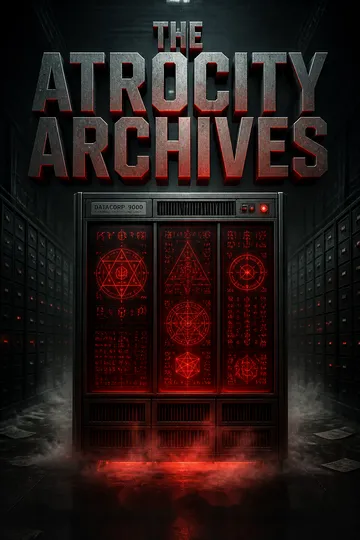
The Atrocity Archives by Charles Stross receives mixed reviews (3.89/5). Readers praise its inventive blend of Lovecraftian horror, spy fiction, and bureaucratic satire featuring Bob Howard, a computer programmer-turned-supernatural agent. Many enjoy the dry British humor and unique premise combining mathematics with magic. However, critics frequently cite excessive technobabble, info-dumps, and computer jargon as barriers to enjoyment. Some find the protagonist unlikable and the pacing uneven. The book particularly appeals to technically-minded readers familiar with Lovecraft and computer science, though others struggle with its specialized references and dense explanations.
People Also Read

Characters
Bob Howard
The reluctant occult hackerBob is a brilliant computer specialist whose curiosity repeatedly carries him past rules designed to keep people safe. He uses irreverence and technical jargon to deflect fear, but the deaths and injuries he witnesses leave him unable to treat danger as an abstract puzzle. His moral instinct is personal: he helps people in immediate need even when procedure says to withdraw. That instinct makes him effective and troublesome in equal measure. Bob's work at the Laundry forces him to connect mathematics, magic, and violence, while his relationship with Mo tests whether he can build intimacy without pretending that secrecy and risk have disappeared.
Dominique O'Brien
The probability philosopherDominique, whom Bob calls Mo, is a British philosopher whose research explores how beliefs can be assessed when ordinary evidence is absent. She is intellectually fearless, perceptive about institutional self-interest, and impatient with being treated as a passive asset. Her academic experience has taught her to navigate professional politics, but it has not made her comfortable with the secrecy that surrounds her work. Mo and Bob connect through a shared capacity to think across disciplines and a mutual distrust of sanitized explanations. Her clarity under pressure makes her an active interpreter of the danger around them, not merely its object.
Angleton
The keeper of secretsAngleton is a senior Laundry intelligence officer whose austere manner conceals an exact understanding of institutional power. He values results, secrecy, and control, and he distrusts Bob's habit of treating classified boundaries as invitations. Yet he recognizes Bob's unusual technical range and repeatedly gives him work that demands independent judgment. Angleton understands that bureaucratic structures can be weapons, shields, or traps depending on who knows how to read them. His relationship with Bob is both supervisory and adversarial: he protects the organization, but he also knows when official procedure must bend to preserve it.
Josephine Sullivan
The relentless local detectiveJosephine is a detective inspector whose ordinary criminal workload gives her little patience for unexplained interference. She follows physical evidence, asks direct questions, and resists being managed by people who refuse to explain their authority. Her police instincts remain valuable even when the case involves occult weapons and entities beyond her training. Josephine's skepticism is not closed-mindedness; it is a professional demand that extraordinary claims survive scrutiny. Her encounter with Bob forces her to reassess what counts as a plausible crime scene, while preserving her insistence on accountability.
Andy
Bob's operational supervisorAndy is Bob's immediate supervisor and a capable manager caught between field judgment and the Laundry's procedural machinery. He understands Bob's motives better than many of the agency's administrators and tries to guide him without pretending that every decision can be made safe. Andy's practical sympathy coexists with a deep commitment to the organization. He often translates between Bob's impulsive reasoning and the formal demands of command, making him an important source of both protection and pressure.
Alan Barnes
The soldier with a planAlan commands the military team assigned to occult emergencies. He is disciplined, dryly humorous, and attentive to the difference between specialist expertise and battlefield experience. He does not romanticize danger and expects Bob to follow orders when soldiers' lives depend on it. Alan's leadership rests on clear priorities, contingency planning, and a willingness to accept personal risk. His sternness gives Bob a practical model of responsibility that differs from the Laundry's paperwork-driven version.
Harriet
The procedural gatekeeperHarriet manages training and administrative matters, and she measures work through schedules, approvals, and documented compliance. Her clashes with Bob arise partly from genuine accountability demands and partly from the pleasure she takes in enforcing them. She represents the Laundry's ordinary bureaucratic face, where a missed phone call can matter as much as a hazardous operation. Her insistence on formal authority makes her a formidable obstacle whenever operational secrets collide with departmental routine.
Bridget Brody
The ambitious department headBridget is a senior manager focused on influence, reputation, and advancement within the Laundry. She speaks in the language of performance reviews and accountability, using institutional procedure to position herself above less powerful colleagues. Her polished manner makes her political instincts easy to underestimate. Bridget embodies a form of ambition that thrives in organizations where outsiders cannot inspect the evidence and success can be defined by whoever controls the report.
Fred Ironsides
The misplaced traineeFred is an accounting clerk who is sent to an occult-computing course by administrative mistake. He is socially oblivious, confident in his own practical concerns, and unable to recognize the danger of the technical exercise around him. His ordinary workplace habits collide fatally with rules he does not know exist. Fred's presence makes the Laundry's abstract risks painfully human: catastrophe can begin not with malice, but with a confused employee reaching for the wrong thing.
Malcolm Denver
The theorem's discovererMalcolm Denver is a mathematician whose independent work recreates a result the Laundry has spent decades suppressing. He is gifted, absorbed in pure theory, and initially unaware of the practical danger embedded in his proof. His case shows how intellectual discovery can make a person strategically important before he understands why. Bob sees the possibility of recruitment where the agency's first instinct might be coercion.
Mhari
Bob's unsettled former partnerMhari is Bob's volatile on-and-off partner, whose returns offer him familiar intimacy mixed with hurt and uncertainty. She wants closeness without consistently offering the commitment Bob hopes for, and their mismatched expectations turn private affection into recurring conflict. Bob's attachment to her reveals his tendency to mistake emotional endurance for a workable relationship. Their connection is a grounded counterpoint to the extraordinary dangers surrounding his work.
Pinky
The unruly housematePinky is one of Bob's Laundry-cleared housemates, a flamboyant and sociable man whose experiments and nightlife make their home feel one mishap away from disaster. He is more emotionally perceptive than his eccentricity first suggests, and he sometimes offers Bob useful, if unconventional, perspective on relationships. His partnership with Brains gives the household a durable domestic rhythm amid its hazardous hobbies.
Brains
The experimental housemateBrains is Pinky's partner and a brilliant, obsessive experimentalist who approaches both engineering and domestic life as problems to be solved. His basement projects routinely blur the line between scientific curiosity and occult hazard. Despite his self-absorption, he can recognize when Bob is emotionally shaken and tries to care for him in his own eccentric manner. His presence shows how Laundry employees build private routines around knowledge that would terrify most people.
Boris
Angleton's guarded aideBoris is a terse, imposing Laundry operative who works close to Angleton and rarely explains more than necessary. He values discretion and institutional discipline, and his silence can make even routine meetings feel like interrogations. Though he is not emotionally demonstrative, his place in the agency makes him a reliable link between operational staff and its hidden power structures.
Dr. Vohlman
The occult instructorDr. Vohlman teaches the technical foundations of summoning and containment. He is exacting about procedure because minor errors in his field can have lethal consequences. His formal demonstrations give trainees a controlled view of powers that are anything but safe.
Mark McLuhan
The Q Division specialistMark McLuhan is a technical specialist associated with the development and oversight of occult security systems. His professional position connects research laboratories with the wider bureaucratic machinery of the Laundry. He represents the risks of giving powerful tools to people whose institutional motives may be difficult to distinguish from their technical work.
Nick the Beard
The standards inspectorNick works in communications security and visits the Laundry to inspect its software and technical practices. He is a conscientious bureaucrat with genuine expertise, though his visits force Bob to disguise the agency's unconventional systems. His presence turns compliance into a comic contest between approved standards and the dangerous reality the Laundry must manage.
Plot Devices
The Turing theorem
Mathematics opens the supernaturalThe theorem allows certain computational problems to be solved with impossible speed and lets carefully designed mathematical patterns reach beyond ordinary spacetime. The Laundry suppresses rediscoveries because the same work that defeats encryption can generate gateways to other universes. It binds Bob's life as a computer specialist to the agency's occult mission, making programming both a practical skill and a form of dangerous ritual. The theorem also gives the book a materialist version of magic: precise structures, not faith or incantation alone, produce supernatural effects.
The Laundry
Bureaucracy contains cosmic threatsThe Laundry is a secret British government agency descended from wartime intelligence work. It suppresses dangerous discoveries, trains specialists, deploys field teams, and hides operations behind classified law and ordinary administrative routines. Its paperwork is not mere decoration: access, budgets, clearances, and reporting lines determine who can act and who can know why. The agency provides Bob's workplace and the book's central institutional conflict, since its defensive mission is constantly complicated by ambition, turf wars, and the need to conceal its methods from the public.
Geometry gates
Ritual maps connect universesOccult diagrams function as engineered routes through a multiverse. Small gates can pass information or entities; larger ones require far more energy and can admit physical matter. Human observers, circuits, and carefully specified geometries help create or constrain the connection. The Ahnenerbe's diagrams and the later rituals built from them turn mathematical notation into a map with lethal consequences. These gates make distance and reality unstable, allowing a London hallway, a museum archive, and a dead universe to become parts of one causal chain.
Hands of Glory and basilisks
Occult tools alter visibility and matterA Hand of Glory disrupts an observer's ability to perceive its holder, while a basilisk device uses an observation-mediated effect to transform carbon in its target into silicon. Bob learns to use these devices as practical equipment rather than folklore: one helps people evade possessed watchers, and the other can destroy a hostile body or disrupt a nuclear weapon's explosive arrangement. Their functions are established before their most consequential use, tying survival to Bob's ability to understand the mechanism rather than simply trust the legend.
SCORPION STARE
Surveillance cameras become weaponsSCORPION STARE is software that can turn networked cameras into a distributed basilisk system. A camera's gaze becomes a line-of-sight weapon, making ordinary security infrastructure capable of killing people or animals with exposed carbon-rich bodies. The system is developed as a defense against future incursions, but its reach and vulnerability to unauthorized access make it dangerous in civilian settings. Its use in Milton Keynes exposes the threat, while its later repurposing shows how the same infrastructure can protect or endanger people depending on who controls it.
Laundry Files Series
About the Author
Other books by Charles Stross

Download PDF
Download EPUB
.epub digital book format is ideal for reading ebooks on phones, tablets, and e-readers.








