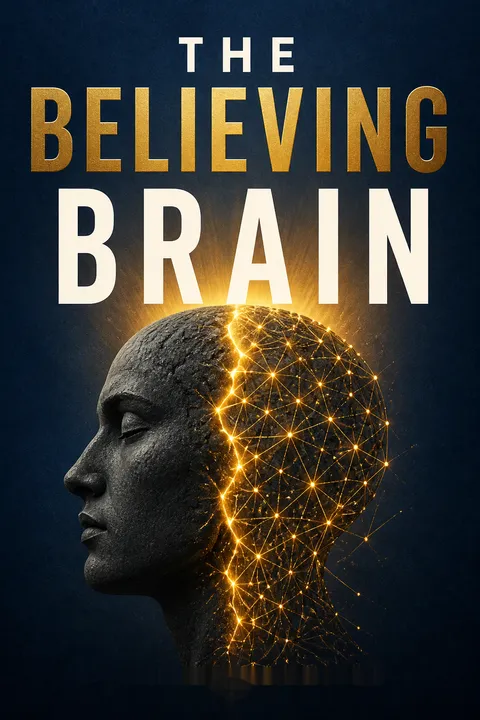


Key Takeaways
Audit where a belief came from before admiring how well it argues
Belief has a biography. Shermer’s friend Chick D’Arpino heard a voice during a painful divorce and concluded that a loving source beyond the world had contacted him. Francis Collins, a leading geneticist, moved from atheism toward Christianity after confronting suffering among patients, reading C. S. Lewis, and having a powerful experience in the mountains. Shermer himself moved from evangelical Christianity toward skepticism through new social surroundings, scientific study, and personal loss.
Reasons can arrive later. Shermer calls this belief-dependent realism: people’s understanding of reality is shaped by beliefs formed through personal experience, emotion, family, and culture. Reasoning then often helps explain and defend those beliefs. This does not mean every belief is false, or that evidence is irrelevant. It means a persuasive argument should prompt a second question: did the evidence create the conviction, or was it recruited to support one already held?
The idea is most useful as a check on self-confidence, not as a universal law that people never reason their way into beliefs. Personal origins can explain why a claim feels compelling without settling whether it is true. That distinction guards against two opposite errors: treating conviction as proof, and dismissing a claim solely because its believer has emotional reasons. The three life stories also show that similar experiences can support incompatible interpretations. Examining the path to a conclusion is therefore a reason to scrutinize evidence, not a shortcut for judging it.
Assume a rustle may be a predator, but verify before building a worldview
False alarms can protect. Patternicity is the tendency to find meaningful patterns in both meaningful and meaningless information. Shermer illustrates its evolutionary logic with a hominid hearing movement in grass. Mistaking wind for a predator costs time; mistaking a predator for wind could cost a life. When a missed danger is costlier than a needless alarm, selection can favor quick pattern detection, even if some patterns are imaginary.
Accidental rewards teach. B. F. Skinner found that pigeons given food at unpredictable intervals repeated whatever movement they happened to make before the food arrived. Some spun or hopped as if their ritual caused the reward. People can do much the same around slot machines, where wins and losses invite invented rules. The instinct to connect events is useful for learning, but it cannot by itself distinguish cause from coincidence.
This account makes superstition understandable without making every superstition harmless. A mental shortcut can be well suited to urgent danger and poorly suited to slow judgments about medicine, markets, or public events. The key question is not whether pattern detection is rational in the abstract, but whether its error costs fit the situation. A false alarm in tall grass may be cheap; a false causal belief can become costly when it guides treatment or policy. Good judgment keeps the detector, then asks for a test.
Separate the feeling of an agent from evidence that one exists
Meaning gets a face. Agenticity is the tendency to interpret a pattern as the work of an intentional being. A rustle can seem not merely dangerous but caused by something that intends to act. This helps people navigate a social world, yet it also makes unseen agents feel plausible, from ghosts and gods to aliens and conspirators.
Brains supply companions. Shermer describes the sensed-presence effect, in which people under severe strain or isolation feel that someone is nearby. Climbers, explorers, and exhausted endurance cyclists have reported helpful or frightening companions. Sleep paralysis can bring a sensed presence as well as floating or paralysis; the surrounding culture may name it a demon, spirit, or alien. The force of such an experience is real to the person, but its intensity alone does not establish an external visitor.
The distinction between experience and interpretation is crucial. A person can be sincere, frightened, and deeply changed by an encounter without having correctly identified its cause. That approach respects the experiencer while keeping the claim open to testing. It also explains why similar bodily sensations can acquire different supernatural explanations in different settings. The caution is that a plausible brain-based account is not, by itself, proof that every particular report has been explained. A good investigation compares the proposed explanation with the details and evidence of the case.
Explain why people believe without mistaking explanation for disproof
Belief is widespread. The book reports that, around 2009, roughly 84 percent of the world’s population belonged to an organized religion. Shermer argues that people readily imagine minds apart from bodies, and that culture supplies the particular deity, afterlife, or spiritual story. Twin studies discussed in the book suggest that genetic differences account for about 40 percent of variation in measured religious attitudes. That finding concerns tendencies, not a gene for Christianity, Hinduism, or any other specific faith.
Origin is not verdict. Shermer treats belief in an afterlife as an extension of our intuitive sense of self: people can picture their minds and identities continuing without their bodies. He argues that memories and personality depend on the brain, so their destruction challenges the idea of an enduring personal soul. Still, explaining how a belief arises does not, on its own, prove or disprove what that belief describes.
This separation is an important safeguard against a common reasoning mistake: explaining the source of a belief is not the same as evaluating its truth. A religious belief may be culturally transmitted, emotionally sustaining, or cognitively intuitive, yet its factual claims still require evidence. Conversely, showing that a brain process contributes to spiritual experience does not logically settle every metaphysical question. The book is strongest when it distinguishes these questions. Its heritability figures should also be read as population-level estimates, not as predictions about any individual’s faith or destiny.
Watch labels and expectations turn ambiguous evidence into confirmation
A label steers perception. In psychologist David Rosenhan’s 1973 study, eight people without a history of mental illness reported hearing a brief voice to gain admission to psychiatric hospitals. All were admitted, and staff interpreted ordinary actions through the diagnosis they had received. One patient’s writing was treated as evidence of pathology. In a second phase, a hospital warned staff to expect impostors, although none had been sent; staff identified 41 patients as fakes and suspected another 42.
Expectations filter facts. Shermer connects this to belief confirmation, the tendency to notice evidence that supports an existing view and discount evidence that challenges it. Once a label or explanation is in place, ambiguous behavior can be made to fit. The study is a striking demonstration of how context shapes interpretation, not a license to conclude that all psychiatric diagnosis is unreliable.
The study’s lasting value lies in its question: what evidence would make an observer revise a diagnosis rather than reinterpret every new fact to preserve it? That question applies to medicine, education, workplaces, and everyday judgments. Labels can organize information, but they can also become filters that hide alternative explanations. The sensible response is not to abandon expertise, but to make the reasoning behind a label visible, check it against later observations, and preserve room for correction. A vivid historical experiment illustrates a risk; it does not measure the frequency of that risk in every institution.
Intelligence can defend a belief better than it can choose one
Ability is not immunity. Shermer argues that intelligence alone does not reliably prevent paranormal or mistaken beliefs. People often acquire commitments through family, peers, temperament, and experience, then use reasoning to support them. The more intellectually capable person may be better at constructing a defense, rather than better at selecting the belief in the first place.
Expertise has boundaries. The book describes Nobel Prize-winning geneticist Kary Mullis, whose work on the polymerase chain reaction transformed biology, but who also endorsed claims Shermer considered unsupported. Alfred Russel Wallace, co-discoverer of natural selection, likewise accepted spiritualism and other ideas his peers rejected. These examples do not show that expertise is useless. They show that brilliance in one domain does not automatically supply reliable judgment in every other domain.
The distinction between generating arguments and calibrating confidence is valuable. A polished explanation can be evidence of verbal skill, not evidence that the underlying claim survived serious tests. At the same time, a few striking examples cannot establish how often expertise leads to poor judgment; they serve better as reminders than as statistics. The practical lesson is domain-specific humility: ask whether a person’s competence matches the claim, and whether the reasoning can be checked independently. Credentials deserve attention, but they should not replace examination of the evidence.
Count the misses and the denominator before calling coincidence a signal
Small odds mislead. Folk numeracy is the tendency to misread probability, favor memorable anecdotes, and overlook the many chances an event had to occur. A friend calling just as someone thinks of them feels extraordinary if considered alone. Across millions of people making calls and thinking about friends, some overlaps are inevitable.
Selection changes the question. Leonard Mlodinow’s example in the book concerns a fund manager who beat a market index for 15 straight years. The chance for one manager chosen in advance is low. But there were thousands of managers, and the book reports about a 75 percent chance that at least one would achieve such a streak over the period examined. Before accepting a premonition or miracle as evidence, record predictions in advance and count the misses as well as the hits.
This is a compact lesson in selection effects: an event that seems astonishing after it is selected from a vast pool may be ordinary at the level of the pool. The proposed habit of recording predictions before outcomes arrive also limits the temptation to reshape a vague memory into a precise forecast. Numerical examples need their assumptions stated, since a probability changes with the size and definition of the comparison group. The general discipline remains sound: specify the claim, identify how many opportunities existed, and include failures in the tally.
Test conspiracies against human limits, not just suspicious details
Real conspiracies happen. Watergate and the secret plot by al-Qaeda members to attack the United States were conspiracies. A theory about a conspiracy, however, needs more than an odd detail. Shermer recommends asking whether the supposed agents have implausibly great power, whether the plan requires many people to stay silent, and whether simpler explanations fit the evidence.
Plans unravel. The 1914 assassination of Archduke Franz Ferdinand was organized by a secret Serbian group, yet the operation was chaotic. Some assassins failed to act, a grenade missed its target, and the archduke later encountered Gavrilo Princip by chance after the motorcade took a changed route. The real conspiracy succeeded through a mixture of planning, mistakes, and contingency, not perfect control. Separate observed facts from speculation, then compare the whole account with competing explanations.
The book’s emphasis on coordination costs is a useful antidote to stories that treat powerful groups as nearly omniscient. But complexity alone cannot disprove a conspiracy; real plots can involve many people and institutions. The stronger test is cumulative: what evidence supports each link, what evidence would count against the theory, and does the account explain more than its rivals? Suspicion can be justified, especially where secrecy is documented. The discipline is to keep suspicion proportional to evidence instead of letting every gap become proof of the preferred story.
Read political conflict as competing moral priorities, not defective minds
Values cluster. Jonathan Haidt’s research, summarized by Shermer, compares five moral foundations: harm and care, fairness and reciprocity, in-group loyalty, respect for authority, and purity or sanctity. In surveys of more than 118,000 people across over a dozen countries, liberals tended to emphasize care and fairness more, while conservatives tended to give greater weight to loyalty, authority, and purity. The pattern describes broad tendencies, not a rule for every voter.
Different fears, different policies. One side may worry most about neglecting vulnerable individuals; another may worry most about weakening institutions that hold a group together. Shermer argues that calling one side mentally defective replaces understanding with caricature. Moral foundations can help explain why people who hear the same facts favor different policies, but they do not determine which policy is best.
This framework shifts debate from diagnosing opponents to identifying which harms and obligations they prioritize. That can make disagreement more intelligible without requiring agreement. It also cautions against treating political labels as complete descriptions of a person: the five foundations are a map of tendencies, not a test of character or a substitute for policy analysis. A further question is whose interests a moral appeal serves, and what consequences follow in practice. Understanding a value explains its appeal; it does not settle whether a political choice is fair, effective, or justified.
Make theories earn belief through converging evidence and public correction
Observation needs a model. Galileo’s telescope revealed moons orbiting Jupiter and blemishes on the sun, challenging the belief that Earth was the center and the heavens perfect. Yet Galileo also misread Saturn’s changing appearance because his data and theory were limited. The episode shows that seeing is not separate from interpreting.
Independent lines matter. In 1923, Edwin Hubble identified a Cepheid variable star in Andromeda. Its brightness helped show that the nebula lay beyond the Milky Way, supporting the view that it was another galaxy. Other astronomers revised their positions as the evidence accumulated. Shermer presents science as a fallible but powerful method: test claims against observations, compare independent evidence, and keep conclusions open to revision rather than treating uncertainty as permission to believe anything.
The historical cases make a more realistic picture of science than the myth of a clean sequence from observation to certainty. Data require interpretation, and even careful observers can misread them when the available model is weak. Reliability comes from exposing interpretations to evidence that others can inspect and challenge. The method is not a guarantee that each conclusion is correct, nor does every mystery have a settled answer. Its advantage is procedural: it makes error discoverable and gives communities ways to correct claims without relying solely on an individual’s confidence.
Analysis
The book’s organizing claim is that belief is not a neutral report issued after the mind has finished weighing evidence. Human beings detect patterns, infer agents, absorb social commitments, and then interpret new information through those commitments. Shermer makes this argument memorable by moving from intimate belief journeys to neural processes, paranormal claims, politics, and the history of astronomy. Chick D’Arpino’s voice, Francis Collins’s conversion, and Shermer’s own deconversion show how different experiences can become coherent but incompatible accounts of reality. The historical cases then supply a counterweight: beliefs can change when evidence accumulates and competing explanations are tested.
The strongest contribution is not that people are irrational, but that reasoning is socially and emotionally situated. That insight encourages scrutiny of one’s own certainty without collapsing into relativism. The distinction between explaining a belief and testing its object is especially important: a belief’s psychological origin does not decide whether its claim is true.
Some of Shermer’s broad formulations need restraint. The claim that belief typically precedes reasons is a useful pattern, not a complete description of every act of inquiry. His evolutionary account of pattern detection can explain why false alarms persist, but adaptive stories should not be mistaken for proof of a specific historical pathway. Likewise, his examples of brilliant people holding dubious beliefs expose the limits of expertise, but do not quantify how common the problem is. The political discussion also mixes a general account of moral differences with Shermer’s own libertarian preferences, so readers should distinguish the descriptive framework from his policy conclusions.
The book’s deepest practical lesson is methodological: conviction is not a measure of accuracy. Use base rates, seek disconfirming evidence, distinguish a direct observation from an inferred cause, and prefer claims supported by independent lines of evidence. Science is not an escape from human bias. It is a collective set of practices for making bias visible and correction possible.
Review Summary
The Believing Brain receives mixed reviews, with many praising its exploration of belief formation and cognitive biases. Readers appreciate Shermer's scientific approach and engaging writing style. Some find the book informative and thought-provoking, while others criticize its repetitiveness and perceived bias. The book's discussions on religion, politics, and conspiracy theories generate diverse reactions. Many readers value the insights into how our brains form and reinforce beliefs, though some feel Shermer's arguments are too dismissive of opposing viewpoints. Overall, the book is considered a worthwhile read for those interested in skepticism and cognitive science.
People Also Read










Glossary
belief-dependent realism
Belief-shaped understanding of realityThe view that reality exists independently of people, while each person’s understanding of it depends partly on beliefs already held. Shermer argues that these beliefs arise from personal, emotional, social, and cultural conditions, then shape how new evidence is interpreted. The concept does not mean all accounts of reality are equally accurate.
patternicity
Finding meaningful patternsShermer’s term for the tendency to detect meaningful patterns in both meaningful and meaningless information. The tendency supports learning by helping organisms connect events that predict danger or reward. It can also produce false associations, such as treating an accidental sequence of actions and rewards as a reliable cause-and-effect relationship.
agenticity
Inferring intentional agentsShermer’s term for the tendency to interpret patterns as the products of beings or forces with intention and agency. It can lead people to perceive invisible agents behind events, including spirits, gods, aliens, or conspirators. The concept describes a way of interpreting experience, not proof that any particular agent exists or does not exist.
belief confirmation
Reinforcing existing beliefsShermer’s broad name for the cognitive processes that strengthen beliefs after they form. People may notice supporting evidence, discount contradictions, reinterpret ambiguous information, and feel increased confidence when a belief is reinforced. Confirmation bias is one central process within this wider pattern.
folk numeracy
Intuitive errors about probabilityShermer’s term for ordinary difficulties in judging probability and frequency. People often reason from vivid anecdotes, short runs, or memorable coincidences rather than considering the full number of opportunities and outcomes. This can make chance events look extraordinary and can obscure longer-term patterns.
Middle Land
Human-scale world of perceptionShermer’s name for the range of sizes, speeds, and time spans that human senses and everyday intuition handle most readily. People function between scales that are too tiny or immense, too slow or fast, and too brief or long to perceive directly. This perceptual range shapes intuitive judgments about randomness, change, and probability.
null hypothesis
Claim unaccepted until testedShermer uses the term broadly for the starting position that a proposed claim has not been established as true. Evidence must be strong enough to justify rejecting that position. In formal statistics, a null hypothesis has a more specific technical meaning, so Shermer’s general usage should not be confused with every statistical application.
convergence of evidence
Independent evidence pointing togetherA method for evaluating claims that cannot be settled by one simple laboratory experiment. Researchers compare distinct sources of evidence and ask whether they support the same explanation. The approach is used in historical and inferential sciences, such as reconstructing the past of the universe, Earth, or human societies.
Realistic Vision
Politics grounded in human limitsShermer’s proposed view of human nature as partly constrained by biology, inheritance, and evolved social tendencies. It rejects the idea that people can be remade without limit by policy, while recognizing that institutions and moral education can shape behavior. Shermer uses it to argue for social arrangements that account for both cooperation and self-interest.
FAQ
What's The Believing Brain about?
- Exploration of belief systems: Michael Shermer's book investigates how beliefs are formed, reinforced, and sometimes changed, drawing on his extensive research.
- Cognitive processes: It introduces concepts like "patternicity" and "agenticity," explaining why people believe in the supernatural and paranormal.
- Science vs. belief: The book highlights the complexity of human cognition, showing how beliefs often contradict scientific understanding despite living in the Age of Science.
Why should I read The Believing Brain?
- Understanding human behavior: The book provides insights into why people believe in conspiracies, aliens, and the afterlife, helping readers understand their own and others' beliefs.
- Combines science and philosophy: Shermer blends scientific research with philosophical inquiry, making it accessible for both skeptics and believers.
- Practical implications: It offers tools to navigate discussions about belief, skepticism, and truth in a world filled with misinformation.
What are the key takeaways of The Believing Brain?
- Beliefs are emotional: Shermer emphasizes that beliefs often arise from emotional needs rather than rational thought, a process he terms "belief-dependent realism."
- Patternicity and agenticity: Humans have evolved to find patterns and attribute agency, leading to beliefs in supernatural forces.
- Science as a tool: Shermer advocates for the scientific method as the best means to discern truth, mitigating cognitive biases that lead to false beliefs.
What are the best quotes from The Believing Brain and what do they mean?
- “The brain is a belief engine.”: This quote encapsulates the idea that our brains are wired to form beliefs based on patterns and experiences, often regardless of evidence.
- “Beliefs come first, explanations for beliefs follow.”: It highlights that emotional and psychological factors drive belief formation, with rational justifications constructed afterward.
- “We live in the Age of Science, in which beliefs are supposed to be grounded in rock-solid evidence.”: Shermer points out the contradiction between the scientific age and the persistence of unfounded beliefs.
What is patternicity as defined in The Believing Brain?
- Finding meaningful patterns: Patternicity is the tendency to find meaningful patterns in both meaningful and meaningless data, crucial for survival.
- Type I and Type II errors: Humans often err on the side of caution, assuming patterns are real (Type I error) rather than missing a real threat (Type II error).
- Evolutionary advantage: This cognitive trait has been favored by natural selection, as identifying patterns increased survival and reproduction chances.
How does Shermer explain agenticity in The Believing Brain?
- Infusing patterns with intention: Agenticity is the tendency to attribute intention and agency to patterns, leading to beliefs in supernatural agents.
- Cultural implications: This bias has led to various belief systems, including religion and conspiracy theories, as people seek to explain experiences.
- Neuroscientific basis: Shermer discusses how the brain's wiring predisposes us to see agency, influencing beliefs and perceptions.
How does The Believing Brain address the problem of evil?
- Philosophical inquiry: Shermer questions the nature of belief in an all-knowing, all-powerful deity in a world with evil.
- Personal experiences: He shares his experiences with loss and suffering, shaping his skepticism about a benevolent deity.
- Cognitive dissonance: The book explores how believers reconcile evil with faith, often leading to complex justifications.
How does Shermer differentiate between belief and knowledge in The Believing Brain?
- Belief-dependent realism: Shermer argues that beliefs are often formed based on emotional needs rather than empirical evidence.
- Role of science: He emphasizes science as the best method for discerning truth, relying on evidence and critical thinking.
- Cognitive biases: The book discusses how biases distort reality, making it essential to differentiate between belief and knowledge.
What role does dopamine play in belief formation according to The Believing Brain?
- Belief reinforcement: Dopamine is linked to the brain's reward system, reinforcing behaviors and beliefs leading to positive outcomes.
- Signal-to-noise ratio: It enhances the brain's ability to detect meaningful patterns amidst noise, leading to both accurate and inaccurate beliefs.
- Connection to creativity and madness: High dopamine levels can foster creativity but also lead to psychosis, illustrating the fine line in pattern recognition.
How does Shermer connect belief systems to politics in The Believing Brain?
- Political beliefs as extensions: Shermer argues that political ideologies are rooted in psychological needs and cognitive biases, similar to religious beliefs.
- Polarization and tribalism: Belief systems contribute to political polarization, with individuals aligning with groups reinforcing their beliefs.
- Need for critical engagement: Shermer emphasizes critical thinking and skepticism in political discourse to bridge divides.
What is the significance of the sensed-presence effect in The Believing Brain?
- Psychological phenomenon: The sensed-presence effect occurs when individuals feel another being's presence, often in extreme conditions, linked to agenticity.
- Cultural interpretations: This effect can manifest as feelings of guardian angels, ghosts, or other entities, depending on cultural context.
- Neuroscientific explanations: The phenomenon can be explained by brain activity during stress or isolation, leading to the perception of an external presence.
What is the availability heuristic and how does it influence beliefs in The Believing Brain?
- Definition of availability heuristic: It's a cognitive bias where individuals judge event likelihood based on how easily examples come to mind.
- Impact on decision-making: It can lead to overestimating dramatic events' frequency due to vivid media coverage, resulting in irrational fears.
- Mitigating the heuristic: Shermer encourages seeking objective data and statistics to counteract this bias, leading to informed decisions.
About the Author

Download PDF
Download EPUB
.epub digital book format is ideal for reading ebooks on phones, tablets, and e-readers.








