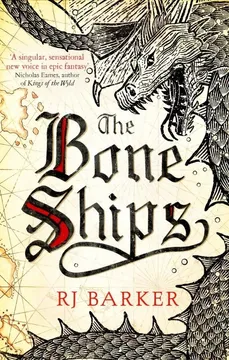


Plot Summary
Meas Names the Caller
In Bernshulme, Shipwife Meas Gilbryn is bound to a chair while a hagpriest tortures her for the secret of raising sea dragons. Meas insists she cannot summon the keyshans. The power belongs to Joron Twiner, her former deckkeeper, and the Gullaime aboard his ship, Tide Child.
Her captors refuse to believe her, and the priest claims Meas’s mother has not even asked after her. That possibility wounds Meas more deeply than the instruments do. She holds on to two opposing hopes: that Joron will find her, and that he will stay away before her enemies seize him too.
The opening makes captivity a contest over who controls the meaning of Meas’s identity. Her captors treat her as a useful vessel for supernatural power, while Meas insists that the power belongs to Joron and the Gullaime. Her resistance is not a denial of their danger but a refusal to accept the role imposed on her. The reported absence of her mother attacks a more intimate defense, her belief that blood ties still matter. Her hope for Joron is therefore double-edged: rescue may restore a relationship, but it may also expose him to the same machinery of coercion.
Windhearth Sees Black
At Windhearth, deckkeeper Vara Deere spots Tide Child entering the harbor without its usual lights. Joron Twiner, now the feared Black Pirate, leads the raid that destroys the defending ship and leaves the settlement in flames. He demands to know where Meas is being held, but Deere has no answer.
Joron offers her a place among his deckchilder; she refuses, choosing loyalty to the Hundred Isles even with a noose around her neck. His fleet takes captives and kills those who resist, making clear that the search for Meas has become a campaign of terror. Joron’s officers divide the black ships to strike other supply points while he heads for the Gaunt Islands to demand the attack on Bernshulme he believes will free her.
The raid gives Joron a recognizable objective, but his methods already threaten to corrupt it. He wants Meas back and believes weakening the Hundred Isles fleet will force an invasion of Bernshulme. Yet the people suffering at Windhearth have little connection to his private promise. Deere’s refusal punctures his self-image as a liberator: she sees a murderer, not a savior. His decision to press on rather than reconsider the campaign shows how grief can turn a moral goal into a justification for escalating harm.
A Deckkeeper Rejects Command
Joron’s fleet has grown, but command has not made him feel like Meas’s successor. He refuses the two-tail hat, believing his deckchilder will lose faith if he claims a rank he once swore to reject. He also refuses to summon a keyshan, because the Hundred Isles may kill Meas if they learn she cannot do it herself.
His restraint sits uneasily beside the destruction he orders. Meanwhile, the keyshan’s rot advances through his body and clouds Coxward’s mind with delusions. When the old bonemaster briefly recognizes Joron, Joron ends his suffering with a knife. The moment leaves him shaken, and a report of a ship on the horizon gives him no time to grieve.
Joron’s refusal of the two-tail is at once humility and a way to preserve the crew’s loyalty. He knows that rank is not merely a title aboard a boneship; it is an agreement about who may command whom. His restraint with the keyshans likewise protects Meas, but it also keeps his fleet exposed to ordinary violence. Coxward’s death sharpens the parallel between physical decay and moral responsibility. Joron can end one man’s suffering, yet he cannot control the larger consequences of his campaign. The call of a ship interrupts mourning, as command repeatedly does.
The Dead Keyshan's Prize
Joron catches sight of a dead keyshan floating in the sea, its body scored by enormous bite marks. The Hundred Isles ships that tried to lure Tide Child away now race toward the carcass, hoping to claim enough bone for new warships. The Gullaime warns that the corpse leaks a deadly poison, a danger confirmed by the dead fish and birds circling it.
Joron orders Tide Child away from the contaminated water and devises a way to turn the discovery against the enemy. He tells Chiver’s Last Light to flee as if seeking reinforcements, while Tide Child makes a brief show of fighting. If the Hundred Isles ships tow the corpse home, the poison may devastate their fleet and capital.
The corpse converts a coveted resource into a weapon without changing its physical nature. The enemy sees bone, the material that sustains its military system; the Gullaime sees a lethal danger the human crews cannot perceive. Joron’s response depends on accepting knowledge from a being his society has trained itself to dominate. Yet the plan is morally unstable. He hopes to use the corpse’s poison against Bernshulme, and he knows civilians may bear the cost. Strategic ingenuity here cannot be separated from the bodies it risks.
The Storm Takes a Ship
Tide Child trades bolts with two pursuing ships, and the broadside kills crew members while damaging the already weakened mainspine. Joron refuses to turn for revenge. Instead he throws cargo overboard, then builds a crude decoy to draw the pursuers off course. They catch up anyway. As a violent storm closes in, Joron strings barrels together to foul the larger ship’s rudder.
Aelerin reads the currents and helps place the trap. The larger enemy ship turns sharply when its steering fails, then capsizes in the waves, carrying hundreds of people to their deaths. Tide Child loses crew as well, and Joron salutes the ship he helped destroy before ordering his exhausted survivors onward.
Joron’s tactical restraint is an advance over the massacre at Windhearth, but it does not make his choices clean. He declines a satisfying counterattack because he is thinking in terms of the whole fleet, then deliberately uses the storm to magnify a trap that kills hundreds. His salute recognizes the skill and lives aboard the enemy vessel without pretending the result was avoidable. Aelerin’s practical knowledge also gains weight: survival depends not on prophecy alone but on careful observation. Joron’s command matures through such decisions, even as their human cost grows.
Ghosts at Spantonnis
The surviving pursuer stays on Tide Child’s wake, forcing Joron to shed stores and eventually even the ship’s gallowbows to gain speed. He races for Spantonnis Bank, a fogbound ice field feared for ghost ships and lost crews. Aelerin guides Tide Child into a channel between moving ice islands, and the crew pass silent ice dwellers who throw a spear but do not pursue.
In the fog, they find Keyshanpike, the pursuing ship, apparently abandoned and still stocked with supplies. Joron boards to investigate and recover what his fleet needs. Blood on the deck and the absence of boats make the ship’s stillness feel less like safety than a trap.
The ice passage tests the crew’s relation to fear. They have to distinguish superstition from physical danger without dismissing either, since the supposed ghost stories conceal real hazards. Joron’s decision to board Keyshanpike is not simply greed: his fleet is short of food and weapons, and the ship appears to offer a chance to repair that imbalance. Still, he moves into an unknown danger because need has narrowed his choices. The abandoned vessel becomes an image of how little command can guarantee, even when a ship seems intact.
The Toothreach Hunt
A toothreach erupts from the mist and snatches crew members before Joron can reach Tide Child. He gets the survivors to a gallowbow, but the creature’s partner attacks from the water and drags the ship under. When a tentacle catches the one-armed Gavith, Joron cuts through his arm to keep him and Solemn Muffaz from being hauled overboard.
The ship is close to breaking when a keyshan charges through the ice field and attacks the toothreaches. Its passage smashes Tide Child against an ice island, tears away spars, and kills more crew, including the bonemaster Colwulf. Joron uses the Gullaime’s wind to escape the fighting beasts, leaving the ship badly damaged but afloat.
Joron’s choice to sever Gavith’s arm is the novel’s harshest demonstration of command as immediate triage. He cannot save every part of the man, only prevent the whole body from being lost. The keyshan’s intervention is equally ambivalent: it rescues the survivors from one threat while nearly destroying their ship through sheer scale. This is not a creature enlisted in human service. Its power exposes the fantasy of control that both armies and prophecies encourage. Joron survives by acting decisively, then must live with the damage caused by the very force that saved him.
No Help from Sparehaven
Tide Child limps into the Gaunt Islands’ port of Sparehaven, where its damage makes the cost of Joron’s campaign visible. Tenbern Aileen refuses to attack Bernshulme directly. She fears its defenses and the plague already spreading through the city, but offers to fight if Joron can draw the Hundred Isles fleet out.
Joron’s fleet is nearly broke, and the Gaunt Islanders treat his displaced people as unwelcome guests. While walking with the Gullaime to a windspire, Joron is confronted by Deckkeeper Togir and her armed followers, who resent the refugees. He and Cwell fight them off. With Aileen unwilling to risk her fleet, Joron decides his only remaining path is to enter Bernshulme himself and find Meas.
Aileen’s refusal is not a simple betrayal. She weighs the survival of her own people against an operation that may fail, while Joron measures every decision against the promise he made to Meas. Their incompatible scales of obligation leave the refugees politically disposable. The ambush at Sparehaven reveals that the black fleet’s social refuge is precarious: shared enemies do not automatically create welcome. Joron’s victory over Togir proves that he can defend his people, but it does not solve their structural vulnerability. It instead pushes him toward a more personal, riskier intervention.
Cwell's Smuggler Road
Joron, Mevans, and Cwell travel toward Bernshulme aboard a leaking smuggler ship, with Joron disguised as Cwell’s rot-sick servant. They learn that the city’s harbor is closed because a dead keyshan, towed there by the Hundred Isles, has caused a plague that leaves whole districts abandoned. On the mountain above the town, Joron sees the corpse blocking the harbor and understands the scale of the devastation.
He enters the ragged market as a beggar while Mevans sells their belongings. Cwell discovers that her uncle, crime boss Mulvan Cahanny, has died in the plague. His lieutenant has no reason to help them, but Cwell finds Narza, Meas’s elusive protector, who agrees to guide them toward Indyl Karrad.
Joron’s disguise makes him experience the hierarchy he normally navigates from above. The people he once commanded now see a diseased beggar, and the town’s exclusions become bodily rather than theoretical. The dead keyshan has transformed his earlier tactic into a public catastrophe, forcing him to confront consequences that cannot be revised. Cahanny’s death removes the political route he expected, while Cwell’s survival skills open another. The plot’s narrowing options echo the city itself: once a dense center of power, Bernshulme is now partitioned by invisible lines of illness and fear.
The Bothy Changes Hands
Joron and his companions break into Indyl Karrad’s townhouse, where Karrad confirms Meas is in the Grand Bothy. Joron infiltrates the building through a water culvert and confronts Thirteenbern Gilbryn, who believes Meas died during the escape from Sleighthulme. Before they can make sense of the contradiction, Karrad arrives with armed guards and announces that he has seized Bernshulme.
He says he has Meas and wants Joron’s power to raise keyshans. Narza attacks him and is shot down. Cwell prevents Joron’s immediate execution by presenting herself as Cahanny’s heir and offering to deliver the city’s criminal network to Karrad. Joron and Meas’s mother are taken prisoner.
The coup exposes how political power survives by exploiting the assumptions of others. Karrad uses the Thirteenbern’s trust in her own institutions and prejudices to isolate her, then converts Joron’s supposed supernatural power into a claim to rule. Narza’s death strips away the fantasy that loyalty alone can protect Meas. Cwell’s apparent turn toward Karrad is more strategic than sentimental: she negotiates from the only asset the new ruler needs. In this world, survival often requires appearing to serve power long enough to alter the terms of exchange.
Mevans Pays the Price
Karrad offers Joron a place in his new regime, but Joron demands Meas’s freedom and a home for their people. Gueste tests his obedience by binding Mevans and ordering Joron to kill his trusted hatkeep. Mevans urges him to do it, and Joron drives the sword through his friend’s heart. Gueste then sends him to the cell where Meas is held.
Meas is alive, badly tortured, and missing an eye. She reveals that she once fled a battle because she feared dying, and that under torture she gave up information about Joron. He tells her Karrad, not her mother, has held her. Their reunion brings grief and relief together, while both recognize the damage they have done in each other’s names.
Mevans’s death turns Joron’s promise to rescue Meas into an unbearable moral test. He complies because he believes refusing would destroy the only chance to reach her, but the act cannot be cleansed by its strategic purpose. Meas’s confession complicates the heroic legend surrounding her: she has been courageous, but also afraid, and her survival has required betrayal. Their reunion matters because neither demands innocence from the other. They begin to replace idealized loyalty with an honest reckoning about what duty has cost.
The Egg Behind the Prophecy
Meas’s mother explains that windtalkers are female and windshorn are male, and that windshorn control them by stealing their eggs. Madorra’s hold over the Gullaime is therefore maternal, not mystical. The Thirteenbern agrees that Karrad will not release her, but gives Joron her blessing to save Meas.
Karrad wants the Caller and Gullaime in exchange for Meas and a settlement for the black fleet. Joron accepts the bargain to buy time, planning to send a secret message to his ships. On the journey to collect the Gullaime, Meas learns that Karrad has executed her mother. At the lamyard, she stops a hagpriest from whipping the chained windtalkers and strikes her down.
The egg revelation replaces an abstract prophecy with a concrete instrument of coercion. Madorra’s influence comes from control of a future generation, a form of leverage that the human characters initially failed to recognize because they treated the Gullaime as a tool rather than a parent. Meas’s intervention at the lamyard marks a change in her political imagination: she no longer sees the windtalkers’ suffering as an unfortunate cost of keeping ships moving. Her mother’s blessing offers emotional release, but the execution confirms that compassion cannot undo the institutions built around domination.
Wyrm Sither Turns
Karrad’s officers put Joron and Meas aboard Wyrm Sither with the Gullaime and a group of unchained windtalkers, while Barnt keeps Meas under guard. Joron returns to Tide Child under the pretense of persuading the Gullaime to cooperate. When a messenger reveals that keyshans are rising without him, Barnt decides Joron is no longer useful and threatens Meas.
Joron calls the Gullaime the Windseer; she removes her mask and unleashes a blast of wind that throws the ship into chaos. The enslaved windtalkers attack their guards. Meas defeats Barnt, Cwell kills him, and the Gullaime’s followers overwhelm the crew. The survivors seize Wyrm Sither and escape, then transfer back to Tide Child.
The uprising begins only when the Gullaime is recognized as an agent rather than a weapon. Joron’s public naming gives the windtalkers a shared focus, but their collective action is their own, not an extension of his command. Their violence is not sanitized: they kill quickly and brutally, as their captors have trained the world to expect from them. The reversal reveals the cost of denying political agency to a people. Once released from chains, they do not become harmless; they become capable of acting on their own history.
A Life Against the Law
Back aboard Tide Child, Joron discovers that Farys is pregnant by Gavith, a relationship forbidden by the Bernlaw because it could bring a child onto a warship. Meas holds a formal hearing. Farys accepts the prescribed death penalty and refuses to name Gavith, fearing the crew will treat her as unlucky if she lives.
Meas tries to replace execution with demotion and confinement, but Farys insists the law requires a sentence. Solemn Muffaz steps forward and falsely claims he forced Farys and fathered the child. Meas sentences him to die. He accepts the judgment and steps from the ship into the sea, saving Farys and the baby at the price of his own life.
The law presents itself as neutral discipline, yet its penalties fall unevenly on those whose bodies make the ship’s future visible. Farys is prepared to die because she has internalized the same rules Meas hopes to change. Solemn Muffaz exploits the law’s certainty by placing himself inside its machinery, turning a false confession into a protective act. His sacrifice is loving but not uncomplicated: it preserves the ship’s order while also exposing how little room the system leaves for a different resolution. Meas inherits the burden of changing a rule that her crew still believes necessary.
Madorra Loses the Egg
Meas addresses the crew and admits that returning to the old laws would betray the future she wants. She throws the deckmother’s punishment cord overboard and asks the crew to commit to a life beyond the Bernlaw. Then Joron confronts Madorra over the Gullaime’s injuries. Madorra holds Joron at clawpoint, but Gavith arrives carrying the stolen egg.
Without that leverage, Madorra cannot control the Gullaime. The windtalker attacks and kills him, ending his abuse and freeing herself to protect her child. The crew witnesses her choice and accepts her as an ally. Meas’s reform is no longer a promise alone; it has begun with a public rejection of punishment as the foundation of order.
Meas’s discarded cord is a material break with inherited authority, not merely a speech about better values. Yet reform does not erase the need for decisions or the possibility of force: Madorra dies when the Gullaime chooses to defend her egg. The difference lies in who is acting and why. The Gullaime is not disciplined into obedience; she exercises agency against a captor. Gavith’s role also matters. His damaged body does not make him useless; his observation and courage expose the hidden mechanism of control.
Gueste Falls at Parlay
Meas and Joron meet Karrad aboard Painful Loss, hoping to secure their fleet’s freedom and avoid another battle. Karrad refuses to surrender power or release them, arguing that he needs hiyl to hunt the rising keyshans. Meas offers him a route to peace, but he chooses control over reconciliation.
When Gueste attacks Joron, he takes her hostage and cuts her throat in revenge for Mevans. Meas and Joron retreat to their flukeboat under crossbow fire, while the Gullaime’s sudden wind blast drives it clear of the bolts. They return to Tide Child and escape. Joron’s vengeance gives the crew a measure of justice, but it closes off any remaining chance of negotiation with Karrad.
The parlay demonstrates that shared knowledge of injustice does not guarantee a shared future. Karrad understands the unfairness of the old order, yet treats power as the only reliable protection against it. Meas offers a political alternative, but he cannot accept a settlement in which he no longer controls the outcome. Joron’s killing of Gueste is both personal and public: it answers Mevans’s death, while also making reconciliation harder. The escape succeeds through the Gullaime’s action, another reminder that the people treated as instruments repeatedly determine whether human plans survive.
Brekir's Burning Signal
Joron and Meas reunite with their black fleet as Farys gives birth to a daughter named Muffaz. Meas abolishes the rule against children aboard their ships and sends Brekir ahead to bring the Gaunt Islands fleet. The black ships move north with the brownbones, hoping to reach Namwen’s Pass before Karrad catches them.
Brekir appears with the Gaunt fleet in sight, but instead turns Snarltooth against its leading ship and signals the betrayal. Her attack gives Meas warning, but Snarltooth is destroyed by the Gaunt Islanders. Meas abandons the planned passage and steers for Barcles Bight, where she hopes narrow waters and islands can offset the enemy’s numbers.
The birth of Muffaz makes Meas’s new rule tangible: the fleet can carry life instead of treating every child as a threat to discipline. That fragile hope is immediately tested by political betrayal. Brekir’s attack is not proof that she changed sides; it is a signal purchased with her ship and crew. The distinction matters because the novel repeatedly asks whether loyalty is measured by survival or by the choices made when survival is unlikely. Meas responds by changing course, turning geography into the only remaining defense against forces she cannot match in open water.
The Bight Eats Ships
With the Gaunt and Hundred Isles fleets closing, Meas sends her damaged ships toward Barcles Bight, keeping the brownbones protected behind them. Turrimore takes Bloodskeer into the Arakeesian Dread’s broadside and is destroyed. Adrantchi drives Beakwyrm’s Glee close enough to detonate the ship, damaging the Dread and stripping away much of its weaponry.
Their sacrifices buy the seconds Tide Child needs to reach Tunir’s Claw. Meas rams the enemy two-ribber, tearing into its stern and trapping both ships together. Joron’s crew fights off the boarders while others force the ships apart. Tide Child breaks free, battered and leaking, and follows its fleet into the islands as the pursuing armadas close behind.
The battle refuses the clean logic of victory: Bloodskeer is annihilated, Beakwyrm’s Glee becomes a bomb, and Tide Child survives only by accepting further damage. Meas’s fleet does not defeat the Dread in a conventional contest; it changes the conditions under which the larger ship can fight. The sacrifices are deliberate, but the novel does not make them glorious or painless. Joron’s response to the collision is physical and immediate, while Meas’s strategy depends on her crews trusting her enough to spend themselves. Their escape carries both the cost and the debt of that trust.
The Keyshans Open Sky
Tide Child can no longer outrun the pursuing fleets, and Meas orders Joron to summon the keyshans. He sings, joining the Gullaime and the other windtalkers and windshorn in a call that reaches across the sea. Keyshans burst from islands and deep water, then gather around the fleet as the Northstorm bears down.
The Gullaime reveals that the windspires are part of the sleeping creatures and that their awakening can open a passage through the storm. She can create the opening, but only by giving her life to hold it. Meas and Joron try to find another way, yet the enemy fleets are nearly upon them and the storm is closing. The crew prepares to abandon Tide Child.
The awakening of the keyshans transforms the scale of the story without making them obedient allies. They answer the song, but their movement is immense enough to threaten every ship nearby. The Gullaime’s revelation reframes the islands as living bodies and the storm as a boundary that can be opened, not conquered. Its price is not an abstract sacrifice: a friend and parent must die so that others can pass. Meas’s instinct to find another route expresses the ethical center of her leadership. Survival matters, but it cannot be purchased without recognizing whose life is being spent.
One Shipwife Remains
As the keyshans and the Gullaime hold open the storm’s passage, Meas orders Joron to flee with the others. He refuses, revealing that the rot is already killing him. Meas removes her two-tail and places it on his head, naming him shipwife and acknowledging the leader he has become.
He makes her leave with Cwell, Farys, baby Muffaz, Shorn, and the surviving fleet. Joron stays beside the gallowbow with Garriya and the dead he has carried in memory. He fires at the Gullaime, ending her life and closing the passage before the enemy can follow. As fire overtakes Tide Child, he joins the figures of his lost companions, and the pain finally ends.
Joron’s final choice completes the movement from reluctant subordinate to a leader willing to accept responsibility without confusing it with control. Meas cannot command him into safety, and he cannot save the Gullaime by refusing her decision. The transfer of the two-tail recognizes that authority has become a burden he can carry, not a status he must reject. His shot is simultaneously an act of mercy, a necessary end to the storm passage, and an intimate betrayal of a friend’s body. The return of the dead gives his ending emotional company, but it does not erase the lives his choices cost.
Epilogue
On a bright shore in the new land, Meyans brings her baby, Fras, and her twins, Jeron and Mees, in from the heat. Safe sea dragons move through the clear water outside, and her husband rests aboard a ship. The children ask how the world began, so Meyans tells them the story of the people who crossed the storm and the shipwife who returned to her crew.
She starts with the moment Meas first asked Joron for his hat. In this sheltered world, their dangerous passage has become family history, carried forward by children who know the sea as home rather than a sentence.
The epilogue answers the novel’s opening world of captivity and inherited punishment with an ordinary family scene. The children are not introduced through prophecy or command, but through curiosity, warmth, and the safety to ask questions. Meyans’s story turns Meas and Joron into ancestors, yet its beginning preserves their relationship in a small, personal gesture rather than reducing them to icons. The calm sea and unthreatened keyshans suggest that the passage succeeded in creating a different social possibility. The future does not erase the dead; it gives their choices a living audience and a reason to be remembered.
Analysis
The Bone Ships makes its world’s violence visible in the materials people accept as ordinary. The fleets are built from keyshan bones, their lights come from dead children, and their laws present coercion as the price of keeping a ship in order. Joron begins by believing he can use the same machinery to retrieve Meas and eventually reach peace. His campaign proves that good intentions do not exempt a commander from responsibility: the poisoned keyshan he helps send to Bernshulme kills people who never chose his war.
The novel’s strongest counterpoint to human command is the Gullaime. Humans interpret its service as obedience, while its songs, parenthood, and independent judgments reveal a society with its own needs. The stolen egg makes that conflict legible: Madorra’s authority rests on a form of control that the human characters recognize only after they have already reproduced it. When Meas throws away the punishment cord, she begins to change the ship not by abolishing responsibility but by refusing to equate discipline with cruelty.
Joron and Meas become leaders through different forms of self-correction. Joron must accept that his decisions have consequences beyond his intentions; Meas must accept that her legend cannot protect her from fear, injury, or error. Their relationship works because each can challenge the other without denying the bond that gives the challenge meaning. The Gullaime’s final sacrifice extends that ethic beyond human politics. She chooses to save friends, not because humans own her loyalty, but because she has made a relationship with them.
The ending refuses a clean victory. Joron’s death and the Gullaime’s loss are not repaid by a declaration that the old world has been fixed. Instead, the survivors pass into a place where new children can live with keyshans as neighbors and hear the past as a story. The epilogue suggests that peace is not the absence of memory. It is the inheritance of a world in which the next generation is not born already sentenced to serve its rulers.
Review Summary
The Bone Ships receives widespread praise for its inventive world-building, unique nautical terminology, and richly imagined setting. Many readers note a slow start requiring patience, with the story gaining momentum in the second half. Comparisons to Robin Hobb's Liveship Traders and Patrick O'Brian's work are frequent. Characters Joron Twiner, Lucky Meas, and the Gullaime are highlights, though some readers felt character development was sacrificed for world-building. Seafaring fans are most likely to connect deeply with this book.
People Also Read



Characters
Joron Twiner
Reluctant shipwifeJoron begins as a disgraced, one-legged deckkeeper who distrusts authority and expects little of himself. Meas’s example gives him a model of command built on listening as well as orders. He is practical, observant, and often more compassionate than he believes, but grief and fear can turn him toward ruthless choices. His damaged body and failing health sharpen his awareness that leadership means choosing among losses, not escaping them. Joron’s relationship with Meas is both hierarchical and intimate: she is the shipwife who gave him purpose, while he becomes the person able to challenge her when her judgment falters. His defining tension is between accepting responsibility and hiding behind the claim that he is only a deckkeeper.
Meas Gilbryn
The fleet's hard-won leaderMeas is a formidable shipwife whose discipline, daring, and political intelligence have made her a legend among the crews. As the Thirteenbern’s firstborn, she has also lived under the pressure of a society that treats birth, gender, rank, and obedience as matters of public control. Her authority is earned rather than effortless; she can act decisively, but she is capable of fear, error, and doubt. Joron is the deckkeeper she trusts to question her, even when the truth is painful. Meas’s deepest ambition is not conquest but a fairer peace, though the methods required to reach it repeatedly threaten to reproduce the cruelties she wants to end.
The Gullaime
Tide Child's windtalkerThe Gullaime is a powerful windtalker who speaks in clipped, playful phrases and treats human customs with open impatience. Her bright robes, collected objects, and unpredictable habits can make her seem comic, but she is a skilled officer and a careful judge of danger. She has an unusual bond with Joron, whom she regards as a friend rather than simply a commander. Her people have been blinded, controlled, and forced to serve human ships, so her mistrust is grounded in lived experience. She is also a parent, a fact humans initially overlook. Her loyalty is particular and chosen, not the automatic obedience the island powers expect from her.
Cwell
Joron's dangerous shadowCwell is a small, fierce fighter who serves as Joron’s shadow and protection. She is a capable knife fighter, a practiced infiltrator, and a realist who trusts ambition and money more readily than sentiment. Her hard exterior grew from surviving a world where the vulnerable are used by people with rank. She begins as an adversary to Joron, then becomes one of the few people he relies on without reservation. Cwell rarely offers comfort in soft language, but her actions repeatedly demonstrate care. Her family connection to Cahanny’s criminal network gives her political leverage, while her loyalty to Meas and Joron keeps that leverage from becoming the only thing that defines her.
Indyl Karrad
The ambitious KeptKarrad is a handsome, strategic member of the Kept who has spent his life planning for the moment powerful people might discard him. He understands the injustice of the Hundred Isles, especially the limits placed on men, but his response is to seize power rather than dismantle the structures that distribute it. His past with Meas and the Thirteenbern makes his ambitions personal as well as political. Karrad can be candid about his motives while remaining manipulative about his methods. He sees security as something one must possess absolutely, a conviction that makes compromise feel like surrender and turns his reasonable grievances into a justification for control.
Thirteenbern Gilbryn
Meas's formidable motherThe Thirteenbern rules the Hundred Isles from a position built on tradition, political calculation, and the visible cost of childbirth. She is formidable, but not omnipotent; the institutions she commands also constrain her, particularly when Meas is young. Her love for her daughter is tangled with decisions that helped shape Meas’s painful life, and she understands that affection does not undo injury. She is accustomed to being obeyed and has little patience for those who challenge her authority, yet she can recognize when an enemy’s argument is true. Her character exposes the gap between personal care and public responsibility: a ruler may love someone deeply and still participate in the system that harms them.
Brekir
Joron's steadfast fleet allyBrekir is an experienced shipwife with a mournful face, a steady judgment, and a long history of serving beside Meas. She often challenges Joron when loyalty threatens to become self-deception, and her advice helps him see the political and human cost of his choices. Brekir values practical survival but does not confuse caution with cowardice. Her friendship is expressed through frank counsel and dependable action rather than warmth alone.
Mevans
Tide Child's steady hatkeepMevans is Tide Child’s hatkeep, a practical steward whose knowledge of ships, supplies, and people keeps the vessel functioning. He is talkative, resourceful, and quietly brave, often easing Joron’s burdens by noticing what the commander has missed. His humor never makes him careless; he understands both the ship’s material needs and the morale that holds its crew together. Mevans treats Joron as a person as well as an officer, offering a form of friendship the rigid ship hierarchy rarely permits.
Farys
A capable deckholderFarys is a scarred deckholder whose competence and loyalty have grown through years of service aboard Tide Child. She is thoughtful under pressure and increasingly willing to take responsibility, though she still carries the uncertainty of someone who once had little authority. Her bond with Gavith develops within a culture that gives private relationships dangerous public consequences. Farys’s strength is not fearlessness but an ability to keep working while afraid, and her care for her crew persists even when the ship’s rules put her own future at risk.
Gavith
The one-armed bowsellGavith grows from a timid cabin boy into a skilled bowsell and dependable member of Tide Child’s crew. He is shy around officers but confident in the technical work he understands, especially aiming and rigging. His relationship with Farys gives him a private life in a culture that treats intimacy as a threat to the ship’s order. Injury and guilt challenge his sense of usefulness, but his attention to the people around him remains a strength.
Solemn Muffaz
Tide Child's stern deckmotherSolemn Muffaz is a massive, disciplined deckmother who keeps order aboard Tide Child and cares for Farys with a protective, almost parental regard. His own history of violence has left him conscious of the cost of breaking rules, but he believes the ship’s survival depends on discipline. He is not sentimental in manner, yet his loyalty to the crew runs deep. His choices reflect the painful overlap between personal affection and the harsh customs that govern life at sea.
Garriya
The fleet's hagshandGarriya is Tide Child’s healer, an old, sharp-eyed woman whose practical medical skill sits beside an unsettling knowledge of prophecy and the deep. She speaks in riddles and insults, but she often recognizes danger before the officers do. Her rough manner disguises a clear understanding of grief, illness, and the limits of command. Garriya’s counsel unsettles Joron because it asks him to face realities he would rather postpone.
Aelerin
Tide Child's careful courserAelerin is the courser responsible for reading charts, winds, and currents. Once quiet and self-effacing, they become a more confident adviser as Joron learns to value their careful observations. Their knowledge is precise but never absolute; they understand that weather and sea resist certainty. Aelerin’s relationship with Joron is built on mutual trust and an unusual freedom to question decisions. Their practical intelligence repeatedly turns limited information into a route through danger.
Madorra
The controlling windshornMadorra is a one-eyed windshorn who serves as guard and intermediary among the Gullaime. He is suspicious of humans and protective of the role he believes his people should play in their prophecy. His relationship with the Gullaime is shaped by hidden leverage and competing understandings of what their people need. Madorra’s devotion is real, but it is also controlling; he mistakes coercion for protection and treats the future as more important than individual consent.
Gueste
The ruthless hagpriestGueste is an officer and hagpriest whose polished manner conceals a taste for coercion. She believes duty excuses cruelty and sees the bodies of others as acceptable instruments of statecraft. Her conflict with Joron is personal, but she rarely admits to personal feeling; she presents harm as professional necessity. Gueste represents a system that turns violence into procedure and expects victims to call it order.
Narza
Meas's silent protectorNarza is Meas’s shadow, a taciturn and highly capable fighter who communicates through action more readily than speech. She navigates the hidden routes of Bernshulme and protects Meas with an intense, almost exclusive loyalty. Narza is difficult for Joron to read, but her priorities are clear: the shipwife’s safety comes before political alliances or personal comfort. Her guarded nature reflects a life in which trust must be earned slowly.
Barnt
The shipwife of Wyrm SitherBarnt is a polished Hundred Isles shipwife who treats rank and inherited privilege as natural measures of worth. He is confident in the authority of the fleet and dismissive of those he considers lowborn. His belief in honor is selective, strongest when it protects people like himself. Barnt’s manner makes him a clear contrast to the crews whose labor and sacrifice sustain the ships he commands.
Tassar
A loyal Thirteenbern officerTassar is a Kept officer who remains personally loyal to the Thirteenbern even as the political order around her shifts. He blames Joron for the damage done to Bernshulme, but he can still honor a promise made to his ruler. His discipline and resentment make him dangerous, while his sense of duty prevents him from becoming merely vindictive.
Coxward
Tide Child's ailing bonemasterCoxward is an experienced bonemaster whose knowledge of ships is valued by Joron. The keyshan’s rot eventually distorts his mind, leaving fragments of insight amid frightening delusions. His decline forces Joron to confront the disease’s human cost.
Coult
A hard-bitten shipwifeCoult commands Sharp Sither and is known for his viciousness in battle. Beneath the rough humor and metal tooth, he understands the importance of loyalty and shared purpose. He is willing to challenge Meas directly, but his respect for her leadership is genuine.
Adrantchi
A grieving shipwifeAdrantchi commands Beakwyrm’s Glee and was once famed for his humor. The loss of his deckkeeper has left him subdued and deeply affected by grief. He retains courage and a strong sense of fellowship, though the weight of loss makes him more willing to risk himself than he once might have been.
Turrimore
A scarred fighting shipwifeTurrimore commands Bloodskeer and carries herself with fierce impatience. She is blunt, combative, and willing to challenge authority, traits that can frustrate her allies but also make her a valuable voice in planning. Her respect is not easily won, and she judges leadership by whether it can withstand danger.
Black Orris
Tide Child's foul-mouthed birdBlack Orris is a corpsebird who perches on Joron and the ship’s officers, punctuating tense moments with rude calls. The bird offers the crew a small, familiar source of humor amid violence and uncertainty.
Plot Devices
Boneships and corpselights
A fleet built from deathThe Hundred Isles and Gaunt Islands sail on ships built from the bones of keyshans. The vessels’ size, speed, weapons, and need for repair shape nearly every decision Joron makes. Corpselights above the ships are made from the remains of children, turning the fleet’s beauty into a visible sign of the society’s cruelty. Ships function as homes, workplaces, military units, and political identities; a damaged hull threatens an entire community. The ships also give the story its language of command, from the deckkeeper’s duty to question a shipwife to the shipwife’s responsibility for every life aboard.
The Caller and keyshans
A song beyond commandJoron and the Gullaime can call or awaken keyshans through song, but they cannot reliably control what the creatures do. The power is tied to prophecy and to the Gullaime’s role as Windseer, which makes it valuable to political leaders and dangerous to everyone nearby. Joron initially withholds it to protect Meas, then must use it as the fleets close in. The keyshans are neither obedient weapons nor human allies; their immense movement reshapes islands, ships, and seas without regard for either fleet. The device tests the difference between calling a force and owning it.
Windspires and island eggs
A world asleep in stoneWindspires rise from islands and carry the song of the keyshans sleeping beneath them. Their presence is first treated as part of the archipelago’s strange geography, then understood as evidence that the islands shelter living creatures. The connection links the Gullaime’s songs, Joron’s dreams, and the keyshans’ awakening. It also changes the meaning of the landscape: islands are not inert ground but enclosures around ancient life. This revelation prepares the final mass emergence and makes the world itself part of the conflict rather than a neutral setting. This device contains a major revelation.
The keyshan's rot
A cost written on bodiesThe rot is a disease associated with keyshan exposure that damages skin, joints, and eventually the mind. Joron lives with its sores and fears the confusion and delusions that overtook Coxward. It makes the danger of calling keyshans personal, not merely strategic, because the power that might save a fleet also marks and consumes the people near it. The dead keyshan’s poison expands this danger to whole communities: its corpse contaminates the sea and brings plague to Bernshulme. The disease therefore binds supernatural power to visible bodily cost and political catastrophe.
The storm's open door
A passage bought by sacrificeThe Gullaime discovers that the keyshans and the windtalkers can open a passage through the Northstorm. The windspires focus their power, while the Gullaime gathers her people into a burning bird shape that parts the clouds. The opening can carry the fleets into a different world, but it cannot remain open without a life being spent to close it. Joron must choose whether to let the Gullaime die and whether to stay behind himself. This device resolves the long-running conflict between human command and nonhuman agency by making escape dependent on a choice rather than ownership. This device reveals the ending.
Download PDF
Download EPUB
.epub digital book format is ideal for reading ebooks on phones, tablets, and e-readers.








