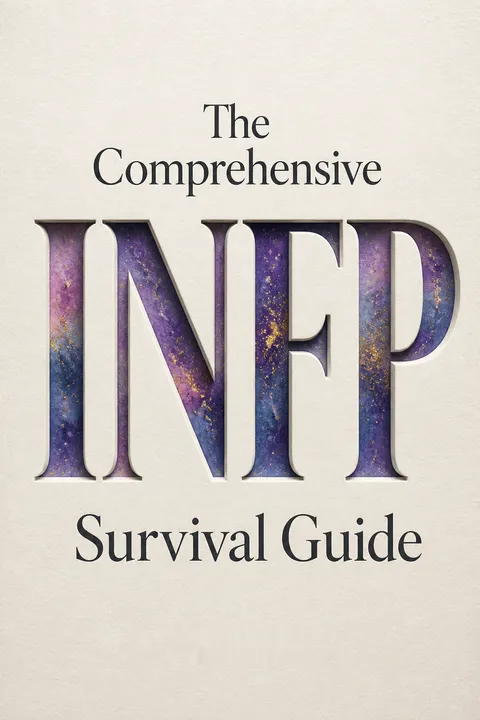


Key Takeaways
Be an INFP on purpose, not a poor imitation of another type.
Make identity a starting point. Priebe’s central message is that an INFP need not sand down sensitivity, creativity, or idealism to resemble a more conventional personality. The type is described as inwardly guided by personal values, yet curious about many possible futures. That combination can feel contradictory: someone may crave solitude and still light up during a lively brainstorm, or care deeply about people while needing distance to recover.
Use the label lightly. The book warns that online quizzes often measure how someone sees themselves at a particular moment, so results can shift. It presents INFP as a way to make sense of recurring patterns, not a demand to perform a stereotype. Its stories and advice are most useful when they help readers recognize choices, rather than explain away every behavior.
The book’s permission to be distinctive is a welcome counterweight to personality advice that turns self-knowledge into a checklist of deficiencies. At the same time, personality labels can become self-fulfilling: someone who believes they are bad at planning may stop practicing it. Contemporary personality psychology generally finds more support for trait continua, such as the Big Five, than for sharply bounded types. The practical middle ground is to treat INFP as a reflective vocabulary, not a validated diagnosis or a ceiling on what someone can learn.
Let values choose the direction, then test possibilities in the real world.
A four-part map. The book explains INFP thinking through four cognitive functions, its term for preferred ways of evaluating experience. Introverted Feeling, or Fi, checks what feels morally and personally true. Extroverted Intuition, or Ne, generates possibilities and connects ideas. Introverted Sensing, or Si, compares the present with past experience. Extroverted Thinking, or Te, organizes action and measures results.
Use the sequence, not the stereotype. In this model, values provide a compass, while imagination opens routes forward. Memory can help distinguish attractive fantasies from options that have worked before, and practical planning can turn a choice into steps. For instance, enthusiasm about a creative career can prompt exploration, then a review of past interests, and finally a plan for training or applications. The functions are presented as a lens for reflection, not directly observable mental machinery.
The model’s strength is its insistence that feeling and reasoning are not enemies. Values can identify what deserves effort, while external feedback can reveal whether a chosen route is workable. That resembles decision-making approaches that combine personal priorities with iterative testing. The weakness is evidential: cognitive functions are not established as discrete mental modules in the way the book presents them. Their value is therefore best judged by whether the prompts improve reflection and behavior, not by whether they offer a literal map of the brain.
Give ambitious ideals a schedule, structure, and finish line.
Structure can serve creativity. Priebe argues that many INFPs know what matters to them before they know how to make it happen. The book describes introverted sensing and extroverted thinking as functions that become more accessible with age: one supports routines informed by experience, the other helps organize goals and carry them through. Its rough lifespan account places self-definition early, exploration in adolescence, and greater structure in adulthood. These age patterns are the author’s model, not a universal timetable.
Make the bridge concrete. A person who wants to write a book can reduce the distance between aspiration and action by setting small, repeatable targets, reviewing progress, and adjusting the plan. The point is not to impose a rigid life on a spontaneous person. It is to make room for meaningful work even on days when inspiration is missing.
This is a useful correction to the romantic idea that discipline contaminates creativity. In practice, a routine can protect creative attention from being consumed by repeated decisions about when and how to begin. The book’s developmental account should be treated cautiously, since its claims about specific functions maturing at particular ages are not established developmental findings. Still, the underlying lesson travels well: systems can be adapted to temperament, and a flexible structure can make values more visible in daily life.
When reflection becomes a spiral, interrupt it with one real-world experiment.
Two stress patterns. A dominant-tertiary loop, in the book’s terminology, occurs when an INFP turns from values directly to memories and repeats old interpretations without gathering new information. A severe stress response, called a shadow-function pattern here, reverses the usual function order and can make practical judgment feel harsh and self-punishing. The book distinguishes these patterns, though both can trap someone in narrow conclusions.
A divorce story shows the shift. Priebe describes a woman who withdrew after her marriage ended, tried travel and impulsive distractions, then became fixated on the past and unable to move forward. Small commitments, including writing again and applying for work, helped her rebuild a routine and reconnect with other people. The practical lesson is to pair reflection with an external test: make one call, attend one event, or take one manageable step.
The narrative gives a memorable account of how rumination can masquerade as problem-solving: the mind keeps revisiting the same evidence, while life supplies nothing new. Behavioral activation, a clinical approach that schedules meaningful or rewarding activity, similarly uses action to loosen withdrawal, rather than waiting for motivation to return first. The book’s function labels are not a clinical assessment, and prolonged distress may call for professional support. Still, the distinction between useful reflection and repetitive self-prosecution is valuable.
Treat intense feelings as signals to understand, not orders to obey.
Make room for emotion. The book does not ask INFPs to feel less. It suggests first acknowledging what is present, then gaining perspective, looking for recurring patterns, and choosing a response. In its function vocabulary, Fi names the emotional meaning, Ne considers alternative explanations, Si recalls similar episodes, and Te creates a practical way to cope.
Turn feelings into usable information. An INFP who feels anxious about a social event might note that the fear is real without treating it as proof of danger. A journal can record when a feeling appears, what was happening, and what helped it pass. The author also recommends scheduled time to decompress, talk, or write, particularly for people whose work exposes them to others’ distress. Emotions deserve attention, but they do not have to dictate immediate action.
The distinction between an emotion and a fact is subtle but powerful. Feelings often carry information about needs, expectations, or perceived threat, while remaining imperfect forecasts of what will happen. Naming an emotion and describing its context can create a pause between reaction and choice, a principle also used in emotion-regulation research. The book rightly resists dismissing sensitivity as weakness. Its advice works best when emotional acceptance is not confused with endless analysis: attention should clarify what is needed, then support a next step.
Choose work by values and working conditions, not personality-based job lists.
Fit matters more than title. Priebe says INFPs often seek work that feels authentic, useful, creative, and connected to people. The book lists writing, counseling, design, the arts, ministry, academia, psychology, and technical specialties as common fields, but its worker testimonies range much more widely. Contributors describe jobs in software development, statistics, law, translation, teaching, and ice-cream decorating. The shared thread is not a single profession, but finding some combination of meaning, autonomy, and manageable structure.
Map the trade-offs. Before committing to a path, the author advises considering required training, likely pay, core values, advancement, and what the worst day in that job might feel like. She also warns that helping professions can be emotionally draining, while a practical job may leave energy for creative work outside work. A career plan should account for both purpose and the conditions that make a life sustainable.
The varied testimonials quietly undermine the notion that a personality type has a prescribed career. They point instead to job design: autonomy, social contact, task variety, and the perceived value of work can matter as much as occupational category. The book’s emphasis on purpose is compelling, but purpose alone cannot pay bills or prevent burnout. Salary, access to training, caregiving duties, and local opportunities are real constraints, not failures of authenticity. A sound choice includes both what feels meaningful and what is materially workable.
Love the person in front of you, not the future you imagined together.
Fantasy can outrun evidence. The book portrays INFPs as intensely romantic, often imagining an elaborate future with someone before the relationship has taken shape. In a partnership, the same imaginative strength can turn into idealization: a few appealing traits become evidence of a whole personality the other person may not possess. Disappointment follows when the real partner cannot meet expectations they never agreed to.
Check the projection. When hurt or dissatisfied, ask whether the expectation was spoken and shared, or silently built up in imagination. Then describe the concrete behavior and ask for a specific change. Priebe also notes that a 2015 survey of 300 INFPs found quality time, words of affirmation, and physical touch were their most commonly preferred love languages. These preferences can guide conversation, but they do not replace asking a particular partner what matters to them.
The distinction between a partner’s actual behavior and a hoped-for version of that partner is useful far beyond typology. Relationship research often finds that idealization can support satisfaction, but unchecked projection can also obscure incompatibility or excuse harmful conduct. The book’s advice to communicate expectations keeps romantic imagination from becoming an unspoken contract. The love-language survey is descriptive of respondents, not proof that all INFPs share the same preferences. Its best use is as a conversation starter, not a compatibility test.
Set clear limits before generosity becomes resentment or self-erasure.
Care needs edges. INFPs are described as highly responsive to other people’s needs, sometimes to the point of overcommitting or making themselves responsible for someone else’s change. The book’s counselor example makes the boundary clear: helping another person does not mean allowing their crisis to pull the helper under. A boundary is a stated limit on what someone can offer, tolerate, or continue doing.
Make the limit observable. Rather than vaguely promising to spend less time with a draining person, decide how much contact is manageable and communicate it. Priebe recommends being specific, holding the limit consistently, and asking a trusted person or professional for support when guilt makes follow-through difficult. Boundaries may be needed even with people who mean well. Their purpose is not punishment; they preserve the conditions for care to remain freely given.
The book’s strongest point is that empathy without limits can become a form of self-neglect. In caregiving professions, family systems, and ordinary friendships alike, sustainable support requires distinguishing compassion from responsibility for another adult’s choices. A boundary is also more effective when paired with a clear alternative, such as what help is available and when. The claim that healthy people always respect boundaries is too absolute: reasonable limits can be difficult for anyone to hear. Respect is better measured by whether people engage with the limit rather than repeatedly override it.
Translate personality differences into direct requests, not verdicts about compatibility.
Conflict has several escape routes. The book describes INFPs as prone to accommodating others, avoiding a difficult conversation, or becoming unexpectedly defensive when core values feel threatened. It argues that assertiveness is a healthier target: state what happened, how it affected you, and what change you are asking for. Writing thoughts down first can help someone who feels flooded during a conversation.
Ask instead of assuming. Priebe’s compatibility chapters compare how different types may approach emotion, planning, or problem-solving, but she explicitly cautions that type does not determine whether a relationship succeeds. A partner who offers solutions may be trying to help, not dismiss feelings; a partner who needs time alone may not be withdrawing affection. Ask what the other person means, explain what support would help, and return to unresolved issues at an agreed time.
This approach treats disagreement as a translation problem before treating it as evidence of incompatibility. That is a constructive use of personality language: it can suggest questions about different needs without claiming to read another person’s mind. Assertive communication also protects against the false choice between keeping peace and being honest. Still, labels can encourage stereotyping if a person assumes a partner must behave according to type. The most reliable evidence remains the individual’s stated preferences, repeated actions, and willingness to repair conflict.
Analysis
The book is part reference guide, part coaching manual, and part collection of first-person testimony. Its through-line is a practical argument for authenticity: a sensitive, imaginative person need not imitate conventional discipline or sociability, but must find ways to translate personal values into behavior. That makes its most useful tension also its central challenge. The INFP is encouraged to honor inner experience while not allowing inner experience to become the only source of evidence.
The cognitive-function model gives the book a memorable vocabulary. Fi, Ne, Si, and Te organize discussions of values, possibility, memory, and execution. The labels help the author connect broad personality descriptions to specific traps, such as idealizing a partner or replaying old mistakes. Yet the typological claims are presented with more certainty than current personality science supports. The MBTI’s categories and proposed cognitive-function stack are not equivalent to clinically validated mechanisms, and the book’s age-linked development claims should not be read as universal developmental facts. This caveat does not erase the practical usefulness of its prompts. A reader can test whether a model helps without believing that it maps the brain.
The book’s strongest evidence is experiential rather than experimental. Its accounts of career variety, heartbreak, conflict, and recovery make abstract advice feel recognizable. The divorce narrative is especially effective because it shows that insight alone did not restore momentum: renewed routine, creative work, employment, and social contact mattered too. This aligns with broader approaches to behavior change that use small actions to counter withdrawal, while leaving room for professional help when distress is severe.
The adaptation’s most durable lesson is therefore not that every INFP shares a fixed destiny. It is that self-understanding should increase agency. Use values to select priorities, imagination to generate routes, memory to learn from experience, and structure to follow through. In relationships, replace mind-reading with requests. At work, balance meaning with material conditions. In emotional life, make room for feeling without confusing intensity with certainty. Personality language is helpful when it opens choices, and harmful when it closes them.
Review Summary
The Comprehensive INFP Survival Guide receives largely positive reviews, with readers praising its accuracy in describing INFP traits and experiences. Many find it therapeutic and validating, helping them understand and accept themselves better. The book is noted for its in-depth exploration of cognitive functions, relationship dynamics, and personal growth strategies for INFPs. Some readers appreciate the practical advice and insights into both healthy and unhealthy INFP behaviors. While a few criticize its repetitiveness or overreliance on MBTI jargon, most find it a valuable resource for self-discovery and improvement.
People Also Read








Glossary
Cognitive functions
Information-processing preferencesIn the book’s Myers-Briggs framework, cognitive functions are preferred ways of perceiving information and making decisions. Each function is described as either introverted or extroverted, and the INFP is assigned a typical order of Fi, Ne, Si, and Te. The framework is useful here as an interpretive vocabulary, though its claims should not be mistaken for established brain mechanisms.
Introverted Feeling (Fi)
Inner values and emotional meaningThe book describes Introverted Feeling as an inward process that evaluates experiences against personal values and emotional understanding. For the INFP, it is the dominant function, associated with authenticity, moral conviction, and close attention to what feels significant. It is presented as the person’s internal compass, not simply as being emotional or making arbitrary choices.
Extroverted Intuition (Ne)
Exploration of possibilitiesIn the book’s model, Extroverted Intuition looks outward for connections, alternatives, and potential futures. It helps the INFP generate ideas, shift perspectives, and explore new experiences. The author presents it as a partner to Introverted Feeling: Ne opens possible routes, while Fi evaluates their personal meaning. When isolated from other functions, it can also encourage scattered or unfinished pursuits.
Introverted Sensing (Si)
Reference to past experienceIntroverted Sensing is described as comparing present situations with remembered experiences, details, routines, and known facts. In the INFP function stack, it is tertiary. It can support useful continuity by helping someone notice what has worked before, but the book also portrays it as limiting when memories are treated as reliable predictions of every future situation.
Extroverted Thinking (Te)
Organizing action and resultsExtroverted Thinking is the INFP’s inferior function in the book’s model. It focuses on external organization, measurable outcomes, logical presentation, and completing plans. The author distinguishes a constructive use, which helps turn values into action, from an unhealthy stress response marked by harsh self-criticism, rigid judgments, and anxiety about appearing incompetent.
Shadow Functions
Stress-related reversed function useThe book uses this term in two ways, including for functions outside a person’s usual four-function stack. Its stress discussion uses it to describe a reversal of the INFP’s usual function order, beginning with underdeveloped Extroverted Thinking. In this account, the person may become unusually rigid, judgmental, and self-critical. This is a typological description, not a clinical diagnosis.
Dominant-Tertiary Loop
A closed internal feedback patternA Dominant-Tertiary Loop occurs, in the book’s framework, when a person bypasses the auxiliary function and relies heavily on the dominant and tertiary functions. For an INFP, this is described as a Fi-Si loop: personal feelings and remembered experiences repeatedly reinforce one another, while new external possibilities receive little attention. The suggested interruption is to re-engage Extroverted Intuition through new information and action.
Enneagram of Personality
Nine motivation-based personality typesThe Enneagram is a personality system organized around nine types, each associated with characteristic fears and motivations. Priebe uses it alongside the INFP framework to describe differences among people who share the same Myers-Briggs type. The book reports that its 2016 poll found Type 4 most common among INFP respondents, followed by Types 9, 6, 2, and 5; those results describe that poll, not a definitive population distribution.

Download PDF
Download EPUB
.epub digital book format is ideal for reading ebooks on phones, tablets, and e-readers.








