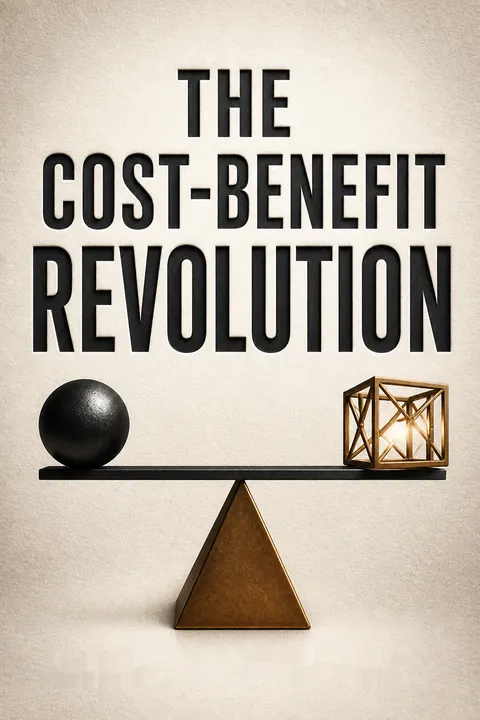


Key Takeaways
Make public policy answer to consequences, not political identity
Follow effects, not labels. Sunstein argues that policy disputes often look like clashes of deep values when they also depend on contestable facts: how many lives a rule saves, who pays, and what else the rule changes. Cost-benefit analysis makes officials ask those questions rather than act on anecdotes, organized pressure, or partisan instinct. It can block an expensive rule with meager benefits, but it can also strengthen a rule that political leaders dislike when the benefits are large.
A bipartisan shift. Reagan established the federal review system in 1981, Clinton reaffirmed it, and Obama strengthened it. Trump retained the framework but added a zero-net-cost budget and a one-in, two-out rule. Sunstein argues those filters can reject rules with substantial net benefits because they count rules or costs rather than outcomes.
The case is strongest when cost-benefit analysis is treated as a shared method for clarifying disagreement, not as a machine that removes politics. Public choices still depend on judgments about fairness, rights, and which harms deserve attention. The method's democratic value lies partly in making assumptions visible and contestable. Its technocratic danger is equally real: expertise can clarify consequences, but it cannot by itself decide whose interests should count or how much weight they deserve.
Translate risks into comparable terms before panic sets policy
Intuition has blind spots. People often judge a danger by how readily an example comes to mind. After a few highly publicized Ebola cases in the United States in 2014, many people feared infection far more than the actual risk warranted. Public alarm can spread socially too: people may adopt a belief because others appear convinced, not because they have independent evidence.
Numbers create distance. Sunstein compares cost-benefit analysis to thinking in a foreign language: it can slow immediate emotional reactions and expose choices hidden by framing. In a classic experiment, people favored a risky option when outcomes were described as lives lost, but a safer option when the same outcomes were described as lives saved. Putting both descriptions into comparable terms can reveal that they are equivalent.
A common metric can function like a cognitive speed bump. It asks decision-makers to compare risks that feel different because one is vivid and another is routine. That is useful in public policy, where attention often follows headlines rather than frequency or scale. Yet translation is not neutral: choices about which risks to measure, which time horizon to use, and which outcomes to include shape the result. Quantification disciplines intuition, but it does not eliminate judgment.
Value risk reductions, never pretend to price identifiable people
A statistical life is a risk measure. The value of a statistical life, or VSL, is a way to estimate the benefits of small risk reductions across a population. It does not claim that a particular person is worth a fixed sum. US agencies used a figure around $9 million in the period discussed. If many people each pay about $90 to remove a one-in-100,000 mortality risk, that implies a VSL of roughly $9 million.
Willingness to pay has limits. In relatively simple cases, where those receiving protection also pay its full cost, willingness to pay can respect both welfare and personal choice. Harder cases arise when costs and benefits fall on different groups. A regulation can help poorly paid workers while costing consumers more overall, making distribution and welfare relevant beyond the headline total.
The distinction between a person and a statistical risk is ethically essential. Without some common valuation, officials still make implicit choices about how much money to spend on safety, but those choices remain hidden and inconsistent. Willingness to pay offers a transparent starting point, especially when people are informed and bear the costs themselves. Its weakness is that money does not mean the same thing to everyone. A low figure from a poor community can reflect limited means, not indifference to safety.
Treat cost-benefit figures as welfare proxies, not verdicts
Money is not well-being. Cost-benefit analysis uses monetary values because they are available and comparable, but welfare is the real concern. A rule can pass a monetary test and still impose serious harm not captured in the ledger, such as lasting unemployment. Losing a job can damage income, mental health, and a person's sense of purpose.
Look beyond totals. Sunstein's examples include safety rules whose benefits fall mainly on very old people, rules that prevent young children's deaths, and rearview cameras that may ease driving even when their monetized safety benefits appear too low. Measures of reported well-being can add insight, including pleasure and purpose, but researchers cannot reliably translate many regulatory effects into a common welfare scale. They are another imperfect proxy, not a ready replacement.
This is the book's crucial qualification: a clean total can conceal very different human experiences. A small cost spread among millions may barely register for each person, while a concentrated job loss can reshape a life. Distribution and subjective well-being help expose that asymmetry. But once policy weighs these effects, it faces difficult comparisons of its own. The answer is not to abandon accounting, but to make the omitted consequences explicit and treat close numerical results with appropriate caution.
Make regulators learn from outcomes, not just forecasts
Central planners lack local knowledge. The knowledge problem is the difficulty of gathering information held across individuals, firms, and places. Regulators may not know the actual cost of a rule for small businesses, or how a safety measure changes behavior. Public comments can reveal overlooked costs and alternatives, especially when proposed rules and supporting analysis are accessible online.
Build a feedback loop. Sunstein argues for four ways to improve decisions: public comment, retrospective review of existing rules, controlled experiments, and measure-and-react methods that adjust as evidence arrives. Retailer Zara illustrates the last approach: it watches what shoppers buy, tests products, and adapts production quickly rather than trusting long-range predictions. Government cannot use this method for every slow-moving problem, but it can test and revise policies where outcomes are observable.
This approach turns regulation from a one-time act of confident prediction into a learning process. That is a powerful connection to experimental science: a policy is not only a proposed solution, it is also a claim about what will happen. Retrospective review and trials can test that claim. The difficulty is institutional. Agencies need permission, resources, and incentives to acknowledge failure and revise rules. Without those conditions, more data can become another report on a shelf rather than a correction to policy.
Count moral concern, but keep constitutional boundaries
Moral commitments affect people. Consumers may care about dolphins, workers abroad, or the use of minerals connected to atrocities. Sunstein argues that when such concerns affect people's welfare, regulators should try to include people's willingness to pay to honor them. A dolphin-protection label, for example, may matter to consumers even if they do not personally use the product differently. The book also describes a prison-rape regulation whose analysis included public willingness to pay to prevent abuse.
Not every preference belongs. Preferences that conflict with constitutional protections, such as demands for racial segregation or suppression of protected speech, cannot simply be counted as policy benefits. Nor does the method settle whether a moral belief is justified. It estimates the weight people place on it, within legal and ethical limits.
The argument usefully distinguishes moral concern from narrow self-interest: people can care about harms to others and experience a real loss when those harms occur. That makes policy analysis more humane than a ledger limited to consumer prices. But willingness to pay measures intensity under a budget constraint, not moral truth. It can also reward prejudice if used without safeguards. The key discipline is to treat the measure as evidence about welfare, while law and public reasoning determine which preferences are legitimate grounds for government action.
Labels cost attention, distress, and sometimes consumer choice
Information is not free. A label takes time and attention to process. It can also upset people who continue buying a product, or make them switch to an option they enjoy less. Those losses can offset some benefits, even when the new choice improves health or saves money. Voluntary disclosure may be enough when sellers have an incentive to distinguish their products, as with gluten-free foods. It may fail when consumers overlook missing labels or cannot infer what silence means.
Use breakeven reasoning. When benefits are hard to quantify, regulators can ask how large they would need to be for a rule to justify its cost. The GMO-labeling case shows the stakes: the book reports 86 percent public support for labels and a median estimated cost of $2.30 per person annually, over $700 million in total. It describes strong evidence of no added health risk, alongside unresolved environmental questions.
The chapter's sharpest insight is that disclosure changes the decision environment, not merely the information available within it. A label can inform, distract, alarm, or steer. That makes evaluation more demanding than counting how many consumers switch to a supposedly healthier product. Breakeven analysis is a practical tool when precision is impossible, but the low per-person cost can obscure a large social bill. Regulators should show both the aggregate expense and a plausible account of what consumers gain.
Balance every precaution against the risks it creates
There is no risk-free side. Sunstein sets out two extreme positions on security and privacy. One treats broad surveillance as justified by the possibility of catastrophe; the other treats surveillance itself as a threat to free society. Each focuses on one danger and can discount the other. The same problem appears in environmental regulation: a precaution against one hazard can create new health, economic, or ecological costs.
Use a wider screen. When probabilities are hard to estimate, the book offers several practical checks: ask what benefits would make a measure worthwhile, remove costs that provide no genuine benefit, forbid surveillance for illegitimate purposes such as punishing political beliefs, and examine the worst plausible outcomes. These tests do not produce automatic answers, but they prevent fear of one danger from erasing all the others.
Risk management is more demanding than simply being cautious, because caution can transfer danger rather than remove it. The useful question is not whether privacy or security matters more in the abstract, but what a specific measure changes, for whom, and under what safeguards. Worst-case reasoning can be appropriate when catastrophe is genuinely possible, yet it can also inflate low-probability threats until ordinary costs disappear from view. A defensible precaution names both the hazard it targets and the risks it introduces.
Let courts demand reasons, not mechanical arithmetic for every right
Require an explanation. Under the Administrative Procedure Act, agencies can be challenged for arbitrary decisions. Sunstein argues that ignoring costs, accepting huge costs for tiny benefits, or rejecting a highly beneficial rule without reason can invite legitimate scrutiny. But courts should not require full numerical analysis in every case. Statutes may forbid cost balancing, evidence may be unavailable, and some values resist monetization. Judges also lack the expertise to settle many technical disputes themselves.
Speech is a special test. The book contrasts open-ended balancing with the clear-and-present-danger standard, which protects speech unless danger is sufficiently immediate and likely. Balancing might seem more consistent with ordinary regulation, but officials can use claims of danger to suppress dissent. Sunstein therefore treats speech protections as a context where institutional abuse matters greatly, while asking whether terrorism creates cases that challenge the traditional test.
The institutional lesson is that good policy depends on who reviews the evidence, not just on the formula used. Judicial review can force agencies to explain themselves, but rigid numerical demands may delay useful action or disguise value judgments as technical necessities. Free speech makes the limits especially vivid: a government that predicts harm also has an interest in silencing critics. The case for consequence-based reasoning therefore needs procedural safeguards and domain-specific restraint, particularly where rights protect people from the decision-makers doing the balancing.
Analysis
The book's argument is best understood as a defense of disciplined comparison, not of money as the ultimate measure of human worth. Sunstein's history of federal regulatory review shows how a procedural demand for evidence became a bipartisan governing norm. Its most compelling promise is double-edged: the same method can stop an expensive rule with little public value or supply the evidence needed to enact a lifesaving rule that political instinct resists.
The adaptation's central tension is that the framework is strongest where consequences are measurable and weakest where values, distribution, and uncertainty dominate. A VSL can make decisions about small population risks more consistent, but willingness to pay inherits the inequalities of income. Reported well-being can reveal harms hidden by monetary estimates, yet it lacks a dependable scale for comparing many policy outcomes. Moral commitments can be included as welfare effects, but they must be bounded by rights and laws that cannot be reduced to popular demand.
The knowledge problem prevents the technocratic answer from becoming a technocratic fantasy. Forecasts are fallible, and regulation can reshape systems in ways no analyst anticipates. Sunstein's response is institutional rather than merely mathematical: invite informed public criticism, review rules after implementation, test alternatives, and respond to observed outcomes. These practices make analysis corrigible, although they depend on officials being willing and able to learn.
The lasting contribution is a political ethic of public justification. Officials should show what a rule is expected to accomplish, who bears its costs, what evidence supports the prediction, and what would count as failure. Cost-benefit analysis cannot resolve every moral conflict, and it should not displace constitutional protections. It can, however, expose weak arguments, make trade-offs legible, and create a common factual ground on which people with different values can deliberate. The method earns trust not by claiming certainty, but by making choices visible and revisable.
Review Summary
The Cost-Benefit Revolution receives mixed reviews, with an average rating of 3.61/5. Positive reviews praise its exploration of regulatory cost-benefit analysis and evidence-based policy. Critics find it dry and lacking in real-world examples. Some readers appreciate Sunstein's enthusiasm for technocratic approaches, while others desire more insider perspectives. The book is seen as a primer on cost-benefit analysis in government decision-making, valuable for those interested in policy and regulation but potentially challenging for casual readers.
People Also Read









Glossary
Cost-benefit analysis
Compares policy consequencesA method for assessing a proposed policy by identifying its expected benefits and costs, including effects that are difficult to express in money. In Sunstein's account, it helps officials compare alternatives, examine who gains and loses, and decide whether a rule's benefits justify its burdens. It is a practical proxy for welfare, not a complete measure of it.
value of a statistical life
Values risk reductionA monetary estimate used to measure the benefit of reducing small mortality risks across a population. It does not assign a price to an identifiable person. Agencies derive it from evidence about how much people pay for safer conditions or how much compensation workers receive for accepting risk. The book gives an approximate US figure of $9 million.
willingness to pay
Measures stated preferenceThe amount a person would pay to obtain a benefit or avoid a harm. In cost-benefit analysis, it can help estimate the value people place on safety, information, or moral commitments. Sunstein treats it as a useful starting point when choices are informed and people bear the relevant costs, while warning that limited income, bias, and shared costs can distort its meaning.
knowledge problem
Limits official informationThe difficulty officials face in collecting all the information needed to predict a policy's consequences. Relevant knowledge is spread among individuals, businesses, and local communities, and some effects are impossible to foresee in advance. Sunstein argues that public comments, retrospective review, experiments, and rapid measurement can reduce this problem without eliminating it.
breakeven analysis
Finds the threshold benefitA method used when a policy's benefits cannot be reliably quantified. Analysts calculate how large the unknown benefits would need to be for them to equal the known costs. For example, if a label costs a fixed amount to produce, breakeven analysis asks how much consumers would need to benefit for the mandate to be worthwhile.
availability heuristic
Judges by recallA mental shortcut in which people estimate how common or likely an event is by how easily examples come to mind. Dramatic, recent events can therefore seem more probable than less vivid but more frequent dangers. Sunstein uses this concept to explain why public alarm can surge after rare incidents and why policy should examine actual risk, not attention alone.
measure and react
Adjusts to observed resultsA strategy of measuring how an intervention performs in practice and changing it in response, rather than relying entirely on forecasts made beforehand. Sunstein describes businesses that rapidly test products against actual customer behavior and argues that governments can use similar feedback where outcomes are observable. The approach is less feasible when effects take a long time to appear.
Precautionary Principle
Acts despite uncertain harmA family of approaches that supports protective action when an activity may cause serious harm, even without complete scientific proof. Some versions shift the burden of proof to those proposing the activity. Sunstein argues that precautions can create risks of their own, so the principle needs limits that account for both the hazard being avoided and the costs of intervention.
foreign-language effect
Reduces intuitive biasA finding discussed in the book that people can make less biased decisions when reasoning in a language other than their native one. The proposed explanation is that using a less familiar language dampens immediate emotional reactions and encourages slower, more systematic thought. Sunstein uses it as an analogy for cost-benefit analysis, which makes policy trade-offs feel less intuitive but more comparable.
About the Author
Other books by Cass R. Sunstein






Download PDF
Download EPUB
.epub digital book format is ideal for reading ebooks on phones, tablets, and e-readers.








