

Key Takeaways
Nudge choices when predictable errors defeat people's own stated aims
The central case. A nudge steers a decision without removing the option to choose differently. At Washington’s Daily Grill, a prominently displayed section of meals under 600 calories made lighter choices easier to notice, while leaving the rest of the menu available. The example captures the book’s argument: when people reliably make mistakes that frustrate their own goals, carefully designed guidance can help without dictating what a good life must be.
Mill’s challenge. The Harm Principle, associated with John Stuart Mill, holds that government should not coerce adults solely for their own good. Sunstein argues that this rule overlooks evidence that people sometimes misjudge their interests. The case for intervention is strongest when it protects people’s own aims, preserves meaningful choice, and responds to a demonstrated problem.
The argument is strongest when the policy’s destination is anchored in people’s own expressed goals, such as wanting to save money but overlooking future costs. That resembles informed-consent practices in medicine: better presentation can help a person act on a preference already held. Yet preferences are not always stable or easy to interpret. A stated wish to be healthier can coexist with a genuine love of rich food. The ethical task is therefore not simply to identify an error, but to show whose goal is being served and how confidently it can be attributed to the person affected.
There is no neutral menu, form, or default
The background steers. Choice architecture means the arrangement surrounding a decision, including what appears first, which options are preselected, and how difficult each option is to reach. It is unavoidable. A printer set to single-sided output leads to more paper use than one set to double-sided printing, even when users never consciously choose a setting. A default is not nature’s decision; it is a decision built into the environment.
Small changes travel. When an exam administrator increased the number of free college application reports from three to four, students applied to more colleges, and low-income students attended more selective schools. The lesson is not that every default is good. It is that refusing to design a choice still leaves some arrangement in place, often one inherited without scrutiny.
This insight connects policy design to interface design: a website’s layout, like a government form, distributes attention and effort before a user makes a conscious choice. Calling a system neutral can therefore conceal who benefits from its existing friction. Still, inevitability does not grant designers unlimited authority. A useful test is whether the design makes the relevant consequences legible and whether affected people can contest the arrangement. Otherwise, the claim that every option is already framed risks turning a description of influence into a blank cheque for influence.
Protect future-you when today's inertia keeps winning
Short-term gravity. Present bias describes giving immediate rewards more weight than later benefits. It can lead people to postpone retirement saving, exercise, or quitting smoking, even when they expect their future selves to regret the delay. Time inconsistency occurs when a person’s preferences at one moment conflict with those held later. Sunstein calls harms people impose on their own future selves internalities, distinguishing them from harms imposed on other people.
Design for follow-through. Automatic enrollment in a savings plan can turn inaction into saving, while reminders can make a neglected task harder to forget. Individuals also use precommitment, setting limits in advance to protect later intentions. These tools do not prove that the future self should always win. They address cases where delay or self-control problems repeatedly obstruct a person’s own longer-term priorities.
The future-self problem resembles commitment devices in personal finance and addiction treatment: people create structure while their long-term intentions are clear, because they expect temptation or distraction to return. This can increase agency rather than diminish it. The hard question is whose preference counts when selves disagree. A present choice may express a real value, not merely a lapse. Policies should therefore distinguish predictable, unwanted self-sabotage from legitimate decisions to prioritize present enjoyment, and should avoid treating longevity or saving as everyone’s supreme goal.
Make consequential costs visible before people commit
Attention is limited. In the famous gorilla experiment described in the book, people counting basketball passes often failed to notice a person in a gorilla suit crossing the scene. The point is practical: people miss visible facts when their attention is occupied, and businesses can benefit when important product terms stay out of focus. Fees on bank accounts, credit cards, and phone plans may be especially easy to overlook.
Surface the hidden part. Reminders about loan payments and dental appointments changed behavior, while survey questions about overdraft fees helped make those fees more noticeable. The 2009 CARD Act required clearer credit-card disclosures; Sunstein reports annual consumer savings of more than $20 billion associated with the law. Fuel-economy labels similarly put future operating costs beside a car’s purchase price.
This principle is central to consumer protection because more information is not automatically better information. A dense disclosure can technically reveal a fee while practically hiding it. Human-factors design suggests that the timing, placement, and simplicity of information matter as much as its presence. The challenge is to make one neglected cost salient without implying that it outweighs every other feature. A fuel label can clarify operating expenses, but it cannot decide how a buyer should trade those expenses against performance, appearance, or other priorities.
Treat confidence and vivid anecdotes as poor probability calculators
Intuition can misread risk. The book describes two common errors. Unrealistic optimism leads people to think bad outcomes are less likely to happen to them personally; the text reports that roughly 80 percent of people show some such bias. The availability heuristic estimates likelihood by how easily examples come to mind, so a recent disaster can make a rare danger seem common, while an unfamiliar danger can be underestimated.
Frames shape judgment. People respond differently to an operation described by its survival rate than to the same outcome described by its death rate. The text also discusses research in which people using a less comfortable second language showed fewer framing and loss-aversion effects in certain tasks. Clear risk communication can help, but warnings may need to counter strong optimism or vivid fear rather than merely present statistics.
Risk communication sits at the intersection of psychology and public health: people need probability estimates, but they also need to understand what those estimates mean for their own circumstances. Emotional language can attract attention, yet it can also distort judgment or erode trust if it exaggerates. The useful standard is calibrated vividness: make a hazard understandable without making it seem more certain than it is. Any single result about framing or language should also be treated cautiously, since the book itself stresses that behavioral findings vary by context and require continued testing.
Prefer choice-preserving nudges, but let evidence justify stronger rules
Start with the lightest tool. Sunstein’s proposed default is to use disclosures, warnings, and carefully chosen defaults when behavioral failures cause harm. These tools usually preserve the option to refuse. But interventions fall on a continuum: a warning, a fee, a tax, and a ban impose different kinds and degrees of cost. A policy that looks mild in money may still impose a substantial psychological or practical burden.
Escalate with evidence. The proposed New York restriction on oversized sugary drinks limited container size but did not prevent consumers from buying multiple drinks. Sunstein found its costs relatively low but its health benefits uncertain. By contrast, fuel-economy standards might be justified if consumers systematically overlook lifetime savings and those benefits exceed the costs. The governing question is not whether a policy is paternalistic, but whether its likely overall effects warrant its intrusiveness.
This is a proportionality principle, familiar in legal reasoning: match the force of a remedy to the seriousness of the problem and the evidence that the remedy works. It discourages both reflexive bans and the assumption that an opt-out makes every intervention harmless. Cost-benefit analysis can discipline policy, but its results depend on difficult judgments about whose costs count, how freedom is valued, and how uncertain future effects should be treated. A credible assessment should make those judgments visible rather than presenting a calculated total as morally self-explanatory.
Test paternalism against markets, learning, diversity, and government failure
The objections matter. Critics argue that individuals know their circumstances better than officials, markets can reward companies that solve consumer problems, and people learn through making choices. They also point to diverse tastes: one person’s sensible default may be another’s poor fit. Finally, officials can be biased, influenced by organized interests, or simply mistaken. These are not abstract excuses; they are real risks in deciding how to improve people’s lives.
Compare actual alternatives. Markets sometimes correct harmful products, but companies may also profit by obscuring fees or exploiting consumer biases. Learning matters, but requiring active decisions about every complicated issue can overwhelm people. Personalized defaults may respect differences better than a single rule, though they raise privacy and accuracy concerns. The case against paternalism is therefore not decisive in every instance, just as the case for intervention is not.
The book’s comparative method is a strength: public policy should be judged against the likely private alternative, not against an imaginary world with perfect consumers and perfect officials. This also makes institutional design crucial. Independent evaluation, clear public reasoning, and periodic review can expose policies that fail or serve concentrated interests. Yet those safeguards are imperfect, and behavioral expertise can lend a scientific gloss to disputed value choices. The more a policy constrains options, the stronger the case for evidence, public scrutiny, and attention to who bears its costs.
An opt-out is real freedom only when people can use it
Permission is not access. Soft paternalism aims to influence choices without imposing significant material costs on people who choose otherwise. Automatic enrollment in a savings plan is a standard example: a person can leave the plan, but inertia means many will remain enrolled. This can be helpful when the default fits their aims, and harmful when it does not. The formal ability to opt out does not guarantee that people notice, understand, or act on the option.
Make influence accountable. Critics worry that subtle steering can receive less public attention than a visible ban or tax. Sunstein’s answer is to make behaviorally informed policies open to scrutiny, including through public review. He also distinguishes between nudges that invite reflection, such as clear cost information, and those that work mainly through attention or inertia. Both shape decisions, so transparency and a meaningful route to change matter.
An opt-out is best understood as a practical capability, not a checkbox in a policy description. The design should show what the default does, explain how to change it, and avoid making reversal needlessly difficult. That standard is especially important in digital services, where consent can be nominal while settings remain confusing. At the same time, requiring active choice for every decision has its own burden. Good oversight therefore asks not only whether a person can reverse a nudge, but whether the default is defensible and the reversal process usable.
Do not confuse correcting means with dictating a good life
Means and ends differ. Means paternalism tries to help people achieve goals they already hold, such as saving money by noticing a product’s long-term costs. Ends paternalism tries to change which goals people should pursue, such as insisting that health must outweigh pleasure. The distinction can blur: a disclosure policy highlights some attributes over others, and a person’s short-term and long-term preferences may conflict.
Keep human motives in view. Sunstein warns against treating deliberate calculation as the only legitimate source of value. Pleasure, emotion, risk-taking, and present enjoyment are genuine parts of life, not automatically errors to be corrected. Government must also avoid using nudges to pursue improper ends, such as favoring incumbents or particular religious groups. A policy can preserve formal choice and still be objectionable if its purpose is illegitimate.
This distinction identifies the deepest ethical boundary in the book. Correcting a mistaken estimate of a fee is different from deciding that a citizen ought to value health more than taste or present enjoyment. Still, even a means-focused policy selects what to measure and display, so it cannot be entirely value-free. A sound approach makes that selection explicit, gives reasons for it, and protects a pluralism of reasonable lives. Respect for emotion matters too: careful policy should reduce unwanted error without assuming that every impulsive or risky choice is a failure.
Analysis
Sunstein’s central move is to replace a categorical argument about whether paternalism is permissible with a comparative question about which decision environment produces better lives, and at what cost to freedom. That shift is powerful because it exposes a hidden asymmetry in many defenses of nonintervention. A person’s choice is treated as intentional and informed, while an official’s intervention is treated as designed and consequential. Behavioral evidence complicates the first assumption, and the inevitability of defaults complicates the second. There is no untouched baseline against which policy can be measured.
The book’s strongest contribution is its insistence on distinguishing correction from control. A warning that clarifies a future cost is not equivalent to a prohibition on buying the product. Yet the distinction is not clean: any disclosure selects facts, and any default uses inertia. The moral quality of a nudge therefore depends not only on whether alternatives remain available, but on what the intervention makes salient, whose interests it serves, and whether people can recognize and contest it.
The argument also reveals a measurement problem. “Welfare by the chooser’s own lights” sounds modest, but people disagree across time, and their expressed preferences can be unstable. A government that treats a later regret as proof that an earlier choice was mistaken risks privileging one temporal self over another. Conversely, treating every immediate choice as authoritative can abandon people to predictable exploitation. The answer is not a universal rule but stronger evidentiary standards for more intrusive policies, alongside transparency and review.
This framework is most persuasive as a method of disciplined policy design, not as a general license for benevolent officials. Behavioral research can identify where attention, defaults, or optimism shape choices, but it cannot by itself establish which outcomes deserve priority. Democratic legitimacy, individual difference, and limits on state purposes remain substantive constraints, not technical details. The practical lesson is to treat nudges as interventions requiring justification, evidence, and accountability, while refusing to mistake either unregulated choice or official expertise for neutrality.
Review Summary
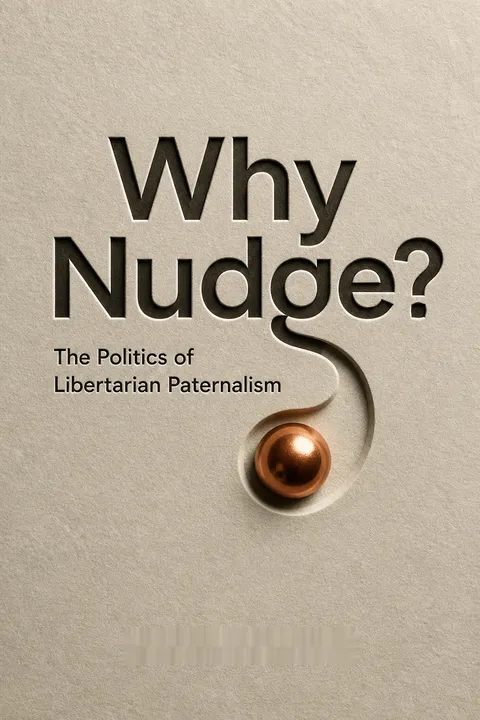
Why Nudge? receives mixed reviews with an average rating of 3.47/5. Critics frequently cite poor writing style, excessive repetition, and dense academic language that obscures Sunstein's arguments. Many readers appreciate the philosophical discussion of "libertarian paternalism" and the challenge to John Stuart Mill's Harm Principle, but find the book less accessible than Nudge. Some view it as repetitive of Sunstein's earlier work. Supporters value the framework for understanding behavioral market failures and when government intervention through "nudges" is justified, while skeptics question the paternalistic approach and potential government overreach.
People Also Read










Glossary
Harm Principle
Limits coercion to preventing harmA principle associated with John Stuart Mill that says coercive power over adults is justified to prevent harm to others, not solely to protect people from their own choices. Sunstein argues that behavioral evidence weakens the principle’s case against all self-regarding intervention, while retaining its warning against excessive government power.
Choice architecture
The setting around a choiceThe arrangement in which people make decisions, including defaults, order, visibility, wording, and the effort required to select an option. It influences choices whether deliberately designed or not. Since people cannot make decisions outside some context, Sunstein treats choice architecture as unavoidable and asks whether it helps people or exploits predictable errors.
Behavioral market failures
Market harms from predictable errorsFailures that arise when human tendencies such as present bias, inattention, unrealistic optimism, or poor probability judgment lead people to choices that undermine their own aims. The concept supplements conventional market failures, such as pollution or monopoly. Sunstein argues that these behavioral failures can justify public responses, subject to evidence about government mistakes and policy costs.
Libertarian paternalism
Steering while preserving choiceAn approach that guides people toward choices thought to support their own welfare while keeping alternatives available and avoiding significant costs for choosing differently. It commonly uses disclosures, warnings, and defaults. Its libertarian element is the preserved freedom to refuse; its paternalistic element is the intentional design of the decision setting to influence outcomes.
Means paternalism
Helping people reach their endsIntervention intended to help people achieve goals they already hold by improving their choice of methods. For example, clearer information about a product’s long-term costs may help consumers who want to save money. The distinction from ends paternalism can be difficult when goals change over time or when policy highlights some values and not others.
Internalities
Costs imposed on future selvesHarms people impose on themselves through choices affected by self-control problems, inattention, or misjudgment. The term distinguishes these costs from externalities, which affect other people. A present-focused decision that damages a person’s future health or finances is an example. Policies addressing internalities aim to protect people’s own interests, though identifying those interests can be contentious.
Affective forecasting errors
Mistakes predicting future feelingsErrors in predicting how an experience, purchase, or decision will affect future well-being. People may expect a choice to bring more or less enjoyment than it actually does. Sunstein uses the idea to challenge the assumption that choices always reveal what will make someone better off, while cautioning that well-being includes more than pleasure.
Bridge Exception
Preventing a certain, imminent mistakeSunstein’s label for Mill’s example of stopping someone from crossing a bridge known to be unsafe when there is no time to warn them. The intervention is justified because the person does not want to fall into the river and the danger is certain. The example raises the broader question of when officials can reliably know a choice defeats a person’s own ends.
First (and only) Law of Behaviorally Informed Regulation
Prefer nudges for behavioral failuresSunstein’s proposed rule of thumb: when behavioral market failures justify a response, nudges are generally preferable, especially where no harm to others is involved. Disclosures, warnings, and defaults can address errors while preserving choice. The principle is not absolute; stronger intervention may be warranted if evidence shows its benefits outweigh its full costs.
About the Author
Other books by Cass R. Sunstein







Download PDF
Download EPUB
.epub digital book format is ideal for reading ebooks on phones, tablets, and e-readers.








