

Key Takeaways
Make constitutional promises real by protecting the people who rely on them.
Rights need enforcement. After the Civil War, the Thirteenth Amendment abolished slavery, the Fourteenth made formerly enslaved people citizens, and the Fifteenth barred racial discrimination in voting. Yet Southern Black Codes and organized terror showed how easily rights on paper could be denied in daily life. Congress responded with the Enforcement Act and a new Justice Department; President Grant also used troops and federal prosecutions against the Ku Klux Klan. Those efforts reduced violence in places such as South Carolina, but they drew political resistance and depended on Washington's continued commitment.
The promise was fragile. Grant's second inauguration in 1873 offered Black voters a visible sign of inclusion. But the book's central argument is that Reconstruction's promise could not survive on amendments and ceremony alone. It needed courts, prosecutors, troops, and political support willing to protect people where local authorities would not.
What's striking is the gap between declaring a right and building the capacity to defend it. Political science often distinguishes formal institutions from state capacity: laws matter only when officials can investigate violations, reach witnesses, and enforce judgments. The Reconstruction amendments supplied powerful principles, but the book shows how quickly those principles weakened when prosecutions became politically costly. Federal intervention also carried a legitimacy problem, since opponents could portray enforcement as tyranny. That tension does not make protection optional; it makes consistent rules and credible public explanations essential.
When local offices control ballots, a disputed election can become a fight for survival.
Local power mattered. Grant Parish was carved from the Calhoun plantation lands in 1869. Its courthouse, sheriff, judge, and election records were not minor posts: they determined who could govern, and whose claims the law would recognize. Black voters formed a majority, while white supremacists feared losing political control. Violence and intimidation had already suppressed Republican voting in the 1868 election.
Two governments collided. Louisiana's disputed 1872 election produced competing claims to state and parish offices. In Colfax, Republicans occupied the courthouse and asserted that their candidates had won; Fusionists, a coalition of Democrats and anti-Warmoth Republicans, claimed authority through a different count. Armed Black men gathered to defend the Republican courthouse, while white leaders organized to retake it. The fight grew from both racial domination and a concrete struggle over who controlled local institutions.
A contested election becomes explosive when political actors reject not only the result, but the rules that determine who has authority to certify it. The Colfax crisis shows that legitimacy is built locally: a commission, a ballot box, or possession of a courthouse can matter more than distant constitutional language. The Republican coalition was also divided, and some of its leaders made tactical choices that weakened trust. Acknowledging those complications sharpens the history without equating factional conflict with the organized racial violence that followed.
At Colfax, armed white men killed Black prisoners after their surrender.
A battle became a massacre. On Easter Sunday, April 13, 1873, roughly 140 white men attacked Black defenders near the Colfax courthouse. The defenders had fewer, poorer weapons and little ammunition. After hours of fighting, the white force used a small cannon to break their position, then set the courthouse roof on fire. Men who ran from the flames were shot, including men trying to surrender. Those captured were marched away in pairs and killed during the night.
The death toll is uncertain, not the atrocity. Deputy U.S. marshals documented 62 Black deaths, including men who later died of their wounds. A later Army report named 81 victims, a plausible upper estimate. Three white men died. The book treats the massacre as one of Reconstruction's deadliest single-day episodes of white racial terror.
The distinction between combat and massacre turns on what happens to people who are no longer fighting. The defenders were armed, and the fighting itself was real, but that does not erase the killing of captives and fleeing men. The uncertain count is also instructive: victims were buried hastily, records were incomplete, and local power shaped what could be documented. Responsible history can preserve uncertainty about totals while remaining clear about the pattern of violence and the asymmetry in who was killed.
Control the story, and violence can be recast as public order.
Competing accounts shaped response. Early reports presented Colfax as a clash between armed racial factions. White leaders claimed Black Republicans had rioted, threatened white families, and violated a flag of truce. These claims helped portray the white attack as self-defense. Black survivors and federal officers described a different sequence: a defensive gathering, an assault, the burning courthouse, and killings after surrender. Evidence from the scene included bodies shot in the head or back, and no Black bodies identified as armed casualties.
A narrative traveled faster than a trial. Newspapers repeated allegations of Black criminality, while white supremacists invoked the recent Modoc conflict to frame the victims as treacherous enemies. The competing stories mattered because officials in New Orleans had to decide whether to send troops, and the public had to decide whose testimony deserved belief.
The episode illustrates a familiar political mechanism: claims of disorder can convert coercion into an apparent defense of stability. The book's close attention to newspapers, witnesses, and physical evidence is a reminder that sources are not neutral simply because they are contemporary. At the same time, the record should not be flattened into a story of perfectly unified camps. Republican witnesses disagreed, some Black officials opposed William Ward, and their testimony could be compromised by fear or faction. Triangulation makes the account stronger, not less certain.
Moral outrage needs a legal theory that reaches private terror.
Murder was not enough. Federal prosecutors ordinarily left murder cases to state courts. U.S. Attorney James Beckwith therefore used the Enforcement Act, a federal law intended to punish conspiracies that interfered with citizens' constitutional rights. He argued that the Colfax killings were part of a plan to intimidate Black citizens and suppress their political rights, not simply a local criminal dispute.
The charge shaped the evidence. Beckwith focused on Levi Nelson, who survived being shot and could identify his attackers, and Alexander Tillman, whose political activity and death helped connect the violence to rights protected by federal law. His indictment contained 32 counts against 98 men, alleging conspiracies to violate specific rights. Undercover investigator John Hoffman helped identify suspects and witnesses. Beckwith had to translate a massacre into legal categories before a federal court could act.
The prosecution exposes a durable feature of rights litigation: harm must be translated into a claim that a particular institution is authorized to hear. That translation can create a route to accountability, but it can also narrow what counts as relevant. Beckwith's conspiracy theory made the political purpose of the attack legible to federal law, yet it made the case depend on proving protected rights and intent rather than simply establishing murder. His strategy was courageous, but the legal framework left the victims' most obvious injury difficult to prosecute.
A narrow reading of federal power can leave rights exposed to hostile states.
The legal ground shifted. In the 1873 Slaughterhouse Cases, the Supreme Court upheld Louisiana's public-health law but interpreted the Fourteenth Amendment's Privileges or Immunities Clause narrowly. The ruling encouraged the view that most rights remained primarily under state protection. In 1874, Justice Joseph Bradley applied that approach to the Colfax case. He said federal prosecution of private violence required a clearly alleged racial motive and a specific right Congress could protect. He found Beckwith's indictment too broad or insufficiently precise and set aside the convictions.
The full Court followed. In 1876, the Supreme Court affirmed in United States v. Cruikshank. It did not erase every federal power to protect civil rights, but it made prosecutions of private racial violence far harder. The Court required prosecutors to connect violence to particular federal rights and prove racial intent, while emphasizing that states bore primary responsibility for protecting citizens.
The state's responsibility to protect rights is a sensible federalism principle when local institutions function fairly. Colfax presents the harder case: what happens when local authorities are unwilling or unable to protect a targeted population? A doctrine focused on state action can miss the practical relationship between private violence and official inaction. The ruling did not formally forbid federal intervention in every civil-rights case, a distinction worth preserving. Its effect, however, was to make the protection of Black citizens depend heavily on institutions controlled by people hostile to them.
Treat a technical acquittal as a limit on power, not proof of innocence.
The verdict was mixed. At the first trial in 1874, jurors deadlocked on most defendants, with the men of color voting to convict and most white jurors favoring acquittal. In the second trial, the jury found William Cruikshank, Johnnie Hadnot, and Bill Irwin guilty of conspiracy to violate civil rights. It acquitted five others. The verdict stopped short of convicting anyone of murder.
The convictions did not last. Bradley then ruled that the indictment did not adequately allege the racial motive and specific rights required by his interpretation of federal law. The Supreme Court later affirmed that ruling, and the three men were released. The case illustrates a crucial distinction: a court can conclude that the prosecution has not established a valid federal charge without concluding that the killings never happened or that the defendants were innocent.
That distinction protects both historical accuracy and the rule of law. Courts must follow jurisdictional limits and rules of pleading; abandoning them whenever the facts are horrifying would endanger defendants in other cases. But procedural failure is not a verdict on the underlying history. Here, the narrow legal theory left well-documented violence without an effective federal remedy. A strong account can hold both judgments at once: the prosecution had to meet legal standards, and those standards were poorly suited to confronting racial terror.
Federal retreat lets terror shape elections without winning every battle.
Violence changed political behavior. After Bradley's ruling, attacks resumed in Grant Parish and elsewhere. In 1874, the White League, a white supremacist political and paramilitary movement, organized openly. It helped drive Republicans from office, intimidated Black voters, and briefly seized control of New Orleans before President Grant sent federal troops to restore Governor Kellogg. In Grant Parish, Black voter registration fell from about 700 in earlier years to 441 in 1874, while 473 white voters registered.
The retreat became national policy. The Supreme Court decision was not the sole cause of Reconstruction's collapse. Economic crisis, Northern fatigue, party conflict, and political calculation all mattered. But the ruling weakened federal prosecution just as terror escalated. In 1877, the political compromise that settled the disputed presidential election led to the withdrawal of federal troops from the remaining Republican Southern governments. The rights of Black Southerners were left increasingly to hostile state authorities.
Violence can suppress participation without needing to persuade voters or win a fair count. The figures from Grant Parish make that mechanism visible: fear changes who registers and who dares to vote. Yet this outcome should not be attributed to one court decision alone. The book's account also shows economic panic, fading Northern commitment, and fractures within Republican leadership. Legal rulings matter most when they interact with political incentives, weakening enforcement precisely when communities most need it.
Remember whose monument stands, and whose victims remain beneath unmarked ground.
Public memory chose its heroes. In 1921, Colfax unveiled a monument honoring three white men who died in the 1873 attack, describing them as fighting for white supremacy. No comparable marker honored the Black victims, who lay in a mass grave that later construction disturbed. In 1951, Louisiana erected a historical marker that called the massacre a riot and falsely claimed it marked the end of carpetbag rule.
Memory shaped the record. For generations, the massacre was publicly remembered through white supremacist accounts, while Black families preserved their own stories largely outside official history. Lane's closing argument is not only about the court's failure to punish the killers. It is also about how communities decide whose deaths deserve names, monuments, and a place in the story of the nation.
Monuments are not passive decorations. They teach a civic account of who acted honorably, who belonged, and whose suffering can be ignored. The Colfax memorials show how public commemoration can preserve a political victory long after the institutions that produced it have changed. Recovering the victims' names and evidence does not make historical memory complete, but it challenges the false impression that the old marker's version was simply settled fact. The physical absence of a memorial is itself part of the story.
Analysis
The book's central achievement is to connect a local massacre to a national constitutional retreat without treating either as inevitable. Colfax was not simply an eruption of racial hatred detached from politics. It followed a struggle over elections, parish offices, and control of a courthouse, shaped by years of violence against Black voters and by the failure of local institutions to command shared legitimacy. That setting explains why armed men gathered, but it does not excuse the massacre of surrendering prisoners.
The legal story adds a second layer. Beckwith had to convert murder into a federal civil-rights offense because ordinary federal jurisdiction did not reach local killings. His strategy exposed the gap between the broad purposes of Reconstruction and the narrow legal categories available to enforce them. Bradley's ruling and the Supreme Court's decision in Cruikshank did not erase the amendments, but they made protection depend on proving specific rights and racial intent while leaving the primary burden to states that often refused to act. The result was not only doctrinal; it changed the expected risks of terror and the practical safety of voting.
The narrative is most persuasive when it holds two truths together: Reconstruction's Republican governments were factional and sometimes compromised, while organized white violence was aimed at restoring racial rule. That distinction resists both romanticizing Republican actors and adopting the false equivalence used by the massacre's defenders. The book also treats political outcomes as contingent. The Court's retreat mattered, but so did economic crisis, Northern exhaustion, party division, and the bargain that ended federal protection in 1877.
Its lasting question concerns the design of rights. Federalism can protect local self-government, but when local governments become instruments of exclusion, a strict division between state action and private violence can make constitutional guarantees hollow. Colfax shows how legal doctrine, enforcement capacity, political will, and public memory combine to determine whether freedom is lived or merely declared.
Review Summary
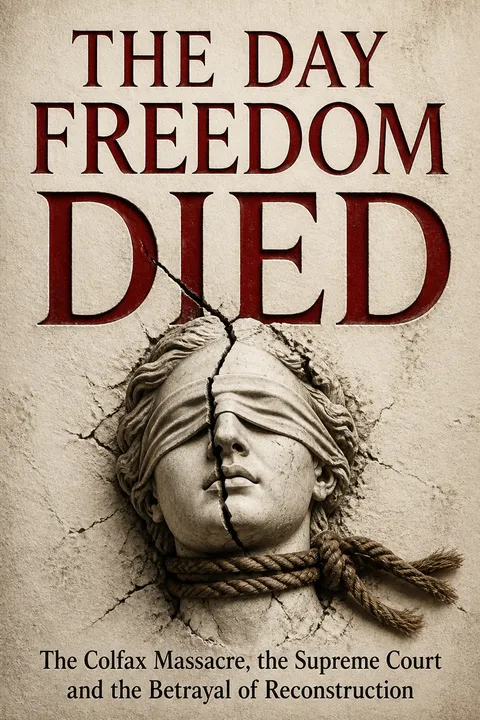
The Day Freedom Died examines the 1873 Colfax Massacre in Louisiana, where white supremacists killed over 60 African Americans, and the subsequent failed legal proceedings. Readers praise Charles Lane's extensive research and detailed account of how the Supreme Court case United States v. Cruickshank effectively ended Reconstruction. Reviews note the book requires focus due to numerous characters and legal complexity, but consider it essential reading for understanding racial violence, the failure of Reconstruction, and lasting impacts on civil rights. Many describe it as heartbreaking yet crucial for comprehending contemporary America's racial dynamics.
People Also Read
Glossary
Enforcement Act
Federal civil-rights enforcement lawA federal law enacted in 1870 to protect rights established by the post-Civil War amendments. It made certain conspiracies to intimidate citizens or interfere with their constitutional rights federal crimes. Its reach was disputed: prosecutors used it against racial terror, while courts narrowed when federal authorities could prosecute violence committed by private individuals.
The Slaughterhouse Cases
Narrow reading of citizenship rightsAn 1873 Supreme Court decision upholding Louisiana's law requiring butchers to use a central slaughterhouse. The Court interpreted the Fourteenth Amendment's Privileges or Immunities Clause narrowly, limiting which rights were protected by national citizenship. Though the case concerned public health and economic regulation, its reasoning constrained later efforts to use the amendment against racial violence.
United States v. Cruikshank
Federal limits on civil-rights prosecutionsThe Supreme Court's 1876 decision arising from the Colfax Massacre prosecutions. It affirmed the release of three convicted men because the indictment did not adequately allege specific federal rights and racial intent. The decision emphasized that many protections against private violence remained the states' responsibility, sharply limiting federal enforcement of civil rights without formally eliminating every federal remedy.
state action
Conduct attributable to governmentA legal concept distinguishing government conduct from acts committed by private people. Under the Fourteenth Amendment, courts generally treated the amendment as restricting states, not private individuals directly. In the Colfax dispute, this distinction made it difficult for federal prosecutors to reach private violence, even when state and local authorities failed to protect Black citizens.
White League
White supremacist political militiaA Reconstruction-era organization that combined political campaigning with armed intimidation. It sought to remove Black people from political power and restore white Democratic control in Louisiana. Its members drilled openly, threatened Republican officials and voters, and in 1874 briefly seized control of New Orleans before federal troops restored the Republican government.
Knights of the White Camellia
Secret white supremacist organizationA network of white vigilantes organized in Louisiana during Reconstruction. Members opposed Black voting and officeholding, using secrecy, threats, and violence to defend white political dominance. The organization helped establish the climate of terror that suppressed Republican activity and preceded later, more openly organized movements such as the White League.
Fusionists
Louisiana Democratic allianceThe name for a Louisiana political coalition formed when Governor Henry Clay Warmoth and Liberal Republicans joined forces with Democrats. In the 1872 election, the coalition supported John McEnery against Republican William Pitt Kellogg. Its rival claims to election victory produced competing governments and officeholders, including opposing claims to authority in Grant Parish.
Privileges or Immunities Clause
Fourteenth Amendment citizenship protectionA clause in the Fourteenth Amendment stating that states may not abridge the privileges or immunities of United States citizens. Its meaning became central to postwar civil-rights disputes. The Slaughterhouse Cases restricted the clause to a narrow set of rights tied to national citizenship, limiting its usefulness as a broad shield against state abuses.
Download PDF
Download EPUB
.epub digital book format is ideal for reading ebooks on phones, tablets, and e-readers.








