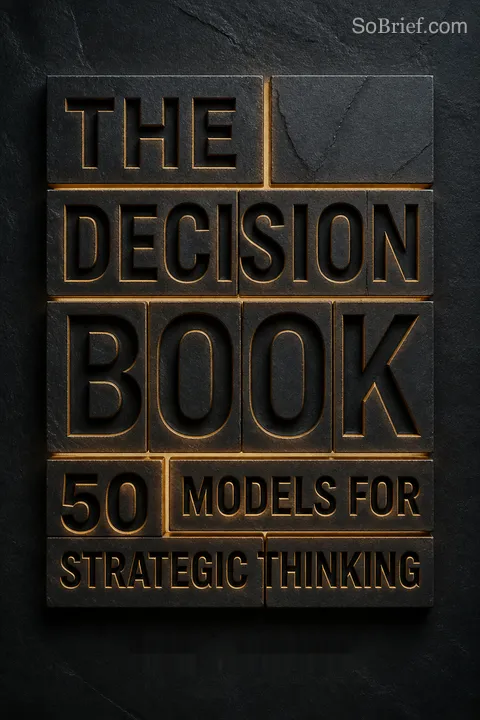


Key Takeaways
Use models to sharpen judgment, never to outsource it
A model is a lens. The book’s fifty models turn tangled situations into visible questions: What matters, what is missing, and which factors should shape a choice? A decision model simplifies reality, emphasizes what seems useful, and gives ideas a structure. It does not deliver an answer by itself. Users are meant to fill in, revise, and even reject the diagrams as they work through a problem.
Keep the frame in view. A matrix can make assumptions easier to inspect, but it can also hide whatever its axes leave out. The familiar warning that a tool shapes what its user notices applies here: a market-share chart may spotlight growth while ignoring social value. A useful model makes thinking clearer without pretending that its categories are the whole world.
The book’s strongest premise is methodological: a diagram can improve judgment by making assumptions visible, not by making judgment unnecessary. This resembles a map in science, where every representation selects certain features and suppresses others. The practical test is to ask what the model excludes, whose interests its categories serve, and what evidence would change the conclusion. A tidy matrix can create false confidence, especially when people mistake crisp boxes for precise knowledge. Used as a prompt for inquiry, however, simplicity becomes an advantage rather than a distortion.
Protect important work before urgency consumes the day
Separate pressure from value. The Eisenhower matrix sorts tasks by whether they are urgent and whether they matter. Urgent, important work needs attention now; important but non-urgent work includes planning and long-term decisions. The latter is easy to neglect because it rarely arrives with an alarm attached. A task can be urgent without being important, and some tasks are neither.
Make room for the strategic. Classifying a to-do list is only the beginning. The useful question is when important work will actually get time, before neglect turns it into a crisis. The model pushes people to notice how often immediate demands crowd out work that prevents future problems. Its purpose is not to make every hour efficient, but to keep the loudest task from automatically winning.
Urgency is a signal about timing, not a reliable measure of consequence. This distinction helps explain why people can spend a day responding to messages and still feel that nothing essential moved. The matrix is particularly useful when paired with a calendar: a protected block for strategic work converts a category into a commitment. Still, not every non-urgent task deserves attention. The framework works best when importance is defined against real responsibilities and goals, rather than whatever feels personally satisfying or prestigious.
Evaluate projects by what they cost and what they teach
See the whole portfolio. The project portfolio matrix helps people compare simultaneous commitments, including private projects. Its axes might track time and money, or learning and progress toward an overriding aim. Costs include more than cash: energy, stress, and the involvement of friends all count. A project that consumes resources without teaching anything or serving a larger direction may deserve to be dropped.
Compare before investing. The BCG box applies a related logic to business investments, sorting them by market share and market growth. A mature, high-share unit may generate reliable returns, while a fast-growing position may need substantial investment. A weak position in a stagnant market may have little financial case, though nonfinancial value can matter. These categories prompt a portfolio conversation; they do not make the decision for the people responsible.
Portfolio thinking counters a common bias: evaluating each commitment as if it stood alone. The relevant cost is often the best alternative use of the same time, money, or attention. That makes the learning-and-purpose version of the matrix especially useful for individuals whose projects do not have clean financial returns. Business matrices also deserve caution: market share and growth are indicators, not destiny. A small project may have strategic value, while a large, profitable one can crowd out experimentation. The framework invites comparison, not automatic pruning.
Make consequential decisions while change is still possible
Timing changes the stakes. The consequences model highlights a common project pattern: early decisions often carry the greatest consequences, even when information is thin. Near the end, people know more, but fewer fundamental choices remain open. Waiting for certainty can therefore mean losing the chance to shape the outcome.
Make delay explicit. Not deciding does not keep a situation neutral. An unannounced delay can leave colleagues guessing whether a choice is pending, forgotten, or quietly rejected. If more information is needed, state what is being waited for and when the decision will be revisited. The model favors timely commitment, not reckless certainty: it makes the cost of waiting visible and encourages a deliberate choice about when to act.
This is a useful correction to the fantasy that more analysis always improves a decision. Information has value only while there is room to act on it; beyond that point, research can become an elegant form of avoidance. Decision theory often distinguishes reversible choices from hard-to-reverse ones, and that distinction can refine this model: move quickly on reversible experiments, while seeking stronger evidence for choices with lasting consequences. The book’s key organizational insight remains sharp: silence about a delayed decision creates uncertainty for everyone who depends on it.
When both choices attract you, ask what holds and what pulls
Name the competing attractions. The rubber band model is designed for dilemmas between two appealing possibilities, such as changing careers or moving to a new city. Instead of listing only pros and cons, ask what is holding a person in the current situation and what is pulling them toward the alternative. This language makes room for the fact that both options may contain genuine value.
Look beyond the obvious. The exercise can uncover attachments, obligations, hopes, and fears that a simple comparison misses. It is also useful to imagine options that have not yet been considered, as the crossroads model encourages. The aim is not to produce a mechanical score. It is to clarify the forces shaping a choice so the decision-maker can recognize what they are choosing to preserve and what they are willing to leave.
Pros-and-cons lists can quietly assume that one option is good and the other bad. The rubber band framing better fits choices between two valued futures, where the task is not to eliminate regret but to decide which commitments deserve priority. It also exposes a useful distinction between a real constraint and an emotional anchor. Still, positive wording should not disguise danger or coercion: some situations are not balanced dilemmas. The model is most helpful when both paths are genuinely viable and the person choosing retains meaningful agency.
Choose work where challenge meets skill and feedback is clear
Find the workable stretch. Psychologist Mihaly Csikszentmihalyi used the term flow for deep absorption in an activity. The book describes it as involving focused attention, personal choice, a clear aim, immediate feedback, and a challenge that fits a person’s abilities. Too little challenge can become boredom; too much can become overwhelming. Flow helps explain why satisfying work is not always easy or restful.
Check the fit over time. The personal performance model asks people to rate how much their tasks are imposed on them, match their abilities, and reflect what they want. Repeating those ratings each evening for three weeks can reveal whether a job is consistently misaligned or simply varies from day to day. The ratings do not prescribe a career change, but they turn a vague feeling of dissatisfaction into questions that can be examined.
Flow makes happiness less dependent on passive comfort and more connected to engaged effort. That is a valuable counterweight to the idea that a good life should feel effortless. The fit between skill and challenge also offers a practical way to diagnose whether a task needs training, greater difficulty, or a different role. Yet absorption alone cannot establish that work is worthwhile: exploitative or unhealthy tasks can also command attention. Autonomy, fair conditions, and the purpose of the activity remain important context for interpreting a satisfying stretch.
Interrogate the gap between your stated values and actual behavior
Notice what remains unseen. The Johari window organizes self-knowledge into four areas: what a person and others both know, what the person keeps private, what others notice but the person misses, and what neither side yet recognizes. Asking trusted people for feedback can reveal blind spots, although disagreement does not automatically mean that their view is correct.
Question your explanations. Cognitive dissonance is the discomfort that arises when actions conflict with beliefs. People may reduce it by changing their behavior, or by defending the behavior and discounting contrary evidence. Double-loop learning goes further than correcting a particular action: it asks whether the goals and assumptions behind that action should change. Together, these ideas turn self-reflection from a search for flattering labels into an examination of patterns and their underlying logic.
Self-knowledge is not simply a private act of introspection. Other people can observe recurring effects that are hard for an individual to detect, while the individual has access to motives outsiders cannot see. Combining feedback with scrutiny of behavior gives a fuller, if still imperfect, picture. The challenge is to avoid treating social consensus as truth: a group may share the same bias, and some feedback may reflect the giver’s preferences more than the recipient’s character. Good reflection tests both the observation and the explanation attached to it.
Fix the layers that let one mistake become a disaster
Failures travel through systems. The Swiss cheese model, developed by James Reason, depicts safeguards as layers with gaps. A mistake is less likely to cause catastrophe when the gaps do not line up; harm becomes possible when it passes through several defenses. The model shifts attention from the final person involved to the combination of human actions, equipment, organization, and outside conditions that made failure possible.
Learn beyond the immediate error. The book distinguishes a wrong process from forgetting a step or carrying out the right process incorrectly. Any of these can be made more dangerous by weak procedures or poor timing. Double-loop learning adds another question: not only how to correct the mistake, but why the existing method seemed reasonable in the first place. That inquiry can reveal a faulty rule or assumption instead of merely assigning blame.
The system view is especially powerful in high-stakes work because it treats safety as a property of interacting defenses, not as a demand for flawless individuals. It also changes the question after failure from who made the last mistake to how multiple protections failed together. This does not erase personal responsibility; people still make choices and can learn from them. But blame alone often leaves the conditions intact. A strong review distinguishes accountability from scapegoating and produces changes that make a repeated failure harder.
Use constraints and combinations to make creativity repeatable
Give imagination a working surface. Fritz Zwicky’s morphological box generates possibilities by listing a problem’s dimensions and the available attributes for each, then combining them in new ways. SCAMPER offers a related set of prompts for altering an existing idea, such as changing a component, combining functions, or removing something unnecessary. Both methods make creativity more structured without requiring every idea to be entirely unprecedented.
Stretch the frame. The classic nine-point puzzle asks people to connect nine dots with four continuous lines. Solving it requires lines to extend beyond the apparent square. The lesson is not that all creative thought must ignore rules; it is that unnoticed assumptions can make a problem seem narrower than it is. Structured prompts can expose those assumptions and give a group more routes to explore.
Creativity is often portrayed as a mysterious flash, but recombination and deliberate variation make it more accessible. A structured prompt reduces the burden of starting from a blank page, while an explicit constraint gives collaborators something concrete to challenge. The nine-point puzzle is memorable because its boundary is assumed rather than required. Still, generating many combinations is not the same as finding a valuable idea. Creative methods need a second stage of testing, where feasibility, user needs, and unintended effects matter as much as novelty.
Match leadership to what people can do and need now
Treat teams as developing systems. The Drexler-Sibbet model describes groups moving through stages as they clarify purpose, build trust, decide how to work, and carry out a project. Skipping unresolved questions can force a team to revisit them later. The model is a guide to discussion, not a timetable that every group must follow identically.
Adjust the level of direction. Situational leadership, associated with Paul Hersey and Ken Blanchard, asks leaders to adapt their approach to an employee’s competence and motivation. Someone new to a task may need clear instruction; a capable and committed person may need room to lead. A team model can also compare required skills with available ones, including the soft skills and expertise the project actually needs. Complementary strengths matter more than superficial similarity.
These models share a useful premise: effective leadership is contingent, not a single personality style applied everywhere. Teams need clarity when uncertainty is high and autonomy when members can take responsibility. The distinction is important because excessive direction can suppress initiative, while premature delegation can leave inexperienced people stranded. Readiness should be assessed for a particular task, not inferred from a person’s general status or confidence. Stages and skill charts can prompt a better conversation, but they should not become labels that freeze people into roles.
Forecast with distributions, and leave room for events your history misses
Expect uneven outcomes. The Pareto principle describes situations in which a small share of inputs accounts for a large share of results. The long-tail model adds that many individually unpopular products can collectively matter, especially when distribution makes niche offerings available. These patterns warn against assuming that value is spread evenly, but neither ratio is a law that fits every market.
Treat prediction as provisional. Monte Carlo simulation estimates outcomes by repeating calculations with random samples; it can clarify a range of possibilities without naming the exact future. The black swan model highlights a different limitation: past experience may not prepare people for an event outside what they imagined. Innovation also spreads unevenly, with products facing a difficult transition from early enthusiasts to more skeptical users. Forecasts are useful, but confidence should not exceed the evidence.
Together, these models challenge the comfort of a single expected outcome. Skewed distributions mean averages can conceal where most value or risk actually sits, while rare events can dominate consequences despite being absent from the data people rely on. Simulation helps explore uncertainty already represented in a model; it cannot automatically reveal what the model has omitted. That distinction is crucial. A prudent forecast reports assumptions and plausible ranges, then asks which decisions remain robust if the assumptions fail.
Analysis
The book is best understood as a portable toolkit rather than a unified theory of decision-making. Its breadth is the point: a time-management matrix, a self-awareness exercise, a market model, and a team-development map are not versions of one master formula. They are different ways to make a specific question visible. The reader’s task is therefore diagnostic before it is analytical: identify what kind of uncertainty or conflict is present, then select a frame that exposes the relevant variables.
That approach is powerful because people often confuse complexity with profundity. A simple diagram can make an implicit assumption discussable, distribute attention across a team, or reveal that a supposed dilemma contains two attractive paths. The repeated invitation to draw, compare, and revise also turns abstract advice into a working practice. Models become useful not through passive familiarity but through application to a real decision.
The corresponding danger is false precision. A neat quadrant can disguise contested judgments about what counts as important, valuable, or competent. Some frameworks also carry historical claims or categories that may not transfer cleanly across cultures, industries, or changing conditions. Treating a model as a provisional map, and asking what it leaves out, is essential to using it responsibly.
The most practical reading strategy is to pair each model with three questions: What decision is this meant to clarify? Which assumptions determine its categories? What would make the model misleading here? The first question prevents tool-shopping, the second exposes values, and the third keeps simplification from hardening into dogma. The book’s lasting contribution is not a promise of perfect decisions. It is a repertoire for turning muddle into questions that can be examined, challenged, and acted upon.
Review Summary
The Decision Book receives mixed reviews. Many find it a useful reference for decision-making models and strategic thinking, praising its concise format and visual aids. However, some criticize its lack of depth and questionable content. Readers appreciate the book's diverse range of models for personal and professional development, but note that not all are equally valuable. Some view it as a starting point for further exploration, while others find it too superficial. Overall, it's seen as a handy guide for quick reference rather than an in-depth resource.
People Also Read




Glossary
Eisenhower matrix
Task priority gridA time-management model that classifies tasks by urgency and importance. It distinguishes immediate, consequential work from important work that is not yet urgent, as well as urgent distractions and tasks with little importance or urgency. Its central use is to protect time for important work before it becomes an emergency.
Project portfolio matrix
Project comparison gridA matrix for comparing several projects against two chosen dimensions, such as cost and time, or learning and contribution to a larger objective. Cost can include money, energy, stress, and other resources. The comparison helps identify projects to stop, reshape, delegate, or prioritize.
Rubber band model
Competing attractions clarifiedA decision exercise for situations in which two options are both appealing. It asks what is holding a person in the current situation and what is pulling them toward an alternative. The questions help reveal attachments, obligations, hopes, and fears without reducing the dilemma to a simple list of advantages and disadvantages.
Flow
Absorbed, well-matched engagementA state of deep involvement in an activity, described by psychologist Mihaly Csikszentmihalyi. In the book, flow is associated with focused attention, personal choice, a clear objective, immediate feedback, and a challenge suited to the person’s abilities. A poor fit can produce boredom or excessive strain rather than absorption.
Johari window
Map of self-awarenessA model of personal awareness developed by Joseph Luft and Harry Ingham. It separates information about a person into what is known both to that person and others, what the person keeps private, what others see but the person does not, and what neither side recognizes. Feedback can expand awareness of blind spots.
Cognitive dissonance
Conflict between belief and actionThe mental discomfort that arises when a person’s actions conflict with their beliefs or standards. The book emphasizes that people may resolve this tension by changing their behavior or by justifying it and discounting evidence that challenges their view. The concept helps explain why acknowledging mistakes can be difficult.
Double-loop learning
Question assumptions behind actionsA learning approach that examines not only whether an action succeeded, but also the goals, values, and assumptions that shaped it. Single-loop correction changes a behavior while leaving its governing logic intact. Double-loop learning asks whether that logic itself should change, helping people address repeated patterns rather than isolated errors.
Swiss cheese model
Layered defenses against failureJames Reason’s model compares safety measures to layers with gaps. A mistake may cause little harm if it passes through only one weakness, but a serious failure can occur when gaps across several safeguards align. The model directs attention to interacting human, technical, organizational, and external conditions.
Morphological box
Structured idea combinationsA problem-solving method associated with Fritz Zwicky. The user identifies a problem’s important dimensions, lists possible attributes for each, and combines attributes into potential solutions. The approach supports invention by systematically recombining existing elements rather than relying only on spontaneous inspiration.
SCAMPER
Prompts for modifying ideasA checklist for developing or changing an existing product or idea. Its prompts invite users to consider substituting or combining elements, adapting or modifying features, finding another use, removing parts, or reversing the arrangement. It gives brainstorming a repeatable structure while leaving the quality of ideas to later evaluation.
Pareto principle
Uneven input-output patternA statistical pattern in which a relatively small share of causes, inputs, or participants accounts for a large share of results. The book uses the familiar 80/20 relationship as a rough guide to concentration, while noting that the ratio does not apply universally. Its practical value is to identify where results are disproportionately generated.
Black swan model
Limits of past-based predictionA concept associated with Nassim Nicholas Taleb describing events that people fail to anticipate because their experience and assumptions make the events seem unimaginable. Afterward, people may reinterpret past clues as if the outcome had been predictable. The concept warns against treating repeated past patterns as guarantees of future outcomes.
Prisoner's dilemma
Trust under conflicting incentivesA game-theory problem in which two people choose independently between cooperation and self-protection. Each has an incentive to defect, yet both can fare better if both cooperate. The book uses repeated versions of the game to illustrate a strategy of beginning cooperatively and responding in later rounds to the other person’s previous move.
FAQ
What's "The Decision Book: 50 Models for Strategic Thinking" about?
- Overview: "The Decision Book" by Mikael Krogerus and Roman Tschäppeler is a guide to understanding and applying decision-making models. It presents 50 models that help in strategic thinking and decision-making.
- Purpose: The book aims to simplify complex decision-making processes by providing visual and pragmatic models that can be used in various personal and professional scenarios.
- Structure: It is divided into sections that focus on improving oneself, understanding oneself and others better, and improving others, each with relevant models.
- Practical Use: The book is designed as a workbook, encouraging readers to actively engage with the models by filling them out and adapting them to their needs.
Why should I read "The Decision Book"?
- Daily Relevance: The book is useful for anyone who deals with people regularly, such as teachers, managers, or team leaders, by providing tools to make better decisions.
- Self-Improvement: It offers insights into personal development, helping readers understand their goals, motivations, and decision-making processes.
- Efficiency and Clarity: The models help in organizing thoughts, improving efficiency, and gaining clarity in both personal and professional contexts.
- Knowledge and Application: Readers will gain knowledge that can impress peers and be applied to real-life situations, enhancing both personal and professional growth.
What are the key takeaways of "The Decision Book"?
- Simplification of Complexity: The book emphasizes simplifying complex situations through models that focus on relevant aspects, making decision-making more manageable.
- Visual and Pragmatic Models: It highlights the importance of visual aids and pragmatic approaches in understanding and solving problems.
- Active Engagement: The book encourages readers to actively engage with the models, suggesting that answers emerge through their application and adaptation.
- Decision-Making Insights: It provides insights into various decision-making scenarios, from personal dilemmas to strategic business decisions, offering a comprehensive toolkit for different situations.
How can the Eisenhower Matrix improve efficiency according to "The Decision Book"?
- Distinguishing Tasks: The Eisenhower Matrix helps distinguish between urgent and important tasks, allowing for better prioritization and time management.
- Strategic Focus: It encourages focusing on important but not urgent tasks, which are crucial for long-term strategic planning and decision-making.
- Immediate Action: The model suggests dealing with urgent and important tasks immediately, ensuring that critical issues are addressed promptly.
- Time Management: By categorizing tasks, the matrix aids in organizing time effectively, reducing stress and increasing productivity.
What is the SWOT Analysis and how is it used in "The Decision Book"?
- Evaluation Tool: SWOT Analysis is used to evaluate the Strengths, Weaknesses, Opportunities, and Threats of a project or decision.
- Clarity and Understanding: It helps in gaining a clearer understanding of a project by emphasizing strengths and compensating for weaknesses.
- Versatility: The model is versatile and can be applied to both business and personal decisions, making it a valuable tool for various scenarios.
- Strategic Planning: By identifying opportunities and threats, SWOT Analysis aids in strategic planning and decision-making, ensuring informed choices.
How does "The Decision Book" define a decision-making model?
- Simplification: Decision-making models simplify complex situations by focusing on relevant aspects, making them easier to understand and manage.
- Pragmatism: They are pragmatic, emphasizing usefulness and practical application in real-life scenarios.
- Visual Representation: Models are often visual, using diagrams and images to convey complex concepts in an accessible way.
- Organizational Tool: They provide structure and organization, helping to create a systematic approach to decision-making.
What is the significance of the "Flow Model" in "The Decision Book"?
- Happiness and Satisfaction: The Flow Model explores what makes people happy, focusing on activities that provide deep satisfaction and engagement.
- Five Key Elements: It identifies five elements of flow: intense focus, self-chosen activity, balanced challenge, clear objectives, and immediate feedback.
- Immersion and Time: People in flow lose track of time and become fully immersed in their activities, leading to a profound sense of satisfaction.
- Contradictory to Relaxation: The model suggests that happiness is not about relaxation but about being absorbed in challenging and meaningful activities.
How does "The Decision Book" explain the "Black Swan Model"?
- Unexpected Events: The Black Swan Model addresses the occurrence of unexpected events that cannot be predicted from past experiences.
- Challenge to Assumptions: It challenges the assumption that past experiences can reliably predict future outcomes, emphasizing the need for flexibility.
- Historical Examples: The model uses historical examples, like the discovery of black swans, to illustrate how unforeseen events can change perceptions.
- Preparedness: It encourages questioning assumptions and being prepared for unexpected events, fostering resilience and adaptability.
What are the best quotes from "The Decision Book" and what do they mean?
- Eisenhower's Insight: "The most urgent decisions are rarely the most important ones." This quote emphasizes the need to prioritize important tasks over merely urgent ones.
- Margaret J. Wheatley on Creativity: "The things we fear most in organizations... are the primary sources of creativity." It suggests that embracing uncertainty can lead to innovation.
- Lucille Ball on Decision-Making: "I’d rather regret the things I have done than the things that I haven’t." This highlights the importance of taking action and making decisions.
- Albert Einstein on Simplicity: "Everything should be made as simple as possible. But no simpler." This underscores the value of simplicity in understanding and solving problems.
How does "The Decision Book" suggest using the "Project Portfolio Matrix"?
- Project Classification: The Project Portfolio Matrix helps classify projects based on cost and time, providing an overview of multiple projects.
- Resource Evaluation: It considers costs not only in terms of money but also resources like energy and psychological stress.
- Strategic Decisions: The matrix aids in making strategic decisions about which projects to pursue, modify, or reject based on their alignment with goals.
- Learning and Vision: It encourages focusing on projects that offer learning opportunities and align with overarching visions, ensuring meaningful engagement.
What is the "Prisoner's Dilemma" and its application in "The Decision Book"?
- Trust and Strategy: The Prisoner's Dilemma explores the complexities of trust and strategy in decision-making, particularly in competitive scenarios.
- Game Theory: It is a classic example in game theory, illustrating how individuals might not cooperate even when it is in their best interest.
- Optimal Strategy: The book suggests that the best strategy is to cooperate initially and then mimic the other party's previous actions, fostering trust.
- Real-World Application: The model is applicable in various real-world situations, from business negotiations to personal relationships, highlighting the importance of trust.
How does "The Decision Book" address the "Hype Cycle"?
- Technology Adoption: The Hype Cycle describes the typical progression of new technologies from initial hype to eventual productivity.
- Five Phases: It includes five phases: technology trigger, peak of inflated expectations, trough of disillusionment, slope of enlightenment, and plateau of productivity.
- Understanding Trends: The model helps in understanding and predicting the adoption and success of new technologies, aiding strategic planning.
- Real-World Examples: It uses examples like the iPod to illustrate how products move through the cycle, providing insights into market dynamics.
About the Author

Download PDF
Download EPUB
.epub digital book format is ideal for reading ebooks on phones, tablets, and e-readers.








