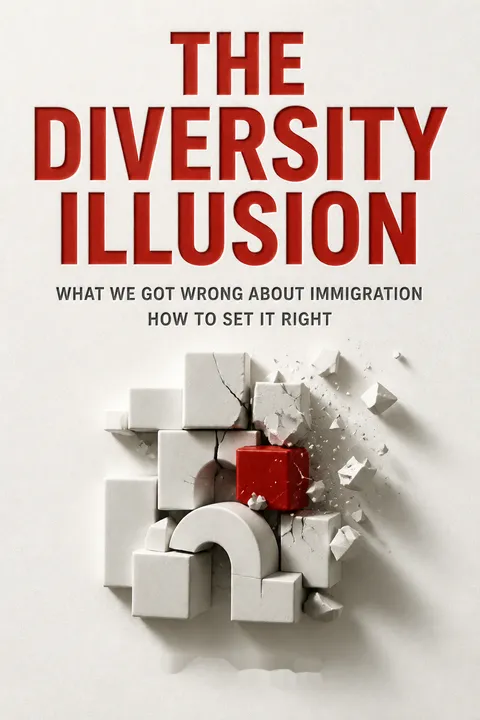


Key Takeaways
Make immigration policy debatable without branding every skeptic racist
A question becomes taboo. The book opens with a political collision: in 2010, Prime Minister Gordon Brown privately called Rochdale voter Gillian Duffy a bigot after she raised immigration and other local concerns. A BBC poll found that 77 percent of white British respondents feared that criticism of immigration would earn them a racist label. Earlier and later polls recorded widespread public concern, including a 2012 survey in which 67 percent said immigration over the previous decade had harmed Britain, while 11 percent called it beneficial.
Consent matters too. West treats the episode as evidence that a major change could proceed without an open, meaningful public debate. His point is not that public opinion alone determines good policy, but that democratic legitimacy suffers when people cannot discuss consequences without being morally disqualified.
What's striking is the difference between disagreement and exclusion from debate. Democratic systems need more than votes: citizens must be able to raise concerns, hear evidence, and revise their views without being assigned a moral identity in advance. That principle does not make every complaint accurate or harmless. Immigration debates can be used to stigmatize minorities, so open discussion also requires clear distinctions between criticizing policy and attacking people. The book is strongest when it asks who gets to speak, rather than treating public anxiety as proof of its own explanation.
Treat diversity as a possible benefit, not a moral verdict
A side effect becomes a goal. West calls the diversity illusion the assumption that greater ethnic and cultural diversity is inherently beneficial, regardless of its scale or consequences. In his account, immigration initially drew support as a way to fill labour shortages. When that economic case became less persuasive, cultural variety was increasingly presented as a social and moral good in itself. The book argues that public institutions came to measure their virtue by visible commitments to diversity.
Separate description from policy. A diverse society is a fact about its population; a diversity policy is a choice about how to shape institutions and manage change. West argues that those choices should be judged by their effects on prosperity, cohesion, equality, and liberty, rather than presumed virtuous. The distinction allows support for individual migrants alongside scrutiny of the overall policy.
The useful conceptual move is to separate a descriptive fact from a moral objective. The presence of different backgrounds does not by itself establish whether a particular policy is fair or effective. That leaves room to recognize cultural exchange and individual achievement while also asking who bears costs and who receives benefits. Yet a simple ledger can miss less measurable goods, including freedom of association and the value of equal membership. The book challenges a one-sided celebration, but its own emphasis on social costs can also crowd out evidence of successful pluralism.
Do not confuse centuries of arrivals with postwar mass migration
Scale changes the story. West challenges the popular claim that Britain has always been a nation of immigrants. He points to earlier arrivals, such as perhaps 40,000 to 50,000 Huguenots over roughly a century, as small relative to the population. The 1948 arrival of the Empire Windrush, carrying 492 Jamaican men alongside Polish passengers, became a symbol of a new era. The British Nationality Act of that year allowed Commonwealth citizens to enter, although politicians did not expect large-scale permanent migration.
Policy later shifted. The book distinguishes that unintended beginning from the sharp increase under New Labour after 1997. It cites former government adviser Andrew Neather's account of ministers pursuing social aims as well as economic ones, while public explanations emphasized economics. West argues that the rate and permanence of change, not migration as such, are central to the debate.
Historical comparisons are most useful when they specify scale, duration, and the rules governing settlement. A small flow over generations is not socially identical to a large flow within a decade, even when both involve people moving across borders. Still, the book's contrast can make the past look tidier than it was: invasion, settlement, and migration overlap, and historical evidence does not yield a single uncontested definition of national continuity. The sound question is not whether Britain changed before, but how fast change occurred, who chose it, and how institutions adapted.
Judge immigration per person, not by GDP's swelling headline
A bigger economy is not automatically richer citizens. West distinguishes total GDP, which tends to rise when the population grows, from income per person and the distribution of gains. He cites a 2008 House of Lords inquiry that found no evidence that net immigration generated significant economic benefits for the existing UK population. Other research discussed in the book suggests that immigration can put modest downward pressure on wages at the lowest end while benefiting some higher-paid workers and employers.
Temporary needs can become permanent. Employers may recruit migrants to fill vacancies, but labour shortages can change, while workers and their families may settle. West argues that cheap labour can also weaken incentives to train local workers or improve conditions. A serious calculation, in his view, must include housing, schools, healthcare, transport, and other public costs, not just tax receipts or output.
This is an important accounting correction: aggregate growth and broad public benefit are different questions. Distribution matters, as do time horizons and the counterfactual. A wage effect may vary by occupation, skill level, and local labour market, while public costs depend on age, employment, family circumstances, and the services counted. The book's economic evidence is a snapshot from its publication period, and its claims should not be treated as settled current estimates. Its durable contribution is methodological: ask who gains, who pays, and what alternative policy would have produced.
Protect social trust as carefully as economic growth
Trust is civic infrastructure. Social capital is the trust, shared norms, and networks that help people cooperate. West draws on Robert Putnam's study of nearly 30,000 Americans, which associated greater ethnic diversity with lower trust, volunteering, charitable giving, and participation in local projects. Putnam described residents in more diverse settings as withdrawing not only from unfamiliar neighbors but, in some cases, from social life more generally.
The progressive dilemma. This is the tension between valuing diversity and sustaining solidarity for shared public services. A welfare state relies partly on citizens believing that people who receive help belong to a community that also supports them. West argues that trust cannot simply be ordered into existence by government, and that policies which weaken it may make redistribution harder to sustain.
The link between trust and collective provision is persuasive because public goods require people to accept costs for benefits they may not personally use. It also helps explain why cohesion is more than nostalgia. But correlation does not establish that diversity itself causes lower trust. Poverty, rapid neighborhood turnover, unequal institutions, and residential sorting can shape both diversity and civic participation. The most productive application is diagnostic: when trust falls, examine how communities interact and whether public institutions are credible, rather than assuming either that diversity is harmless or that shared ancestry is the only route to solidarity.
Build integration around shared institutions, not state-sponsored cultural relativism
A common language gives newcomers a route in. West contrasts late nineteenth-century Jewish schooling with later multicultural policy. The Jewish Free School taught immigrant children English and prepared them for participation in British life while allowing them to retain their religious identity. He presents it as an example of integration that did not require abandoning every inherited tradition.
Separate communities can become official policy. In West's account, multiculturalism moved beyond tolerance toward treating cultures as equally authoritative and organizing public life through community representatives. Councils funded ethnic or religious groups, sometimes encouraging competition for resources and making group identity more politically important. The book argues that this weakened a shared civic framework. It favors a common public culture and law, while recognizing that institutions must protect minorities from discrimination.
A shared institutional floor can make pluralism workable: people need common rules, a language for public participation, and confidence that laws apply consistently. This is not the same as demanding cultural sameness in private life. The hard question is where a society draws that boundary, especially when minority practices conflict with individual rights or when the majority's customs are treated as neutral by default. West's critique usefully exposes the risks of governing through appointed group spokespeople, but integration also depends on whether newcomers are genuinely welcomed into institutions, not only whether they are asked to adapt.
Keep anti-racism law focused on conduct, not hidden thoughts
Definitions shape enforcement. West criticizes the Macpherson inquiry into the police handling of Stephen Lawrence's murder for describing institutional racism in ways he considers difficult to test or disprove. He argues that when institutions must answer for unconscious attitudes as well as identifiable conduct, officials may avoid decisions that could attract accusation. The book connects this concern to expanding equality duties, hate-crime rules, and state efforts to influence institutional outcomes.
Distinguish protection from prediction. The argument is not that racial discrimination never occurs. The book acknowledges the history of exclusion and the need for legal protection, but warns that rules become unjust if a charge of bias is treated as proof of bias. It urges safeguards that make allegations investigable without making them impossible to contest.
The distinction between observable conduct and inferred motive is essential to due process. At the same time, patterns in hiring, education, or policing can reveal unequal treatment even when no individual admits discriminatory intent. A sound standard therefore needs both measurable outcomes and a fair procedure for identifying causes. The book is right to worry about unfalsifiable accusations, but too narrow a focus on explicit acts can miss structural barriers that accumulate across many ordinary decisions. Good anti-discrimination policy must be testable in both directions: it should detect exclusion and allow institutions to challenge mistaken claims.
When mainstream debate closes, extremists inherit legitimate grievances
Silence has political consequences. West revisits Enoch Powell's 1968 immigration speech, which won substantial public support but was condemned by political leaders and much of the press. The speech's language was inflammatory, and the book notes that immigrants felt threatened after it, yet West argues that the episode helped make immigration criticism socially unacceptable. Later, as mainstream parties avoided the subject, far-right groups could present themselves as the few willing to discuss it.
Do not confuse explanation with endorsement. West's claim is that refusing debate does not remove public concerns; it can leave them to movements with harsher rhetoric and poorer answers. The response, in his view, is to contest claims openly and reject violence and racial hostility without declaring every restrictionist argument beyond discussion.
The mechanism is plausible: when respectable institutions refuse to address a concern, less respectable actors can claim exclusive ownership of it. But speech does not operate in a vacuum. A warning framed through menace can intensify fear or make minorities feel under threat, even when it identifies a real policy question. The useful standard is not unrestricted amplification, but open argument with evidence, clear boundaries against dehumanization, and a willingness to answer uncomfortable claims rather than delegitimize the people making them.
Expect communal politics when identity outruns shared national belonging
Elections can become group headcounts. West argues that where citizens feel weak attachment to a common national community, political competition can shift from class interests toward ethnic or religious identity. He points to Britain, where minority voters strongly favored Labour in the elections he discusses, and to examples such as Northern Ireland and Lebanon, where political divisions were closely tied to communal affiliation. He warns that rapid demographic change can make public decisions feel like contests between groups rather than negotiations among citizens.
The risk is not destiny. The book's concern is that parties may target communities through leaders and bloc voting, while citizens lose faith that ordinary politics can respond to them. Its historical comparisons suggest that demographic balance can matter, but do not establish that diverse societies must become violent or undemocratic.
The strongest insight is institutional: identities become politically consequential when parties, electoral incentives, and public services encourage people to act as blocs. That process is not caused by demographics alone. Electoral rules, party strategy, inequality, and the quality of cross-group organizations can either harden or soften group boundaries. Comparisons with conflict zones can illuminate risks, but they can also exaggerate them if different histories and institutions are treated as interchangeable. The practical question is how to preserve political coalitions that cross identity lines while ensuring that minority rights do not depend on majority goodwill.
Pair controlled migration with welfare reform and a teachable national story
Control should serve clear public aims. West's prescription is to limit immigration, especially low-skilled migration from poorer countries, while allowing more movement among countries with broadly comparable incomes and admitting highly skilled workers. He also calls for reforming welfare incentives, improving training, strengthening English-language learning, and teaching British history and literature as shared reference points. He favors a patriotism that welcomes attachment to country without turning it into hostility toward outsiders.
The policy has moral costs. West also proposes revisiting asylum obligations and restricting outside funding for religious institutions he considers incompatible with British law. These recommendations follow from his argument that an open-ended system strains trust and state capacity. They are proposals, not neutral conclusions: they raise difficult questions about humanitarian duties, family unity, and who decides which cultural practices belong in public life.
The conclusion is most coherent when it treats migration, employment, education, and civic identity as connected policy choices rather than isolated problems. A common historical curriculum can provide shared reference points, but it should not turn national memory into a test of loyalty or omit the experiences of minorities. Likewise, border controls may improve democratic accountability, yet restrictions can impose severe costs on people seeking safety or family life. The book's proposals deserve evaluation against explicit goals, transparent evidence, and humane protections, rather than acceptance as the sole alternative to unregulated change.
Analysis
The book is a polemic about immigration, but its deeper subject is the politics of legitimate speech. West argues that postwar guilt, anti-racist moral language, economic liberalism, and elite consensus combined to make rapid demographic change difficult to debate. The Gillian Duffy episode supplies a human-scale entry point: a voter asks questions, a prime minister privately condemns her, and the exchange exposes a gap between popular concern and acceptable political language. From there, the book moves through history, labour economics, social trust, multicultural policy, law, and national identity before advocating tighter controls and a renewed civic story.
Its strongest contribution is to separate the moral worth of migrants from the effects of migration policy. It also insists that total GDP, cultural variety, and official declarations of cohesion are insufficient measures of public benefit. Questions of distribution, housing, wages, social trust, democratic consent, and institutional capacity belong in the same evaluation. The book is particularly useful as a challenge to arguments that treat diversity as automatically enriching or assume that contact alone dissolves group boundaries.
Its limitations are substantial. Much of the evidence is correlational, drawn from diverse settings with different histories, and presented through a single causal lens. The author's examples often support the case for restraint more directly than they test it against alternatives. Some claims about identity, ethnicity, and national continuity are asserted more confidently than the evidence warrants. The figures and political context are also anchored to 2012, so they should not be read as current measurements. Finally, the book's own restrictionist prescriptions create unresolved tensions between democratic control, equal citizenship, and humanitarian obligation.
The most durable reading is therefore neither endorsement nor dismissal. The book makes a forceful case that policy requires public consent and that cohesion is a real political resource. Its claims about causes and remedies need independent scrutiny, especially where association is treated as proof. Its central question remains valuable: how can a society welcome individuals, manage change at a democratic pace, and preserve the institutions that let citizens cooperate?
Review Summary
The Diversity Illusion receives mixed reviews, with an overall rating of 4.04/5. Supporters praise its well-argued critique of mass immigration and multiculturalism, citing statistics and research. Critics argue it lacks nuance, makes unsupported leaps, and ignores key factors like discrimination. Some find it thought-provoking and necessary, while others dismiss it as racist ideology. The book explores topics like social trust, crime rates, and cultural clashes, with some readers appreciating its challenging perspective and others finding it biased or poorly supported.
People Also Read






Glossary
Diversity illusion
Diversity treated as inherently goodWest's label for the belief that increasing ethnic and cultural diversity is a moral and social good in itself, independent of its scale or effects. He argues that this belief helped make immigration policy harder to question and shifted public institutions toward treating diversity as an objective rather than a possible outcome of policy.
Social capital
Trust that enables cooperationThe networks, shared expectations, and interpersonal trust that help people cooperate and support common institutions. In the book, social capital helps explain why communities may sustain public goods and welfare systems, and why reduced trust can make collective action harder. West discusses the term through Robert Putnam's work on civic engagement and community life.
Progressive dilemma
Diversity versus welfare solidarityA tension identified by David Willetts: progressive politics may seek both cultural diversity and generous, universal welfare, although support for redistribution can depend on a sense of shared community. West uses the idea to question whether societies can expand diversity without weakening the trust and solidarity that make people willing to fund common services.
Bonding social capital
Trust within a groupThe ties and mutual support formed among people who share a community or identity. West contrasts this with bridging social capital, which links people across group boundaries. Strong bonding can provide belonging and practical support, but in a diverse society it may coexist with isolation or competition between communities.
Bridging social capital
Trust across group boundariesConnections that enable cooperation among people from different communities or backgrounds. In West's discussion, bridging social capital is important to social cohesion, but efforts to promote it can conflict with the close internal ties that give people belonging and support. The book uses the distinction to question whether diversity automatically creates meaningful interaction.
Diversity paradox
Diversity brings gains and costsA term attributed in the book to political scientist Scott Page for the possibility that diversity can improve problem-solving and innovation while also reducing cohesion or cooperation in some settings. The implication is that diversity's effects depend on context and scale, so benefits cannot be assumed to outweigh social costs automatically.
E Pluribus Unum: Diversity and Community in the 21st Century
Study of diversity and civic lifeRobert Putnam's study of American communities, discussed by West as evidence that ethnic diversity may be associated with lower social trust, volunteering, and civic participation. Putnam's findings are central to the book's argument about social capital. The study reports associations across communities; it does not by itself prove that diversity is the sole cause of those differences.
When Prophecy Fails
Study of belief after disconfirmationA social psychology study by Leon Festinger, Henry Riecken, and Stanley Schachter about a group that expected a catastrophic flood and rescue by aliens. When the prediction failed, some committed believers intensified their efforts to persuade others. West uses the case to explain how people may defend a deeply invested belief after evidence contradicts it.
Multiculturalism
State recognition of cultural groupsWest distinguishes ordinary cultural exchange from a policy approach that treats different cultures as equally valuable and organizes public institutions around group difference. He argues that this approach can weaken shared civic expectations and make communities more politically separate. The term has several meanings in the book, from descriptive diversity to government policy.
FAQ
What's The Diversity Illusion about?
- Critical Examination of Immigration: The book analyzes the impact of mass immigration on British society, arguing that the benefits of diversity are often overstated.
- Political and Social Consequences: Ed West discusses the political motivations behind immigration policies and the resulting societal ambivalence towards multiculturalism.
- Call for Honest Discussion: The author advocates for open dialogue about immigration, challenging the taboo surrounding criticism of diversity.
Why should I read The Diversity Illusion?
- Informed Perspective: The book provides insights into the complexities of immigration and diversity, encouraging critical thinking about mainstream narratives.
- Historical Context: It offers a historical overview of immigration in Britain, essential for understanding contemporary social issues.
- Engaging Writing Style: Ed West's journalistic background ensures the book is both informative and accessible, using polling data and real-life examples.
What are the key takeaways of The Diversity Illusion?
- Mass Immigration's Impact: West argues that mass immigration has led to significant societal changes, often resulting in segregation and social tension.
- Cultural and Social Costs: The book highlights the social costs of diversity, such as lower social trust and community cohesion.
- Need for Honest Debate: A major takeaway is the importance of having an honest conversation about immigration and its consequences.
What are the best quotes from The Diversity Illusion and what do they mean?
- “Diversity became not just the side effect of immigration policy but an official good in itself.”: This quote underscores how diversity is often framed as inherently positive without critical examination.
- “Mass immigration in England happened largely by accident.”: West points out that current immigration levels were not part of a strategic plan but rather a series of uncoordinated decisions.
- “To even question whether this is either ethically right or beneficial to society is viewed as immoral.”: This reflects the societal taboo surrounding discussions of immigration.
How does Ed West define multiculturalism in The Diversity Illusion?
- Multiculturalism as Policy: West defines it as a policy promoting the idea that all cultures should be valued equally, often at the expense of the dominant culture.
- Cultural Relativism Influence: He argues that multiculturalism is influenced by cultural relativism, which can lead to a lack of accountability.
- Historical Roots: The book traces multiculturalism back to the 1960s, evolving from a desire for tolerance to a policy prioritizing minority rights over national cohesion.
What are the social implications of immigration discussed in The Diversity Illusion?
- Increased Segregation: West argues that immigration has led to greater social segregation, with communities becoming more insular.
- Crime and Safety Concerns: The book discusses the rise in crime associated with certain immigrant communities, particularly among youth gangs.
- Impact on Public Services: West highlights how increased immigration strains public services, leading to competition for resources.
How does The Diversity Illusion address the concept of social capital?
- Importance of Social Trust: West discusses how social capital is crucial for community cohesion and argues that diversity can erode this trust.
- Diversity vs. Solidarity: The book posits that while diversity can bring new perspectives, it often comes at the expense of social solidarity.
- Consequences of Erosion: As social capital declines, so do the benefits of a cohesive society, such as lower crime rates and better public services.
How does The Diversity Illusion challenge the mainstream narrative about immigration?
- Questioning the Benefits: West challenges the belief that immigration is unambiguously beneficial, presenting evidence of significant drawbacks.
- Political Motivations: The book highlights how political motivations have shaped immigration policies, often prioritizing electoral gains.
- Cultural Critique: West critiques cultural narratives surrounding diversity, arguing they often overlook social fragmentation and conflict.
What solutions does Ed West propose in The Diversity Illusion?
- Need for Honest Dialogue: West advocates for open discussions about immigration and its effects, encouraging society to confront uncomfortable truths.
- Reassessing Immigration Policies: He suggests that immigration policies should be re-evaluated to consider long-term social impacts.
- Fostering Community Cohesion: West emphasizes the importance of fostering social cohesion and trust within communities.
How does The Diversity Illusion relate to current events and debates about immigration?
- Relevance to Modern Discourse: The book is highly relevant to ongoing debates about immigration, addressing complexities and challenges of diverse societies.
- Impact of Political Decisions: West discusses how recent political decisions regarding immigration have shaped public sentiment and societal dynamics.
- Cultural and Social Implications: The author highlights the cultural and social implications of immigration, often overlooked in political discussions.
How does The Diversity Illusion critique the media's portrayal of diversity?
- Media Bias: West argues that the media often presents an overly positive view of diversity, ignoring associated challenges.
- Censorship and Self-Censorship: The book discusses how fear of backlash can lead to self-censorship, preventing honest discussions.
- Impact on Public Perception: West highlights how media narratives shape public perceptions, often leading to misconceptions.
What role does cultural identity play in The Diversity Illusion?
- Cultural Aspirations: West discusses how individuals often adopt new cultural identities out of aspiration or insecurity.
- Impact on Integration: The book argues that strong cultural identities can hinder integration, as individuals may feel more connected to their ethnic group.
- Cultural Relativism's Effect: West critiques cultural relativism for promoting the idea that all cultures are equally valid, which can undermine the host culture.
Download PDF
Download EPUB
.epub digital book format is ideal for reading ebooks on phones, tablets, and e-readers.








