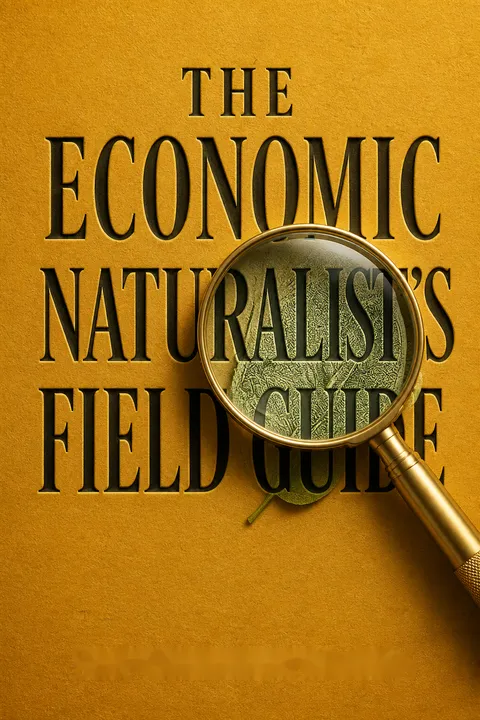


Key Takeaways
Treat economics as choice under scarcity, not a theory of selfish robots
Choices have trade-offs. Frank’s starting point is that economics studies choices made with limited resources, not just money or markets. Its traditional models often assume people are narrowly self-interested, evaluate options in isolation, and make calm, rational decisions. Everyday behavior complicates all three assumptions: people return lost wallets, vote, and respond to what others around them consider normal. A Paris wine merchant, for instance, recommended a less expensive champagne for cocktails because the finer bottle’s quality would be lost when mixed. His advice reflected a norm about using goods appropriately, not simply a calculation of personal gain.
Context changes value. A car, home, or meal can feel adequate in one era or neighborhood and inadequate in another. The book’s behavioral economics perspective takes these social comparisons and predictable judgment errors seriously, making economic arguments more realistic and less dismissive of human motives.
The strength of this starting point is methodological: economic models become more useful when their assumptions are treated as hypotheses rather than portraits of human nature. Psychology has long shown that judgments depend on framing and comparison, while anthropology reveals how norms define what counts as appropriate consumption. Yet contextual influence does not make people irrational by definition. Norms can encode valuable shared knowledge, as the merchant’s advice did, or enforce costly conformity. The useful question is not whether preferences are socially shaped, but which social pressures improve decisions and which merely move the standard.
When rewards depend on rank, voluntary choices can trap everyone in an arms race
Competition can cancel its gains. Thomas Schelling’s hockey example shows the problem: a player may gain an edge by removing a helmet, perhaps by seeing or hearing better. If every player does so, the competitive balance returns, but everyone faces more risk. A helmet rule can leave all players better off by preventing the race.
Everyday contests work similarly. Families may accept dangerous jobs for higher pay to afford homes near better schools. If everyone takes riskier work, they bid up housing prices without changing which children attend above-average schools. Applicants who buy increasingly expensive interview clothes may likewise spend more without changing who gets hired. In these cases, individual choices make sense within the contest, but the group’s outcome can be worse. Rules can limit a race without denying that its participants have real reasons to compete.
This is a powerful correction to the assumption that choice itself proves a person is better off. In evolutionary biology, a trait can spread because it improves an individual’s relative position, even when it imposes a cost on the group. The same logic appears in organizational cultures where long hours become a signal of commitment. Still, collective rules need careful design: a restriction that prevents wasteful competition can also block genuine innovation or individual preference. The test is whether the rule reduces a positional race while preserving choices that create value beyond rank.
Make efficient policies fair with compensation instead of preserving waste
Efficiency can fund fairness. Frank rejects the idea that society must choose between an efficient policy and protecting people who would bear its costs. If a policy creates gains larger than its losses, those gains can often compensate the people harmed and still leave a net benefit.
The car-emissions example makes the point. In Los Angeles, older vehicles produced a large share of smog, yet were exempted from stricter standards partly because poorer drivers owned them. That exemption forced more expensive pollution cuts from newer cars. Frank argues that the savings from removing the exemption could instead fund vouchers helping low-income drivers replace older vehicles. The example captures his broader policy rule: identify who loses, then ask whether compensation can address the burden more cheaply than preserving an inefficient system. Transfers are not an afterthought; they can make better policies politically and morally workable.
The argument connects economic efficiency to the practical design of social insurance. A policy that raises total welfare but leaves specific groups exposed may be theoretically attractive and politically doomed. Compensation can bridge that gap, much as transition assistance helps workers adapt to technological change. But the promise that everyone can be made better off is conditional: gains must be measurable, transfers must reach the affected people, and administrators must be able to deliver them. Distribution cannot be solved by invoking a larger economic pie alone. It requires institutions that actually share the gains.
Charge users for social costs, then return revenue without erasing incentives
Prices should reflect real costs. When a product’s price excludes harms imposed on others, people tend to use too much of it. Economists call these spillover costs negative externalities. Pollution, congestion, and accident risks are examples. A tax can bring the price closer to the full social cost, encouraging people to reduce the most costly uses.
The rebate need not undo the signal. Frank’s gasoline proposal pairs a higher fuel tax with a broadly distributed payroll-tax rebate. A household would receive the rebate regardless of how much gasoline it used, preserving the incentive to conserve while cushioning the financial hit. The same logic applies to congestion fees: a city could charge motorists for scarce road space and use revenue or vouchers to protect lower-income commuters. A London congestion charge, the book reports, reduced downtown traffic and travel times.
The key distinction is between changing a price and changing a household’s overall resources. A rebate can protect purchasing power without making extra fuel use cheap again, a design principle also used in some carbon-pricing proposals. The approach is elegant, but its distributional details matter: a flat rebate may not match differences in commuting needs, rural access, or household size. Moreover, price signals work best when people have alternatives. Transit, efficient vehicles, and walkable neighborhoods determine whether conservation is a practical choice or simply another burden.
Tax spending, not saving, to loosen luxury races and rebuild investment
Relative standards can inflate spending. Frank argues that rising luxury consumption at the top can reset what others consider normal. Bigger houses, more expensive cars, or lavish celebrations may bring little lasting advantage when everyone moves the standard upward. The book calls the resulting chain of upward pressure expenditure cascades.
A consumption tax changes the calculation. Instead of taxing income regardless of whether it is spent or saved, a progressive consumption tax would tax spending after a deduction, leaving savings untaxed until used for consumption. Frank argues that this could encourage investment while making high-end purchases more expensive at the margin. He also links insufficient saving to retirement insecurity and reliance on foreign borrowing. The aim is not to condemn luxury buyers, but to alter incentives so that reducing spending does not require one household to unilaterally fall behind its neighbors.
This proposal brings together behavioral economics and tax design: if social comparison makes private spending partly positional, taxing consumption may reduce a race without reducing satisfaction proportionately. The argument also recognizes that saving and investment can support future productivity. Its most important limitation is empirical: not all expensive consumption is status competition, and a consumption tax can burden households that spend most of their income. A workable version would need careful exemptions, progressivity, and transition rules. The underlying insight is broader than the specific tax: incentives can shape social norms as well as individual budgets.
Winner-take-all rewards pull talent toward contests society already has enough of
Small differences can produce huge prizes. In winner-take-all markets, technology lets a few top performers serve enormous audiences, so slight differences in perceived performance can translate into enormous differences in earnings. Voice cloning, recorded entertainment, and widely distributed software are examples: the most popular provider can reach many customers at low additional cost.
The rewards can misallocate talent. Frank points to hedge funds, where conspicuous high earnings attract ambitious graduates. Yet in a crowded field, one more portfolio manager may capture fees from competitors without creating much additional value. Overconfidence about the odds of winning intensifies the rush. Similar status contests affect universities, where rankings can spur merit aid for already privileged applicants at the expense of need-based support. The social question is not whether top performers contribute, but whether the reward structure draws too many capable people into contests with diminishing returns.
The analysis of winner-take-all markets clarifies why inequality can rise even without a sudden collapse in competition. Digital distribution lowers the cost of serving an additional customer, allowing small advantages to scale globally. But high pay does not automatically prove either social value or waste. Some financial expertise can improve the allocation of capital, and broad access to successful creative work can benefit consumers. The hard task is distinguishing productive scale from rent-seeking and congestion. Policy should focus less on envy of outcomes and more on whether rewards attract effort toward activities with high social returns.
Keep cooperation viable with norms, trust, and enforceable rules
Honesty is not just altruism. People sometimes cooperate for moral reasons, but business can also reward trustworthiness. An employer may promote an honest manager to a job that requires working far from direct supervision. Reputation can therefore make ethical conduct economically valuable, even when cheating is difficult to detect.
Rules prevent a race toward dishonesty. If firms exaggerate earnings to keep up with competitors, cautious reporting can threaten their survival. Without monitoring and penalties, one company’s aggressive practices pressure others to follow. The same logic applies to doping in sports and tax cheating. Yet sanctions are not the whole story: civic volunteers and small political donors often contribute without expecting a personal payoff. Frank’s account of collective action insists that people can value participation itself, not only the private benefits it brings.
The argument joins institutional economics with social psychology. Trust can reduce the need for costly monitoring, but institutions help make trust rational by punishing predictable exploitation. This complementarity matters: moral norms alone can place compliant people at a disadvantage, while enforcement alone may produce rule-following without commitment. A further complication is that reputations are imperfect and can reflect prejudice as well as character. Fair systems need transparent standards, proportionate penalties, and ways to correct mistaken judgments, not simply faith that good people will be recognized.
Treat health coverage and credit as systems, not isolated bargains
Private choices can create public costs. Health insurers have incentives to avoid people likely to need care, leaving individuals exposed to costs that can overwhelm a household and spill into emergency services. Frank argues that broad coverage can reduce both exclusion and administrative duplication. He also stresses that national policy is often more effective than local programs when people, costs, or benefits cross borders. A local health plan, for example, could attract costly patients while wealthier taxpayers leave.
Easy credit can exploit short-term judgment. Payday loans may solve an urgent cash problem, but repeated rollovers can make repayment far exceed the original loan. Frank argues that this pattern reflects not only lender conduct but also rules that allow people to borrow on terms they struggle to evaluate. Restrictions can protect vulnerable borrowers, although they may also cut off credit that some people value. The relevant question is how to manage the whole system’s risks and benefits.
Health insurance and short-term lending both reveal why consent alone does not settle questions of welfare. Health coverage involves adverse selection, where people’s expected need affects who buys insurance, while borrowing can be shaped by present bias, the tendency to give immediate relief more weight than future repayment. These are genuine market-design problems, not proof that all private choices need state control. Regulation can also create shortages or push borrowers toward less visible alternatives. Good policy therefore needs evidence about outcomes, attention to unintended substitution, and accessible alternatives.
Do not confuse available information with reliable knowledge
Disclosure can help, but silence is ambiguous. The full disclosure principle predicts that people may reveal even unflattering facts because others could imagine something worse if they remain quiet. Yet political candidates may still withhold medical or financial records, since concrete revelations can be more damaging than speculation. Disclosure rules matter when voters need information to make informed choices.
First impressions can distort learning. In a trust-game experiment described in the book, participants continued to trust partners portrayed as good, even after seeing that all partner types shared at the same rate. The experiment suggests that prior beliefs can interfere with updating. Hiring can show a related problem: a résumé field experiment found that applicants with names associated with Black Americans received fewer interview callbacks than similarly qualified applicants with names associated with white Americans. More information is not automatically better if bias shapes how it is interpreted.
This section connects information economics to the psychology of belief revision. Data do not enter a neutral mind; expectations influence which evidence is noticed and how it is weighted. That makes disclosure necessary in high-stakes settings, but not sufficient. Institutions also need standardized comparisons and accountability for decisions, especially in hiring and politics. The trust-game finding should be interpreted carefully: a controlled experiment isolates one mechanism, not every real-world interaction. Still, it warns against assuming that people update fairly just because relevant facts are available.
Learn economics by explaining ordinary puzzles, then apply opportunity cost
Master a few ideas through use. Frank argues that introductory economics often overwhelms students with technical material while leaving basic reasoning behind. His alternative is the economic naturalist assignment: students pose a question about something they have observed and explain it with economic principles. One student asked why drive-up ATMs have Braille keypads. The answer was that using the same keypad for walk-up and drive-up machines can be cheaper than managing separate inventories.
Count what you give up. Opportunity cost is the value of the best alternative forgone. In a concert example, a free ticket to one performer is not costless if attending means giving up a second-best concert worth more than its ticket price. The book also cautions would-be investors: widely reported economic data rarely give individuals a durable edge once markets have already reacted. Clear reasoning beats a flood of numbers.
The teaching method reflects a robust principle from learning science: active retrieval and explanation help people retain ideas better than passive exposure. An everyday puzzle gives an abstract concept a memorable setting and makes students test whether the explanation fits. But one neat explanation is not proof of the true cause; economic naturalists should compare alternatives and look for evidence. The same discipline helps investors resist false confidence. Familiarity with economic indicators can improve understanding without granting a reliable ability to predict prices or time a market.
Analysis
The book’s unifying claim is that economics becomes more humane and more accurate when it stops treating isolated rational choice as a sufficient explanation. Across taxation, health care, education, energy, finance, and ethics, Frank repeatedly asks what happens after millions of individually sensible decisions interact. The answer is often a positional contest, a spillover cost, or an institutional feedback loop. That shift in scale is the book’s strongest contribution: it makes policies such as safety rules, pollution taxes, and social insurance intelligible without assuming that citizens are foolish or that markets are inherently corrupt.
Its deepest practical lesson is to separate three questions that political debate often collapses. Does a choice benefit the person making it? Does the combined pattern benefit the group? Can policy improve the group outcome while fairly treating those who bear transition costs? The book’s examples show why the answers can differ. A worker may rationally accept danger to afford a better school district, while universal competition for those homes leaves relative rankings unchanged. A fuel tax may discourage harmful consumption, but rebates and alternatives determine whether its burden is acceptable.
The framework also has limits. Relative comparison explains some spending, but not all demand for quality; absolute income still enables health, security, and meaningful choice. A policy that enlarges total surplus does not automatically compensate losers, and estimates of social costs are contested. Rules can curb arms races, but can also freeze institutions or shelter incumbents. These are reasons to demand measurement and institutional scrutiny, not to retreat to simplistic claims that either markets or government always know best. Frank’s economic naturalist approach offers a fitting method for navigating that complexity: begin with a concrete puzzle, identify incentives and alternatives, then examine effects beyond the immediate chooser. The method does not guarantee a correct answer. It does make hidden assumptions visible, which is often the first step toward better public judgment.
Review Summary
The economic naturalist's field guide receives mixed reviews, with an average rating of 3.48/5. Readers appreciate its accessible explanations of economic principles using real-life examples, though some find it repetitive and US-centric. The book is praised for its engaging writing style and diverse topics, covering politics, sports, and consumer behavior. Critics note that some explanations feel rushed or unconvincing. Many readers find it informative and thought-provoking, especially for those new to economics, but some experienced economists may find it less valuable.
People Also Read








Glossary
Economic naturalist assignment
Explain everyday puzzles economicallyA writing exercise in which students ask a question about an observed pattern or behavior, then use basic economic principles to explain it. The assignment emphasizes familiar examples and clear prose rather than technical notation. Frank presents it as a way to learn economics through repeated application, explanation, and storytelling.
Expenditure cascades
Spending standards spread downwardA chain reaction in which higher spending by people near the top changes the reference standards of those just below them, who then spend more in response. The process can continue down the income ladder. In Frank’s account, these cascades help explain why housing, cars, and other purchases grow more expensive even when middle incomes stagnate.
Winner-take-all markets
Small edges earn huge rewardsMarkets in which a small difference in performance, reputation, or perceived rank can produce a very large difference in income. Technologies that let one performer or provider serve a vast audience intensify the effect. Frank applies the idea to entertainment, software, finance, education, and executive pay.
Relative income hypothesis
Spending responds to social comparisonsJames Duesenberry’s account of consumption, in which people’s spending depends partly on their income relative to others and on their own past living standards. It helps explain why saving rates differ across income groups and why households resist cutting consumption during downturns. Frank argues that this approach better captures context than theories based only on long-run average income.
Opportunity cost
Value of the best forgone optionThe value of the most attractive alternative a person gives up when making a choice. It includes more than direct cash expenses. For example, attending a concert with a free ticket still has an opportunity cost if it means missing another event that the person values more than its admission price.
Negative externalities
Costs imposed on outsidersCosts created by producing or consuming something that fall on people other than the buyer and seller. Pollution, traffic congestion, and some accident risks are examples discussed in the book. When market prices omit these costs, people have an incentive to consume or produce more than is socially worthwhile.
Aspen effect
Inequality pushes workers outwardFrank’s term for the way rising wealth in desirable areas can price service workers out of local housing, forcing them to commute from farther away. He uses resort communities such as Aspen to illustrate how income inequality can contribute to longer commutes and congestion, even for people who do not live in those communities.
Full disclosure principle
Silence can imply worse informationA principle from economic signaling theory that predicts people may disclose relevant information, even when it is unfavorable, because observers could otherwise assume the undisclosed facts are worse. Frank applies it to political candidates and explains why the prediction can fail when actual disclosure creates a more vivid or damaging impression than speculation.
Statistical life
An abstract probability of survivalA policy concept used to describe a small change in risk spread across many people, such as a safety measure expected to prevent an average of one death. Frank contrasts it with an identified life, the known individual in immediate danger. The distinction helps explain why people may respond differently to preventing a probable future death and rescuing a visible victim.
FAQ
1. What is The Economic Naturalist's Field Guide by Robert H. Frank about?
- Everyday economics explained: The book uses real-life examples and newspaper columns to illustrate how economic principles apply to daily choices and public policy.
- Behavioral economics focus: Frank incorporates insights from psychology and social context, showing that people often act beyond narrow self-interest.
- Policy and social issues: It addresses topics like income inequality, health care, environmental policy, and market failures, making economics accessible and relevant.
2. Why should I read The Economic Naturalist's Field Guide by Robert H. Frank?
- Clear, practical insights: Frank distills complex economic ideas into core principles, using familiar situations to make them understandable and useful.
- Challenges common misconceptions: The book debunks popular myths about taxes, government spending, and market behavior with evidence-based explanations.
- Broad topic coverage: Readers gain tools to analyze personal decisions and public debates, from financial markets to environmental issues.
3. What are the key takeaways from The Economic Naturalist's Field Guide by Robert H. Frank?
- Efficiency and equity align: Frank argues that economic efficiency can promote fairness, especially with wise redistribution.
- Context shapes choices: Social context and relative comparisons heavily influence spending, saving, and happiness.
- Behavioral economics matters: Recognizing cognitive biases and motives beyond self-interest leads to better policy and personal decisions.
- Pragmatism over ideology: Economic choices should be based on cost-benefit analysis, not rigid beliefs.
4. What are the main economic concepts explained in The Economic Naturalist's Field Guide by Robert H. Frank?
- Negative externalities and taxes: The book explains how activities like pollution impose costs on others and how taxes can correct these market failures.
- Winner-take-all markets: It explores how small differences in talent can lead to huge income disparities, especially in globalized, competitive fields.
- Behavioral economics and information: Frank discusses how imperfect information and cognitive biases affect economic decisions.
5. How does Robert H. Frank use behavioral economics in The Economic Naturalist's Field Guide?
- Beyond self-interest: The book shows that people often act ethically and cooperatively, not just out of self-interest.
- Cognitive biases: Frank highlights how biases and emotional influences lead to decisions that deviate from traditional economic predictions.
- Policy implications: Understanding real human behavior helps design more effective policies, such as regulating predatory lending.
6. How does The Economic Naturalist's Field Guide by Robert H. Frank explain income inequality and its causes?
- Globalization and competition: Rising inequality is linked to more competitive, globalized markets that reward top performers disproportionately.
- Expenditure cascades: Increased spending by the wealthy raises social standards, pressuring others to spend more and often leading to financial strain.
- Policy effects: Tax cuts for the wealthy and reduced social spending worsen inequality and can harm social mobility and growth.
7. What does Robert H. Frank recommend for addressing inequality and market failures in The Economic Naturalist's Field Guide?
- Progressive consumption taxes: Frank advocates taxing consumption rather than income to curb luxury spending and reduce inequality.
- Efficient pricing: He supports pricing scarce resources (like congestion pricing) to reduce waste and improve welfare.
- Reforming subsidies and taxes: The book suggests eliminating fuel subsidies and increasing gasoline taxes, with rebates to protect low-income groups.
8. How does The Economic Naturalist's Field Guide by Robert H. Frank explain the role of incentives in economic behavior?
- Incentives shape choices: People respond rationally to incentives, but these often ignore external costs or social context.
- Arms races in spending: Social norms and relative comparisons can create wasteful competition in consumption and education.
- Policy realignment: Taxes, subsidies, and regulations can correct market failures and encourage socially beneficial behavior.
9. What insights does Robert H. Frank provide about winner-take-all markets in The Economic Naturalist's Field Guide?
- Technology amplifies rewards: Digital distribution allows top performers to reach larger audiences, increasing income disparities.
- Overcrowding and inefficiency: Too many entrants compete in these markets, leading to wasteful competition and misallocated resources.
- Impact on education: Elite universities compete for top students with merit-based aid, reflecting the high stakes of winner-take-all labor markets.
10. How does The Economic Naturalist's Field Guide by Robert H. Frank address the relationship between money, happiness, and well-being?
- Insatiable desires: Human wants for quality and status are boundless, driving continuous consumption even as incomes rise.
- Happiness vs. welfare: While happiness may not increase with income due to adaptation, economic growth still improves health, safety, and social support.
- Limitations of GDP: GDP growth doesn't fully capture well-being, especially when income inequality affects relative happiness.
11. What does Robert H. Frank say about economics education and learning in The Economic Naturalist's Field Guide?
- Traditional teaching falls short: Introductory courses often overwhelm students with technical detail, leading to poor retention.
- Repetition and simplicity: Focusing on a few core principles and applying them in familiar contexts improves understanding.
- Professors’ understanding matters: Some instructors lack mastery of basic concepts, undermining effective teaching.
12. What practical advice does Robert H. Frank offer on investing and financial decision-making in The Economic Naturalist's Field Guide?
- Efficient markets skepticism: Frank explains that most information is already reflected in stock prices, making it hard to consistently beat the market.
- Beware of bubbles: Herd behavior and relative performance pressures can lead to speculative bubbles, as seen in tech stocks and the 2008 crisis.
- Long-term strategies: He advises focusing on long-term investment strategies and the power of compound interest, rather than trying to time the market.
About the Author
Other books by Robert H. Frank





Download PDF
Download EPUB
.epub digital book format is ideal for reading ebooks on phones, tablets, and e-readers.








