

Key Takeaways
Build wealth by widening the gap between income and spending
Saving creates choices. The book opens with Oseola McCarty, a washerwoman who saved for decades and left $150,000 to the University of Southern Mississippi. Her example makes the central point: wealth depends less on a dazzling income than on consistently spending less than you earn. The authors contrast her with a man earning more than $10 million annually who still ran short because his lifestyle consumed it all.
Make saving sustainable. Saving is not meant to turn life into a joyless contest of denial. The point is to spend deliberately on what matters and reserve money for future needs, from retirement to education. Reviewing purchases, skipping impulse buys, and redirecting low-value spending can make saving a repeatable habit rather than a temporary austerity plan.
What's powerful here is the distinction between income and financial agency. Behavioral economics calls the tendency to spend more as income rises lifestyle inflation, a pattern that can quietly erase raises before they become security. A deliberate savings rate counters that drift by giving future priorities a claim on today's income. Still, McCarty's story should not imply that thrift alone overcomes every barrier: housing costs, health expenses, wages, and family obligations constrain many households. The useful lesson is not to imitate her exact sacrifices, but to protect a sustainable margin between what comes in and what goes out.
Start investing early; time can beat both luck and larger deposits
Compounding rewards patience. Investment growth can build on earlier growth, so time in the market matters enormously. The Rule of 72 is a rough mental shortcut: divide 72 by an annual percentage return to estimate how many years it takes money to double. At 8 percent, that is about nine years. The return is not guaranteed, but the arithmetic shows why starting early can matter more than finding a perfect entry point.
The twins illustrate the gap. In the book's example, William invests $4,000 annually from age 20 for 20 years, then stops. James starts at 40 and invests annually for 25 years. Assuming a steady 10 percent tax-free return, William has nearly $2.5 million at 65, while James has less than $400,000. The assumptions are illustrative, not a forecast, but the time advantage is real.
Compounding is often described as a mathematical effect, but its practical force is behavioral: early contributions buy time, while repeated postponement makes later saving more demanding. The twins' example is deliberately stark, and its fixed 10 percent return should not be mistaken for a dependable annual outcome. Actual markets fluctuate, and taxes and fees matter. The robust conclusion survives those qualifications: begin with an amount that is manageable, increase it when possible, and avoid waiting for the confidence or ideal market conditions that rarely arrive on schedule.
Pay off costly card balances before chasing investment returns
Debt compounds against you. The authors treat credit-card balances as a financial emergency because their interest charges can overwhelm ordinary investment gains. At 18 percent, a balance roughly doubles in four years if unpaid, then continues growing as interest accrues on interest. Paying down that balance is effectively a certain improvement to your finances, unlike an investment return, which is uncertain.
Not all borrowing is alike. The book distinguishes revolving card debt from a home mortgage. A mortgage can provide a stable place to live, usually carries a lower interest rate, and has defined repayment terms. That does not make every mortgage wise, but it explains why the authors condemn card debt far more strongly. Their practical rule is to use a credit card for convenience only when the balance can be paid in full.
This advice rests on a clean comparison: a high, contractually charged borrowing cost versus a volatile expected investment return. It is a useful antidote to the temptation to invest while carrying expensive debt just to feel like an investor. Personal finance also depends on liquidity, however. A household that empties every cash reserve to repay debt may become vulnerable to the next car repair or medical bill and borrow again. A small emergency buffer alongside a serious repayment plan can make the rule more durable without weakening its core logic.
Own broad index funds instead of betting on tomorrow's star manager
Buy the whole market. An index fund holds the securities in a chosen market measure rather than trying to select the winners. The authors argue that prices already incorporate information gathered by many investors, making it exceptionally difficult to identify mispriced stocks or predict market moves consistently. They report that, over the 10 years ending in 2019, 89 percent of active U.S. equity funds underperformed the S&P 500.
A winner is hard to spot early. In the book's example, 14 funds beat the market for nine consecutive years through 2007, but only one beat it in 2008. Past success did not reliably identify future success. Indexing does not prevent losses when markets fall. It offers broad ownership, predictable market-level exposure, and less dependence on choosing a rare manager who will keep outperforming.
Indexing turns a difficult forecasting problem into a simpler ownership decision. It resembles accepting the aggregate judgment of competing participants rather than assuming that a private forecast can outperform theirs after costs. That is especially attractive when even professional skill is hard to distinguish from luck over short periods. The caveat is that an index is not a safety guarantee: a broad stock fund can lose heavily, and an index's composition reflects the market it tracks. Investors still need to choose suitable risks and avoid confusing broad diversification with protection from every downturn.
Make fees and turnover your first performance screen
Costs come out of your share. The authors emphasize that management fees, trading costs, and taxes reduce the return investors keep. In one comparison covering general equity funds from 2001 to 2018, the lowest-cost quartile returned an average 10.29 percent annually, while the highest-cost quartile returned 8.85 percent. The comparison does not prove fees explain every performance difference, but the pattern supports treating cost as a serious selection factor.
Trading has hidden friction. Frequent portfolio changes can create commissions, bid-ask spreads, market impact, and taxable gains. The book warns against chasing funds with recent hot records or paying a broker whose incentives may favor transactions. For investors choosing funds, the authors favor low-cost, broadly diversified products and urge attention to expense ratios, turnover, and the tax consequences of investing outside retirement accounts.
Fees are unusually visible among investment variables because they are known in advance, while future returns are not. That makes cost control a form of decision-making under uncertainty: remove a predictable drag rather than pay for a promise that may not materialize. Historical cost comparisons can still reflect differences in strategy, risk, or fund survival, so they should not be read as a controlled experiment. Their practical force is more modest and stronger: avoid paying persistently high costs unless the service offers a clear value that a simple, low-cost alternative cannot provide.
Diversify away from the company paying your paycheck
One employer can be two risks. The book recounts an Enron secretary whose retirement savings were concentrated in her employer's stock. When the company collapsed, she lost both her job and her nest egg. James Rhodes, an auto-industry worker, and his wife similarly concentrated savings in Chrysler bonds, tying their retirement to the industry that had employed him. Loyalty and familiarity did not make either investment safe.
Spread risk across holdings. Broad stock funds reduce dependence on any one company. Bonds can steady a portfolio when stocks fall, while international holdings expose investors to economies beyond the United States. The authors also discuss real estate and other real assets as possible diversifiers. Diversification cannot prevent all losses, especially when markets fall together, but it can keep one company's failure from determining an entire financial future.
The Enron example reveals a risk that a portfolio-only view can miss: a worker's income and investments may depend on the same organization. In risk management, this is concentration across connected exposures, not merely a shortage of stock tickers. The same logic applies to industries and countries. Diversification works best when holdings respond differently to economic events, yet correlations can rise during crises, so spreading assets is not a force field. Its purpose is to reduce avoidable dependence, not to promise that some corner of a portfolio will always rise.
Keep buying on schedule when volatility makes prices uncomfortable
Regular investing spreads entry points. Dollar-cost averaging means investing a set amount at regular intervals rather than committing all contributions at one moment. When prices fall, the same contribution buys more shares; when prices rise, it buys fewer. The technique does not eliminate the risk of losses, but it can reduce the regret of investing everything just before a decline.
A volatile example surprises. The authors compare five annual $1,000 investments in two markets. In one, prices swing sharply and end where they began; in the other, prices rise steadily by 40 percent. The investor in the volatile market ends with $6,048, compared with $5,915 in the rising market, because lower prices allowed more shares to be bought. This result depends on the sequence of prices and does not mean volatility always helps.
Regular contributions make volatility psychologically and mathematically different for someone still accumulating assets than for someone who must sell to fund current spending. Falling prices can benefit a continuing buyer, but only if the buyer has income, a long horizon, and the ability to keep contributing. There is an important boundary: when a lump sum is already available, investing it gradually may sacrifice expected growth in a steadily rising market. The book's strongest case is for automating contributions from ongoing earnings, not treating periodic investing as a universal trick for every cash-flow situation.
Set your stock-bond mix by horizon, finances, and nerve
Allocation is personal. Asset allocation is the division of a portfolio among categories such as stocks and bonds. The authors say it should reflect how soon the money is needed, the investor's financial resources, and the amount of market movement the investor can tolerate without abandoning the plan. A long horizon can support more stocks; someone relying on savings for near-term living costs may need more stability.
There is no universal age formula. The authors offer different age-based allocation ranges: Burton Malkiel generally recommends more bonds than Charles Ellis, who favors greater stock exposure for investors able to endure severe declines. Their disagreement reinforces the need to fit a portfolio to real circumstances, not age alone. They also recommend a cash reserve for unexpected expenses and discuss owning a home as both a place to live and a form of real estate exposure.
The distinction between willingness and capacity to take risk sharpens this advice. Someone may feel comfortable with stock volatility but lack the financial cushion to recover from a large loss; another investor may have ample resources but panic during downturns. A workable allocation must account for both. Age-based rules offer a useful starting point, not a substitute for examining obligations, income stability, and withdrawal timing. The authors' differing recommendations are valuable precisely because they expose the limits of a single formula presented as suitable for every household.
Rebalance annually to restore the risk level you chose
Let a rule override emotion. Rebalancing means bringing a portfolio back toward its chosen stock and bond proportions after market movements have shifted them. If stocks rise until they exceed the target, an investor can direct new contributions toward bonds or sell some stocks. If stocks fall below target, the investor can shift toward them. The method maintains the intended risk profile and can force investors to buy assets that have become cheaper.
A historical 60-40 portfolio. In the book's 1996 to 2017 comparison, annual rebalancing produced a 7.83 percent average yearly return, versus 7.71 percent without rebalancing. The rebalanced portfolio also had lower measured volatility. That period is an example, not proof that rebalancing always boosts returns. The authors suggest checking annually rather than reacting to every market movement, and using tax-sheltered accounts where possible.
Rebalancing is valuable partly because it converts a portfolio target into a behavioral commitment. Without a rule, investors often add to what has recently risen and abandon what has fallen, turning performance chasing into a habit. Rebalancing creates a disciplined counterweight. Its benefits are not automatic in every market path, and taxable sales, transaction costs, or large threshold swings can affect the result. A sensible policy specifies a schedule or tolerance band in advance, then follows it consistently rather than improvising during a crisis.
Take the employer match before making taxable investments
Use the available head start. The book urges workers to contribute enough to a 401(k) or similar workplace plan to receive the full employer match. A match adds employer money to the worker's contribution, while tax-advantaged accounts can allow investment earnings to compound with taxes deferred or, in some cases, avoided on qualified withdrawals. The authors also explain traditional and Roth IRAs, whose tax treatment differs.
Keep the plan simple. Their KISS approach centers on regular saving, broadly diversified low-cost stock and bond funds, and an allocation the investor can maintain. They warn readers away from complicated products and exotic investments they cannot evaluate. Specific contribution limits and tax rules change over time, so the durable lesson is to learn the current rules, capture benefits available through work, and seek qualified help for unusually complex situations.
An employer match is compelling because it is a benefit defined by the plan, not a speculative return forecast. Automatic payroll contributions also exploit a behavioral advantage: money is saved before everyday spending can absorb it. Tax shelters add another layer by changing when or whether investment growth is taxed, but the best account depends on individual eligibility, future tax rates, and withdrawal needs. The book's historical limits and examples should not be used as current tax guidance. The lasting habit is to check the plan documents and make deliberate use of benefits that are actually available.
Analysis
The book's central achievement is not a novel market theory but a hierarchy of decisions. First create money to invest by saving. Then choose a diversified allocation suited to actual needs. Keep implementation cheap, automate contributions, rebalance periodically, and resist emotional trading. The order matters. A sophisticated fund choice cannot compensate for persistent overspending, and a theoretically optimal portfolio is useless if its owner abandons it during a crash.
Its most persuasive argument combines market competition with human behavior. Because investors collectively set prices, and because active management adds fees and trading friction, matching the market cheaply is a strong default. The behavioral case strengthens it: investors often chase recent winners, sell amid fear, and mistake luck for skill. Indexing is therefore more than a product recommendation. It is a way to reduce both financial drag and opportunities for self-sabotage.
The book's simplicity is an advantage, but it has boundaries. Broad indexing does not remove market risk, guarantee a particular retirement outcome, or settle how much risk a household should take. The authors themselves disagree on stock allocations, showing that a single age-based table cannot replace attention to income security, liabilities, time horizon, and temperament. Dollar-cost averaging is most naturally applied to regular contributions from earnings; it is not necessarily the best deployment method for every lump sum.
The edition also contains dates, fund expenses, contribution limits, yields, and tax rules tied to its publication period. Those particulars require current verification. Its advice on bonds and retirement income likewise reflects a specific market environment. Readers should preserve the framework while checking contemporary plan rules and financial conditions. The durable message is disciplined simplicity, not blind adherence to every historical example: save consistently, diversify broadly, control costs, and make a plan robust enough to survive both market shocks and ordinary human emotion.
Review Summary
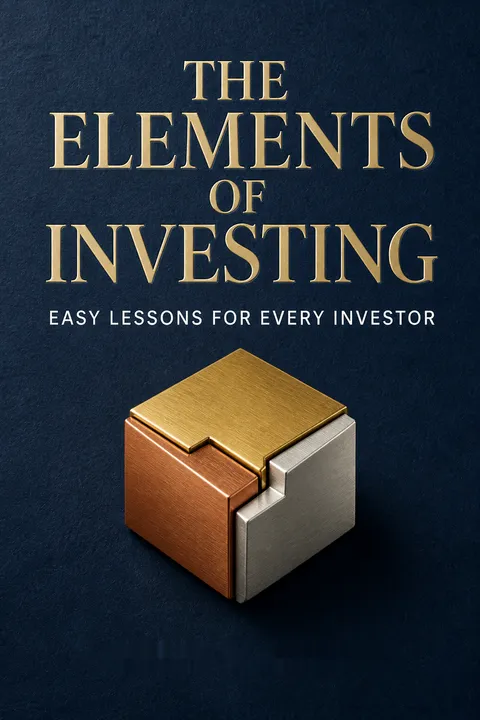
The Elements of Investing receives mostly positive reviews, praised for its concise, straightforward advice on basic investing principles. Readers appreciate its focus on index funds, diversification, and long-term strategies. Many find it ideal for beginners or those seeking a refresher. Some criticize its simplicity, repetitiveness, and US-centric approach. The book emphasizes saving early, avoiding debt, and using low-cost index funds. While experienced investors may find little new information, many recommend it as an essential read for those starting their investment journey.
People Also Read







Glossary
Rule of 72
Estimates doubling timeA mental shortcut for estimating how long an investment takes to double under a steady annual return. Divide 72 by the annual percentage return to estimate the number of years. For example, at 8 percent, the estimate is about nine years. It is an approximation, not a forecast, and assumes a stable rate.
Index fund
Tracks a market measureA mutual fund or exchange-traded fund designed to hold securities represented in a specified market index. Rather than trying to select investments expected to outperform, it aims to deliver returns close to that index before fees and other costs. A broad market index fund can hold shares in many companies, spreading company-specific risk.
Dollar-cost averaging
Invests at regular intervalsA technique of investing a fixed amount on a regular schedule, such as monthly or annually, instead of investing all contributions at one time. When prices are lower, each contribution buys more shares; when prices are higher, it buys fewer. It can reduce the risk of investing all new money at a temporary peak, but does not prevent losses.
Rebalancing
Restores target proportionsThe process of bringing a portfolio back toward its chosen allocation after changes in market prices cause its proportions to drift. An investor might sell some of an asset that has grown beyond its target and add to one that has fallen below target. This maintains the intended risk mix, though it does not guarantee higher returns.
Asset allocation
Sets the portfolio mixThe division of investments among broad categories such as stocks, bonds, and cash. The book presents allocation as a decision shaped by investment horizon, financial circumstances, and emotional tolerance for losses and volatility. It determines the portfolio's overall exposure to different kinds of risk and is distinct from selecting individual securities.
Mr. Market
Personifies market moodsA character drawn from Benjamin Graham's investment writing and used in the book to represent the market's changing offers and emotional extremes. In the authors' account, euphoric prices tempt investors to buy too much, while pessimistic prices tempt them to sell at a loss. The investor's task is to avoid treating those moods as instructions.
Timing penalty
Cost of mistimed tradingThe reduction in returns that investors can experience by adding money near market highs and withdrawing it near market lows. The book attributes this pattern to emotional reactions and return-chasing behavior. It distinguishes the return of a market held through time from the return investors actually receive after their timing decisions.
KISS
Keep investing simpleThe book's shorthand for a straightforward personal investing approach built around regular saving, broad diversification, low-cost index funds, an appropriate stock and bond mix, and disciplined rebalancing. The authors use the phrase to argue that most individuals can avoid complicated products and frequent trading while still following a coherent long-term plan.
FAQ
What's "The Elements of Investing" about?
- Purpose: "The Elements of Investing" by Burton G. Malkiel and Charles D. Ellis is a guide to personal finance and investing, aimed at providing easy-to-understand lessons for every investor.
- Content: The book distills the authors' extensive experience into a sensible plan for saving and investing, focusing on simplicity and practicality.
- Structure: It covers topics such as saving, index funds, diversification, avoiding investment blunders, and keeping investment strategies simple.
- Audience: It is intended for both new and seasoned investors, offering timeless advice that can be applied throughout one's investing journey.
Why should I read "The Elements of Investing"?
- Simplicity: The book offers straightforward, jargon-free advice that is accessible to all levels of investors.
- Proven Strategies: It provides time-tested strategies that have helped millions achieve financial success.
- Comprehensive Guidance: From saving to investing in retirement, the book covers all essential aspects of personal finance.
- Expert Authors: Written by renowned investment experts, the book distills decades of experience into practical advice.
What are the key takeaways of "The Elements of Investing"?
- Start Saving Early: The book emphasizes the importance of saving early and regularly to take advantage of compound interest.
- Index Funds: It advocates for investing in low-cost index funds as a way to achieve market returns without the high fees of active management.
- Diversification: Diversifying across asset classes, markets, and time is crucial to reducing investment risk.
- Avoiding Mistakes: The book highlights common investment blunders and how to avoid them, such as overconfidence and market timing.
What is the Rule of 72 mentioned in "The Elements of Investing"?
- Definition: The Rule of 72 is a simple formula used to estimate the number of years required to double an investment at a fixed annual rate of return.
- Formula: Divide 72 by the annual rate of return to get the approximate number of years needed to double the investment.
- Example: At an 8% return, it takes approximately 9 years to double your money (72 divided by 8).
- Application: This rule helps investors understand the power of compounding and the importance of starting early.
How does "The Elements of Investing" suggest you diversify your investments?
- Across Asset Classes: Diversify by holding a mix of stocks, bonds, and real estate to spread risk.
- Across Markets: Include international investments to benefit from global economic growth and reduce reliance on any single market.
- Over Time: Use dollar-cost averaging to invest regularly over time, reducing the risk of market timing.
- Broad Index Funds: Invest in broad-based index funds to achieve diversification with minimal effort and cost.
What are the benefits of index funds according to "The Elements of Investing"?
- Low Costs: Index funds typically have lower management fees compared to actively managed funds, increasing net returns.
- Market Returns: They aim to replicate market performance, providing consistent returns over time.
- Tax Efficiency: With less frequent trading, index funds often generate fewer taxable events, benefiting investors in taxable accounts.
- Simplicity: They offer a straightforward way to invest in a diversified portfolio without the need for constant monitoring.
What mistakes should investors avoid according to "The Elements of Investing"?
- Overconfidence: Believing you can consistently beat the market can lead to risky and costly investment decisions.
- Market Timing: Attempting to predict market movements often results in buying high and selling low.
- High Costs: Paying high fees for active management can significantly reduce investment returns over time.
- Ignoring Diversification: Failing to diversify can expose your portfolio to unnecessary risk and volatility.
How does "The Elements of Investing" recommend you approach asset allocation?
- Age-Based Allocation: Adjust your asset mix based on your age, with more stocks when young and more bonds as you approach retirement.
- Risk Tolerance: Consider your comfort with market fluctuations when determining your stock-bond allocation.
- Rebalancing: Periodically adjust your portfolio to maintain your desired asset allocation, especially after significant market movements.
- Personal Circumstances: Tailor your allocation to your financial situation, goals, and investment horizon.
What is the KISS investing strategy in "The Elements of Investing"?
- Keep It Simple, Sweetheart: Focus on simple, straightforward investment strategies that are easy to understand and implement.
- Index Funds: Use low-cost index funds for broad market exposure and diversification.
- Regular Saving: Emphasize the importance of saving regularly and starting early to build wealth over time.
- Long-Term Focus: Ignore short-term market fluctuations and stay committed to your investment plan.
What are the best quotes from "The Elements of Investing" and what do they mean?
- "The secret of getting rich slowly but surely is the miracle of compound interest." This highlights the power of compounding and the importance of starting to save early.
- "Nobody knows more than the market." This emphasizes the efficiency of markets and the difficulty of consistently outperforming them.
- "Diversify, Diversify, Diversify." A reminder of the importance of spreading investments across different asset classes to reduce risk.
- "Minimize your investment costs." A fundamental principle that underscores the impact of fees on long-term investment returns.
How does "The Elements of Investing" address investing during volatile times?
- Stay the Course: The book advises against making impulsive decisions based on short-term market volatility.
- Rebalancing: Use market fluctuations as an opportunity to rebalance your portfolio and maintain your desired asset allocation.
- Dollar-Cost Averaging: Continue investing regularly to take advantage of lower prices during market downturns.
- Focus on Long-Term Goals: Keep your investment strategy aligned with your long-term financial objectives, regardless of market conditions.
What is the significance of the "Confession" section in "The Elements of Investing"?
- Honesty: The authors share their personal investment experiences, acknowledging that even experts can have biases and make mistakes.
- Real-Life Examples: They illustrate how personal preferences and emotions can influence investment decisions.
- Indexing Core Investments: Despite personal stock picks, the authors emphasize that their core retirement funds are safely indexed.
- Learning from Mistakes: The section serves as a reminder that disciplined investing and sticking to proven strategies are crucial for success.
About the Author
Other books by Burton G. Malkiel

Download PDF
Download EPUB
.epub digital book format is ideal for reading ebooks on phones, tablets, and e-readers.








