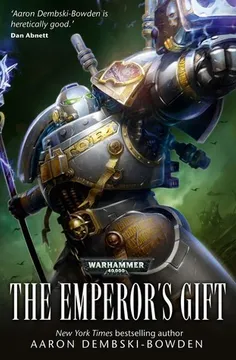


Plot Summary
Prologue
For ninety-nine nights, a boy wakes in a lightless cell and answers every question with the only truth he knows: he remembers nothing. His unseen captors punish any other answer, then give him a number, a date, and the command to open eyes he already believes are open.
When the deception ends, he discovers that he was never blind and the cell was never sealed. His captors have altered his senses and memories to test him for corruption. They tell him his former life is over. He will become one of them, or die trying.
The opening makes identity a controlled experiment. The boy is denied not only his name but confidence in his own senses, so obedience becomes inseparable from survival. His captors call the process purification, yet it begins with coercion and manufactured uncertainty. That tension will shadow Hyperion's life as a Grey Knight: he is taught to trust a strict code over private memory, while his unusual gifts make him unusually dependent on other minds. The prologue also gives his later curiosity about his past real weight. Recovering a name is not merely sentimental; it challenges the institution that remade him.
Cheth's Bloody Court
On Cheth, Inquisitor Annika Jarlsdottyr confronts the Imperial Regent after evidence shows his government has fallen into heresy. Hyperion, a young Grey Knight whose psychic abilities let him sense thoughts and shield others, waits above the planet with Justicar Galeo and three brothers. When the Regent's body reveals a daemon, the squad teleports into the throne room and destroys both host and creature.
Annika orders the court purged as its nobles and guards flee, and Hyperion deflects a dying guard's shot before burning him. The operation saves Cheth from a spreading revolt, but Annika's urgency and the Grey Knights' brutal methods make their partnership feel less like trust than a dangerous bargain.
The Cheth operation establishes how swiftly the Imperium converts suspicion into force. Annika's evidence is substantial, but the execution expands into the killing of an entire court, including people whose guilt is not individually established. Hyperion experiences the operation as necessary service, not moral choice. His psychic perception grants him access to others' fear, yet does not make him more humane; it often turns people into readable threats. Annika, by contrast, combines authority with instinct and accepts the cost of acting before rebellion becomes public. Their uneasy respect begins in a setting where competence and cruelty are difficult to separate.
A Summons Called Regalia
After Cheth, Annika receives a secret assignment, Code Regalia, and asks Hyperion's squad to abandon its existing oath to another inquisitor. She cannot yet disclose the mission, but insists that she needs warriors she trusts.
Hyperion initially refuses, citing the Grey Knights' duty and the approaching Frostborn mission's distant destination, Valdasca. Annika appeals to each member of Squad Castian before Justicar Galeo decides. Malchadiel and Sothis support her, Dumenidon abstains, and Hyperion admits he would go.
Galeo then learns that a Space Wolves destroyer has been found powerless in the Valdasca Caul, far from its assigned route. Its unexplained fate, and an urgent psychic cry only Hyperion can hear, make the detour impossible to ignore.
This choice puts institutional duty and personal trust on a collision course before the threat is understood. Annika cannot offer evidence, so she stakes her request on a relationship built through earlier campaigns. Galeo's decision is not simple disobedience: he weighs competing obligations and accepts responsibility for choosing between them. Hyperion's willingness is more revealing than his formal objections. Curiosity draws him toward the unknown, and his growing psychic sensitivity makes him the first to detect a call others cannot hear. The mission begins because the squad trusts Annika enough to enter uncertainty, not because it has already been persuaded that she is right.
The Frostborn's Empty Halls
Castian boards the Frostborn, a Space Wolves destroyer drifting in the lethal dust of the Valdasca Caul. The ship has no power, no gravity, and no bodies in its hangar, yet damage across its hull shows that something burst outward from inside.
The Grey Knights find murdered crew and Wolves in the armoury, their weapons spent and their bodies torn apart. Hyperion uses his psychic sending to read one dead warrior's final vision: daemonic attackers swarmed the ship. Malchadiel discovers that the engines were deliberately killed and the ship's machine-spirit destroyed.
The signs point toward a Navigator who prevented the crew from escaping the warp. Hyperion's sending then finds a living presence on the starboard arming deck, prompting the squad to move deeper into the wreck.
The Frostborn is not merely a haunted setting; it is evidence of a failed attempt to regain control. The crew chose to destroy their own ship rather than remain in the warp, but the removed ignition keys and ruined machine-spirit suggest they were trapped by an enemy operating through both human and machine systems. Hyperion's ability to read a corpse turns the dead into witnesses, though their testimony arrives as images of violence rather than a coherent account. The ship's silence therefore becomes a problem of interpretation. Each technical clue narrows the cause while the psychic cry keeps the Grey Knights moving toward danger.
Grauvr's Last Warning
On the arming deck, Hyperion and his brothers find Grauvr, a Space Wolf whose legs have been severed and whose body survives only in suspended animation. Annika comes aboard rather than remain safely on the Karabela, and her team helps revive him. Grauvr explains that his ship's Navigator opened the way for daemons, destroying the crew and forcing the Wolves to flee.
Their Rune Priest's final psychic cry named a Devourer of Stars, a vast mass of fused ships and warp corruption approaching Armageddon. The warning makes clear that the destroyer's fate is part of a larger assault, not an isolated possession. Galeo orders the Frostborn scuttled and the Karabela back to Titan, but Annika insists they first confirm what remains aboard.
Grauvr brings the mystery into human scale. His ruined body carries the price of survival, while his account gives the Grey Knights a warning that cannot be dismissed as a shipboard haunting. The Devourer is frightening partly because its name describes a phenomenon the witnesses struggle to explain: a warship-sized accumulation of vessels and corruption, not a conventional storm. Annika's decision to remain aboard also exposes the emotional motive behind her insistence. The fallen ship belongs to the Wolves, and she has personal ties to Fenris. Hyperion recognizes that attachment as a possible compromise, but the story leaves open whether emotional investment can also be a form of loyalty.
The Navigator's False Room
In the Frostborn's Navigator sanctum, the squad finds a ragged, frostbitten man standing in a chamber that only appears intact. Hyperion sees through the psychic illusion and recognizes the possessed Navigator. His third eye can destroy anyone who meets its gaze, so Hyperion cuts Annika's mind-link before it exposes her.
Galeo channels the squad's power into an attack, but the daemon catches his sword and the room fills with Wraith Angels. Hyperion crosses the warp with his warding stave and destroys the Navigator's third eye, allowing Galeo to finish the host. The daemonic presence does not die with its body. It slips into the Frostborn's dead engine systems, where it begins restoring power and preparing to eject the warp core.
The sanctum turns the idea of perception into a tactical hazard. A beautiful, undamaged room is not a safe place but a lie the possessed Navigator imposes on observers. Hyperion's independent sight protects the squad, while his decision to sever Annika's link shows that care can require exclusion rather than shared experience. His intervention succeeds on one level and fails on another: he destroys the host but does not contain the daemon. The shift into the engine core also broadens the enemy's reach. The threat is no longer a corrupted person to be executed, but an intelligence able to occupy the systems that make a warship function.
A Brother Lost in the Rift
As the Frostborn's possessed core begins to rupture, Hyperion sends the Karabela away before the blast can destroy both ships. The core tears open reality, releasing daemons into the void. Castian fights through the horde, but the larger threat escapes Hyperion's attempted banishment and hurls him outside the ship.
Sothis pulls him back, and the daemon kills Sothis in the same motion. Hyperion returns to the fight, and Malchadiel helps the four survivors destroy the greater daemon. They scuttle the Frostborn, but victory leaves Hyperion wounded by guilt and Malchadiel furious at him. The squad's bond, once a constant shared presence, now contains an absence they cannot repair.
The battle makes Hyperion's central flaw consequential: he trusts his own power and judgment more than the formation that keeps his brothers alive. Sothis's rescue is not presented as a mistake Hyperion can simply erase with remorse. His brother chose to save him, and that choice gives the loss moral complexity as well as emotional force. Malchadiel's anger reflects grief's tendency to seek a cause it can accuse. The Grey Knights win, yet the victory damages their defining instrument, their shared psychic unity. Their bond had made collective action feel nearly instinctive; Sothis's absence reveals how much that strength depended on individual lives.
The Message Reaches Titan
Back aboard the Karabela, Hyperion accepts Castian's rebuke for acting recklessly, while Malchadiel begins to accept his apology without forgiving him. Annika tells him that Grauvr may survive, and that the Inquisition's records can identify who the Grey Knights were before their memories were erased.
The squad returns to Titan with Sothis's body. Hyperion asks his former mentor, Enceladus, to fill the vacancy in Castian, and the old knight agrees despite fearing he will slow the squad.
Before the funeral and preparations can settle, the Space Wolves ship Veregelt crashes through the Titan fleet, destroys the Unforsaken, and broadcasts a warning about Armageddon. The survivor's report reaches the Grey Knights, and the order summons its scattered forces.
This passage converts private grief into a wider obligation. Hyperion cannot restore Sothis, but he can accept that the squad must continue, and Enceladus's return gives that survival an uneasy, practical shape. The revelation that the Inquisition retains records of erased identities creates a quieter possibility: the past can be recovered, even if the institution has chosen to make it irrelevant. Then the Veregelt's catastrophic arrival makes the war impossible to postpone. Its crash is not simply a dramatic entrance; it is the price of carrying a warning across a galaxy that the enemy has rendered silent.
The Last Prognosticar
At Titan, the exhausted Prognosticar Torcrith explains that the Grey Knights' seers failed to detect the Armageddon invasion. He carries Hyperion and his brothers through the warp to witness the planet themselves.
There they see the Devourer already destroyed by the Space Wolves, but discover the deeper danger: Angron, the fallen primarch of the Twelfth Legion, has concealed his presence from the order's visions. Torcrith says the Grey Knights must kill him, though barely a hundred knights can be assembled.
Enceladus joins Castian, and Hyperion learns that his own unstable power once made him a candidate for the Prognosticars before he was rejected. The order's only surviving seer sends the ragged brotherhood toward a battle he expects few to survive.
Torcrith's vision changes the scale of the story while exposing an institutional blind spot. The Grey Knights trust prophecy as an early-warning system, yet Angron has hidden not only himself but the invasion that carried him to Armageddon. Torcrith's near-total exhaustion suggests that vigilance is not omniscience; it is labor performed by a finite person. Hyperion's possible place among the Prognosticars links his unruly talent to that same failure of control. He was rejected for a weakness the order now needs him to understand. The approaching battle is therefore both a military crisis and a test of what imperfect instruments can do.
The Wolf's Battlefield Terms
Above Armageddon, Logan Grimnar meets the Grey Knights and explains how the war has consumed the planet's first continent. He says Angron's forces are advancing toward the remaining cities across the River Styx.
Grimnar asks the Grey Knights to stay hidden until he signals, since ordinary citizens who witness daemons may later be killed to preserve the secret. The agreement makes the Wolves responsible for holding the human armies together while the Grey Knights prepare a single strike. Before battle, Hyperion asks Annika to uncover his former identity.
She shows him a record naming him Zael Efferneti, a neglected child brought to Titan for his unusual psychic potential. Knowing his past unsettles him, but he chooses to carry the name as information, not as a replacement for the life he has built.
Grimnar's plan assigns each force a different moral burden. The Wolves will absorb the visible war and its casualties; the Grey Knights will remain a concealed weapon, sparing civilians from knowledge that could condemn them. This secrecy looks protective, but it also anticipates the later violence committed in its name. Hyperion's search for his identity runs alongside the strategy: he wants to know who he was before his memories were taken, yet the record offers facts without restoring lived experience. His past becomes neither a cure nor a destiny. Instead, he must decide whether to let an erased childhood alter his understanding of the person who now chooses to fight.
The Black Blade Breaks
When Grimnar gives the signal, 109 Grey Knights teleport into the daemon army's midst. Their collective psychic Aegis scatters lesser daemons, but Angron and his elite guards withstand the assault. The knights press forward under fire, losing voices from their shared communion one by one. Hyperion breaks formation to rescue Malchadiel, then rejoins the attack as squads fall around them.
At the heart of the charge, he catches Angron's black blade with his mind and shatters it, nearly killing himself through psychic strain. Captain Taremar takes the opening and kills Angron. The daemon army loses its central force, but the Grey Knights have paid for the victory with catastrophic losses.
The climax turns the Aegis from a sacred defense into a fragile collective achievement. The knights' shared strength weakens each time a brother falls, so their unity is both weapon and vulnerability. Hyperion's choice to save Malchadiel breaks the planned advance, but it also embodies the loyalty the plan cannot fully account for. His most decisive act is not a display of effortless superiority: holding Angron's sword costs him his health and nearly his life. Taremar's finishing strike depends on that sacrifice. The victory belongs to coordinated action, not to a single flawless hero, even though Hyperion's deed gives the battle its name.
Thirteen Return Breathing
Hyperion wakes on the battlefield hours after Angron's defeat and finds Galeo dead. He and Brand Rawthroat locate Malchadiel alive but gravely injured, while Enceladus is near death. Only thirteen of the 109 Grey Knights survive. Hyperion later spends 131 days in a coma; when he wakes, an Apothecary tells him the war ended with Angron, though the planet's fighting continued.
Meanwhile, the Inquisition decides to sterilize Armageddon's survivors and confine them to labor camps, despite Grimnar's insistence that untouched cities be spared. The order turns victory into a new crisis: the Grey Knights have saved the planet from Angron, but their superiors intend to break its population to preserve secrecy and industrial output.
The aftermath denies the comfort of a clean victory. Hyperion's survival is measured against a roll call of absent brothers, while his damaged body makes his earlier confidence in his own resilience look misplaced. The Inquisition's policy then exposes a second kind of violence, bureaucratic rather than demonic. The inhabitants are not being punished for serving Angron; they are being controlled because their survival creates a problem for the institution. The Grey Knights' success has protected the Imperium's machinery more clearly than it has protected Armageddon's people. Hyperion's emerging doubt is not abstract: it begins with the visible gap between what they fought to save and what their masters now plan to do.
The Trident Fires Back
As the Inquisition empties Armageddon's cities and secretly sterilizes those sent to camps, the Space Wolves try to hide civilians from the roundup. Hyperion remains in orbit and insists that obedience leaves him no choice.
When the troopship Trident of Ilmatha prepares to depart, Grand Master Joros orders the Karabela to escort it and destroy it beyond fleet surveillance. Brand Rawthroat's Runefyre shields the transport, but Hyperion orders the Karabela to fire. Its lances destroy the engines and kill the ship's 400,000 people.
Rawthroat warns that the Wolves will remember who fired first. Soon, Grimnar's larger fleet arrives and threatens overwhelming force. The Inquisition breaks off its assault, allowing many transports to escape, but Hyperion cannot undo the first massacre or the choice that made it possible.
The Trident is the point at which abstract obedience becomes an irreversible act. Hyperion understands the order's human cost and still carries it out, telling himself that the risks of corruption justify the killing. Rawthroat's challenge is powerful because it does not deny the danger of exposure; it rejects treating millions of loyal soldiers as expendable insurance. The battle's temporary halt does not absolve Hyperion, since the transport has already been destroyed. The story makes complicity concrete: a system may distribute responsibility across inquisitors, commanders, and ship crews, but someone still gives the firing order. His self-image as a weapon cannot shield him from having chosen to use it.
The Armistice Is Broken
After months of escalating threats, Inquisitor Kysnaros summons Grimnar to negotiate and secretly hopes to force the Wolf Lord's surrender. At the meeting, Grimnar challenges the Inquisition's claim to moral authority, while Joros stands beside Kysnaros. Grimnar kills Joros with one blow, then Grey Knights try to hold him and his Wolf Guard in place with psychic force.
The Wolves kill four Justicars, breaking the squads' shared focus, and teleport away. Their escape turns the conflict from a dispute over Armageddon's survivors into open pursuit. Kysnaros has lost both his chance to control Grimnar and the Grand Master whose counsel helped shape his policy. Instead of ending the crisis, the failed parley makes further violence more likely.
The attempted negotiation fails because its language of surrender disguises a plan for domination. Grimnar recognizes that Kysnaros is not offering equal terms, and Joros's presence cannot lend legitimacy to an ambush. His death also demonstrates how quickly the Grey Knights' psychic unity can collapse when squad leaders are killed. The Wolves escape by exploiting that structural weakness, not by defeating the entire order in battle. Kysnaros's strategic error is psychological as well as political: he treats a Chapter's honor as a lever he can pull, while Grimnar treats betrayal as proof that compromise has become unsafe. Each leader's certainty now feeds the other's worst expectation.
The Months of Shame
The Inquisition begins hunting every ship and world touched by Armageddon's survivors. It destroys listening stations, transports, settlements, and whole planets to keep witnesses from spreading the secret.
The Wolves answer by escorting refugees and scattering soldiers among distant destinations, while Grey Knights ships pursue them. Hyperion sees the campaign grow harder to justify as each massacre fails to close the information leak. When Kysnaros orders the armada to Fenris, Annika and Malchadiel join other dissenting Grey Knights in secret opposition.
Hyperion, who has spent months assuming that duty means obedience, finally admits that he intends to kill Kysnaros. He enters their planning meeting and discovers they have already been preparing to resist him.
The campaign's name is earned through repetition: each act of containment creates more bodies without restoring control. The Inquisition treats secrecy as a solvable logistical problem, but the Wolves disperse witnesses faster than the fleet can find them. Hyperion's ethical shift arrives through accumulated evidence rather than sudden enlightenment. He has fired on civilians himself, and that history makes his new opposition costly; he cannot pretend he was always against the policy. Annika's resistance gives him a practical alternative to solitary violence. By joining her group, he begins to replace his old pattern of acting alone with the cooperation his squad had demanded from him.
Bjorn Speaks for Fenris
As the Inquisition's fleet surrounds Fenris, Annika joins Hyperion, Kysnaros, and Malchadiel in a meeting with the Wolves' emissary. The emissary is Bjorn the Fell-Handed, a Dreadnought carrying one of the Chapter's oldest warriors.
His presence changes the negotiation: Annika recognizes a figure from Fenrisian history, while Bjorn rejects a proposed penitent crusade and warns that the Wolves will not submit. Before terms can be settled, Grimnar's returning fleet arrives, seeing the Inquisition's weapons pointed at the Fang.
The fleets clash. Grimnar boards the Corel's Hope, kills Kysnaros, and nearly kills Malchadiel. Hyperion attacks Grimnar but cannot overcome him. Bjorn stops the fighting, orders both sides to end the war, and demands that the Grey Knights reveal themselves to the Wolves.
Bjorn's arrival introduces a different kind of authority: not rank sustained by a current fleet, but memory embodied in a warrior who has outlived generations. Kysnaros seeks a negotiated structure that preserves institutional control; Bjorn asks whether the people and the Chapter can remain intact. Once Grimnar's fleet returns, abstract leverage becomes immediate physical danger. Hyperion's confrontation with the Wolf Lord repeats the older temptation to solve a political crisis through individual force, but this time he cannot win by strength alone. Bjorn's intervention ends the immediate battle by forcing both sides to accept limits, including the loss of secrecy that has shaped the Grey Knights' identity.
A Bell for Sothis
After the battle, the Inquisition continues scheming against the Wolves, while Bjorn is lowered into sleep and the remaining Grey Knights help clear the wreckage around Fenris. Decades pass.
Hyperion rises to serve as a Prognosticar, and Malchadiel returns from his long assignment on Mars, bearing new augmetics and the same grief for Sothis. Hyperion takes him to Terra and reveals the unfinished duty he has carried: he never rang the Bell of Lost Souls for their fallen brother.
Together they use their psychic power to guide a Palace servant through the protections around the bell. The servant pulls the lever and speaks Sothis's name. The bell tolls across Terra, granting public mourning to a warrior whose order was built to remain unknown.
The final act transforms remembrance from a private burden into a deliberate breach of protocol. Hyperion could have rung the bell earlier, but waits until Malchadiel can share the act, turning grief into an obligation between surviving brothers. The Bell's public sound contrasts with the Grey Knights' enforced anonymity: their sacrifice is honored only through a system designed to prevent anyone from knowing who they were. The long time jump also refuses an easy cure. Hyperion's guilt remains, but it no longer governs him in isolation. By helping Malchadiel mourn, he makes a form of brotherhood possible even after the squad that first defined it has vanished.
Epilogue
In the weeks after the fighting, Annika reports the peace to the Inquisition, but its agents immediately consider new ways to punish the Wolves. Hyperion watches Bjorn's warriors return the ancient Dreadnought to sleep, where he urges them to preserve the truth of what happened.
Much later, Malchadiel returns to Titan, and he and Hyperion travel to Terra together. They secretly set the Bell of Lost Souls ringing for Sothis, whose name had waited decades for its final honor.
The epilogue refuses to equate a ceasefire with reconciliation. The Inquisition's instinct is still to turn defeat into another plan for control, while Bjorn's return to sleep leaves the Wolves with memory rather than permanent protection. The later bell toll offers no restoration of the dead and no public knowledge of the Grey Knights, but it changes what Hyperion and Malchadiel can do with their loss. Their act makes mourning communal, even if only through a single name and a sound most listeners cannot interpret. The ending's tenderness is therefore modest and earned: remembrance becomes possible where justice remains incomplete.
Analysis
The Emperor's Gift follows a warrior formed by erasure as he learns that obedience can be both a defense against corruption and a way to evade moral responsibility. Hyperion's childhood is stripped away in the name of purity; his adult identity is then built around the certainty that Grey Knights act correctly because they are made to act. The Armageddon campaign breaks that certainty by giving him two kinds of evidence: his brothers die to stop Angron, and the Inquisition later condemns the very population their sacrifice was meant to protect.
The conflict between the Grey Knights and the Space Wolves is not a simple contest between cruelty and compassion. The Wolves risk disobedience to defend civilians, but their refusal to accept the Inquisition's calculations helps provoke a wider war. Kysnaros and the Grey Knights fear that surviving witnesses could spread corruption or expose secrets, yet their response destroys lives on a far larger scale. Each side sees a real danger and turns that danger into permission. The novel's most unsettling point is that sincere motives do not make institutional violence less violent.
Hyperion's psychic gift gives this conflict an intimate form. He can enter other minds and share a squad's strength, but understanding another person's thoughts does not automatically produce empathy. His growth comes when he stops treating power as proof that he should decide alone. Sothis's sacrifice and Malchadiel's grief teach him that loyalty is made of choices between people, not merely vows to an order.
The final bell cannot repair the damage or reconcile the factions. It does something smaller and more credible: it allows two survivors to name their loss together. Against a world where institutions hide, classify, and erase, remembrance becomes Hyperion's most personal act of resistance.
Review Summary
The Emperor's Gift is widely praised as one of the best Warhammer 40k novels, offering deep insights into the Grey Knights and Space Wolves chapters. Readers appreciate the complex characters, epic battles, and exploration of morality in the 40k universe. The book's first-person narrative through Hyperion's perspective is compelling, though some found the pacing uneven. Many commend Dembski-Bowden's writing style and his ability to capture the essence of the 40k setting. While most reviews are highly positive, a few critics found certain aspects disappointing or cliché.
Characters
Hyperion
The restless psychic knightHyperion is a young Grey Knight of Squad Castian, trained to erase his past and serve as a weapon against daemons. His unusual psychic talent lets him perceive thoughts and borrow power, but he struggles to control it and to trust the judgment of his brothers. Curious about ordinary human behavior, he often watches people more easily than he understands them. His formal speech and certainty in duty conceal an unsettled mind, especially when loyalty demands actions he cannot reconcile with conscience. The people closest to him, particularly Annika and his squad, expose the gap between being powerful and being dependable.
Annika Jarlsdottyr
The uncompromising inquisitorAnnika is an Inquisitor of the Ordo Malleus, raised on Fenris and accustomed to acting decisively when evidence points toward corruption. She uses authority with little ceremony, carries a bolter built for an Astartes, and relies on instinct as well as investigation. Her loyalty to the Imperium is real, but she is not blind to the Inquisition's capacity for abuse. Annika's relationship with Hyperion grows through repeated missions, candid disagreement, and the unusual intimacy of their psychic link. Her stubbornness can cloud her judgment, yet it also makes her willing to challenge policies that others treat as inevitable.
Galeo
Castian's measured leaderGaleo is the Justicar who leads Squad Castian. A veteran marked by earlier losses, he controls the squad's psychic strength and expects each warrior to act as part of a whole. His authority is quiet rather than theatrical, built on discipline, experience, and a willingness to hear his brothers before deciding. Galeo is patient with Hyperion's potential but not indulgent toward his recklessness. He understands that a powerful warrior can still endanger the people beside him. The squad's shared bond reflects Galeo's leadership: its strength depends on trust, restraint, and attention to others.
Malchadiel
The careful twinMalchadiel is a Grey Knight and telekinetic, known for precise control and an unusually courteous manner. He is Sothis's twin, a rare bond preserved despite the memory-stripping that defines Grey Knight training. Curious about machinery, he hopes to study with the Adeptus Mechanicus and often approaches problems through patient analysis. His restraint contrasts with Hyperion's impulse to act alone, though grief can make Malchadiel severe. His bond with his twin gives him a personal history the order cannot fully erase, and his persistence reflects a desire to keep learning even when his body and circumstances change.
Sothis
The scarred loyal twinSothis is Malchadiel's twin and a seasoned Grey Knight whose face bears the cost of earlier battles. He trains with Dumenidon and brings a steadiness to Castian that Hyperion is still learning to offer. His humor is quiet, often expressed through his eyes rather than his damaged features. Sothis understands the demands of the squad and accepts danger without turning courage into performance. His relationship with Malchadiel is both familial and deeply shaped by their shared life as warriors. He represents the human ties that survive even within an order designed to sever its members from their former selves.
Dumenidon
Castian's master swordsmanDumenidon is a disciplined Grey Knight and the most accomplished swordsman in Castian. He mentors Sothis and values precision, obedience, and control, while remaining capable of dry humor among his brothers. His reserve can make him seem severe, but his standards come from a clear understanding of how quickly one warrior's error can endanger an entire squad. Dumenidon follows Galeo's leadership rather than seeking command for himself. He embodies the martial discipline Hyperion admires and cannot yet consistently match.
Enceladus
The veteran of the Dead FieldsEnceladus is an aging Grey Knight who tends the order's burial grounds after a long life of service. His body is heavily augmented, and his quiet manner reflects both deep experience and a hard-won attachment to peace. He once trained Hyperion and still addresses him with the fondness of a mentor, though he is frank about the young knight's faults. Enceladus measures honor by how a warrior treats his brothers, not by acclaim. His return to active duty comes from responsibility to Castian, even as he doubts his ability to keep pace.
Logan Grimnar
The defiant Great WolfLogan Grimnar leads the Space Wolves as their Great Wolf, a battle-hardened commander who prizes the people his Chapter is sworn to defend. Blunt and deeply suspicious of the Inquisition, he speaks through action as readily as through words. His authority rests on the loyalty of his warriors and on a long record of standing with them in danger. Grimnar's insistence that untainted civilians should not be treated as expendable makes him a direct challenge to the Grey Knights' secrecy-driven orders. He respects courage, but has little patience for institutions that mistake obedience for moral wisdom.
Ghesmei Kysnaros
The Lord InquisitorKysnaros is a Lord Inquisitor who sees containment as a necessary defense of the Imperium. He is intelligent and politically capable, but his experience with small purges leaves him poorly prepared for a conflict involving entire Astartes Chapters. He can be sincere about his burdens while still choosing devastating policies. Kysnaros depends on hierarchy and pressure to secure cooperation, and initially underestimates how strongly the Wolves will resist coercion. His willingness to consider consequences does not prevent him from treating human lives as costs in a larger calculation.
Torcrith
The exhausted seerTorcrith is the Prognosticar responsible for searching the warp for signs of danger to the Imperium. His immense psychic reach comes at a visible physical and mental cost, and he knows that one seer cannot watch every threat across the galaxy. Torcrith is candid about the limits of his order and willing to admit failure without abandoning responsibility. He uses his power to let the Grey Knights witness what his words cannot fully convey. His role reveals both the value and the human limits of prophecy.
Grauvr
The wounded Wolf witnessGrauvr is a Space Wolf survivor of the Frostborn, found gravely wounded in suspended animation. His bluntness and grim humor reflect the warrior culture of Fenris, while his deteriorating body makes every account a struggle. He carries the warning that connects the abandoned destroyer to the war on Armageddon. Grauvr remains focused on his duty even when he can scarcely survive long enough to explain what happened.
Bjorn the Fell-Handed
Fenris's ancient warriorBjorn is an ancient Space Wolf preserved within a Dreadnought, a walking war machine that carries the body and voice of a long-serving warrior. His age grants him perspective, but not patience for empty ceremony or political evasions. He speaks plainly to both the Wolves and their enemies, and his authority comes from a history few living warriors can match. Bjorn's presence links Fenris's present conflict to the Chapter's distant past.
Angron
The hidden daemon primarchAngron is the principal enemy whose presence lies behind the assault on Armageddon. Once a primarch of the Emperor's forces, he is now a vast daemonic warlord capable of concealing his approach from the Grey Knights' seers. His scale and rage make him a threat beyond ordinary battlefield command. The order's limited force must reach him before the planet's remaining defenses collapse.
Brand Rawthroat
The Wolf who challenges HyperionBrand Rawthroat is a Wolf Guard serving Grimnar, a direct and battle-worn warrior who judges others by what they choose to do under pressure. He survives the struggle around Armageddon and later confronts Hyperion with the consequences of the Inquisition's orders. Brand's loyalty to the Wolves does not prevent him from treating Hyperion as a possible brother, but he refuses to soften a moral challenge for the sake of their shared danger.
Vasilla Teress
The young faithful scrivenerVasilla is a young Sister of the Order of the Scrittura who serves Annika's retinue as a scrivener and accompanies the group into danger. Quiet and devout, she is often treated as a child by older members of the team, but her faith is not childish. She prays through fear and offers Hyperion a perspective grounded in compassion rather than military logic. Her gentleness gives the story a human counterpoint to the Grey Knights' emotional restraint.
Frederic Darford
The sharp-eyed former soldierDarford is a former Mordian Guardsman and sniper who serves Annika with polished manners, meticulous dress, and a steady stream of complaints. His vanity and humor make him seem lighter than the violence around him, but his military experience gives him a clear view of what operations cost. He is one of the first humans to treat Hyperion as a person rather than an untouchable weapon.
Sosa Khatan
The restless Attilan fighterKnown as the Khatan, Sosa is a former Attilan Rough Rider whose spear, furs, and preference for open skies set her apart from the shipbound team. She is irreverent, bold, and quick to puncture the stiffness of those around her. Her teasing of Hyperion is a form of social testing; she pushes him to notice the human exchanges he would otherwise observe from a distance.
Rymir Clovon
The inquisitor's redeemed hereticClovon is a former heretic now serving Annika, his scarred face marked with religious tattoos. Hyperion distrusts him as a living reminder that the Inquisition sometimes grants redemption to those it would otherwise condemn. Clovon is perceptive, patient, and unafraid to challenge Hyperion's self-righteousness. His willingness to discuss mistakes without excusing them offers a perspective Hyperion finds difficult to accept.
Garven Merrick
The quiet former enforcerMerrick is a former enforcer who serves Annika in battered armor, usually accompanied by his cyber-mastiff, Faith. He is guarded, practical, and more comfortable maintaining his equipment than discussing his feelings. His concern for Annika reveals a protective loyalty beneath his reserve. He rarely seeks attention, which makes Hyperion find him easier to be around than more socially fluent humans.
Talwyn Castor
The Karabela's lifebonded captainCastor commands the Grey Knights vessel Karabela. A former Imperial Navy officer, he combines practiced competence with eccentric dress and a taste for archaic styles. His humor persists even when the ship is in danger, but he never mistakes levity for lack of responsibility. Castor's steady command gives Hyperion a rare example of authority that does not depend on psychic force or ritual intimidation.
Axium
The silver Mechanicus artisanAxium is the Adeptus Mechanicus executor assigned to the Karabela, his body crafted entirely from silver to resemble a natural human form. He is an artist as well as an engineer, attentive to detail and capable of warmth without hiding his mechanical nature. Axium repairs the Grey Knights' equipment and treats their needs with calm good humor. His craftsmanship suggests that devotion to machinery can coexist with respect for human individuality.
Taremar Aurellian
The golden captainTaremar, called the Gold, is a celebrated Grey Knights captain who commands the battle-barge Ruler of the Black Skies. His reputation is built on a long record of service, and he accepts the difficult role of coordinating the Ragged Brotherhood. Taremar understands that a decisive strike requires patience as well as courage, and he expects his warriors to arrive prepared for a nearly impossible task.
Joros
The ambitious Grand MasterJoros leads the Grey Knights' Eighth Brotherhood and is known as a formidable dual-blade fighter. He values command, tradition, and the strategic advantages of decisive action. His relationship with Kysnaros places him near the center of the Inquisition's campaign against the Wolves. Joros's ambition is tempered by genuine service, though his confidence in authority can make him underestimate the cost of coercion.
Nadion
The exacting ApothecaryNadion is an Apothecary of the Eighth Brotherhood who treats the wounded with blunt care and clinical precision. He explains the consequences of Hyperion's psychic exertions without softening the facts. His attention keeps the warriors alive, even when they would rather return to battle than accept their physical limits.
Plot Devices
The Aegis
Collective psychic defenseThe Aegis is the Grey Knights' shared psychic protection against daemons. Squad members combine their wills to weaken enemies, shield one another, and focus power through a leader. It makes their formation more than a tactical arrangement: each knight's attention strengthens the others. The same dependence creates vulnerability. When a Justicar dies, the squad's shared focus can fracture, leaving the survivors exposed. The Aegis therefore expresses both the Grey Knights' greatest advantage and the cost of treating brotherhood as an operational necessity.
Hyperion's reflective psychic gift
Power borrowed from othersHyperion cannot initially access his psychic ability in the usual way. Instead, he draws on nearby psychic power and can reproduce the abilities he encounters. The talent makes him unusually adaptable, able to read minds, share senses, project himself through the warp, and wield force or fire when the situation demands it. It also encourages dependence and overreach: he can mistake borrowed strength for mastery of his own limits. The gift links his hidden childhood to his difficulty fitting within a squad, while making his choices in battle especially consequential.
The Frostborn's dead core
A ship becomes a daemonic trapThe Frostborn's disabled engines initially appear to be evidence of a desperate attempt to escape the warp. Hyperion and Malchadiel discover that its Navigator prevented the crew from stopping the ship, while the machine-spirit was killed and the ignition keys removed. The possessed Navigator is only one host: after his defeat, the daemon moves into the ship's power systems and tries to eject the core. The device turns a derelict-ship investigation into a crisis that threatens the Karabela and opens a breach between realities.
Imperial secrecy
Knowledge becomes a death sentenceThe Inquisition treats public knowledge of daemons and the Grey Knights as a threat that must be contained. After Armageddon, this policy becomes a mechanism driving the human conflict: survivors are sterilized, confined, hunted, or killed, while the Wolves try to scatter and protect them. The secrecy doctrine begins as a plausible defense against panic and corruption, but the campaign shows how it converts innocent witnesses into targets. It links the battle's supernatural danger to the Imperium's political violence and tests whether protecting humanity means protecting its people.
The Bell of Lost Souls
A hidden order is mournedThe Bell of Lost Souls tolls when a Grey Knight dies, giving the order's otherwise unrecognized sacrifices a public sound. Its ritual weight comes from the contradiction it embodies: the Imperium hears the bell but does not know the identity or story of the warrior being mourned. Hyperion delays ringing it for Sothis until Malchadiel can share the act. Their decision turns a formal custom into an expression of grief, loyalty, and the remembered life of a brother who would otherwise remain unknown.
About the Author

Download PDF
Download EPUB
.epub digital book format is ideal for reading ebooks on phones, tablets, and e-readers.








