Key Takeaways
1. Embrace Stoicism as a Practical Guide to Flourishing
We all deserve to flourish.
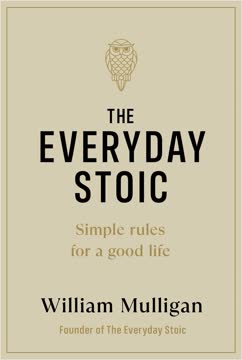
Stoicism for everyone. Stoicism is not an abstract philosophy for a select few, but a practical guide for navigating modern life with ancient wisdom. It offers simple rules and habits that anyone can adopt to live better, for themselves and their loved ones. The author's personal journey, from an anxious teenager and underpaid laborer to a successful entrepreneur, highlights how Stoicism transformed his perspective and actions.
Daily practice. This philosophy is accessible and doesn't require extensive study or withdrawal from society. Instead, it's about building good habits daily, making wise choices easier, and fostering patience, empathy, and wisdom. The goal is not to achieve a peak "Stoicism" but to continuously practice principles that lead to personal improvement and a better experience for those around you.
Immediate improvement. By engaging with Stoic ideas, you can find an immediate improvement in your life. It provides tools to become the best, happiest version of yourself, making life fairer, calmer, wiser, and more enjoyable. Stoicism is about living in a way that benefits all, not just those with ample resources.
2. Master the Four Virtues: Wisdom, Justice, Courage, Moderation
The Virtues are the foundation for everything a character should be, the tried-and-trusted guide for us to be a good person, and the very basis of Stoicism.
Foundational principles. The Four Virtues—Wisdom, Justice, Courage, and Moderation—are the bedrock of Stoic living, offering guidance in any situation. Without this moral compass, our lives can be shaped by fleeting pop culture, social media, and external pressures, leading us to prioritize possessions and superficial presentation over genuine well-being.
Virtues defined. Each virtue encompasses a range of positive attributes:
- Wisdom: Good judgment, quick wit, discretion, resourcefulness, and the ability to discern what is and isn't in our power.
- Justice: Honesty, fairness, equity, piety, and a commitment to the common good, avoiding anger and striving to help others.
- Courage: Cheerfulness, endurance, confidence, industriousness, and the mental fortitude to face fears and manage difficult feelings like pain or tiredness.
- Moderation: Modesty, self-control, good discipline, avoiding greed and vanity, and finding balance in all aspects of life.
Progress, not perfection. Stoicism emphasizes striving towards these virtues, understanding that the path itself brings benefits like happiness and honesty. It's not about achieving perfection, but about daily practice and seeing the positive ripple effects in your life and the lives of others. The opposite of these virtues are the Four Vices: Foolishness, Cowardice, Injustice, and Intemperance.
3. Accept What You Cannot Control (Amor Fati)
You have power over your mind – not outside events.
Love of fate. Amor Fati, or "love of fate," is a core Stoic principle: the world will unfold as it does, and most of it is beyond our control. This realization, initially daunting, becomes profoundly comforting as it frees us from worrying about things we cannot change. Mark Twain famously noted that most of our worries never actually happen, highlighting the futility of fretting over the uncontrollable.
Dichotomy of control. Stoicism clearly delineates what we can and cannot control:
- Within our control: Our opinions, preferences, actions, choices, wants, motivations, and character.
- Beyond our control: Past events, others' actions, natural disasters, accidents, and all other external circumstances.
This distinction allows us to direct our energy effectively, focusing on internal responses rather than external outcomes.
Freedom from struggle. By accepting the universe as it is, we cease to be "compelled" and begin to "walk with the cart," transforming potential obstacles into opportunities for growth. This mindset shifts our perspective from seeing life as happening to us to happening for us, fostering resilience and clarity. Anxiety, though real, can be managed by concentrating on what is within our power, leading to less worry and clearer thoughts.
4. Cultivate Eudaimonia: True Happiness Through Virtue
The essence of philosophy is that a man should so live that his happiness shall depend as little as possible on external things.
Human flourishing. Eudaimonia, best translated as "human flourishing," is the Stoic path to happiness, achieved by living within a specific triangle of actions. This is not about self-indulgence but about finding harmony with oneself and the world. Unlike Nirvana, which may require many lifetimes, eudaimonia is a path accessible immediately, a "beam of golden light" you can step into now.
Three pillars of eudaimonia:
- Take responsibility: Acknowledge your role in your life's journey, letting go of regrets and taking care of your physical and mental well-being.
- Focus on what you can control: Direct your energy towards your opinions, actions, choices, and character, rather than external events.
- Live with Arete: Strive for excellence by consistently practicing the Four Virtues—Wisdom, Justice, Courage, and Moderation.
Internal peace. Marcus Aurelius, despite immense wealth and power, recognized that true happiness comes from character, not possessions. External factors like fame and fortune can even hinder eudaimonia by tempting overindulgence. The pursuit of desires offers fleeting pleasure, a "rollercoaster" of highs and lows, while internal peace provides consistent happiness.
5. Remember Your Mortality (Memento Mori)
You could leave life right now. Let that determine what you do and say and think.
Death's urgency. Memento Mori, the remembrance of death, is a powerful Stoic practice that transforms fear into purpose. The author's childhood terror of death dissipated with the realization that death is a release, and its inevitability lends urgency to life. This universal truth, often avoided in Western culture, becomes a catalyst for living a more vibrant and meaningful existence.
Finite moments. Every interaction, every experience, is finite. Recognizing that there will be a "last time" for everything—a hug, a meal, a commute—makes each moment more precious. This awareness encourages us to live without regret, shaping our conduct and character in a way we wish to be remembered.
Boredom's benefits. In a world obsessed with constant stimulation, boredom is often seen as a waste of time. However, Stoicism encourages embracing boredom as a space for introspection, creativity, and problem-solving. It allows us to question our lives, develop focus, and improve mental health by giving our brains a break from external inputs.
6. Recognize Our Interconnectedness (Sympatheia)
Men are born for the sake of each other. So either teach or tolerate.
Universal connection. Sympatheia is the Stoic belief that all humans and indeed all existence are interconnected, forming a larger, single whole. In a world often focused on division, this principle encourages us to see everyone as a potential friend, a "sister or brother in humanity," fostering empathy and reducing fear and alienation.
Benefits of connection. Embracing our social nature leads to:
- Increased empathy and understanding for others.
- A safer, closer community with less hostility.
- Improved mental health through stronger bonds.
- A reduction in self-consciousness and anger.
Teach or tolerate. While not everyone will adhere to the Four Virtues, our responsibility as Stoics is to either teach them better ways or tolerate their behaviors. This extends to justice systems, advocating for reformation and understanding over mere punishment, as seen in countries like Norway with their focus on restorative justice. Isolation is a weakness; true strength comes from opening ourselves up and supporting one another.
7. Choose Goodness Over Cynicism
Waste no more time arguing what a good man should be. Be one.
Goodness is work. It's easy to succumb to cynicism, believing the world is hopeless and good efforts are futile. However, Stoicism asserts that goodness requires true fortitude and effort, unlike "badness" which often takes the path of least resistance. Even in the bleakest situations, people display hope, generosity, and kindness, demonstrating immense strength.
Be a helper. Inspired by Fred Rogers' advice to "look for the helpers," Stoicism encourages us to be the helpers in every situation, big or small. These acts of kindness, often costing nothing, ripple outwards, influencing others and breaking the spell of a "bad" world. The author's experiences with the binman and children helping cars in snow illustrate how simple acts of goodness can profoundly shift perspective.
Focus on the good. Our focus determines our reality. If we constantly seek badness, we will find it. By consciously choosing to look for good, we train our minds to see opportunities for virtue and positive action. This isn't about ignoring evil, but about recognizing the space to do good in every conscious moment, planting seeds for a better future rather than judging by the immediate harvest.
8. Seek Objective Truth, Not Personal Bias
If it is not right do not do it; if it is not true do not say it.
Truth as a shortcut. In a world of conflicting "truths," Stoicism emphasizes seeking objective truth as a direct route to reality. An "offensive" statement, for a Stoic, is either a truth that can teach us or a lie to be disregarded, neither of which should cause pain. Our biases and emotions often distort truth, leading to arguments focused on "winning" rather than understanding.
Elements of truth: Marcus Aurelius identified three elements to finding truth:
- True Matter: Breaking things down to their simplest, objective form (e.g., wine is fermented grapes, an argument is just noise).
- True Good: Understanding that eudaimonia comes from following the Four Virtues.
- True Feeling: The clarity to pause, recognize individual perspective, and avoid emotional entanglement.
Challenge illusions. We often accept untruths in our relationships and self-perception, influenced by filtered online realities. Stoicism encourages us to disentangle emotions from facts, recognizing that personal interpretations are subjective and not objectively "true." By practicing these elements, we can reduce imperfections in our assessments and approach disagreements as collaborations for increased wisdom, rather than competitions.
9. Embrace Simplicity: Little Is Truly Needed
Very little is needed to make a happy life; it is all within yourself, in your way of thinking.
Desire's trap. Our consumer-driven culture constantly encourages us to want more, equating accumulation with progress and happiness. However, Stoicism teaches that true happiness comes from contentment with what we have, not from chasing endless desires. The pleasure derived from acquiring new things is fleeting, a "fire" that demands constant feeding, leaving us perpetually dissatisfied.
Gratitude over wanting. Instead of focusing on what's missing, a simple gratitude exercise can shift our mindset, highlighting the abundance already present in our lives. This practice builds a mental muscle for appreciating daily joys, reminding us that small moments make up the hours of our lives. The author's experience of achieving his dream studio, only to feel an immediate "Oh...", illustrates that "getting" is rarely the ultimate solution.
Freedom from stuff. The more we accumulate, the less mental space we have for genuine joy, connection, and creativity. Marcus Aurelius, despite his wealth, valued simplicity, dignity, and prioritizing goodness over "Caesar-like objects." The author's social media detox and minimalist travel revealed that shedding external "stuff" freed his mind, proving that less truly is more for clarity and happiness.
10. Your Thoughts Create Your Reality
The happiness of your life depends upon the quality of your thoughts.
Mindset shapes perception. As Shakespeare's Hamlet observed, "There is nothing either good or bad, but thinking makes it so." Our thoughts actively shape our experience of the world. If we constantly seek conflict or negativity, we will find it, creating a self-fulfilling prophecy of despair. The author's realization that his internal monologue of "my life is rubbish" was an addictive narrative, highlights how we can trap ourselves in negative thought patterns.
Beyond toxic positivity. Stoicism is distinct from the Law of Attraction or "toxic positivity." It doesn't promise that positive thoughts will magically manifest desires or that we should repress negative feelings. Instead, it acknowledges that bad things happen but encourages us to confront them with clarity and objectivity, using challenges as opportunities for growth. Jim Carrey's philosophy, "life doesn't happen to you, it happens for you," reflects this Stoic choice of perception.
Conscious choice. Our brains are wired to latch onto negative patterns, a remnant of evolutionary survival. However, our reason allows us to override these instincts. By consciously choosing to perceive challenges as beneficial, we can transform our reality. The story of the monk and the two men illustrates this: if you believe the world is hostile, you will find hostility; if you believe it's kind, you will find kindness.
11. Live Fully in the Present Moment
Life is very short and anxious for those who forget the past, neglect the present, and fear the future.
The eternal now. Life exists only in the present moment, a single "dot" on a timeline of nothingness. The past is gone, and the future is an uncertain projection; neither can be changed by our current actions. Dwelling on regrets or anxieties about what might be distracts us from the only reality we truly possess: right now.
Escape overstimulation. Our modern world encourages constant busyness and overstimulation, leading us to fill every moment with distractions like phones or TV. This habit robs us of the chance to simply exist, reflect, and engage with the real world. Corporations profit by stealing our attention, encouraging vices, and diverting us from our eudaimonic path.
Embrace stillness. True happiness isn't found in future promises but in appreciating the present. Zen practices, like simply sitting and being present, teach us to savor emotions and experiences, even difficult ones. Reading, walking, or engaging in simple tasks mindfully can clear our minds, allowing for deeper thought and genuine connection, reminding us that the tools for a good life are always available in this very moment.
Last updated:
Similar Books