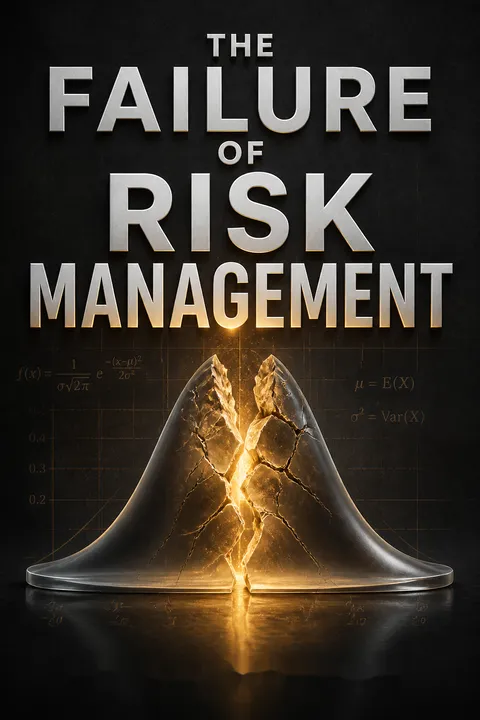


Key Takeaways
Treat a flawed risk process as the organization’s shared hidden hazard
One failure can defeat redundancy. In 1989, United Airlines Flight 232 lost control after turbine debris severed lines to all three hydraulic systems. The systems were designed as backups, but their shared exposure to one failure erased that protection. This is a common mode failure: one cause disables multiple safeguards or systems at once.
Risk methods can share the same flaw. If a company uses the same weak assessment process across safety, finance, cybersecurity, and investment decisions, one blind spot can spread everywhere. A disaster does not by itself prove that risk management failed, and a quiet stretch does not prove it succeeded. The deeper warning is that organizations often cannot show whether their method improves decisions at all.
What's striking is the shift from asking which hazard is largest to asking whether the organization can see hazards reliably. That is a systems perspective: failures emerge not only from defective components, but from dependencies among them. The analogy has limits, though. A bad process does not cause every operational failure, and a sound process cannot prevent every disaster. Its value lies in reducing avoidable exposure across many decisions, which makes consistent evaluation essential.
Define risk as possible loss with probabilities, not as an ambiguous score
Separate uncertainty from risk. Uncertainty means that several outcomes remain possible. Risk is uncertainty in which at least one outcome involves loss, injury, or other harm. To measure risk, specify the probabilities of possible outcomes and the size of the losses. A project might have a 4 percent chance of losing its full investment and a 7 percent chance of a smaller loss.
Do not collapse the pieces too soon. Multiplying probability by loss gives expected loss, a useful average, but not a complete account of how a decision-maker values a risk. Two situations with the same expected loss can feel very different if one includes a small chance of a ruinous outcome. Keeping probability and consequence distinct allows decisions to reflect actual risk tolerance.
Clear definitions do practical work: they let teams combine safety, financial, and operational concerns without pretending that their labels are directly comparable. The distinction also guards against treating volatility as harm, since variation can include gains as well as losses. A shared vocabulary cannot settle every disagreement, however. Teams still need to agree on time periods, what counts as a loss, and whose risk tolerance matters.
Replace risk matrices before their false precision steers scarce resources
Ordinal scores are not measurements. A risk matrix usually assigns labels such as low, medium, or high to likelihood and impact, then combines the ratings into a score. But a 4 is not necessarily twice a 2, and verbal labels do not mean the same thing to everyone. In one study of probability language, people interpreted “likely” as anywhere from 45 to 84 percent, despite being told it meant more than 66 percent.
The distortions can affect decisions. A review of thirty risk matrices found that many distorted the relative size of risks by factors of ten or more, with some exceeding one hundred. The author argues these tools can rank a smaller risk above a larger one and misdirect limited mitigation budgets. A colorful chart may prompt discussion, but it does not establish which action is worthwhile.
The critique is strongest when the matrix is treated as a decision engine rather than a conversation aid. Visual categories can help a group notice and discuss concerns, especially when precise data are unavailable. But that practical role should not be confused with valid measurement. The crucial test is whether the tool changes prioritization in a way that improves outcomes, not whether users find it intuitive or orderly.
Train experts to state odds, then check whether their confidence earns its numbers
Expertise does not guarantee calibration. Calibration means that stated confidence matches actual performance over many forecasts. In studies summarized by Hubbard, people who claimed 90 percent confidence were correct about 66 percent of the time on average. In a ten-question test of 90 percent confidence ranges, 1,165 participants captured the right answer only 53 percent of the time on average.
Practice can improve estimates. Calibration training uses repeated questions, feedback, and techniques such as comparing a judgment with an equivalent bet. Experts also make inconsistent estimates: in one project study, only 22 percent gave the same probability when shown an identical case twice. Separate estimates, peer review, and simple averaging can reduce some errors, but forecasts still need to be tracked against outcomes.
This makes probability assessment a distinct professional skill, rather than a free byproduct of subject expertise. Calibration also creates a useful humility: confidence becomes testable instead of rhetorical. Yet a person can be well calibrated on trivia and poorly calibrated in a specialized workplace domain. Training should therefore be paired with feedback from relevant forecasts, and teams should preserve room for expert judgment about causes and context.
Model uncertainty explicitly, then compare losses with a stated tolerance
Start with a direct replacement. The one-for-one substitution model keeps the familiar list of risks but replaces labels with explicit estimates: the chance an event occurs within a defined period, and a range of possible losses if it does. A Monte Carlo simulation repeatedly samples those uncertain inputs and adds the resulting losses. Its output can be shown as a loss exceedance curve, which reports the chance that total losses will exceed different amounts.
Connect analysis to action. Compare that curve with a risk tolerance curve set by decision-makers. If exposure exceeds the agreed limit, test mitigations by how much expected loss they reduce relative to their cost. The model can then compare spending on different controls instead of asking whether a risk moved from red to yellow. It is a starting model, not a claim of perfect prediction.
The model's strength is not that computation makes uncertainty disappear. It makes assumptions visible and allows alternatives to be compared on common terms. Setting tolerance also forces leaders to own the trade-off rather than delegate it to analysts. One caution: expected-loss reduction can understate the importance of avoiding rare ruinous outcomes, so decision-makers should examine the full loss distribution, not only its average.
Judge methods against outcomes, not confidence, consensus, or dramatic anecdotes
A polished process can be a placebo. In a survey cited by Hubbard, 69 percent of organizations made no attempt to measure whether their risk management worked. Among those claiming to measure it, many relied on staff surveys. Confidence, consensus, and a structured procedure do not prove that decisions improved.
Use evidence suited to rare events. A pharmaceutical manufacturer presented a weighted scoring system for assessing overseas drug suppliers. Months later, contaminated heparin produced severe reactions and was linked to 81 deaths. The episode makes the stakes vivid, but it does not prove that the scoring method caused the harm. Better evaluation can combine large studies, direct evidence, tests of specific components, and checks that the method addresses the actual decision: where to reduce risk, and at what cost.
The distinction between a warning story and proof is an important discipline in a field drawn to catastrophe narratives. Rare events make clean experiments difficult, so several kinds of evidence may need to be combined. Component testing is useful, but it cannot automatically establish that the whole process works in practice. A mature evaluation states what evidence would count, before success is declared.
Model connected failures and heavy tails instead of assuming every risk is independent
Disasters do not always follow a bell curve. A normal distribution makes extreme outcomes appear exceedingly rare. Yet the book reports that a 5 percent daily drop in the Dow Jones should have been unlikely even once over the historical period under a normal model, while the observed record contained seventy such drops. In complex systems, shared stress, cascading failures, and feedback can produce much more severe outcomes than simple assumptions suggest.
Represent the connections. A hurricane could damage a warehouse, interrupt production, and disable a data center at once. Treating these as independent risks can make combined losses look too small. A single correlation coefficient may also miss changing or nonlinear relationships. Detailed models of shared causes and dependencies are often more informative, though they still require checks against observed outcomes.
This is a useful corrective to models that mistake mathematical convenience for a description of reality. The key question is not whether a model uses a normal distribution, but whether the distribution and dependency structure fit the mechanism being studied. Complexity can also tempt modelers to add relationships they cannot justify. Sensitivity tests and historical comparisons help distinguish useful structure from elaborate speculation.
Use reference classes and Bayesian updating when catastrophe data are scarce
Borrow evidence carefully. A reference class is a group of comparable cases used to establish a starting estimate. For example, six breaches among twenty-five comparable companies over four years amount to six events in one hundred company-years, or a 6 percent annual baseline. The comparison group should be chosen without selecting cases just because they confirm the desired answer.
Update rather than wait for a disaster. Bayesian methods combine an initial state of uncertainty with new observations. With no prior information, Laplace’s rule of succession estimates a next-event probability as (hits + 1) divided by (observations + 2). Thus, zero incidents in four years gives a baseline of about 17 percent, not zero. The value of information helps decide whether collecting better data could change a decision enough to justify its cost.
These methods turn limited observations into provisional evidence instead of treating a short record as either conclusive or useless. Their value depends on transparent assumptions. A reference class that is too broad can hide important differences; one that is too narrow can leave almost no evidence. Bayesian updating makes uncertainty explicit, but it does not rescue a poorly chosen comparison group or a rapidly changing environment.
Make forecasts auditable across silos, and reward honest accuracy over reassuring stories
Build a shared view. Hubbard proposes a Global Probability Model, a common repository of uncertainty models that can be reused across organizational teams. Shared assumptions about revenue, outages, or currency exposure reduce duplication and help reveal risks that cross departmental boundaries. At Trustmark, leaders responded positively to loss exceedance curves, while the team identified the challenge of making probabilistic assessment part of ongoing decisions rather than an annual presentation.
Reward accuracy, not bravado. The Brier score evaluates probability forecasts by penalizing both unjustified certainty and incorrect predictions. Forecasts can be recorded, compared with outcomes, and used to improve future estimates. Incentives should also reflect the risks created by decisions, not just near-term profits. Otherwise, managers may benefit from upside while the organization absorbs the downside.
A shared model can function as organizational memory: assumptions are visible, reusable, and open to correction instead of living in separate spreadsheets and departments. Incentives matter because forecasts are social acts, shaped by what people fear or gain from saying. A scoring system alone cannot create candor, and even a proper forecast score can be undermined if leaders punish bad news or reward outcomes without regard to luck.
Analysis
The book’s central contribution is to change the standard of proof for risk management. A process is not effective because it is formal, popular, or reassuring. It must improve decisions, and the organization should be able to show how. That demand connects risk analysis to quality control: forecasts are instruments, and instruments need calibration, testing, and maintenance.
The argument is especially persuasive when it contrasts explicit probabilities and loss ranges with ordinal labels. Numbers permit comparison, updating, and performance checks; vague categories often conceal disagreement while appearing to resolve it. The practical model is deliberately modest: estimate event likelihoods and impacts, simulate combined losses, compare exposure with tolerance, and test mitigation costs. Its simplicity makes adoption plausible without implying that a spreadsheet can capture an entire enterprise.
A necessary qualification is that quantitative form does not guarantee sound judgment. A simulation can precisely propagate biased estimates, omit critical dependencies, or optimize the wrong objective. The book recognizes this danger through its criticism of normal-tail assumptions, weak correlation models, and untested quantitative practice. That self-critique is essential. A useful model is not merely more mathematical than a matrix; it is more transparent, empirically disciplined, and revisable.
There is also a distinction between forecast accuracy and decision quality. A forecast can be well calibrated while a decision remains poor because leaders chose the wrong objective, misunderstood who bears the loss, or ignored ethical and legal constraints. Conversely, a decision can turn out badly despite being reasonable given the information available. Risk governance therefore needs both accurate uncertainty estimates and explicit accountability for choices. The strongest implication is institutional: organizations should treat uncertainty as something they can measure imperfectly, learn about systematically, and manage collectively, rather than as a reason to rely on intuition without inspection.
Review Summary
The Failure of Risk Management receives mixed reviews, with many praising its critique of traditional risk management methods and advocacy for quantitative approaches. Readers appreciate Hubbard's insights on the limitations of qualitative risk assessments and his push for more rigorous, data-driven methods. However, some find the book repetitive and overly critical of other approaches. Critics note that while Hubbard effectively highlights problems in risk management, he provides limited practical solutions. Overall, the book is seen as thought-provoking for professionals in risk management and decision-making roles.
People Also Read








Glossary
Common mode failure
One cause defeats backupsA common mode failure occurs when one cause disables multiple components or safeguards that might otherwise appear independent. Flight 232 illustrates the idea: turbine debris damaged all three hydraulic systems because their lines shared exposure to the same location. Such failures matter because redundancy provides little protection when the backups share a vulnerability.
Analysis placebo
Confidence without better decisionsAn analysis placebo is the impression that a formal analytical method has improved judgments or decisions when there is no measurable improvement. Structure, workshops, extra information, or collaboration can make users more confident and satisfied without making their forecasts more accurate. The term highlights why perceived usefulness is not a substitute for objective evaluation.
Calibration
Confidence matches outcomesCalibration is the degree to which a forecaster’s stated probabilities correspond to actual results across many forecasts. If events assigned a 70 percent probability occur about 70 percent of the time, those estimates are calibrated at that level. Training, repeated practice, and feedback can improve calibration, making confidence testable rather than merely asserted.
Loss exceedance curve
Chance losses exceed amountsA loss exceedance curve shows the probability that total losses will exceed different monetary thresholds over a specified period. It can be generated by simulating many possible outcomes from uncertain event probabilities and impact ranges. Unlike a single risk score, the curve displays a range of potential losses and their associated likelihoods.
One-for-one substitution model
Quantified replacement for matricesThe one-for-one substitution model replaces each item in a conventional risk matrix with explicit estimates of event probability over a stated period and a range of losses if the event occurs. A Monte Carlo simulation combines these uncertain inputs into a loss exceedance curve, which can be compared with organizational risk tolerance and mitigation options.
Exsupero ursus fallacy
Demanding perfection from modelsThe exsupero ursus fallacy is the mistake of rejecting an imperfect model because it makes an error, without comparing its performance with the available alternative. Human intuition is also imperfect, yet it is often held to a more forgiving standard. The relevant test is whether a model performs better than its alternatives across many cases.
Measurement inversion
Measuring low-value uncertaintiesMeasurement inversion is the recurring tendency to collect information about uncertainties that are easy to measure while neglecting those most likely to change a decision. The book uses expected value of information to identify which uncertainties merit further measurement. This can redirect analytical effort from familiar data toward consequential unknowns.
Global Probability Model
Shared uncertainty repositoryA Global Probability Model is a shared organizational repository of probability models and assumptions about important uncertainties. Teams can reuse relevant components, such as revenue forecasts or outage risks, instead of building disconnected models. Combining and updating these components can expose dependencies across departments and support decisions spanning the organization.
Brier score
Score for probability forecastsThe Brier score evaluates probabilistic forecasts by comparing each stated probability with the eventual outcome, then averaging the squared errors. Overconfident wrong forecasts receive larger penalties than cautious ones. The score is a proper scoring method, meaning forecasters cannot improve it through a systematic strategy other than reporting probabilities that reflect their genuine estimates.
FAQ
What's The Failure of Risk Management about?
- Critique of Current Practices: The book critiques traditional risk management methods, particularly qualitative ones, arguing they often lead to poor decision-making.
- Call for Quantitative Methods: Douglas W. Hubbard advocates for a more scientific and quantitative approach to risk management, emphasizing statistical methods like Monte Carlo simulations.
- Structured Analysis: It is divided into three parts: identifying the crisis in risk management, analyzing why current methods are flawed, and offering practical solutions.
Why should I read The Failure of Risk Management?
- Critical Insights: Hubbard provides a thorough examination of the flaws in popular risk management methods, essential for professionals in the field.
- Practical Solutions: The book offers actionable advice and methodologies to improve risk assessment and management practices.
- Broad Applicability: It is relevant for various industries, including finance, engineering, and project management, making it a valuable resource for a wide audience.
What are the key takeaways of The Failure of Risk Management?
- Ineffectiveness of Qualitative Methods: Hubbard argues that qualitative scoring methods, such as risk matrices, often add error and do not improve decision-making.
- Need for Quantitative Analysis: The book advocates for using quantitative methods to better assess risks and make informed decisions.
- Calibration of Expert Judgment: It emphasizes the importance of calibrating expert estimates to improve accuracy in risk assessments.
What are the best quotes from The Failure of Risk Management and what do they mean?
- “First, do no harm.”: This principle should guide risk management practices, ensuring that methods do not introduce additional errors or worsen decision-making.
- “Never attribute to malice that which can be adequately explained by stupidity.”: This highlights the importance of understanding systemic issues rather than blaming individuals for failures.
- “Experience is inevitable. Learning is not.”: This underscores the need for organizations to actively learn from past experiences rather than relying solely on historical knowledge.
What are the “Four Horsemen” of risk management mentioned in The Failure of Risk Management?
- Actuaries: They use scientific and mathematical methods primarily in insurance and pensions, but their influence is limited outside these areas.
- War Quants: Engineers and scientists who apply probabilistic risk analysis and decision analysis, often using simulations to model risks.
- Economists: Financial analysts who focus on statistical analysis of historical data, but may overlook systemic risks and interactions.
- Management Consultants: They often promote qualitative methods that lack empirical support, leading to widespread adoption of ineffective practices.
How does Douglas W. Hubbard define risk in The Failure of Risk Management?
- Long Definition: Risk is described as “a potential loss, disaster, or other undesirable event measured with probabilities assigned to losses of various magnitudes.”
- Short Definition: It is simply “the possibility that something bad could happen.”
- Emphasis on Measurement: Hubbard stresses that risk should be quantifiable, allowing for better decision-making and management.
What is the significance of calibration in risk management according to The Failure of Risk Management?
- Improving Accuracy: Calibration helps experts provide more accurate probability estimates, reducing overconfidence and inconsistency in risk assessments.
- Training Methods: Hubbard discusses techniques for training experts to improve their judgment, which can lead to better decision-making outcomes.
- Empirical Evidence: The book presents research showing that calibrated experts perform significantly better than uncalibrated ones, making calibration a critical component of effective risk management.
What are the problems with popular risk assessment methods discussed in The Failure of Risk Management?
- Qualitative Scoring Issues: Methods like risk matrices often rely on arbitrary scales that compress a wide range of values into limited categories, leading to imprecision.
- Subjective Errors: These methods do not account for known biases and errors in human judgment, which can result in systematic underestimation of risks.
- Lack of Empirical Support: Many popular methods lack scientific validation, making them unreliable for making significant decisions.
How does Douglas W. Hubbard propose to fix the issues in risk management?
- Adopt Quantitative Methods: He advocates for the use of quantitative analysis, such as Monte Carlo simulations, to better assess risks and inform decisions.
- Improve Expert Input: The book suggests methods for calibrating expert judgments and using empirical data to enhance risk assessments.
- Establish Clear Risk Tolerance: Hubbard emphasizes the need for organizations to define their risk tolerance quantitatively, allowing for better resource allocation in risk mitigation.
What is the “one-for-one substitution model” introduced in The Failure of Risk Management?
- Simple Quantitative Model: This model replaces qualitative risk matrices with a straightforward quantitative approach that uses explicit probabilities for likelihood and impact.
- Expert Input: Experts provide subjective estimates of probabilities and potential losses, which are then used in a Monte Carlo simulation to generate a loss exceedance curve.
- Decision Support: The model aims to support decision-making by allowing organizations to visualize risks and compare them against their risk tolerance.
What are the limitations of expert knowledge in risk management according to The Failure of Risk Management?
- Overconfidence: Experts often overestimate their accuracy in predicting outcomes, leading to systematic errors in risk assessments.
- Inconsistency: Experts may provide different estimates for the same risk at different times, indicating a lack of reliability in their judgments.
- Need for Calibration: The book stresses the importance of calibrating expert estimates to improve their accuracy and reduce the impact of biases on decision-making.
How does The Failure of Risk Management address the concept of "calibration"?
- Calibration Importance: Calibration is presented as a critical component of effective risk analysis. Hubbard explains that calibrated estimates lead to more accurate assessments of uncertainty and risk.
- Methods for Calibration: The book outlines various methods for calibrating expert estimates, including the use of equivalent bets and structured reflection on potential errors.
- Impact on Decision-Making: Improved calibration can significantly enhance the quality of risk assessments, leading to better-informed decisions. Hubbard emphasizes that organizations should prioritize calibration training for their experts.
About the Author
Download PDF
Download EPUB
.epub digital book format is ideal for reading ebooks on phones, tablets, and e-readers.








