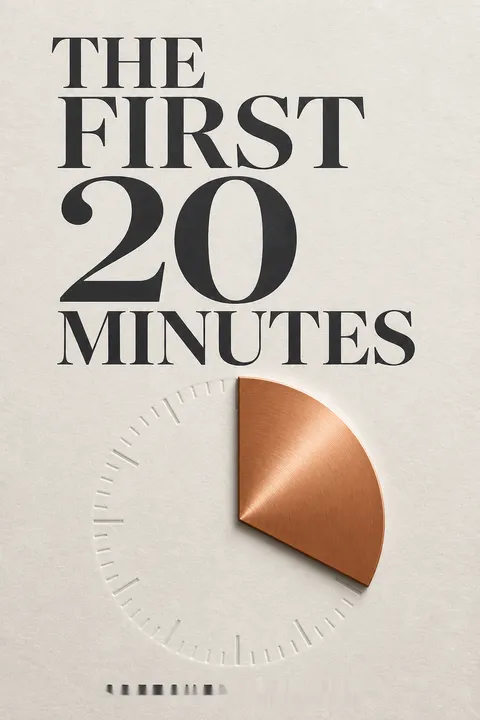


Key Takeaways
The first 20 minutes matter most when they get you moving at all
Start with the smallest dose. The book’s central argument is that movement is essential, but the largest health gains often arrive when an inactive person begins doing something. A review cited in the book found that meeting the guideline of 150 minutes of moderate activity each week was associated with nearly 20 percent lower risk of premature death than doing none. Nearly tripling that amount brought only about 4 percent more reduction. The health curve rises steeply at first, then flattens.
Build toward a practical target. The 2008 US guidelines recommended 150 minutes of moderate aerobic activity, or 75 minutes of vigorous activity, each week, plus strength training twice weekly. Those minutes can be split into short sessions. In a study of previously inactive engineers, three 10-minute walks produced improvements similar to one 30-minute walk.
The useful distinction is between starting and optimizing. Public-health advice often fails when it presents the full target as an entry requirement, making a meaningful first step feel inadequate. This evidence supports a more accessible message: begin with what can be repeated, then build. The precise mortality estimates come from population-level studies, however, and cannot predict an individual’s outcome. The book’s stronger practical point is less fragile: a modest increase in movement can matter, even before it looks like a formal fitness program.
Choose exercise by your goal, then increase the challenge to improve
Health and performance differ. Walking regularly can improve health and fitness, but it may not make someone faster in a race. To improve athletic performance, the body needs progressive overload: a planned increase in workout frequency, duration, or intensity that gives the body a new demand to adapt to. A MET, or Metabolic Equivalent of Task, measures energy use relative to resting; weekly activity of about 500 MET minutes was the guideline threshold discussed for health.
Add difficulty with care. One option is interval training, alternating harder efforts with easier recovery. In a Japanese study, older walkers who repeatedly switched between brisk and gentle three-minute walks improved leg power and aerobic capacity more than those who walked easily throughout. The book also describes evidence that intervals can retrain the brain’s sense of tolerable effort, not just condition muscles. Increase training gradually, and respond to persistent pain or fatigue.
This goal-first approach corrects a common category error: health maintenance, general fitness, and competitive performance are related, but they are not interchangeable outcomes. It also gives readers a way to interpret plateaus. A comfortable routine may continue to support health while no longer challenging the body enough to produce faster times or greater capacity. The limitation is that harder is not automatically better. The appropriate challenge depends on training history, health, and recovery, so overload works best as a gradual experiment rather than a dare.
Warm up with movement, not prolonged static stretching
Prepare muscles for the task. Static stretching means holding a muscle at its limit, usually for 20 to 30 seconds. In a study of collegiate athletes, a 16-minute static routine left runners covering less distance in an hour and using more oxygen than when they had rested before running. Other studies found temporary reductions in muscle strength, with no reliable evidence that pre-exercise stretching prevents injuries in ordinary runners.
Move through the range. A warm-up can instead begin with several minutes of easy activity, then progress to dynamic movements that resemble the sport. A runner might jog gently and add controlled skips or lunges; a golfer can make practice swings. The aim is to raise body temperature and prepare the joints without exhausting the muscles. Research on warm-ups is incomplete, but 10 to 15 minutes is often sufficient.
The distinction between stretching and warming up is more useful than a blanket instruction to stretch or never stretch. The body needs readiness for a particular task, not necessarily maximal flexibility. That principle also explains why a golfer’s practice swings and a runner’s easy jog can be more relevant than a generic routine. Still, the evidence described here concerns performance and common injury outcomes, not every sport or every person. Activities that demand extreme range of motion may require flexibility work, ideally separated from the immediate pre-performance period.
Drink to thirst, and fuel only the workouts long enough to need it
More intake is not always safer. The book challenges the advice to drink constantly during exercise. Drinking more fluid than is lost can dilute blood sodium and cause hyponatremia, or water intoxication. In marathons, some slow runners drank so much that they gained weight during the race, a warning sign. The book recommends listening to thirst and notes that weighing before and after exercise can help identify unusually large fluid losses or gains.
Match fuel to duration. For exercise lasting an hour or less, a normal diet generally provides enough carbohydrate. Long endurance events are different: experts cited in the book suggest roughly 60 grams of carbohydrate per hour, and up to 90 grams during efforts lasting at least two and a half hours. After a hard workout, carbohydrate paired with protein can help replenish muscle fuel. Low-fat chocolate milk is offered as one convenient option.
The deeper lesson is that sports nutrition is conditional, not universal. A marathoner and someone taking a short walk have different needs, even if both encounter the same sports-drink marketing. This is a useful corrective to the assumption that more hydration or more supplements must mean better preparation. At the same time, thirst and weight change are practical guides, not a complete medical assessment for every climate, illness, or athlete. The book’s own examples emphasize variation, so these principles should not be turned into rigid rules.
Use exercise to protect weight, not as a calorie eraser
The scale can mislead. Exercise burns calories, but people often lose less weight than the workout’s energy cost predicts. Some unconsciously eat more afterward or move less during the rest of the day. In one study, women who completed a cycling program often compensated in these ways; those who met expected weight-loss targets tended to increase activity outside their workouts too.
Keep the broader payoff. A moderate cycling session did not produce extra fat burning during the following day in one controlled study. A harder 45-minute ride did increase energy use afterward in a group of men, but the extra burn averaged only 190 calories, and the study did not establish that this effect applies to everyone. Exercise is more reliable for maintaining weight and improving fitness, blood pressure, and mood than for producing large losses by itself.
This is a valuable correction to the arithmetic fantasy that a workout creates a guaranteed calorie deficit. Human behavior and physiology respond to energy loss, so the actual result depends partly on what happens outside the exercise session. The book also avoids reducing exercise to weight: people can become fitter and healthier even when the scale barely changes. One caution is that weight change is shaped by many interacting factors, and a single study cannot settle the best strategy for every person. The practical implication is to treat exercise as health infrastructure, not punishment for eating.
Train strength alongside endurance to preserve independence
Muscle is more than bulk. Resistance training challenges muscles to work against force. The book explains that muscles respond by repairing stressed fibers and improving the nervous system’s ability to activate and coordinate them. Strength gains do not usually mean dramatic size gains for ordinary exercisers. In studies, older adults gained strength with light resistance training, even in their seventies, eighties, and nineties.
The benefits reach beyond lifting. Muscle helps regulate blood sugar because it uses and stores glucose. Resistance training can also improve physical function, and studies cited in the book link it with better strength, coordination, and some measures of cognitive performance. As people age, sarcopenia, the loss of muscle mass and strength, can make rising from a chair or climbing stairs difficult. Two weekly strength sessions are a practical starting point; body-weight movements can provide resistance without gym equipment.
Strength training is presented as a form of functional capacity, not a cosmetic project. That reframing matters because everyday independence depends on producing force, coordinating movement, and retaining enough muscle to meet ordinary demands. It also dissolves the false choice between cardio and weights: the two forms of training have overlapping, but not identical, benefits. The evidence does not mean every exercise program suits every joint or health condition. Instruction and sensible progression remain important, especially for people new to resistance work or returning after injury.
Progress gradually; a previous injury is your strongest warning sign
Protect the body’s margin. The book identifies a previous injury as the clearest predictor of another, with abrupt increases in training, new surfaces, and sudden equipment changes also posing risks. Balance work can help address one mechanism: an ankle sprain may damage sensory receptors that tell the brain where the foot is, leaving a person less stable afterward. Practicing a one-leg stand near a wall, or on a soft surface when ready, is a simple way to challenge balance.
Do not over-trust gear or form rules. Military studies found that assigning running shoes by arch type did not prevent injuries, and in some cases the supposedly tailored shoes were associated with more injuries. Research on running and knee arthritis was also reassuring: after 20 years, one study found arthritis in fewer runners than non-runners. Persistent pain deserves attention, but running itself is not automatically a threat to healthy knees.
Injury prevention is less about discovering a universally perfect shoe or stride than about managing transitions. Bodies adapt to familiar demands, while sudden changes can exceed current capacity. The chapter’s findings also warn against treating fashionable explanations, such as arch type alone, as established causes. There is an important limit: studies of runners who remain active cannot guarantee that running is safe for every knee, especially one with a history of damage. The sensible approach is individualized monitoring, gradual change, and qualified help when pain persists.
Move to strengthen memory and make stress easier to bear
Exercise changes the brain. Neurogenesis is the creation of new neurons. In animal studies described in the book, mice with running wheels produced more new neurons in the hippocampus, a brain region central to memory. A human study found increased blood flow to the hippocampus after 12 weeks of regular exercise, alongside improved word recall. The book also reports studies in which active older adults showed less cognitive decline than inactive peers, even when their activity was modest.
Mood responds, too. Experiments found that a single moderate workout helped limit anger in volunteers exposed to upsetting images. Other research linked activity with greater resilience to stress. These results do not mean that exercise prevents every case of dementia, depression, or anxiety. They do suggest that movement can support cognitive and emotional health across ages, without requiring elite training or exhausting sessions.
The brain findings make exercise more than a matter of muscles and cardiovascular conditioning. They point to a two-way relationship: the brain directs movement, while movement changes the conditions in which the brain functions. That connection can make activity feel worthwhile even when speed or body weight is not the goal. The evidence also requires careful interpretation. Animal neurogenesis studies illuminate possible mechanisms, while human studies often measure blood flow, memory tests, or associations rather than long-term disease prevention. Promise is not the same as a guarantee.
Treat your genes as a starting point, not an exercise verdict
People respond differently. Genetics influence both the inclination to exercise and the body’s response to training. A study of more than 37,000 twin pairs estimated that genes explained about 60 percent of differences in exercise behavior. In another training study, participants’ changes in fitness ranged widely: some improved substantially, while others showed little change or even declined on a measure.
No single gene decides the outcome. Researchers identified 21 genetic markers associated with different aerobic responses, but these markers explain only part of the variation. Likewise, elite athletes did not consistently possess every gene thought to favor endurance or power. Training volume, skill, motivation, support, and opportunity also matter. If one approach produces little improvement, that does not prove that all activity is futile. It may be worth adjusting the activity or intensity, while remembering that exercise can benefit health even without a dramatic fitness response.
This account avoids two tempting errors: pretending biology is irrelevant, and treating genetic influence as destiny. The twin findings suggest that motivation and effort are not distributed on a perfectly level playing field. The variation in training response also challenges the assumption that one standard program should work equally well for everyone. Yet estimates of heritability describe differences in a particular population and environment, not an individual’s fixed limit. The humane implication is personalization: assess what changes, adapt the method, and do not confuse a weak response on one metric with failure.
Keep exercising with age; active twins had cells resembling younger peers
Age is not a fixed timetable. Telomeres are protective structures at the ends of DNA strands; they tend to shorten as cells divide and are used as one marker of cellular aging. In a study of twins, those averaging 30 minutes of daily activity had telomeres comparable in length to sedentary people about ten years younger. When one twin was active and the other inactive, the active twin usually had longer telomeres.
Activity can preserve function. The book also describes accelerated-aging mice whose mitochondrial problems were less pronounced when they exercised. Human research on older athletes found better-preserved muscle and bone than in inactive peers. These findings do not show that exercise stops aging or guarantees a longer life. They show that some features associated with aging are influenced by activity, and that people can gain fitness even after years of inactivity.
The twin comparison is compelling because shared genes and early environments make differences in adult activity especially vivid. Still, telomere length is a biological marker, not a direct measure of how long someone will live, and an association cannot by itself prove that exercise caused the difference. The animal experiments offer stronger control but cannot be mapped directly onto human aging. Taken together, the evidence supports a measured claim: regular movement can preserve capacities that inactivity tends to erode. That is already consequential, even without promises of agelessness.
Break up long sitting; a workout does not erase the rest of the day
Sitting has its own effects. London bus conductors, who climbed stairs throughout their shifts, had fewer heart attacks than the seated drivers. Modern research adds a complication: a person can exercise regularly and still spend most of the day inactive. In one study, men who spent more than 23 hours weekly watching television or sitting in cars had a higher risk of dying from heart disease than those reporting 11 hours or less.
Interrupt the stillness. In a study described in the book, people who stood and walked gently for two minutes every 20 minutes kept blood sugar more stable during a long sitting day than those who remained seated. The important change was breaking up the sitting, not making each break strenuous. Stand during calls, walk between tasks, or get up regularly. Formal workouts remain valuable, but they do not replace movement throughout the day.
This is the book’s most important adjustment to the usual exercise story. It treats inactivity as more than a missed workout, suggesting that prolonged sitting and deliberate exercise operate through partly distinct pathways. That distinction changes the design of a day: the answer is not only to schedule a run, but also to interrupt long periods of stillness. The evidence is persuasive as a public-health warning, though associations between sitting and disease do not mean every sitting hour has the same effect. Small, frequent movement is a plausible, low-cost response.
Analysis
The book’s central move is to replace the question “How much exercise is best?” with three more useful questions: best for what, for whom, and at what cost? Health, fitness, competitive performance, weight control, injury risk, brain function, and aging overlap, but they do not respond identically to the same dose. A short walk can produce meaningful health gains without improving race performance; hard intervals can improve fitness efficiently, but their intensity and recovery demands make them unsuitable as a universal prescription.
Its second major insight is that the body is adaptive, not a machine that simply obeys calorie arithmetic. Muscles, brains, appetite, hydration, and even daily movement respond to the demands placed on them. The surprising practical consequence is that several popular rituals are less reliable than their reputations: static stretching does not reliably prevent injury, drinking beyond thirst can be dangerous, and exercise alone often produces less weight loss than expected. Conversely, strength work and ordinary movement have benefits that are easy to overlook because they do not always change the scale or produce dramatic athletic results.
The book’s journalistic structure makes exercise science memorable by pairing experiments with human stories, from Kenyan runners to older athletes and bus conductors. Its strength is also a limitation. Much of the evidence it discusses comes from small studies, animal experiments, observational comparisons, or research available at the time of publication. These forms of evidence answer different questions. A mouse mechanism can suggest how a process works; it cannot establish the same effect in people. An association between activity and health does not, by itself, prove cause. The book is most trustworthy when it presents science as provisional and most vulnerable when an intriguing finding sounds like a settled rule.
The durable message is not that every reader should become a runner or train with punishing intervals. It is that movement is a basic biological input, and inactivity is not merely the absence of exercise. Start with a manageable dose, choose a form of activity that fits the goal and the person, add challenge when improvement matters, and interrupt long stretches of sitting. The body’s response varies, but the case for moving does not depend on becoming exceptional.
Review Summary
The First 20 Minutes receives mixed reviews, with many praising its science-based approach to exercise and fitness. Readers appreciate the myth-busting, accessible writing style, and practical advice. Some find it eye-opening and motivational, while others criticize its repetitiveness or lack of new information. The book covers topics like cardio, strength training, nutrition, and the mental benefits of exercise. Critics note the absence of a bibliography and overreliance on animal studies. Overall, it's seen as a comprehensive guide to current exercise science, though opinions on its usefulness vary.
People Also Read





Glossary
MET minute
activity dose measureA MET, or Metabolic Equivalent of Task, compares the energy used during an activity with the energy used at rest. A MET minute combines that intensity with the time spent doing the activity. The book uses weekly MET minutes to explain exercise guidelines, distinguishing accumulated activity from simply counting minutes.
overload
progressive training challengeOverload is the principle that fitness or athletic performance improves when exercise places a sufficiently new demand on the body. That demand can rise through greater frequency, duration, or intensity. Once the body adapts to a familiar workload, repeating it may maintain health or fitness but is less likely to keep improving performance.
high-intensity interval training
short, hard exercise boutsHigh-intensity interval training, or HIIT, alternates brief, strenuous periods of exercise with recovery periods. The book describes research in which very short cycling efforts produced fitness-related changes comparable to much longer, easier sessions. The hard efforts are demanding, and the results discussed do not make HIIT appropriate for every person or every goal.
delayed onset muscle soreness (DOMS)
delayed post-exercise sorenessDOMS is muscle soreness that develops hours or a day or two after unfamiliar or strenuous exercise. It is associated particularly with eccentric contractions, in which a muscle produces force while lengthening, such as lowering a weight or running downhill. The book presents soreness as a common response to training, not a reliable measure of workout quality.
rating of perceived exertion (RPE)
subjective effort scaleRPE is a way to estimate how hard exercise feels to the person doing it. The book discusses a scientific scale running from 6 to 20 and a more familiar 0 to 10 version. Research cited there suggests perceived effort can sometimes reflect physiological intensity better than simple age-based heart-rate formulas.
VO2 max
maximum oxygen-use capacityVO2 max is the greatest amount of oxygen a person can take in and deliver to working muscles during intense exercise, usually expressed relative to body weight. It is commonly used as a measure of aerobic capacity. Training can raise it, but the book cautions that it does not alone determine who wins an endurance event.
sarcopenia
age-related muscle lossSarcopenia is the gradual loss of muscle mass and strength associated with aging. It can reduce the ability to perform ordinary tasks, such as rising from a chair or climbing stairs, and can threaten independence. The book presents resistance training as a way to counter this decline, including for older adults.
neurogenesis
creation of new neuronsNeurogenesis is the formation of new neurons. The book describes evidence for neurogenesis in the hippocampus, a brain region involved in memory, and research suggesting that exercise can increase this process in animals. Human studies discussed also associate exercise with changes in hippocampal blood flow and memory performance.
telomeres
protective DNA end capsTelomeres are protective structures at the ends of DNA strands. They help shield genetic material as cells divide, and they tend to shorten over repeated divisions. The book discusses telomere length as a marker associated with cellular aging and reports that more active people in one twin study had longer telomeres than less active counterparts.
active couch potatoes
exercisers who sit extensivelyThe phrase describes people who complete planned workouts but spend much of the remaining day sitting or otherwise inactive. The book uses it to distinguish an exercise session from movement across the whole day. Evidence discussed suggests that regular workouts do not necessarily cancel the physiological effects associated with prolonged sitting.
FAQ
What's The First 20 Minutes about?
- Focus on Exercise Science: The book delves into the latest scientific research on exercise, highlighting how even minimal physical activity can significantly enhance health and longevity.
- User's Manual for Movement: It serves as a practical guide for incorporating effective exercise into daily life, suitable for all fitness levels.
- Challenging Traditional Beliefs: Author Gretchen Reynolds presents new research that questions conventional exercise wisdom, making it a dynamic read for fitness enthusiasts.
Why should I read The First 20 Minutes?
- Evidence-Based Insights: The book is grounded in scientific research, offering reliable information on optimizing exercise for better health.
- Practical Applications: It provides actionable advice that can be easily integrated into daily routines, beneficial for both beginners and seasoned athletes.
- Motivational and Accessible: Written in an engaging style, it simplifies complex concepts and motivates readers to improve their fitness levels.
What are the key takeaways of The First 20 Minutes?
- Small Efforts Matter: Just 20 minutes of physical activity per week can improve mental health and overall well-being.
- Exercise and Longevity: Regular physical activity is linked to increased life expectancy and reduced risk of chronic diseases.
- Strength Training Importance: Emphasizes the role of strength training in maintaining muscle mass and metabolic health as we age.
What are the best quotes from The First 20 Minutes and what do they mean?
- "Almost all of the mortality reductions are due to the first 20 minutes of exercise.": Highlights the significant health benefits of minimal exercise, encouraging readers to start moving.
- "The body wants to move. Go with it.": Emphasizes the natural inclination towards movement and the importance of listening to that instinct.
- "Inactivity is the greatest public health threat of this century.": Stresses the urgent need to incorporate more movement into daily life to combat health risks.
How much exercise do I really need according to The First 20 Minutes?
- Minimum Recommendations: Suggests as little as 150 minutes of moderate-intensity exercise per week, broken into manageable sessions.
- 20 Minutes is Key: Engaging in just 20 minutes of activity can significantly improve mental health and reduce fatigue.
- Individual Variability: Exercise needs vary based on personal goals and health conditions, requiring tailored routines.
What does The First 20 Minutes say about stretching?
- Static Stretching Concerns: Argues that static stretching before exercise may decrease performance by temporarily reducing muscle strength.
- Dynamic Warm-Ups Recommended: Suggests dynamic warm-ups involving movement to effectively prepare the body for exercise.
- Flexibility's Role: While important, extreme flexibility is not necessary for most and can be counterproductive in some sports.
What is the significance of strength training in The First 20 Minutes?
- Muscle Health: Essential for maintaining muscle mass, crucial for metabolic health and physical function as we age.
- Preventing Obesity: Increased muscle mass boosts metabolism and improves insulin sensitivity, combating obesity.
- Functional Benefits: Enhances daily functional movements, making everyday tasks easier and reducing injury risk.
How does The First 20 Minutes address the relationship between exercise and mental health?
- Exercise as Mood Booster: Regular physical activity improves mood and reduces anxiety and depression.
- 20 Minutes of Activity: Just 20 minutes of exercise can significantly enhance mental well-being.
- Long-Term Benefits: Consistent exercise is linked to better stress management and cognitive function.
What are the misconceptions about hydration during exercise discussed in The First 20 Minutes?
- Thirst as a Guide: Thirst is a reliable indicator of hydration needs, suggesting drinking according to thirst rather than rigid guidelines.
- Risks of Overhydration: Warns against overhydration, which can lead to hyponatremia, a potentially life-threatening condition.
- Fluid Needs Vary: Fluid requirements vary based on exercise intensity, duration, and individual sweat rates.
What is the afterburn effect mentioned in The First 20 Minutes?
- Definition of Afterburn: Refers to increased calorie burn post-exercise, where the body continues to consume oxygen and burn calories.
- Study Findings: Moderate exercise does not significantly increase calorie burning after workouts, challenging the belief of eating freely post-exercise.
- Implications for Weight Loss: Understanding afterburn helps manage caloric intake, as fewer extra calories are burned post-exercise than assumed.
How does The First 20 Minutes suggest incorporating exercise into daily life?
- Start Small: Encourages beginning with short, manageable workouts, as even brief activity can lead to health benefits.
- Mix It Up: Advocates combining endurance and strength training for a balanced routine that keeps individuals engaged.
- Listen to Your Body: Advises adjusting exercise routines based on personal feelings and energy levels, rather than rigid plans.
How does The First 20 Minutes relate to overall health and wellness?
- Holistic Approach: Presents exercise as crucial for overall health, linking it to improved mental health and cognitive function.
- Preventive Health: Regular exercise helps prevent chronic diseases like diabetes and heart disease, essential for a healthy lifestyle.
- Quality of Life: Staying active enhances quality of life, allowing enjoyment of daily activities and maintaining independence with age.
Download PDF
Download EPUB
.epub digital book format is ideal for reading ebooks on phones, tablets, and e-readers.








