

Key Takeaways
Earn an artistic reading by making the first pages technically trustworthy
Craft comes first. Lukeman argues that an opening is not a reliable measure of a work’s artistic greatness, but it can expose technical weaknesses quickly. After assessing more than 10,000 manuscripts, he says he saw the same avoidable problems recur, often in the opening sentences. Editors facing crowded submission piles may use such flaws as reasons to stop reading, before plot or promise gets a hearing.
Check beyond the opening. For evaluators, Lukeman’s three-check method means reading the beginning, a section from the middle, and one near the end before rejecting a manuscript that starts badly. The point is to use opening pages as a demanding craft test, not as unquestionable proof of a book’s overall quality.
The opening pages function like a professional audition: they reveal control, care, and whether the writer can guide attention. That makes close revision valuable even when a novel’s real strengths take time to emerge. Yet the method also exposes a tension between quality and access. A rushed reader’s first impression can filter out deliberate strangeness along with genuine weakness. The three-check method is a useful safeguard because it distinguishes a flawed opening from a consistently flawed manuscript, without pretending that any quick test can settle the question of artistic merit.
Treat submission standards as access, not as the art itself
Remove avoidable friction. Lukeman separates a manuscript’s literary value from its presentation, while warning that poor formatting can make a busy reader less willing to engage. His 2000 advice specifies clean white paper, readable 12-point type, double spacing, and consistent margins. The durable principle is simpler: follow the recipient’s stated submission instructions, make the pages comfortable to read, and avoid distracting flourishes.
Research your audience. Rather than sending the same pitch everywhere, identify agents or editors whose work genuinely resembles the project, then explain that fit accurately. Lukeman recounts an author who cited one of his books as a comparison, though the submitted novel belonged to a different genre. Personalization can signal care, but only when the comparison is real.
Presentation is a form of interface design. A clean page lowers the effort required to assess the writing, while a targeted query helps the recipient understand why the work belongs in that particular inbox. The book’s principle remains useful, but its concrete production advice is period-specific: contemporary submission requirements vary, so copying old formatting rules without checking can create the very mismatch the advice seeks to prevent. Nor should costly delivery be mistaken for evidence of literary quality. Care is better shown through accuracy and respect for instructions than through expense.
Replace modifier piles with exact nouns, verbs, and audible rhythm
Let strong words work. Stacking several familiar adjectives onto one noun often slows a sentence without making its image clearer. Instead of describing a character as running quickly, a precise verb may carry the action more economically. Lukeman recommends cutting redundant modifiers, replacing weak verbs and nouns, and keeping only the detail that matters most. The goal is not to eliminate description, but to make each word earn its place.
Listen for friction. Sound includes rhythm, repetition, awkward sentence construction, and unintentional echoes. Read passages aloud to find places where the prose stumbles, repeats a name, or strains after a showy effect. Poetry can train attention to the sound of individual words, but beautiful sound alone is not enough: the sentence must still say something precise.
This approach treats revision as compression with purpose, not as a contest to use the fewest words. Cognitive load offers a useful parallel: a reader must hold details in mind while building an image, and redundant modifiers can add effort without adding information. Reading aloud makes that burden audible. Still, a modifier is not automatically weak because it is familiar, and repetition can be an intentional device. The real diagnostic question is whether the word changes the image, mood, or rhythm in a way the surrounding sentence needs.
Use comparisons only when they sharpen a picture or thought
Make the image precise. A simile or metaphor can compress a description and help readers feel an idea, not merely understand it. But a comparison that is clichéd, mismatched, or unclear draws attention to the writer’s imprecision. Lukeman urges writers to ask whether the idea needs comparison, whether a nearby comparison already does the job, and whether the image truly fits. A character described through one apt resemblance may become clearer than one explained in a long list of features.
Know the word. Specific details, such as naming the particular bird or insect in a scene, make a setting more convincing. A broad vocabulary gives writers more choices, but unfamiliar words should be learned before they appear in a manuscript. Precision matters more than sounding impressive.
Comparison is a compression tool and a model-building tool at once. It gives the reader a familiar structure for grasping something less familiar, which is why a strong image can replace several sentences of explanation. Its risks are equally instructive: the image may import associations the writer did not intend, or compete with the scene’s main action. Specific vocabulary works similarly. It signals close observation, but excessive or unexplained terminology can turn a vivid world into a test of the reader’s patience.
Make dialogue reveal relationships instead of briefing the reader
Listen beneath the words. Dialogue becomes stiff when characters repeat facts they both know, summarize events for the audience, or speak in a constant state of high drama. Lukeman calls dialogue used mainly to deliver background or plot information informative dialogue. He also identifies commonplace exchanges that add no meaningful tension, and “spitfire” dialogue: long, uninterrupted volleys that race past the scene’s action and pauses.
Give speech room. Use speaker identifiers clearly, but do not make every line carry a name or an elaborate substitute for “said.” Break up rapid exchanges when the reader needs time to register action. Conversely, in an urgent confrontation, too much description between lines can drain the moment. Dialogue should arise from what characters want from each other, not merely from what the reader needs to know.
Dialogue is a social act, not simply information in quotation marks. People hint, evade, interrupt, and talk past each other; fictional speech becomes convincing when it reflects the relationship and pressure in the room. The advice to remove exposition is strongest when paired with a clear alternative, such as establishing necessary background through action or narration. Real speech, however, is not automatically engaging. A transcript of ordinary conversation can be dull, so the writer’s task is selective realism: preserve the telling human detail while shaping the exchange for dramatic purpose.
Turn plot summaries into scenes, then let readers judge
Let action carry meaning. Telling labels a character or event directly; showing gives readers observable behavior from which to draw conclusions. Instead of announcing that a place is impossible to escape, a writer might describe barriers, patrols, or other concrete obstacles. Instead of summarizing an argument as hostile, the writer can dramatize what the characters do and say. These choices turn an outline of events into an experience.
Choose what to dramatize. Showing takes more space, so it cannot replace every summary. Use scenes where a character’s behavior, a turning point, or an important relationship deserves the reader’s attention. Telling can also reveal a narrator’s bias: a narrator’s description of someone may tell readers as much about the narrator as about the person described.
The distinction resembles the difference between a report and an encounter. Observable behavior invites interpretation, giving readers a role in making meaning rather than supplying them with a finished verdict. That participation can create emotional investment, but ambiguity is not automatically depth. Without enough context, readers may not infer the intended stakes at all. The useful choice is not “show everything,” but “show where inference matters.” Summary remains efficient for transitions, while scenes earn their length when they change what the reader understands or feels.
Choose a viewpoint that can carry the story without leaking
Anchor the reader. Viewpoint determines whose perceptions shape a scene, while narration determines whether the story uses first, second, or third person. A limited viewpoint cannot state another character’s private thoughts as fact unless the story establishes a reason. It can show what the viewpoint character observes or guesses, leaving room for uncertainty. Abrupt shifts between narrators or perspectives can make a reader lose track of who knows what.
Build a compelling guide. Establish the protagonist early enough that readers have someone to follow into the story. Avoid crowding the opening with a large cast, inconsistent names, or characters who never matter again. A distinctive viewpoint need not be likable, but it should make readers care enough to continue, through attraction, dislike, curiosity, or some combination.
Viewpoint is an information system: it controls what readers can know, when they can know it, and how much they trust it. Consistency helps readers build a stable mental model of the story, while a carefully motivated shift can revise that model productively. The book’s caution against multiple viewpoints is sound for writers still learning control, but multiplicity is not inherently confusing. Clear transitions and genuinely distinct perspectives can make a story richer. The decisive question is whether each shift changes the reader’s understanding enough to justify the added complexity.
Make the opening promise, then sustain its energy beyond page one
A hook is a sustained invitation. Lukeman uses “hook” for an opening that draws readers in through a striking voice, image, situation, or question. Its job is not just to catch attention; it should introduce the kind of experience the work can deliver. An arresting first line followed by unrelated or weaker material feels like a sales trick. The opening paragraph, page, and chapter must carry the promise forward.
Keep the reader leaning in. Hooks can also close paragraphs and chapters, giving the reader a reason to return after a pause. A dramatic final line works best when the preceding material has built toward it. Dialogue can be a difficult opening because it often requires immediate explanation. Subtlety helps too: withholding an obvious explanation can let readers participate instead of having every point underlined.
A hook is best understood as a contract, not a stunt. It creates expectations about voice, tension, or subject, and the next pages either deepen the contract or break it. This explains why a quieter opening can outperform a louder one: it may establish a promise the entire work can honor. The same logic applies to chapter endings, where suspense without meaningful buildup can feel cheap. Not every literary work needs a conspicuous hook, but every opening benefits from a deliberate reason for the reader to pay attention.
Let setting change the scene instead of decorating its background
Make place active. A setting can shape mood, limit choices, alter relationships, and even redirect events. A father and son discussing ordinary matters across a prison visiting barrier carry different tension than the same conversation at home. That change comes from the place’s implications, not from a long explanation. Details such as sound, smell, weather, light, and small imperfections can make a location distinct, but only when they support the scene’s effect.
Spread description out. A catalogue of furniture can halt a scene, while no grounding at all leaves readers unsure where they are. Reveal the environment gradually and let characters interact with it. A noisy clock may frustrate a conversation; difficult weather may change what characters can do. The strongest setting details influence action or deepen the reader’s sense of what is at stake.
Setting works like a constraint in a dramatic system. It changes what actions are possible, what characters notice, and what their behavior means. This is why a location can function almost like another character without being personified: it exerts pressure. Sensory detail helps readers construct a scene, but sensory richness alone does not guarantee significance. A useful test is whether the scene would change if moved elsewhere. If nothing changes, the setting may be ornamental; if the relationships or choices shift, place is doing narrative work.
Make every chapter progress toward a payoff, not merely a page count
Separate speed from destination. Pacing measures how quickly a story moves between events. Progression asks whether those events are taking the reader somewhere. A fast sequence can still feel empty if it returns to its starting point; a slower chapter can hold attention when it develops a character or advances a meaningful question. Dialogue, description, and scene length all affect the speed of reading.
Use the focus eye. Lukeman’s “focus eye” is the editor’s habit of stepping back from attractive prose to ask whether each passage serves the work’s intention. Check whether introduced events and characters receive a meaningful resolution, whether chapters have a purpose beyond dividing pages, and whether tangents belong. A vivid digression may reveal something valuable, but beautiful writing that weakens the whole may need to be cut.
The distinction between pace and progression is useful well beyond fiction. Activity can be plentiful while change is absent; readers need both momentum and evidence that something is developing. The focus eye offers a practical counterweight to an author’s attachment to polished passages. Yet purposeful digressions can create discovery, voice, or thematic depth, so “does this serve the work?” should not mean “does this advance the plot?” A passage may serve a book by changing its texture or complicating its central idea, provided the effect is intentional rather than accidental.
Keep revising through rejection, and find readers who can tell you why
Revision is the craft. Lukeman distinguishes inspiration, which cannot be handed to another writer, from craft, which can be practiced through editing. Writers need distance from their own work, and trusted outside readers can catch repetitions, confusing passages, and tonal problems that familiarity hides. Their feedback is most useful when it identifies a specific reading experience, not when it merely declares a manuscript good or bad.
Persistence has no guarantee. The book describes Stephen King facing several rejections before a publisher bought Carrie, and John Kennedy Toole’s mother continuing to seek publication for A Confederacy of Dunces, which received a Pulitzer Prize after his death. Such stories show that rejection is not a definitive judgment of a work. They do not prove that every manuscript will find a publisher, so Lukeman’s deeper advice is to value the writing craft itself.
Revision combines solitary labor with social calibration. The writer makes choices, but other readers reveal effects that intention cannot guarantee. Specific feedback is especially valuable because it turns vague discouragement into a problem that can be investigated. The publishing stories also require careful reading: persistence can preserve a work long enough to find a receptive audience, but suffering is not a prerequisite for artistic seriousness, and success is not assured. A durable practice depends on valuing the work beyond the verdict of a single editor, while still learning from what the rejection may reveal.
Analysis
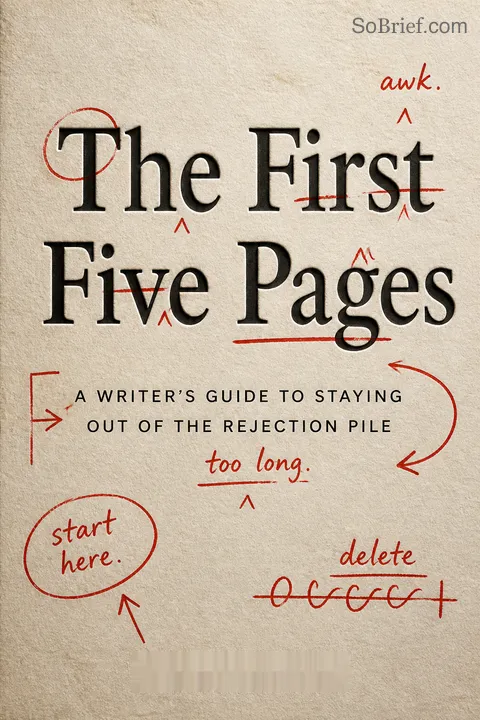
The First Five Pages is organized as an editor’s elimination sequence. It begins with visible presentation, moves through word choice and sound, tests dialogue, then widens to viewpoint, characterization, setting, and narrative movement. That structure turns an intimidating craft into a set of observable editorial questions. Its most important shift is from asking whether a writer has a brilliant plot to asking whether the prose earns enough trust for anyone to reach the plot. The book’s specific strength is diagnostic language: an author can name a problem such as dialogue that briefs the audience or a chapter that moves quickly without progressing, instead of settling for the unhelpful verdict that a manuscript “doesn’t work.” Its limitation is the same editorial lens. A checklist built to reject weak submissions can make conventions sound universal, even though repetition, dialect, fragmentation, and delayed orientation can be deliberate artistic choices. The book recognizes subjectivity, but its impatient-agent premise sometimes treats speed of dismissal as an objective measure of quality. The opening is a sample, not a full proxy for a novel, and craft signals are entangled with a writer’s access to time, training, and knowledgeable readers. Some publication advice, especially formatting and delivery tactics, belongs to its 2000 context and should not be followed without checking current instructions. The more durable contribution is a revision practice: isolate one craft problem, read for its effects, cut or reshape what distracts, then test the result with someone who has not memorized the manuscript. The book is most persuasive when its advice is used as a set of questions rather than laws. Its closing emphasis on devotion to writing beyond publication helps balance the market-facing premise: technical polish can improve a writer’s chances, but it cannot control taste, timing, or the final gatekeeper.
Review Summary
The First Five Pages receives mixed reviews, with many praising its practical advice for writers but some finding it basic or outdated. Readers appreciate the insights into the publishing industry and the helpful exercises provided. Critics note that the book's content doesn't fully match its title, covering broader writing topics beyond just the first five pages. Some find the examples exaggerated and the advice occasionally vague. Overall, it's considered more beneficial for novice writers than experienced ones.
People Also Read




Glossary
three-check method
sample three manuscript pointsA safeguard for evaluating a manuscript whose opening pages appear weak. The evaluator reads the beginning, a section around the middle, and a section nearer the end before deciding whether the whole work is technically deficient. The method recognizes that an opening can misrepresent the quality of the rest of a manuscript.
hook
a sustained invitation to readAn opening or closing feature that draws a reader forward through voice, image, situation, or tension. Lukeman treats a hook as more than a striking first line: the material that follows should fulfill the expectation it creates. Hooks can operate across a paragraph, page, or chapter, and can also encourage readers to return after a pause.
informative dialogue
speech used to deliver expositionDialogue whose primary purpose is to give the reader background, plot facts, or information that the characters already know. It often sounds unnatural because the characters explain matters to each other for the audience’s benefit. The term helps writers identify when information should instead be established through action, narration, or context.
spitfire dialogue
unbroken volleys of speechLong stretches of rapid dialogue with too few pauses, actions, or descriptive beats. The exchange can feel rushed, make events difficult to follow, and leave readers little room to absorb what is happening. The problem is not speed itself, but speed that overwhelms the scene’s action, tension, or emotional meaning.
journalistic dialogue
reported speech used as evidenceDialogue presented as brief quotations inside explanatory narration, often to support a point rather than to create a scene. Characters seem to be quoted for the reader instead of speaking from their own needs and relationships. Lukeman advises writers to let consequential dialogue unfold as an interaction rather than as reported proof.
focus eye
an editor’s purpose testLukeman’s term for the detached editorial attention used to judge whether each passage serves the work’s intention and progression. It asks the writer to look past attractive language and examine tangents, unresolved events, and scenes that continue after their purpose has been met. The focus eye can identify material that is well written but weakens the whole.
FAQ
What is "The First Five Pages" by Noah Lukeman about?
- Focus on Manuscript Rejection: The book is a practical guide for writers on how to avoid common mistakes that lead to manuscript rejection by agents and editors.
- Step-by-Step Criteria: Lukeman reveals the specific criteria professionals use to quickly evaluate and often dismiss unsolicited manuscripts, especially within the first five pages.
- Emphasis on Craft Over Plot: The book prioritizes the craft of writing—word choice, style, dialogue, and presentation—over plot development, arguing that poor execution will get a manuscript rejected regardless of story.
- Broad Application: While most examples are from fiction, the principles are designed to apply to all forms of writing, including nonfiction, journalism, and poetry.
Why should I read "The First Five Pages" by Noah Lukeman?
- Insider Perspective: Lukeman offers the rare viewpoint of a literary agent and editor, sharing what professionals actually look for when reviewing submissions.
- Practical, Actionable Advice: The book provides concrete solutions and exercises for each common writing problem, making it a hands-on resource for improvement.
- Immediate Impact: By focusing on the earliest pages, writers can quickly identify and fix issues that might otherwise doom their work before it’s seriously considered.
- Confidence and Craft: Lukeman encourages writers to build confidence and master the craft, emphasizing that great writing is about rewriting and editing, not just inspiration.
What are the key takeaways from "The First Five Pages" by Noah Lukeman?
- First Impressions Matter: Agents and editors often decide within the first five pages (or even sentences) whether to continue reading a manuscript.
- Common Mistakes Are Universal: Writers worldwide make similar errors, such as overusing adjectives/adverbs, poor dialogue, and weak presentation.
- Craft Can Be Learned: While inspiration can’t be taught, the technical aspects of writing—clarity, sound, style, pacing—can be improved through study and revision.
- Self-Editing Is Essential: Writers must learn to critically evaluate their own work, often with the help of trusted outside readers, to catch issues they might overlook.
How does Noah Lukeman define the importance of the first five pages in a manuscript?
- Gatekeeper Function: The first five pages serve as a filter for agents and editors to separate manuscripts worth further consideration from those to be rejected.
- Predictive Value: Lukeman argues that problems found in the opening pages are likely to recur throughout the manuscript, making early evaluation efficient and accurate.
- Technical Skill Indicator: The opening pages reveal a writer’s mastery of craft, including presentation, style, and dialogue, which are prerequisites for serious artistic evaluation.
- Instant Judgments: Just as a musician can be judged in seconds, a writer’s skill is often apparent almost immediately to a professional reader.
What are the most common reasons manuscripts get rejected according to "The First Five Pages"?
- Poor Presentation and Formatting: Sloppy, unconventional, or unprofessional formatting signals carelessness and can lead to instant dismissal.
- Overuse of Adjectives and Adverbs: Excessive modifiers weaken prose and suggest a lack of confidence in nouns and verbs.
- Awkward Sound and Rhythm: Sentences that are hard to read aloud, filled with echoes or alliteration, or poorly constructed disrupt the reading experience.
- Cliché and Commonplace Dialogue: Dialogue that is too realistic, mundane, or melodramatic fails to engage and reveals a lack of originality.
What specific advice does Noah Lukeman give about adjectives and adverbs in writing?
- Less Is More: Overusing adjectives and adverbs dilutes their impact and can make prose cumbersome and slow.
- Strengthen Nouns and Verbs: Replace weak nouns and verbs plus modifiers with stronger, more precise words to convey meaning more powerfully.
- Cut Commonplace Modifiers: Eliminate cliché or expected adjectives/adverbs and seek more original or necessary alternatives.
- Use Comparisons Sparingly: Occasionally substitute analogies, similes, or metaphors for modifiers to create vivid imagery without overloading sentences.
How does "The First Five Pages" by Noah Lukeman address the issue of dialogue in manuscripts?
- Avoid Commonplace and Informative Dialogue: Dialogue should not mimic everyday small talk or serve as a vehicle for exposition; it must reveal character and advance the story.
- Balance and Breaks: Dialogue should be interspersed with action, description, and pauses to maintain pacing and realism.
- Identifiers and Clarity: Use dialogue tags (“he said,” “she said”) judiciously to avoid confusion, but don’t overuse names or alternative verbs that draw attention to themselves.
- Beware Melodrama and Confusion: Overly dramatic or cryptic dialogue can alienate readers; strive for subtlety and clarity.
What does Noah Lukeman mean by "showing versus telling," and why is it important?
- Engage the Reader: Showing allows readers to experience the story through action and implication, making them active participants rather than passive recipients.
- Ambiguity and Interpretation: Showing leaves room for interpretation and emotional engagement, while telling dictates conclusions and can feel dry or didactic.
- Balance Is Key: While showing is generally preferable, telling has its place, especially for establishing viewpoint or summarizing less important information.
- Artistic Depth: Mastery of showing versus telling distinguishes artful writing from mere reporting or synopsis.
How does "The First Five Pages" by Noah Lukeman recommend writers approach style, tone, and focus?
- Style Should Serve Story: Avoid self-indulgent, archaic, or overly academic styles that draw attention away from the narrative or characters.
- Tone Must Be Intentional: The underlying attitude or voice (sarcastic, serious, intimate, etc.) should match the purpose and content of the work.
- Maintain Focus: Each chapter, paragraph, and sentence should contribute to the overall intention, avoiding tangents and unresolved threads.
- Edit Ruthlessly: Be willing to cut even well-written passages if they do not serve the story’s focus or tone.
What are Noah Lukeman’s recommendations for improving pacing, progression, and setting in a manuscript?
- Pacing and Progression: Ensure the story moves at an engaging speed—neither too slow (boring) nor too fast (confusing)—and that there is a clear sense of development.
- Use Dialogue Carefully: Dialogue can accelerate pacing, so balance it with narrative and description to avoid a rushed feel.
- Vivid, Functional Settings: Settings should be brought to life with specific, sensory details and should influence or interact with characters and plot.
- Structural Awareness: Chapters and scenes should have clear beginnings, middles, and ends, contributing to a satisfying sense of movement and resolution.
What are the best quotes from "The First Five Pages" by Noah Lukeman and what do they mean?
- “There is no such thing as a great writer; there are only great re-writers.” This emphasizes the importance of revision and editing in the writing process.
- “Agents and editors don’t read manuscripts to enjoy them; they read solely with the goal of getting through the pile, solely with an eye to dismiss a manuscript.” This highlights the competitive nature of publishing and the need for writers to make a strong, immediate impression.
- “If you listen to the first five minutes of a piece of music, you should be able to evaluate a musician’s technical skill. … This book will teach you the step-by-step criteria so that you, too, may develop that acute ear and make instant evaluations.” Lukeman draws a parallel between music and writing, stressing the value of technical mastery.
- “Less is always more.” This recurring theme underlines the value of restraint, subtlety, and precision in writing.
What exercises and practical steps does "The First Five Pages" by Noah Lukeman suggest for writers to improve their work?
- End-of-Chapter Exercises: Each chapter concludes with targeted exercises, such as removing all adjectives/adverbs from a page, rewriting dialogue without exposition, or describing a character solely through action.
- Read Aloud and Peer Review: Lukeman recommends reading your work aloud to catch awkwardness and enlisting trusted readers to provide objective feedback.
- Experiment with Style and Structure: Writers are encouraged to rewrite scenes in different styles, tones, or points of view to discover what best serves the story.
- Continuous Vocabulary Building: The book advocates for ongoing vocabulary expansion and specificity in word choice to enhance clarity and originality.
Download PDF
Download EPUB
.epub digital book format is ideal for reading ebooks on phones, tablets, and e-readers.








