

Key Takeaways
Give kindness outward, and five returns reach your own life
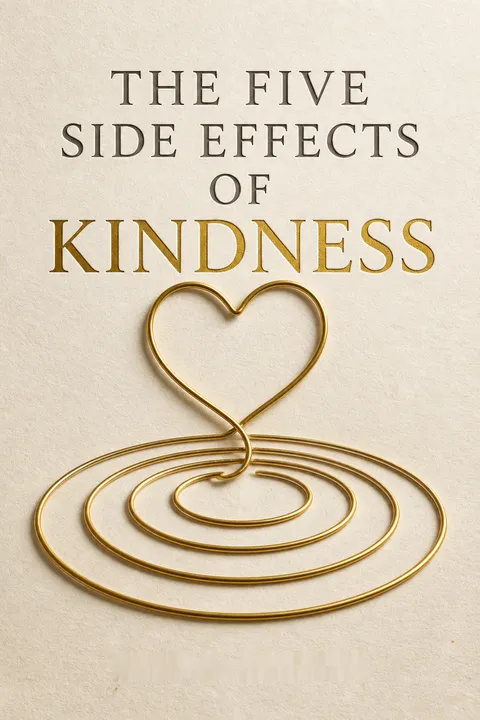
The central claim. David Hamilton treats kindness as an action aimed at another person that also benefits the giver. He organizes those returns into five side effects: greater happiness, a healthier heart, slower ageing, stronger relationships, and kindness spreading to others. The word side effects matters: these outcomes may accompany an act without being its motive. Small gestures count, from helping a stranger with luggage to easing a neighbour’s workload.
More than a bargain. The book argues that mutual benefit does not make kindness fake. A person can want to help and feel better through helping at the same time. Hamilton’s guiding advice is to act kindly because someone needs it, because the opportunity is there, or simply because it feels right, rather than turning generosity into a transaction.
The book’s useful shift is from treating kindness as a personality trait to treating it as a behavior with consequences for both parties. That makes the idea testable in ordinary life: notice what happens to mood, connection, and the recipient’s circumstances after a small act. It also sidesteps a false purity test. Human motives are often mixed, and a recipient’s real benefit does not disappear because the giver feels good. The important ethical distinction is whether the other person is treated as a person, rather than as a prop for the giver’s emotional reward.
When your mood sinks, help someone else before buying yourself a treat
Giving can lift mood. In one six-week study, volunteers asked to do five kind acts each week became happier than a comparison group. The largest gains occurred when the five acts happened on one day. Other studies described in the book found improved happiness after people spent money on others, volunteered, or helped someone in need. A study of people with social anxiety also found that kind acts were associated with better mood, more confidence, and less avoidance of social situations.
A human example. Margaret McCathie describes severe depression and how a kind reply from Patch Adams encouraged her to serve others. Volunteering and helping people became part of her recovery. Hamilton presents kindness as a possible source of connection and purpose, not a substitute for professional mental-health care.
Helping can interrupt the inward attention that often accompanies low mood by creating contact, structure, and evidence that one can matter to someone else. That resembles behavioral activation, a therapeutic approach that encourages people to re-engage with meaningful activities rather than wait for motivation to return. The distinction is important: giving is not a universal treatment, and depression can make even small tasks feel impossible. Kindness works best as one available route toward connection, not as a moral demand imposed on someone who is already struggling.
Nurture warm connections as one overlooked part of heart health
Connection has a body. Hamilton describes a proposed pathway in which warm social contact and kindness increase oxytocin, a hormone involved in bonding. Oxytocin can prompt processes that relax blood-vessel walls and support blood flow. The book connects this account to the Roseto Effect, the unusually low rate of heart disease reported in the close-knit Pennsylvania town of Roseto. Researchers examined possible explanations, including diet and environment, and attributed much of the pattern to residents’ strong community ties.
Quality matters. The argument is not that romance is required. Friendship, family, supportive colleagues, and bonds with animals can all provide connection. The book also cites research linking hostile interactions with signs of coronary artery calcification, while frequent supportive contact was associated with lower blood pressure.
The strongest insight here is social rather than hormonal: health is shaped partly by the conditions people create for one another. Social connection can buffer stress, and the Roseto story makes community visible as a possible health resource, not merely a pleasant backdrop. Still, a town-level observation cannot isolate one cause, and oxytocin is not a simple kindness meter. These mechanisms should be read as plausible pathways, not proof that a generous gesture prevents heart disease. Human connection can support wellbeing, but it does not replace medical care or established cardiovascular prevention.
Treat aging as partly modifiable, not a verdict written by your genes
Biology is not destiny. Hamilton distinguishes chronological age, the years since birth, from biological age, the condition of the body. He estimates that genes account for about 20 to 30 percent of longevity, while learned patterns such as diet, activity, stress responses, and relationships also matter. He groups seven ageing processes: muscle loss, reduced vagal tone, inflammation, oxidative stress, lower nitric oxide, shortening telomeres, and weakening immunity.
Promising, not proven. The book describes studies connecting oxytocin with muscle regeneration, compassion practice with vagal tone, and supportive family programs with preserved telomere length in young people. Telomeres are protective ends of DNA that shorten as cells divide. These findings suggest possible links between kindness and biological ageing, but the cited studies do not establish that kindness alone extends human lifespan.
The most valuable practical point is that inherited risk does not erase the influence of habits and relationships. The biological story is less settled than the behavioral advice, however. A change in a marker such as telomere length is not automatically a change in lifespan, and evidence from small or specialized studies cannot support sweeping claims about slowing every ageing process. The careful reading is neither dismissal nor promise: kindness may affect stress and social support, which are relevant to health, while exercise, nutrition, sleep, and clinical care remain essential parts of the picture.
Make small bids for connection the daily unit of relationship care
Notice the invitation. Relationship researcher John Gottman calls a small request for attention a bid. A partner might point something out or begin a story; the deeper request is often simply to share a moment. Responding with attention is a way of turning toward the person, while ignoring them or replying dismissively turns away. In a study of newlyweds, researchers who observed couples for 15 minutes reportedly predicted with 94 percent accuracy which relationships would last ten years, based on the pattern of positive and negative interactions.
Little actions accumulate. Hamilton also describes a five-to-one ratio: relationships were more likely to last when positive interactions substantially outnumbered negative ones. Enthusiastically responding to a loved one’s good news is another form of connection. Listening, encouragement, and everyday help can add up to a climate of care.
This framework makes relationship maintenance concrete: affection is not only a feeling but repeated attention to another person’s attempts to connect. Research on responsiveness similarly emphasizes that people feel close when they feel understood, valued, and cared for. The numerical ratio is memorable, but it should not become a scorecard or a license to ignore serious harm. Relationship quality depends on context, power, repair, and safety, not just a count of pleasant exchanges. The practical lesson is to notice opportunities for engagement and respond with genuine interest.
Let visible kindness set off the next person's generous act
Goodness can travel. The book uses elevation to describe the warm, inspired response people may feel when they witness compassion or moral courage. In studies cited by Hamilton, people who saw kindness reported wanting to imitate it and were more likely to help afterward. Even toddlers exposed to a simple image suggesting affection were more likely to help pick up dropped pencils than children shown other images.
A chain can grow. In a social-network experiment using a public-goods game, one person’s unusually generous contribution encouraged generosity among people in later rounds, with the effect extending up to three degrees of separation. Hamilton also tells of a kidney-donor chain in which one altruistic donation helped set off 34 transplants. Each act can influence people beyond its direct recipient, though no giver can know exactly how far the effect travels.
Kindness spreads partly because people learn what is normal by watching others. A visible act can make generosity feel more available, especially when it is specific and achievable rather than grand and exceptional. This connects the book’s moral emphasis to social learning: example is a form of informal instruction. The ripple metaphor captures possibility, not a guaranteed multiplication formula. People respond differently, and experiments or network models cannot predict the reach of any particular gesture. Even so, acting kindly in public can quietly widen the range of behavior others imagine they can choose.
Count small kindnesses to see the contribution you already make
Notice what you do. In a study of Japanese women, participants who recorded their daily kind acts became happier; around 30 percent of the kindness group experienced a particularly strong improvement. Hamilton suggests that the practice can also reveal a kinder self-image. Someone who remembers only dramatic good deeds may overlook the daily gestures that support others: listening carefully, offering help, or making someone feel included.
Make room for gratitude. The book also describes a ten-week study in which people who regularly listed things they appreciated reported greater happiness than those who listed hassles. Gratitude can make small moments more visible, including a family member’s help or a friend’s generosity. Neither exercise requires pretending that hardship is absent. The aim is to give positive experiences a fair share of attention.
Recording kind acts functions like a corrective lens: it helps people notice evidence that ordinary memory tends to discard. Gratitude exercises use a related attentional shift, directing awareness toward resources and relationships that may otherwise fade into the background. This is not the same as insisting that everything is fine. Forced positivity can make suffering harder to acknowledge, especially during grief or crisis. The practice is most useful when it broadens the picture rather than edits out the painful parts, allowing a person to recognize both difficulty and the care present within it.
Give freely, but don't confuse kindness with self-erasure
Good motives can mix. Hamilton asks whether kindness becomes selfish when the giver knows it may improve their own mood or health. His answer is that mutual benefit does not invalidate the help. A person who volunteers while depressed may be seeking connection as well as serving others; both needs can be real.
Keep generosity sustainable. The book warns against giving until exhausted, especially when others take help for granted. Kindness toward oneself can mean asserting a need, leaving damaging circumstances, or deciding to expect respectful treatment. It can also mean giving without treating gratitude as payment. The balance depends on the situation: generosity should not require a person to accept ongoing exploitation or neglect their own wellbeing.
This distinction protects kindness from two distortions: moral perfectionism, which demands pure motives, and self-sacrifice, which treats personal needs as suspect. Sustainable care requires boundaries because chronic overextension can turn help into resentment. At the same time, the absence of thanks does not always signal exploitation; people may be distracted, ashamed, or unable to reciprocate. The useful question is whether a pattern remains freely chosen and humane for both sides. Kindness is strongest when it recognizes the recipient’s dignity without erasing the giver’s.
Try seven days of kindness, including one brave and anonymous act
Make practice concrete. Hamilton ends with a seven-day challenge: perform at least one kind act each day, make each day’s act different, step outside your comfort zone at least once, and keep one act anonymous. The challenge turns an abstract ideal into a week of observable choices. Examples in the book range from thanking someone whose work often goes unnoticed to helping a neighbour or writing to a former teacher whose influence mattered.
Look for the ordinary. The point is not to stage a dramatic display or keep score of who owes what. Small acts are more available and often more frequent than grand gestures. A useful way to begin is to notice who could use attention, practical help, or encouragement today, then act without requiring the person to respond in a particular way.
A short challenge works as a low-cost experiment: it gives people a defined period in which to observe effects on their mood, attention, and interactions. The anonymous act usefully tests whether generosity can happen without recognition, while the comfort-zone requirement nudges action beyond routine. Structure can also make a good intention easier to remember. The challenge should remain flexible, since a suitable act depends on capacity, consent, and context. An offer of help is not automatically helpful if it ignores what the other person wants.
Analysis
The book’s central move is to connect an ordinary moral practice with several kinds of return: emotional, relational, social, and bodily. Its strongest contribution is not any single biological claim, but its insistence that small acts deserve attention. A stranger carrying a bag, a teacher receiving thanks, or a partner responding to a bid for connection may not look like health interventions. Yet these moments help build trust, belonging, and reciprocal support, the conditions through which care becomes part of daily life.
The structure also makes the argument memorable. Five effects give the reader a map, while personal stories and research examples keep kindness from becoming a vague virtue. The seven-day challenge translates the map into action. Particularly valuable is the discussion of mixed motives and boundaries: feeling good after helping does not nullify the help, and generosity does not demand endless self-neglect.
The scientific claims require more caution than the book’s confident tone sometimes allows. Evidence that a practice changes mood, social behavior, or a physiological marker does not establish that it prevents disease or extends lifespan. Some findings described are correlational, small, or preliminary, and mechanisms such as oxytocin do not operate as simple switches. The book itself includes a medical disclaimer, and kindness should be understood as supportive behavior, not a replacement for treatment or established health measures.
Read with that distinction in mind, the book offers a compelling, practical thesis: kindness can be both an ethical response to another person and a source of wellbeing for the giver. Its value does not depend on proving every proposed pathway. A more attentive relationship, a moment of relief, or a chain of generosity is already a meaningful result. The invitation is to practice kindness without turning it into either a health guarantee or a purity test.
Review Summary
The Five Side Effects of Kindness receives mostly positive reviews, with readers appreciating its scientific approach to kindness and its benefits. Many find it inspirational and easy to read, praising the practical suggestions and real-life examples. Some critics note repetitiveness and wish for more stories rather than studies. The book's emphasis on kindness as a tool for personal and societal improvement resonates with most readers, who feel motivated to incorporate more kindness into their daily lives. The 7-day kindness challenge is frequently mentioned as a valuable addition.
People Also Read

Glossary
Elevation
inspiration from moral goodnessElevation is the warm, uplifting response a person may feel after witnessing kindness, generosity, or moral courage. In the book, it can bring a sense of emotional openness and a desire to imitate the good action. Hamilton uses the idea to explain why observing kindness may motivate further helping.
Kindnnection
connection characterized by kindnessKindnnection is Hamilton’s coined term for a relationship or interaction shaped by kindness, friendship, or love. It need not be romantic: family members, friends, neighbours, colleagues, and people connected with animals can all share it. The term highlights the quality of care within a connection rather than the relationship label.
Loving-kindness meditation
practice of compassionate wishesLoving-kindness meditation is a contemplative practice in which a person develops wishes for wellbeing and freedom from suffering. Practitioners direct these wishes toward themselves, loved ones, people they find difficult, and other beings. The book describes it as a way to cultivate compassion and study its possible effects on emotion, social behavior, and health.
Vagal tone
measure of vagus nerve activityVagal tone refers to the functional activity of the vagus nerve, which helps regulate processes associated with rest and recovery. In the book, higher vagal tone is linked with compassion and social engagement, and practice such as loving-kindness meditation is described as potentially increasing it. It is a physiological measure, not a direct measure of kindness.
Roseto Effect
community ties linked with heart healthThe Roseto Effect refers to observations of unusually low heart-disease rates among residents of Roseto, Pennsylvania, especially in the mid-twentieth century. Researchers examined possible explanations, including diet and environment, and emphasized the town’s close social bonds. Hamilton uses the case to illustrate a possible relationship between community connection and cardiovascular health.
Helper's high
positive feelings after helpingHelper’s high is a term associated with Allan Luks’s work describing the positive emotional and physical feelings many people report after helping others. The book cites survey findings that helpers commonly felt good, experienced lasting positive emotion, and reported greater self-worth. It names an experience, rather than proving that every act of helping produces the same response.
Inflammaging
age-related chronic inflammationInflammaging describes the association between persistent, low-grade inflammation and ageing. Unlike short-term inflammation that helps respond to injury, chronic inflammation may contribute to damage across body systems. Hamilton presents it as one of several processes connected with biological ageing and discusses the vagus nerve and compassion practice as possible influences on inflammatory regulation.
Mother Teresa effect
immune response after witnessing kindnessThe Mother Teresa effect is the name given to a study in which students watched a film depicting acts of kindness and showed an increase in salivary immunoglobulin A, a component of immune defense. The book connects the change with the uplifting response participants experienced. The term refers to this reported study finding, not a general guarantee of improved immunity.
Magic ratio
balance of positive and negative interactionsThe magic ratio is John Gottman’s shorthand for the finding, as presented in the book, that lasting relationships tend to contain substantially more positive than negative interactions. Hamilton gives a ratio of five positive interactions for each negative one. It is a memorable summary of relationship research, not a universal score that can diagnose every couple.
Bid
request for relational attentionA bid is a small attempt to make contact or share attention with another person. It may be a question, a comment, or an invitation to notice something. In Gottman’s relationship research, a partner can respond by turning toward the bid with attention, or turn away by ignoring or dismissing it. Repeated responses help shape the quality of a relationship.
Three-degree rule
behavior spreading through network layersThe three-degree rule is Hamilton’s description of findings from social-network research in which cooperative behavior influenced people beyond the person directly affected, extending through subsequent rounds of interaction. The book uses it to explain how kindness may travel through social ties. It describes a pattern observed in a network experiment, not a guarantee that every act reaches exactly three layers.
FAQ
What is "The Five Side Effects of Kindness" by David R. Hamilton about?
- Explores Kindness’ Hidden Benefits: The book reveals five powerful, scientifically-backed "side effects" of practicing kindness—happiness, heart health, slower aging, improved relationships, and contagiousness.
- Mix of Science and Stories: Hamilton combines personal anecdotes, real-life stories, and cutting-edge research to show how kindness impacts our minds, bodies, and communities.
- Practical and Inspirational: The book offers actionable advice, daily kindness challenges, and 50 specific acts of kindness to try.
- Redefines "Side Effects": Drawing from his pharmaceutical background, Hamilton reframes "side effects" as positive, unexpected outcomes of kind behavior.
Why should I read "The Five Side Effects of Kindness" by David R. Hamilton?
- Evidence-Based Benefits: The book is grounded in scientific studies, making a compelling case for kindness as a tool for personal and societal well-being.
- Immediate and Long-Term Gains: Readers learn how kindness can make them happier, healthier, and more connected, both instantly and over time.
- Practical Application: Hamilton provides concrete suggestions and challenges, making it easy to incorporate kindness into daily life.
- Uplifting and Motivational: The stories and research inspire readers to see kindness as a transformative force for themselves and the world.
What are the five side effects of kindness according to David R. Hamilton?
- Kindness Makes Us Happier: Acts of kindness boost mood, self-esteem, and overall life satisfaction.
- Kindness Is Good for the Heart: Kindness triggers oxytocin release, which protects the heart and lowers blood pressure.
- Kindness Slows Ageing: Kindness reduces stress, inflammation, and even impacts cellular aging processes.
- Kindness Improves Relationships: Kindness strengthens bonds, increases trust, and is the foundation of lasting relationships.
- Kindness Is Contagious: Kindness creates ripple effects, inspiring others to act kindly and spreading positivity through communities.
How does "The Five Side Effects of Kindness" by David R. Hamilton explain the science behind kindness?
- Hormonal Effects: Kindness increases oxytocin, dopamine, and serotonin, which are linked to happiness, bonding, and stress reduction.
- Cardiovascular Benefits: Oxytocin and nitric oxide produced by kindness dilate arteries, lower blood pressure, and protect against heart disease.
- Brain Changes: Practicing kindness and compassion can physically alter brain regions associated with empathy and positivity.
- Cellular and Genetic Impact: Kindness slows aging by reducing inflammation, oxidative stress, and protecting telomeres, the end caps of DNA.
What practical advice and methods does David R. Hamilton offer in "The Five Side Effects of Kindness"?
- 50 Acts of Kindness: The book lists specific, actionable kindness ideas for readers to try in daily life.
- Seven-Day Kindness Challenge: Hamilton encourages readers to perform a different act of kindness each day for a week, including at least one anonymous and one outside their comfort zone.
- Loving-Kindness Meditation: The book explains and recommends this meditation as a way to cultivate compassion and boost well-being.
- Self-Kindness and Boundaries: Hamilton emphasizes the importance of being kind to oneself and finding a balance to avoid burnout or resentment.
How does "The Five Side Effects of Kindness" by David R. Hamilton address the question of whether kindness is selfish?
- Motive Matters Less: Hamilton argues that even if we know kindness benefits us, the act is still valuable and not necessarily selfish.
- Mutual Benefit: Helping others often helps ourselves, especially in cases like volunteering to alleviate depression.
- Focus on Action: The book suggests not overthinking motives and instead encourages simply being kind.
- Kindness as Human Nature: Hamilton posits that humans are inherently kind, and benefiting from kindness is a natural part of the process.
What scientific studies and evidence does David R. Hamilton cite in "The Five Side Effects of Kindness"?
- Happiness Research: Studies show that performing acts of kindness increases happiness more than self-focused acts.
- Heart Health Studies: Research on oxytocin, the "love hormone," demonstrates its role in lowering blood pressure and protecting the heart.
- Aging and Telomeres: Studies link kindness, compassion, and supportive relationships to longer telomeres and slower biological aging.
- Contagion and Ripple Effects: Experiments reveal that witnessing or receiving kindness inspires further kind acts, spreading through social networks.
How does "The Five Side Effects of Kindness" by David R. Hamilton connect kindness to improved relationships?
- Foundation of Attraction: Kindness is the most desired trait in a partner across cultures, according to large-scale studies.
- Relationship Longevity: Research shows that a high ratio of positive (kind) to negative interactions predicts lasting relationships.
- Active-Constructive Responding: Being genuinely supportive and enthusiastic about others’ good news strengthens bonds.
- Kindness as Glue: Everyday small acts of kindness are what hold friendships, family, and romantic relationships together.
In what ways does "The Five Side Effects of Kindness" by David R. Hamilton show that kindness is contagious?
- Ripple Effect: Kindness inspires observers and recipients to "pay it forward," creating a chain reaction of positive actions.
- Scientific Proof: Studies demonstrate that kindness spreads up to three degrees of separation in social networks.
- Workplace and Community Impact: Kindness from leaders or colleagues increases job satisfaction, performance, and customer happiness.
- Children and Kindness: Even young children are more likely to act kindly after witnessing kindness, showing early social learning.
What are some of the most memorable stories or examples from "The Five Side Effects of Kindness" by David R. Hamilton?
- Wartime Compassion: A German soldier spares an enemy’s life, illustrating the power of compassion even in conflict.
- The Roseto Effect: A close-knit community with strong bonds and kindness experiences dramatically lower heart disease rates.
- The World’s Longest Kidney Donor Chain: One act of altruism sparks a chain of 34 kidney transplants across the U.S.
- Everyday Acts: Stories of helping strangers, supporting friends, and anonymous gifts highlight the profound impact of small kindnesses.
What are the key takeaways from "The Five Side Effects of Kindness" by David R. Hamilton?
- Kindness Benefits Everyone: Both giver and receiver experience measurable improvements in happiness, health, and relationships.
- Kindness Is a Health Practice: Regular acts of kindness can be as beneficial as diet or exercise for well-being and longevity.
- Small Acts Matter: Everyday kindnesses, not just grand gestures, create the fabric of strong communities and relationships.
- Kindness Is a Choice: Practicing kindness, even when it’s challenging or goes unnoticed, has lasting positive effects for individuals and society.
What are the best quotes from "The Five Side Effects of Kindness" by David R. Hamilton and what do they mean?
- “Kindness isn’t black and white – it’s multi-coloured.” — Kindness is complex, nuanced, and adaptable to every situation.
- “A hug a day keeps the cardiologist away.” — Simple acts of affection have real, measurable health benefits.
- “Kindness is the language that the deaf can hear and the blind can see.” (Mark Twain, quoted in the book) — Kindness transcends barriers and is universally understood.
- “If ever you’re in doubt as to what to do or in which direction to turn, be kind. For kindness is always the right thing, and it’s always the right way.” — Kindness is a reliable guide for action and decision-making in life.
About the Author



Download PDF
Download EPUB
.epub digital book format is ideal for reading ebooks on phones, tablets, and e-readers.








