

Key Takeaways
Treat water as an active material, not merely life's background solvent.
Begin with the puzzles. Why does gelatin hold water without leaking? Why can a droplet sit on a pool, or microspheres in a beaker drift away from a surface? Gerald Pollack argues that such ordinary observations expose a gap in how water is usually understood. He urges readers to question even respected scientific models when they fail to explain what experiments show, a stance shaped by his own disputes over established theories.
Keep the claim provisional. Pollack presents his account as an attempt to build a simpler framework, not a final verdict. The book's central proposal is that water's structure changes with its surroundings and can help drive physical and biological processes. Its evidence and explanations, however, do not all have the same degree of certainty.
The book's most useful opening move is methodological: familiar substances can hide unresolved questions precisely because they seem too ordinary to investigate. That instinct has value well beyond water. In science, however, distrust of orthodoxy is not itself evidence for a replacement theory. The productive version of Pollack's challenge is to make the alternatives precise enough that other laboratories can distinguish them from conventional explanations. His recurring emphasis on experiments readers can see gives the argument an inviting entry point, while the disputes he recounts make independent replication especially important.
Test what happens at interfaces instead of assuming water is uniform.
A boundary changes the picture. Pollack calls the particle-free layer beside certain water-loving surfaces an exclusion zone, or EZ. In his laboratory, microspheres moved away from gels and Nafion, a strongly hydrophilic polymer, leaving zones roughly 100 micrometers wide. That is far larger than the few-nanometer reach predicted by standard double-layer theory. The book reports similar zones beside biological surfaces, metals, and single-molecule-thick coatings.
The zone differs measurably. Pollack reports that EZ water absorbs light differently, appears more viscous, restricts molecular motion, and has a higher refractive index than water farther away. He also describes experiments intended to rule out temperature-driven currents, polymer strands, electrical repulsion, and leaking material as simple explanations. In his account, the results point to a distinct, ordered region, not merely an optical illusion.
The broad lesson is sound as an experimental habit: interfaces can produce behavior that bulk measurements miss, and surface-to-volume ratio matters enormously in small systems. The reported exclusion distances are striking because they challenge a familiar model, but the distance alone cannot identify the mechanism. Particle motion can be influenced by several coupled forces, so careful controls and measurements of the fluid, surface, and particles are essential. Pollack's emphasis on testing mundane artifacts is one of the book's strongest features, even where the interpretation of the surviving effect remains contested.
Add a proposed fourth phase between ordinary liquid water and ice.
A different arrangement. Pollack proposes that EZ water is a semi-liquid, liquid-crystalline phase, meaning its molecules form an ordered structure while retaining some ability to move. His model has honeycomb-like sheets stacked in layers. Unlike ordinary water molecules, the proposed sheets carry net negative charge, which could help explain why the zone excludes dissolved substances and particles.
A phase, not a proven category. Pollack connects this model to measurements such as the EZ's ultraviolet absorption near 270 nanometers, observed molecular order, and similarities to ice. He also points to a proposed hydrogen-to-oxygen ratio of 3:2 in the sheets, rather than water's familiar 2:1. He argues that the EZ is distinct and extensive enough to count as water's fourth phase. The structure is a model inferred from evidence, not a settled account of water's molecular architecture.
The model's appeal is that one proposed structure could link several observations: exclusion, charge, altered optical behavior, and a resemblance to ice. That kind of unification is scientifically valuable when it generates fresh tests rather than merely redescribing known results. The caution is that a familiar-looking pattern, such as a honeycomb, does not by itself establish the full three-dimensional structure or its stability in liquid water. A strong test would measure the proposed arrangement directly while independently checking charge and composition. The phase label is most useful if it sharpens such questions, not if it settles them by definition.
Follow the energy: Pollack says infrared light charges water's interface.
Light expands the zone. Pollack recounts an accidental observation: after a microscope lamp was switched off overnight, an EZ had shrunk; turning the lamp back on restored it within minutes. Follow-up tests, he says, found that many wavelengths could increase EZ size, with infrared particularly effective. Light at about 3,000 nanometers produced strong growth, and reducing infrared exposure made the zone smaller.
A water battery. In Pollack's model, building the EZ separates charge. The ordered zone becomes predominantly negative, while positive hydronium ions, charged water molecules, gather in the surrounding water. He calls the paired regions an interfacial battery. The book reports that electrodes placed across the regions produced current. The account proposes that radiant energy helps charge and maintain this arrangement, which may then supply energy for movement or chemical processes.
The important conceptual shift is from treating a beaker as energetically sealed to asking how environmental inputs affect it. That is a useful question for any system exposed to light, even if the proposed storage mechanism is disputed. A battery claim requires more than detecting separated charges: the energy source, conversion efficiency, duration, and competing reactions must all be quantified. Pollack's light and current experiments offer concrete quantities to investigate, but the analogy should not be mistaken for evidence that water can deliver useful power at practical scale.
Explain like-charge attraction by measuring the opposite charges between particles.
An apparent paradox. Pollack builds on work by Norio Ise and an explanation associated with Richard Feynman: two similarly charged particles can move together if opposite charges accumulate between them. In the book's account, hydrophilic particles acquire EZs, while positive ions collect outside those zones. When particles approach, the intervening opposite charges can draw them together, even though the particles themselves repel.
A balance of forces. Pollack reports experiments in which charged gel beads, initially separated by nearly half a millimeter, moved closer in water. Dye and microelectrode measurements indicated opposite charge in the space between them. Attraction stops when it balances repulsion, leaving small particles arranged in colloidal crystals or, in some cases, larger beads touching. The proposed mechanism preserves ordinary electrostatics: unlike charges attract; the surprising feature is where those charges gather.
This is a useful reminder that a simple slogan about a force can conceal the role of the surrounding medium. The same reasoning applies in many physical systems: particles do not interact in isolation, and intervening material can change the effective force between them. The explanatory burden is to show that the mediator exists in the predicted location and that its measured contribution is large enough. Pollack's reported charge maps address that burden directly. Still, a mechanism observed in particular aqueous suspensions should not automatically be generalized to every similarly charged system.
Track charge gradients when explaining water movement through gels and membranes.
A proposed driver. Pollack argues that osmosis and diffusion should not be treated as self-explanatory movements toward equilibrium. In his account, radiant energy helps create EZs and separate charge; the resulting gradients then drive motion. For osmosis, he proposes that positive hydronium ions move toward negative regions associated with solutes or hydrophilic surfaces, carrying water along.
Gels make the idea concrete. A dry diaper or gel absorbs water and swells. Pollack explains this as water entering a charged mesh, where EZs form and positive ions are drawn inward. The mesh's stiffness eventually limits expansion. He also proposes that charge differences across a membrane help drive the flow in laboratory osmosis experiments. The book extends the same model to diffusion, swelling after injury, and steady flow through hydrophilic tubes, while treating these explanations as a framework to test.
The strength of this account is its insistence that a visible flow needs a driving force and that membranes and surfaces may actively shape transport. It encourages readers to look for gradients rather than invoking equilibrium as a magical cause. The key scientific distinction is between identifying an electrical difference and proving that it dominates the flow. Concentration differences, pressure, membrane properties, and chemical interactions can act together. Pollack's model is most compelling where it makes measurable predictions about charge and flow in the same setup, rather than treating every instance of transport as confirmation.
Separate infrared emission from temperature before explaining water's behavior.
Brightness is not a thermometer. Pollack argues that infrared cameras register emitted radiation, which depends on both temperature and how a material emits. An ordered EZ may appear darker than nearby bulk water because its charges move less, not necessarily because it is colder. The book uses this distinction to interpret infrared images near hydrophilic surfaces.
Revisit familiar effects. Pollack proposes that dissolving some substances changes the balance between EZ water and bulk water, helping explain linked changes in volume and infrared output. He also describes experiments in which vortexed water cooled and preliminary evidence of increased EZ-like structure. These are interpretations, not replacements for established thermal measurements. His broader advice is to specify what an instrument directly measures before translating its signal into a familiar concept such as heat.
The general measurement lesson is valuable: an instrument's display is an interpretation layered on top of a physical signal. Infrared imaging can be affected by emissivity as well as temperature, so a temperature reading depends on assumptions about the surface. But this does not make temperature meaningless or eliminate standard thermometry. Independent measurements are needed to separate temperature changes from changes in emission. Pollack's caution is strongest as a call to calibrate and cross-check, not as a reason to discard thermal explanations whenever an image seems counterintuitive.
See evaporation as organized vesicle traffic, not simply lone molecules escaping.
One proposed family. Pollack uses vesicle as a broad label for a tiny spherical structure with a surrounding EZ-like shell. Its interior may contain liquid or gas, making it resemble either a droplet or a bubble. He reports evidence for such shells in droplets and bubbles, including ultraviolet absorption near 270 nanometers and observations of bubbles attracting, clustering, and moving toward light.
From water to visible vapor. In Pollack's model, vesicles form and gather into network-like patterns at warm water's surface. Some may expand, turn their interiors to vapor, and rise in visible puffs. He links these structures to the mosaic patterns seen in infrared images of warm water and to the distinct clouds rising above coffee. The book presents this account as a proposed mechanism; the claims about vesicle shells, conversion, and organized vapor remain more speculative than the observed patterns themselves.
The book makes the ordinary sight of steam feel newly investigable by asking what visible vapor must contain to scatter light. That question usefully distinguishes invisible water molecules from the visible droplets or structures that reveal them. The larger claim, that evaporation proceeds through organized vesicles and mosaic networks, needs a separate evidentiary case. Seeing patterns at a surface and in rising vapor does not alone prove that one becomes the other through the proposed sequence. The account is imaginative and testable, but its components should be assessed individually rather than accepted as a single package.
Treat freezing as a charge-driven transition, not temperature's automatic result.
The proposed intermediate. Pollack argues that an EZ can precede ice formation because its layered structure resembles ice. In his model, cooling helps build the EZ and concentrate positive hydronium ions nearby. When some protons become free, they can enter the negatively charged layers and help shift them into an ice-like arrangement.
Evidence and open questions. Pollack reports that freezing began near EZ-forming surfaces in his experiments, that positive surface charge promoted freezing, and that pH-sensitive dyes indicated protons in regions where ice formed. He connects this account to the Mpemba effect, the observation that warm water can sometimes freeze faster than cooler water. These results motivate his mechanism but do not establish that charge, rather than cooling and other known factors, generally governs freezing. The proposed explanation is a hypothesis to test across controlled conditions.
The useful insight is to treat freezing as a sequence of events, not simply as a thermometer crossing a universal threshold. Nucleation, surface conditions, dissolved material, and heat transfer can all influence when ice appears, so the question of what starts crystallization is legitimate. Pollack's proposed proton mechanism adds a specific candidate that can be tested against those factors. The fact that warm water sometimes freezes faster does not by itself prove that mechanism, since the outcome depends on experimental conditions. The distinction between an observed anomaly and its explanation matters especially here.
Analysis
Pollack's book is best read as a research program built around one ambitious explanatory wager: water near hydrophilic surfaces forms an ordered, charged region that stores environmental energy and helps drive phenomena usually treated separately. The wager has narrative power. A microsphere-free band, a current between regions of water, or a droplet lingering on a pool becomes a clue in one connected investigation. The reader also sees the author describe failed expectations and attempts to rule out artifacts, which makes the proposed account more concrete than a purely speculative essay.
Its central strength is the demand that explanations account for observable behavior, not merely repeat textbook labels. Its central weakness is a tendency to treat a broad range of observations as convergent evidence for one mechanism before that mechanism is uniquely established. The book moves from measured particle exclusion and optical differences to a particular molecular lattice, then to claims about batteries, transport, evaporation, and freezing. Those steps vary in evidential distance. A measured effect can be real while its proposed cause remains uncertain, and a plausible mechanism for one system does not automatically explain another.
The most productive way to engage the book is therefore neither to dismiss it because its claims are unconventional nor to accept its unifying story because it is elegant. Separate the observations from the inferences, then ask what each account predicts that a competing explanation does not. Can the proposed structure be directly detected? Do charge and energy measurements close quantitatively? Do independent groups reproduce the same effects under blinded, carefully controlled conditions? Such tests preserve the book's spirit of curiosity while applying the discipline that lets unconventional ideas earn confidence. Its enduring value may lie as much in the questions it forces into view as in the answers it proposes.
Review Summary
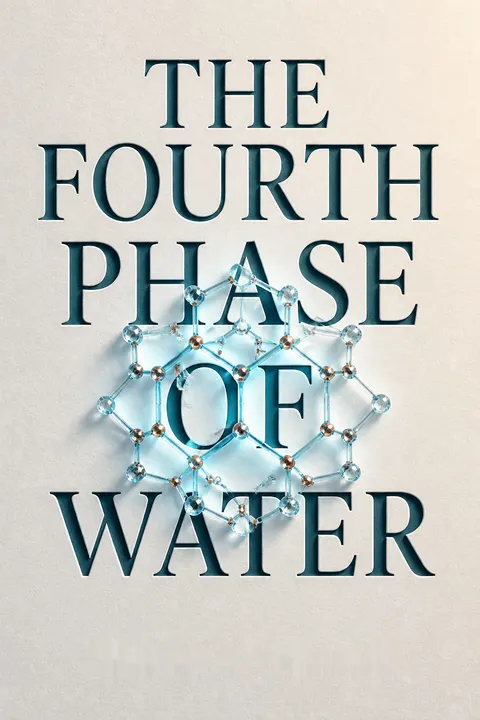
The Fourth Phase of Water by Gerald H. Pollack explores a proposed fourth phase of water beyond solid, liquid, and vapor—called EZ (Exclusion Zone) water. This gel-like, negatively charged structure forms near hydrophilic surfaces and absorbs infrared energy. Reviewers praise Pollack's accessible writing and simple experiments that challenge conventional water science, with implications for biology, medicine, and energy. Critics note some claims lack rigorous scientific support and become speculative. Most readers find it fascinating and thought-provoking, though technically dense in places, revolutionizing everyday understanding of water's behavior.
People Also Read




Glossary
Exclusion zone (EZ)
Interface-adjacent particle-free regionPollack's term for a region of water next to certain hydrophilic surfaces that excludes particles and dissolved substances. He reports that this zone differs from surrounding water in properties such as viscosity, optical absorption, and electrical potential. In his proposed model, the EZ is an ordered, charged, semi-liquid phase. The existence and interpretation of these reported effects remain subjects for scientific evaluation.
fourth phase of water
Proposed liquid-crystalline phasePollack's proposed addition to the familiar solid, liquid, and vapor states of water. He identifies it with the exclusion zone, which he describes as ordered like a crystal but still able to flow. He argues that its bounded extent and distinct properties warrant phase status. This designation expresses the book's interpretation of experimental findings, rather than a universally accepted classification.
interfacial battery
Separated charges near surfacesPollack's name for the paired charge regions he proposes form when an exclusion zone develops. In his account, the EZ is usually negative, while the adjacent bulk water contains positive hydronium ions. The separation creates an electrical potential that, he reports, can produce current when electrodes connect the regions. He argues that radiant energy helps establish and sustain the charge separation.
like-likes-like
Mediated attraction between similar chargesPollack's label for the apparent attraction between similarly charged particles in water. The particles do not directly attract one another in this account. Instead, opposite charges in the fluid between them mediate the attraction, while ordinary repulsion between the particles still exists. Their final spacing or contact depends on the balance between the attractive and repulsive forces.
vesicle
Shell-enclosed liquid or gasPollack's general term for a small, roughly spherical structure whose interior may contain liquid or gas. He proposes that droplets and bubbles share an EZ-like outer shell and may grow by merging with other vesicles. In his account, a liquid-filled vesicle may expand and become gas-filled. The proposed shell structure and its role in evaporation are among the book's more speculative claims.
Download PDF
Download EPUB
.epub digital book format is ideal for reading ebooks on phones, tablets, and e-readers.








