

Key Takeaways
Build the new employment deal around flexibility, shared purpose, and human support
The relationship has changed. The collection argues that the pandemic, social justice movements, and digital change accelerated a shift already underway. Employees increasingly expect employers to support more than the work itself, while employers need to offer flexibility and act credibly on social issues. In the book's framing, the new deal rests on three connected expectations: shared purpose, greater control over where and when work happens, and deeper attention to employees as people with lives beyond work.
Words need operational backing. About three-quarters of employees expect employers to take a position on social issues. Yet a statement without action can damage engagement. By contrast, a holistic approach to employee support is associated with increases in reported mental health, physical health, and high performance. The practical test is whether purpose changes budgets, policies, work design, and access to support, not merely the company message.
What's striking is that these expectations are interdependent. Flexibility without support can shift the burden of coordination and care onto workers; purpose without credible action invites distrust; and benefits without employee autonomy can feel paternalistic. This resembles a broader principle of institutional legitimacy: people judge organizations not only by what they claim, but by whether everyday procedures match those claims. The book's employment deal is best understood as a reciprocal bargain, not a menu of perks. Its scope still varies by job, since many roles cannot be performed remotely or flexibly.
Make remote flexibility a designed operating model, not a location perk
Results depend on the work system. Work from anywhere, or WFA, means employees can perform their jobs from locations of their choosing, rather than being tied to a particular office. Research cited in the book found productivity gains of 13% in one work-from-home experiment, and 4.4% when U.S. Patent and Trademark Office examiners moved from home-based work to geographic flexibility. These findings do not establish that every job performs better remotely, but they show that location can be redesigned without automatically sacrificing output.
Replace office habits deliberately. Distributed teams need written, searchable records, asynchronous communication across time zones, intentional mentoring and social contact, output-based evaluation, and clear security and legal practices. GitLab's searchable handbook made company knowledge available beyond hallway conversations. Zapier used periodic in-person gatherings to build relationships that online meetings alone might not create.
Remote work exposes how much organizations rely on informal transmission: overheard conversations, undocumented decisions, and proximity to influential colleagues. Turning those dependencies into explicit systems can improve access for people who were previously outside the room. At the same time, documentation and scheduled interaction are not costless. They can create meeting overload or make employees feel perpetually visible. The useful question is not whether an organization is remote, but which tasks require synchronous collaboration, which benefit from uninterrupted time, and who bears the hidden coordination work.
Open mental health conversations without turning managers into amateur therapists
Make the subject discussable. The mental health article recommends treating psychological health as part of health, not as a forbidden topic. A manager can gently ask how someone is coping, acknowledge that the question may be personal, and leave room for the employee to decline. Sharing a relevant personal difficulty can reduce stigma, but it should not pressure the other person to disclose.
Support without taking over. When an employee describes a struggle, the manager's job is not to diagnose or repair them. Useful questions include what would help, what work could be temporarily removed, and whether company resources would be useful. Listening means setting aside judgment, attending to the person's experience, and noticing when distraction makes a focused conversation impossible. A manager can connect someone with support while respecting professional boundaries.
The distinction between care and treatment is essential. Managers control workloads, schedules, and workplace norms, so they can reduce some sources of distress even when they cannot address its clinical causes. This gives listening a practical purpose: it can reveal whether the problem is a personal crisis, an unreasonable workload, or an unsafe team climate. The approach also needs safeguards. A conversation is not psychologically safe merely because a manager invites it; employees need confidence that disclosure will not quietly affect promotion, assignments, or job security.
Turn ordinary job decisions into concrete contributions to causes you value
Purpose can enter daily work. The book calls this job purposing: adjusting ordinary work so that it contributes to a social cause. A ski patroller named Tom responded to a patient's sexist objection by affirming his colleague's competence rather than replacing her. The moment helped challenge bias within the work itself. Other examples include inviting quieter employees into meetings, directing purchases toward minority-owned businesses, and using professional skills to help a local nonprofit.
The benefits can be practical. The article cites research associating job purposing with 13% higher job satisfaction. In studies of specific tasks, workers told how their work helped others performed more quickly without losing quality. The idea is not to add grand gestures to every job. It is to notice where routine decisions affect colleagues, customers, or communities, then make those decisions more humane and useful.
This approach makes purpose less dependent on a corporate mission statement and more visible in the small choices through which workplace norms are enforced. It also connects meaning to agency: people may feel more invested when they can see how their skills benefit someone beyond the immediate transaction. The strongest examples are tied to actual responsibilities, not an extra layer of unpaid emotional labor. Organizations should therefore recognize and resource this work, rather than treating employees' social commitments as a substitute for fair policy or institutional reform.
Treat skilled freelancers as part of workforce strategy, not emergency procurement
Platforms widen the talent pool. The book distinguishes marketplaces for premium experts, freelance task platforms, and crowdsourcing sites where large communities compete or collaborate to solve problems. By its account, the number of high-skill talent platforms grew from about 80 in 2009 to more than 330, and nearly all Fortune 500 companies used at least one. Yet many firms still engaged them through scattered, uncoordinated requests.
Plan the work before sourcing people. Companies get more value when they map internal skills, identify gaps, and break projects into clearly defined pieces that outside workers can complete. Enel learned that a vague request for help with renewable energy produced little; a specific description of the problem made it actionable. Managers also need to prepare permanent staff to coordinate and share knowledge with contractors, and update procurement and payment processes that were designed for traditional vendors.
The key shift is from counting employees to assembling capabilities. A company can treat expertise as a portfolio, deciding which knowledge must remain internal and which can be accessed temporarily. That can speed experimentation, but it also raises questions about continuity, bargaining power, and who retains institutional knowledge after a contract ends. Clear task boundaries matter for both sides: they make external work manageable while helping prevent an organization from outsourcing responsibility for decisions that require deep local context.
Introduce AI as a controllable collaborator, not an unexplained replacement
Build trust through increasing responsibility. The AI article proposes a progression: begin with routine assistance, add alerts when decisions appear inconsistent, offer personalized feedback, and move toward humans and AI contributing expertise together. For example, investment software can flag when a portfolio manager's proposed trade increases exposure to a risk limit. The employee can consider the warning, reject it when private information matters, and explain the override so the system can improve.
Keep people in control. Employees should understand what data the system uses, have a meaningful way to challenge its recommendations, and know that interaction data will not become covert surveillance. The article points to the COMPAS risk tool, whose undisclosed workings and reported racial disparities damaged trust. AI adoption is not simply a technical installation; it changes authority, learning, and accountability at work.
The collaboration model is strongest when disagreement is treated as information rather than disobedience. That principle aligns with human-factors design, where systems are safer when operators can detect, question, and override machine output. But a nominal override is not enough if managers punish employees for using it or if the explanation is incomprehensible. Organizations should also guard against skill atrophy: when a system handles routine decisions, employees still need practice reasoning through difficult cases rather than merely approving suggestions.
Replace public solidarity statements with measurable changes in power and practice
Employees notice the gap. The article opens with Kelli, a Black data scientist whose promotion request was ignored while leaders prepared a public statement about racial injustice. The mismatch left the company's solidarity message feeling hollow. The authors argue that organizations need transparent goals, clear reasons for their choices, oversight of implementation, and a response when commitments are missed.
Change structures, not just communications. Potential actions include assessing managers on whether they foster equitable teams, building stronger pathways into leadership, supporting community organizations, and removing hiring practices that unnecessarily exclude candidates. Employees also need ways to raise concerns, learn how to intervene as active bystanders, and see regular updates on progress. The central measure is not how forcefully a company speaks, but whether it changes decisions, resources, and access to opportunity.
This is an argument about procedural credibility as much as moral commitment. When affected employees can see how a decision was made, who is accountable, and what happens after failure, they have grounds to distinguish a serious effort from image management. Measurement alone is not enough, however. Targets can encourage gaming or flatten distinct experiences into a single score. Good accountability combines quantitative indicators with employee testimony, and gives those most affected meaningful influence over what is measured and how remedies are chosen.
Include social groups in policy, but make individual employees feel they belong
Inclusion and belonging differ. An identity threat is a situation that makes someone acutely aware of being treated as different because of identity or background. In a study of 1,500 people, participants reported an average of 11 identity-threatening experiences in a week. These experiences were linked to feeling less included and less belonging, but the consequences were not identical: weak belonging was especially connected to feeling unable to be oneself at work.
Avoid token invitations. Employees described as receiving surface inclusion may be asked for input only because they represent a demographic group. That can make them feel singled out rather than valued. Managers should recognize differences without treating people as spokespersons, build environments where concerns can be raised safely, and seek each employee's distinct experience and strengths. Both representation in organizational decisions and respectful treatment in daily interactions matter.
The distinction helps explain why visible participation can coexist with alienation. A meeting may include a wider range of voices while still assigning one person the burden of representing an entire group. Identity-safe practice therefore requires more than inviting people to speak; it requires listening without making them responsible for solving inequity. The balance is delicate: ignoring identity can erase patterned barriers, while overemphasizing identity can reduce individuals to categories. Organizations need both group-level attention to representation and person-level attention to respect.
Choose ESG priorities that matter to your industry and distinguish you from competitors
Beyond box checking. Environmental, social, and governance efforts create more than reputational protection when they address important industry problems and shape how the business competes. The article distinguishes routine practices, which rivals can readily copy, from strategic initiatives that are harder to imitate. Research cited in the chapter found that companies improving on material ESG issues outperformed competitors, while improvement on immaterial issues was associated with slight underperformance.
Embed responsibility in operations. The suggested approach links ESG priorities to strategy, board oversight, employee purpose, operating decisions, and investor communication. IKEA's work on products designed for reuse illustrates an effort to alter the business model, rather than simply report on waste. The chapter also urges firms to report outcomes, such as emissions or promotion rates, instead of relying on policies and promises alone.
The materiality idea makes sustainability a strategic discipline rather than a checklist. It asks which social or environmental effects are consequential for a particular business, and where a company's capabilities can produce a distinctive response. This can make progress more durable because it is tied to decisions about products, investment, and governance. There is a risk, though, that financial materiality becomes the only lens. An impact can matter greatly to communities even before it appears in investor models, so strategic relevance should not be confused with moral importance.
Let your company's reason for existing shape its response when crisis hits
Purpose should direct action. The final article contrasts one-time charitable gestures with responses rooted in a company's core work. During the pandemic, Microsoft supported remote learning and research, drawing on its technology capabilities. PayPal used its payment infrastructure to distribute small-business loans, reaching customers who often lacked conventional bank access. The point is not that these efforts lacked business benefits, but that their social value followed from what the companies were equipped to do.
Test purpose against real trade-offs. A useful purpose guides choices when needs change or resources tighten, rather than serving as a slogan added after decisions are made. It can help employees, customers, suppliers, and investors understand why a company acts as it does. The article also warns that meaningful action may initially lack an obvious commercial payoff; experimentation can reveal whether a sustainable model can be built around a genuine social need.
Purpose is most convincing when it constrains as well as inspires. If a stated mission never affects resource allocation, product design, or difficult trade-offs, it functions as advertising rather than governance. A company's existing capabilities can make crisis action faster and more coherent, but those capabilities do not automatically confer legitimacy: affected communities should have a voice in whether the intervention is useful. The strongest model pairs organizational competence with humility, treating purpose as a guide for action and a standard by which stakeholders can judge results.
Analysis
This collection is less a forecast of one future workplace than a map of pressures that now interact. Remote work changes where coordination happens. Talent platforms change who counts as part of the workforce. AI changes how decisions are made and who can challenge them. Diversity, belonging, and social purpose determine whether these systems are experienced as fair and worth joining. The recurring lesson is that technology and policy do not produce good work by themselves. Their effects depend on how authority, information, and opportunity are distributed.
That emphasis yields a useful way to assess any proposed workplace change: ask who gains discretion, who absorbs new burdens, whose knowledge becomes visible, and who can contest a decision. A remote policy may expand geographic choice while increasing isolation. A freelance platform may fill a skill gap while weakening continuity. An AI tool may reduce inconsistency while hiding its assumptions. A public commitment may mobilize attention while leaving internal power untouched. Looking at both gains and transferred costs prevents efficiency from being mistaken for fairness.
The book's strongest through-line is alignment. Employee experience should match public commitments; AI should support rather than quietly displace human judgment; ESG claims should connect to material operational choices; and crisis response should arise from a company's actual capabilities and purpose. Alignment is not a one-time declaration. It requires feedback, visible evidence, and the capacity to change course when results diverge from intentions.
The collection also has limits inherent in its business focus. Several arguments emphasize productivity, retention, and competitive advantage as reasons to support employee well-being or social impact. Those reasons can persuade executives, but they should not be the sole measure of whether a practice is justified. Work is also shaped by unequal bargaining power and by constraints that individual choice cannot remove. A durable future of work therefore needs both organizational performance and standards of dignity that remain meaningful even when the immediate return is hard to quantify.
Review Summary
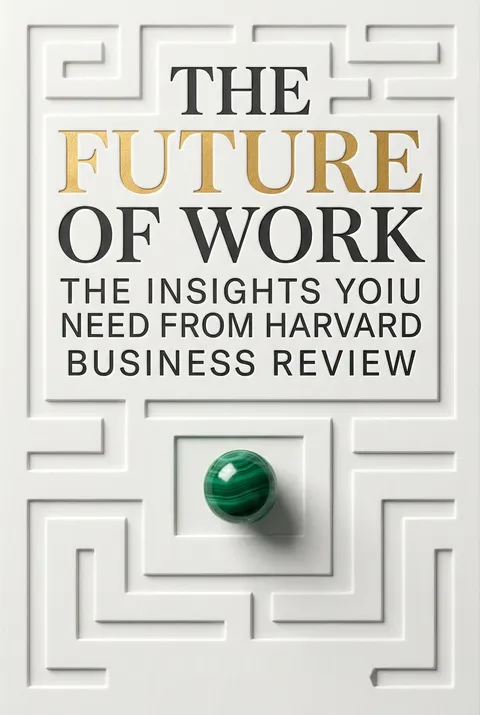
The Future of Work receives mixed reviews, with an average rating of 3.41/5. Readers appreciate its insights on remote work, AI integration, and changing workplace dynamics. The book is praised for its accessible format and thoughtful analysis of post-pandemic business trends. However, some criticize its brevity and lack of in-depth exploration. Positive reviews highlight its value for business leaders seeking to understand modern workplace challenges, while negative reviews question its predictive accuracy and relevance.
People Also Read









Glossary
Work from anywhere (WFA)
Geographic flexibility for workA work arrangement that allows employees to perform their jobs from locations of their choosing, rather than requiring them to live near or regularly attend a particular office. WFA can be hybrid or fully remote. It can widen access to talent and improve worker flexibility, but requires deliberate systems for communication, documentation, social connection, performance assessment, security, and legal compliance.
Job purposing
Adding social contribution to workAdjusting how a person performs their existing job so that the work contributes to a societal cause. The practice can involve changing routine interactions, purchasing decisions, training assignments, or service delivery. It differs from simply volunteering outside work because the social contribution is incorporated into work activities, while the employee continues to pursue the organization's responsibilities.
Identity threat
A cue of being treated as differentA situation that makes a person especially aware that they are different from others because of identity or background. Identity threats can be subtle, such as a remark based on a stereotype, or more consequential. The research described in the book distinguishes feeling excluded from feeling that one does not belong, with weakened belonging connected to reduced authenticity and workplace satisfaction.
Surface inclusion
Inclusion that feels tokenizingAn interaction in which someone is invited to participate mainly because they are expected to represent a social or demographic group. It can appear inclusive while making the individual feel singled out or used as a spokesperson. The term contrasts with inclusion grounded in genuine acceptance, respect, and interest in the person's particular experience and expertise.
Material ESG issues
Relevant social and environmental prioritiesEnvironmental, social, or governance issues with particular significance to a company's industry and financial or operational performance. The relevant issues vary by sector, so companies are advised to focus on the concerns most consequential to their business rather than apply a generic checklist. The book argues that addressing material issues can create stronger strategic value than improving on less relevant measures.
Impact-weighted accounting
Translating impacts into financial measuresAn approach intended to express a company's social and environmental effects in monetary terms and connect them to familiar financial statements. The book describes categories such as product impact, employment impact, and environmental impact. The aim is to help managers and investors compare impacts and incorporate them into business analysis, although the measurement methods are still developing.
Distributed cognition
Thinking shared across people and toolsA theory that cognitive work can be carried out by a system composed of people, tools, and external representations, rather than by an individual mind alone. The book uses ship navigation as an example: sailors coordinate with charts, instruments, and plotting tools. Applied to AI, the concept describes a possible partnership in which humans and machines contribute different forms of expertise.
Community collisions
Deliberately created informal connectionsPlanned encounters among employees who might not otherwise interact, especially in distributed organizations. These may be scheduled virtual conversations, mixed-group gatherings, or in-person events. The goal is to create social connection, exchange knowledge, and expose colleagues to people across teams or levels, instead of relying entirely on chance encounters in a shared office.
About the Author
Other books by Harvard Business Review








Download PDF
Download EPUB
.epub digital book format is ideal for reading ebooks on phones, tablets, and e-readers.








