

Key Takeaways
Judge phi by what it explains, not by its aura.
A precise proportion. The Golden Ratio, usually written as phi, is about 1.618. Divide a line so the whole is to the longer segment as that segment is to the shorter, and both ratios equal phi. Its definition is simple; its consequences are not. The ratio cannot be written as a fraction of whole numbers, making it irrational, and it also has a distinctive self-similar quality: remove a square from a Golden Rectangle and the remaining rectangle has the same proportions.
Surprise, not magic. The book follows phi from ancient geometry into plants, art, and modern physics. Its strongest case is not that every beautiful thing secretly contains the number. It is that a mathematical relationship devised for geometry reappears in unexpected settings, sometimes through a clear mechanism and sometimes as a tempting but unproven resemblance.
The distinction between explanation and aura is the book’s central safeguard. A number can be genuinely useful without being a universal signature of beauty or divine design. The same discipline applies to any striking pattern: first ask whether it is measured reliably, then whether a mechanism produces it, and only then whether it supports a larger interpretation. Phi earns attention through the specific structures it helps explain. Treating it as a charm that explains everything makes its real mathematical reach harder to see.
The pentagon made irrational numbers impossible to ignore.
A geometric doorway. The pentagram, the five-pointed star formed by a pentagon’s diagonals, contains repeated line segments whose ratios equal phi. The Greeks’ interest in these shapes likely helped bring the ratio into mathematics. Euclid gave the proportion a clear definition around 300 B.C., calling it division in extreme and mean ratio. The diagonal and side of a regular pentagon have an irrational ratio, so no pair of whole numbers can express their relationship exactly.
A crisis in counting. The story of Hippasus, a Pythagorean associated with revealing incommensurable lengths, survives in uncertain and conflicting accounts. The reported shock makes sense: a tradition that prized whole numbers and their ratios had to admit that some lengths share no common unit. The history is less certain than the geometry, but the intellectual rupture is real.
This episode shows how a visual object can expose a limit in a worldview. The pentagram was not just a symbol; its construction forced a distinction between what can be measured with a common unit and what cannot. The legend around Hippasus adds drama, but Livio is right to separate the durable mathematical result from the shaky biography. That separation is useful beyond ancient history: memorable origin stories can preserve a genuine conceptual shift while distorting who discovered it, when, or at what cost.
A rabbit puzzle links Fibonacci growth to phi.
A simple recurrence. In Fibonacci’s imagined rabbit problem, each mature pair produces a new pair monthly, and the young become productive after a month. The resulting counts follow a rule: each number is the sum of the two before it. This is the Fibonacci sequence: 1, 1, 2, 3, 5, 8, 13, and so on. Divide one term by the preceding term, and the ratios approach phi, alternating around it as the sequence grows.
Beyond the rabbits. Similar counts arise in puzzles about climbing stairs one or two steps at a time, and in the family tree of male bees. Indian writers on poetic meters described the same additive sequence centuries before Fibonacci published his rabbit problem in 1202. The rabbit tale made the sequence memorable, but it did not mark its first appearance.
The sequence is a neat lesson in how a local rule can generate a large-scale regularity. The rabbit model is deliberately simplified, yet its recurrence is mathematically powerful because it can be studied independently of whether rabbits actually breed that way. The link to phi is not a visual coincidence: it follows from the sequence’s defining rule. The earlier Indian examples also complicate the familiar hero story. Mathematical ideas travel across cultures, while the name that sticks does not always identify the first person to see them.
Plants favor the Golden Angle, but nature has no single blueprint.
Leaves avoid lining up. Phyllotaxis is the arrangement of leaves, seeds, or florets around a growing plant. Successive growth points often turn by roughly 137.5 degrees, an angle related to phi and known as the Golden Angle. This spacing avoids repeated alignment along a few spokes, helping new leaves or seeds occupy available space. Pineapples often display spiral counts such as 8, 13, and 21, which are Fibonacci numbers.
A plausible mechanism. In experiments, Douady and Couder dropped magnetic-fluid beads into silicone oil under a magnetic field. The beads repelled one another and formed patterns whose spacing tended toward the Golden Angle. This supports the idea that local interactions can produce a familiar large-scale arrangement. It does not make the pattern an iron law: plants face different growth conditions, and the book describes phyllotaxis as a common tendency, not a rule governing every plant.
The appeal here is causal rather than mystical. A plant does not need to calculate phi; growth plus limited space and local interactions can produce an arrangement close to the same geometry. That is a more illuminating account than claiming nature follows an invisible design manual. The experimental bead model gives the idea a physical demonstration, while the caveat about exceptions keeps it honest. A recurring pattern can be biologically important without being universal, exact, or evidence that the organism is optimizing by conscious calculation.
A ratio found after enough measuring may be coincidence, not design.
The pyramid’s tempting numbers. The Great Pyramid’s dimensions yield a ratio close to phi, and another relationship close to 2 pi. But measurements alone cannot show which, if either, guided its builders. A famous claim that Herodotus documented the phi design rests on a strained reading of his text. John Taylor helped popularize the interpretation, although Herodotus’s reported dimensions do not match the pyramid’s actual measurements.
Beware flexible evidence. A complex monument offers many edges and distances to compare. Choose different endpoints, ignore inconvenient parts, or accept small measurement errors, and a desired ratio can appear. Similar uncertainties surround claims about the Parthenon. The book’s practical test is demanding: intentional use should be supported by records or by a relationship so clear that it does not depend on arbitrary line-drawing.
This is a compact lesson in confirmation bias and measurement discipline. When many possible distances can be selected, finding one near a favored constant is not surprising by itself; the meaningful question is how often that result would arise under other choices. Documentation and pre-specified measurements help distinguish design from retrospective pattern hunting. The caution does not prove that ancient builders never used sophisticated proportions. It means that an attractive numerical fit is not enough to establish what they knew or intended.
Use phi as one compositional tool, not a universal beauty score.
Artists had different reasons. The 1509 publication of Luca Pacioli’s book on the Divine Proportion brought phi to a wider artistic and intellectual audience. Leonardo da Vinci supplied illustrations of geometric solids for the book. Later, the architect Le Corbusier developed the Modulor, a proportional system based on a model human figure and phi-related measurements. These are examples of deliberate interest, not proof that every admired artwork follows the ratio.
Preference is not a law. In Gustav Fechner’s rectangle experiment, 76 percent of choices clustered around ratios of 1.50, 1.62, and 1.75, with the peak near phi. Later researchers questioned whether the result depended on how rectangles were presented and how preferences were averaged. The evidence does not establish phi as a universal standard of visual pleasure, and many claims about famous paintings or music rely on flexible measurements rather than records of artistic intent.
A proportional system can help an artist organize a work without dictating its success. Le Corbusier’s Modulor is best understood as a design instrument and an effort to standardize dimensions around a human scale, not as a machine that guarantees harmony. Fechner’s result is suggestive, but preference depends on experimental framing, and proximity to phi is not the same as a unique preference for phi. This distinction preserves the legitimate history of artists using mathematics while resisting the more ambitious claim that one number governs aesthetic judgment.
A spiral can preserve shape without proving every curve is golden.
Growth without changing form. A logarithmic spiral expands while keeping the same overall shape. A chambered nautilus can add larger chambers as it grows without changing its general form; rams’ horns and some other natural structures also resemble this spiral. A Golden Rectangle can generate a logarithmic spiral by repeatedly removing squares, connecting the two mathematical ideas.
Look closely at the cause. Peregrine falcons can approach prey along a spiral-like path that helps them keep the target in view. Spiral galaxies also have a striking shape, but their arms are density waves that trigger new star formation, not fixed collections of stars rotating together. These cases illustrate why spiral patterns recur, but not every natural spiral is an exact Golden Spiral. Similar appearances can arise from different mechanisms.
Self-similarity explains why a shape can remain recognizable across changes in size, making it useful for growth processes. Yet the word spiral covers several geometries, and a visual resemblance does not establish a shared cause. The falcon’s path serves a perceptual constraint; the galaxy’s arms emerge from dynamics across a rotating disk. Keeping those explanations distinct makes the broader connection more impressive, not less. Nature reuses certain forms, but it does not follow that every instance is an exact copy of one mathematical curve.
Abstract tiling rules can predict matter no crystal theory expected.
A forbidden symmetry. Roger Penrose devised sets of tiles that cover a plane in ordered but nonrepeating patterns. Their fivefold symmetry is tied to pentagons and phi, yet ordinary periodic tilings cannot reproduce it. In 1984, Dany Shechtman and colleagues found an alloy with long-range order and fivefold symmetry, properties once thought incompatible in a crystal. These materials became known as quasi-crystals.
From puzzle to physical model. Penrose’s tiles did not, by themselves, explain how atoms arrange. Later work proposed that clusters of atoms could overlap in ways resembling mathematical tiling rules, and experiments found evidence consistent with that picture. The episode shows a route from recreational geometry to a useful physical model: mathematics can reveal a possible structure before science understands how nature builds it.
The striking point is not simply that an elegant pattern appears in matter. It is that a mathematical construction widened the range of structures scientists were prepared to recognize. Still, prediction and explanation are different achievements. A tiling can match an observed arrangement without identifying the energetic process that creates it. The history is strongest when those stages remain separate: mathematical possibility, physical observation, and a proposed mechanism. That sequence illustrates how abstract work can guide empirical discovery without substituting for it.
Randomness can obey numerical laws, but a pattern is not a forecast.
Unexpected regularity. Benford’s law describes how first digits are distributed across many naturally varied data sets: about 30 percent begin with 1, while fewer than 5 percent begin with 9. The pattern can help auditors flag suspicious figures. In one company case described in the book, an unusual concentration of healthcare payments beginning with 65 led investigators to fraudulent checks.
Random rules, steady growth. Computer scientist Divakar Viswanath modified the Fibonacci rule by using coin tosses to decide whether to add or subtract. Although each step was random, the absolute values grew at a predictable long-run rate associated with a constant near 1.132. Both examples show that statistical structure can emerge without a simple deterministic path. They do not mean that a market pattern, a suspicious digit, or a random process can predict a specific future event.
These examples separate statistical regularity from certainty. Benford’s law is useful as a screening signal, not as proof of fraud: a deviation invites investigation rather than delivering a verdict. Viswanath’s result makes a complementary point, since randomness at each step can still produce predictable aggregate growth. The wider lesson is to ask what a pattern licenses. A pattern may support a probability estimate or identify an anomaly, while offering no reliable forecast of an individual outcome.
Mathematics is invented in its rules, discovered in its consequences.
Rules and consequences. The book closes with a question: is mathematics found in the universe, or built by human minds? One useful answer combines both views. People choose or inherit mathematical starting rules, but they do not get to choose every result that follows from them. Once Euclidean geometry defines phi, the relation between phi and Fibonacci ratios is a consequence to discover, not a preference to declare.
A wrong model can matter. Kepler tried to explain the number and spacing of planets by nesting the five Platonic solids between their orbits. The model was wrong, but it was mathematical, tied to observations, and testable. Kepler’s later work, including the laws of planetary motion, helped transform astronomy. The episode captures the book’s larger point: mathematics can be humanly formulated, yet its unexpected results can expose structure in the world.
The combined account avoids two easy extremes. Pure invention struggles to explain why mathematical consequences repeatedly fit phenomena that were not used to create them; pure discovery can overlook the historical choices that shaped which mathematics people developed. Kepler’s failure is especially instructive because a theory can be wrong and still advance inquiry if it makes testable claims. Mathematical effectiveness remains a deep question, not a solved slogan. The book’s best answer is a disciplined wonder: human reasoning explores structures whose reach often exceeds its original purpose.
Analysis
The book’s argument depends on keeping three kinds of claims apart. First are mathematical facts: phi is irrational, the ratios of successive Fibonacci numbers converge toward it, and certain constructions generate exact relationships. Second are mechanisms: plant growth can create arrangements near the Golden Angle, while repeating growth can produce spiral forms. Third are interpretations: an artist intended phi, a monument encodes it, or the ratio is inherently beautiful. Confusion begins when a true mathematical fact is treated as evidence for a historical intention or a universal aesthetic law.
That distinction gives the narrative its unusual force. The same number can be mathematically exact, physically approximate, and historically uncertain. The pentagon gives a rigorous route to phi; the Great Pyramid’s apparent fit does not establish that its builders knew the ratio. A sunflower’s spiral counts have an explanatory context; a rectangle drawn over a painting may only reflect the analyst’s choice of boundaries. Livio’s skepticism does not deflate the story. It protects the real discoveries from inflated claims. The historical episodes also show that mathematics develops through both cultural transmission and independent invention. Fibonacci’s name became attached to a sequence whose underlying rule appeared earlier in Indian poetic theory. Pacioli helped circulate mathematical ideas, though questions remain about his debt to Piero della Francesca. Kepler’s Platonic planetary model failed, yet its testable ambition belonged to the emerging scientific method. Progress here is not a march from error to certainty. It is a process in which an imperfect idea can supply questions, tools, or structures that later work refines.
The book finally resists a clean verdict on whether mathematics is invented or discovered. People create systems of symbols and axioms, but the consequences are not freely chosen. That tension is a better conclusion than claiming that the universe is simply written in phi. The ratio matters because it exposes how formal relationships can migrate across geometry, biology, physics, and art, while also reminding readers to distinguish a genuine explanation from a pattern that merely looks meaningful.
Review Summary
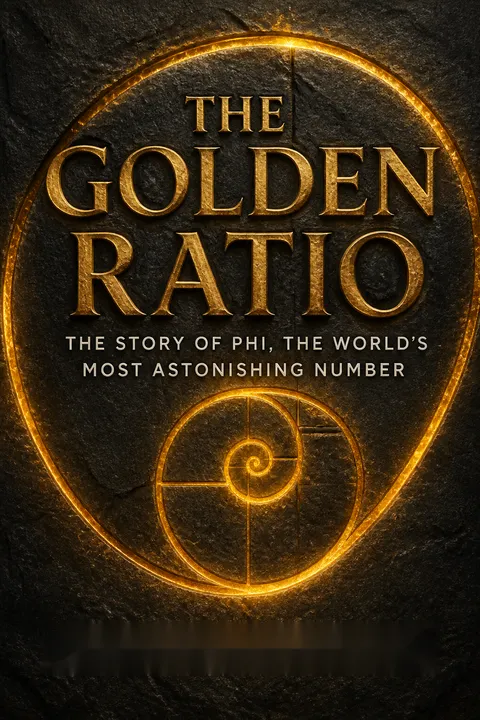
The Golden Ratio explores the history and significance of phi (1.618...), debunking myths about its use in art and architecture while highlighting its mathematical properties and natural occurrences. Readers appreciate Livio's balanced approach, combining mathematical explanations with historical context and philosophical questions. Many found the book engaging and thought-provoking, praising its accessibility for non-mathematicians. Some critics felt it lacked focus on phi itself, spending too much time on general mathematical history. Overall, most readers found it an informative and stimulating exploration of mathematics, nature, and human creativity.
Glossary
Golden Ratio
A self-similar proportionThe Golden Ratio is the positive number approximately equal to 1.618. A line is divided in this ratio when the whole length relates to the longer segment as the longer segment relates to the shorter. It is irrational, meaning it cannot be expressed as a fraction of whole numbers, and it appears in geometric constructions involving pentagons and related shapes.
Fibonacci sequence
A two-term additive sequenceA sequence beginning 1, 1, 2, 3, 5, 8, and continuing by adding the two previous terms to obtain each new one. The sequence arose in a rabbit-breeding problem in Fibonacci’s Liber abaci, though related sequences appeared earlier in Indian writing on poetic meters. Ratios of successive terms approach the Golden Ratio.
Phyllotaxis
Plant-part arrangementPhyllotaxis is the arrangement of leaves along a stem, or of repeated structures such as seeds and florets. Many plants place successive growth points at angles close to the Golden Angle, producing efficient spacing and visible spiral families. The pattern is common but not universal, and its form can vary with the plant and its conditions.
Golden Angle
A phi-related growth angleThe Golden Angle is about 137.5 degrees, the smaller angle associated with dividing a full turn according to the Golden Ratio. In plant growth, successive leaves, seeds, or florets may be separated by an angle near this value. The spacing reduces repeated radial alignment and can help distribute new growth across available space.
logarithmic spiral
A scale-preserving spiralA logarithmic spiral expands while retaining the same overall shape. Turning through equal angles changes its distance from the center by equal ratios, so magnification reveals a smaller version of the same curve. It can describe some growing shells and other forms. A spiral resembling this curve is not necessarily an exact Golden Spiral.
Penrose tilings
Ordered, nonrepeating tilingsPenrose tilings cover a plane using a small set of shapes and matching rules. They have long-range order but do not repeat periodically, and can display fivefold symmetry, which ordinary periodic tilings cannot produce. Their geometry is closely related to pentagons and the Golden Ratio, and later became relevant to models of quasi-crystals.
quasi-crystals
Ordered, nonperiodic solidsQuasi-crystals are solids with long-range structural order but without the repeating unit pattern found in ordinary crystals. Their discovery challenged the belief that ordered solids could have only certain rotational symmetries. Some exhibit fivefold or icosahedral symmetry, resembling properties of Penrose tilings, though tiling geometry alone does not explain how the atoms form.
fractal
A scale-repeating structureA fractal is a structure with patterns that recur across different scales, often with irregular detail that persists under magnification. Fractal geometry describes forms that ordinary whole-number dimensions do not capture well, such as jagged coastlines or branching systems. The book connects self-similar patterns to the Golden Ratio in several mathematical constructions.
Benford's law
A first-digit distributionBenford’s law describes the unequal frequency of first digits in many varied collections of numbers. A leading 1 appears about 30 percent of the time, while a leading 9 appears about 4.6 percent. The pattern can help identify anomalies in financial data, but a mismatch is a reason to investigate, not proof of fraud.
Modulor
A human-scale proportion systemThe Modulor is Le Corbusier’s system for assigning architectural dimensions using a model human figure and a sequence of proportions related to phi and Fibonacci numbers. It was intended to coordinate scales from furnishings to buildings. It represents a deliberate design method, not evidence that the Golden Ratio guarantees beauty or suits every person.
FAQ
What's The Golden Ratio: The Story of Phi, the World's Most Astonishing Number about?
- Focus on φ: The book explores the Golden Ratio, denoted as φ (phi), approximately 1.61803, and its significance in mathematics, art, architecture, and nature.
- Interdisciplinary connections: Mario Livio illustrates how φ appears in diverse contexts, from plant leaf arrangements to famous artworks and architectural structures.
- Historical journey: Livio guides readers through the historical development of the Golden Ratio, discussing its discovery, mathematical properties, and its enduring fascination.
Why should I read The Golden Ratio by Mario Livio?
- Engaging narrative: Livio combines storytelling with scientific exploration, making complex mathematical concepts accessible and enjoyable for all readers.
- Broad appeal: The book appeals to those interested in mathematics, art, history, and science, showing how a single number connects these disciplines.
- Intellectual curiosity: It encourages readers to appreciate the beauty and mystery of mathematics, emphasizing the allure of the unknown.
What are the key takeaways of The Golden Ratio?
- Ubiquity of φ: The Golden Ratio is found in natural phenomena, such as flower petals and shell spirals, demonstrating its universal significance.
- Mathematical properties: φ is unique, being the only number that, when added to one, equals its square, expressed in the equation: “x = 1 + x.”
- Cultural impact: The book highlights how the Golden Ratio has influenced art and architecture, with examples from artists like Salvador Dali and structures like the Parthenon.
What are the best quotes from The Golden Ratio and what do they mean?
- “The fairest thing we can experience is the mysterious.”: This quote by Einstein emphasizes the allure of the unknown, central to exploring the Golden Ratio.
- “A straight line is said to have been cut in extreme and mean ratio...”: Euclid's definition encapsulates the mathematical essence of the Golden Ratio and its foundational role in geometry.
- “The Golden Ratio has inspired thinkers of all disciplines...”: This statement reflects φ's profound impact across various fields, highlighting its significance beyond mathematics.
How does the Golden Ratio appear in nature according to The Golden Ratio?
- Phyllotaxis: Leaf, seed, and petal arrangements often follow the Golden Ratio, optimizing sunlight exposure and space, as seen in sunflowers.
- Animal structures: Mollusk shells, like the nautilus, grow in a logarithmic spiral reflecting the Golden Ratio, showing its aesthetic and functional significance.
- Growth patterns: The Golden Ratio is evident in plant growth patterns, where the divergence angle between leaves is about 137.5 degrees, related to φ.
What is the relationship between the Fibonacci sequence and the Golden Ratio in The Golden Ratio?
- Recursive nature: The Fibonacci sequence is defined such that each number is the sum of the two preceding ones, leading to a series approaching the Golden Ratio.
- Ratios converge: The ratio of successive Fibonacci numbers converges to φ, illustrating a deep mathematical connection between this sequence and the Golden Ratio.
- Natural occurrences: The Fibonacci sequence appears in natural phenomena, like leaf arrangements and tree branching, linking it to the Golden Ratio's aesthetic qualities.
How did historical figures like Pacioli and Kepler contribute to the understanding of the Golden Ratio in The Golden Ratio?
- Luca Pacioli's Contributions: Pacioli's The Divine Proportion popularized the Golden Ratio during the Renaissance, making it accessible to artists and mathematicians.
- Johannes Kepler's Insights: Kepler used the Golden Ratio in his cosmological models, reflecting divine order and harmony in celestial mechanics.
- Interconnectedness of Knowledge: Both figures exemplify the Renaissance ideal of blending art and science, showcasing the Golden Ratio's multifaceted nature.
How does The Golden Ratio by Mario Livio relate to art and architecture?
- Influence on Artists: Artists like Leonardo da Vinci used the Golden Ratio to achieve aesthetic harmony, evident in specific artworks.
- Architectural Applications: The Golden Ratio is believed to be used in architectural masterpieces like the Parthenon for visually pleasing proportions.
- Philosophical Implications: The relationship between the Golden Ratio and beauty raises questions about aesthetics, inviting readers to consider its association with perfection.
What are the mathematical properties of the Golden Ratio discussed in The Golden Ratio?
- Unique algebraic identity: The Golden Ratio satisfies φ = 1 + 1/φ, leading to its defining quadratic equation: x² = x + 1.
- Continued fractions: φ can be expressed as a continued fraction of ones, making it the most “irrational” of all numbers.
- Geometric significance: The Golden Ratio is crucial in constructing regular polygons, like the pentagon, where the diagonal-to-side ratio equals φ.
How does The Golden Ratio address the philosophical implications of mathematics?
- Mathematics and beauty: Livio explores the idea that mathematics, particularly the Golden Ratio, embodies aesthetic qualities resonating with human perception of beauty.
- Existential questions: The book raises questions about the nature of mathematics, such as its existence independent of human thought, echoing philosophers like Einstein.
- Interconnectedness of disciplines: Livio emphasizes mathematics' connection to art, science, and philosophy, suggesting the Golden Ratio as a bridge enriching our understanding of the universe.
What is the historical significance of the Golden Ratio in mathematics according to The Golden Ratio?
- Ancient origins: The concept dates back to ancient Greece, with Euclid providing early definitions in Elements around 300 B.C.
- Influence on later mathematicians: The fascination with φ influenced mathematicians like Fibonacci and Renaissance figures like Piero della Francesca.
- Connection to irrational numbers: The discovery of the Golden Ratio led to understanding irrational numbers, a significant breakthrough for the Pythagoreans.
How does The Golden Ratio connect to nature?
- Natural Patterns: The Golden Ratio appears in natural phenomena like leaf arrangements, tree branching, and shell spirals, demonstrating its prevalence in biological systems.
- Mathematical Relationships: These patterns are often linked to Fibonacci numbers, emphasizing the underlying order and structure in nature.
- Philosophical Reflections: The presence of the Golden Ratio in nature raises questions about mathematics' relationship with the environment, encouraging reflection on life's complexity.
About the Author
Download PDF
Download EPUB
.epub digital book format is ideal for reading ebooks on phones, tablets, and e-readers.








