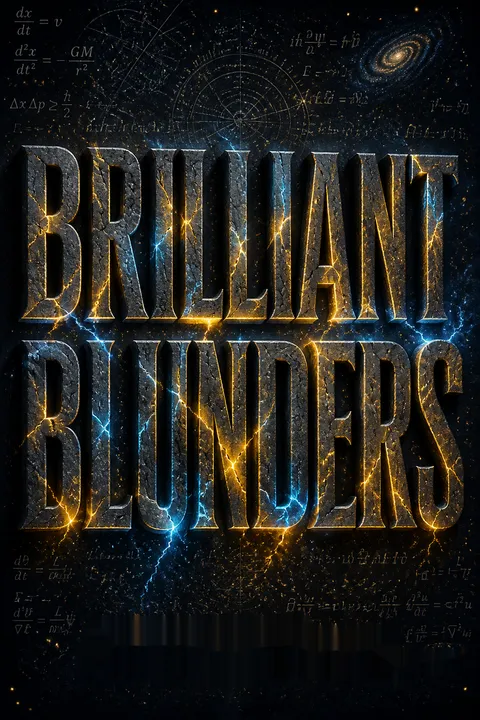


Key Takeaways
Treat even a genius's blunder as a clue, not a verdict
Errors expose hidden assumptions. Mario Livio follows five celebrated scientists to show that major discoveries do not arrive as clean success stories. Darwin missed a problem in heredity, Kelvin trusted a limited model of Earth's interior, Pauling rushed from a successful protein model to a faulty DNA one, Hoyle resisted evidence against his cosmology, and Einstein rejected a term he had added to his equations. Their mistakes revealed questions their fields had not yet answered.
Correction makes error useful. The book's central idea is not that mistakes are automatically good. A blunder becomes productive when it clarifies a problem, invites a decisive test, or gives other researchers something specific to repair. Science advances through that repair work, not through genius alone.
What's striking is that the book treats error as information about the process of knowing, not merely as a defect in an individual's character. Each mistake marks a boundary: what the available evidence could support, what a favored model left out, or what a scientist was prepared to consider. That makes the stories useful beyond science, wherever people build models from incomplete evidence. The caution is important: later success can make an old error look purposeful. Most mistakes lead nowhere. Their value depends on whether other people can detect, test, and correct them.
Darwin's selection needed genes that do not dissolve into averages
Blending undermined selection. Darwin explained adaptation through natural selection: individuals vary, some differences are inherited, and those that aid survival and reproduction become more common across generations. But nineteenth-century heredity was often imagined as paint mixing. If a rare dark-colored animal mated with lighter ones, its offspring would be intermediate, and the distinctive trait would fade with each generation. Engineer Fleeming Jenkin argued that this swamping effect could prevent a favorable novelty from spreading.
Mendel supplied the missing logic. Pea experiments showed that inherited traits behave more like discrete units than blended paint. A recessive trait can disappear from one generation yet reappear in the next, preserving variation for selection to act on. Darwin did not know Mendel's work, and his own proposed explanation, pangenesis, was wrong. The successful theory required Darwinian selection joined to particulate inheritance.
This is more than a historical footnote. It shows that a theory can explain one part of a phenomenon while quietly depending on a second theory that has not yet been established. Darwin's account of selection was powerful, but heredity determined whether its raw material could survive long enough to be selected. The same logical issue appears whenever a process requires variation to persist, rather than average away. The book also avoids an easy accusation: Darwin could not have known modern genetics, but he could have noticed that his assumptions about inheritance strained his own mechanism.
Kelvin's Earth was too young because his model ruled out mantle convection
Good physics, narrow model. Lord Kelvin estimated Earth's age by calculating how long a once-hot planet would take to cool through heat conduction. His estimate was about 98 million years, with a broad range of 20 million to 400 million. It clashed with the much longer history required by geology and evolution. Kelvin's calculation was ingenious, but it assumed that heat moved through Earth in a uniform way and did not adequately allow for convection, the transfer of heat by moving material.
Perry reopened the problem. Kelvin's former student John Perry showed that a partly fluid interior could circulate heat and keep the outer layers warm for far longer. The accepted age of Earth is about 4.54 billion years. Radioactivity later proved to be an additional source of internal heat, but Livio argues that Kelvin's central failure was not simply overlooking radioactivity. It was treating a restricted physical model as if it exhausted the possibilities.
Kelvin's story separates mathematical competence from model adequacy. The equations can be flawless while the imagined system is incomplete. Perry did not need to prove that convection was definitely occurring to expose the vulnerability: a physically possible alternative was enough to weaken Kelvin's confident upper limit. This is a useful standard for evaluating quantitative claims. Ask which assumptions are measured, which are inferred, and which are simply convenient. The nuance is that no model can include every possibility. The relevant question is whether uncertainty in an omitted mechanism could change the answer by orders of magnitude.
Notice when commitment makes contrary evidence feel threatening
Beliefs defend themselves. Livio connects Kelvin's long defense of his age estimate to cognitive dissonance, the discomfort people feel when evidence conflicts with a belief or choice they have invested in. In a 1955 experiment, 225 students rated products, chose between two, then rated them again. They tended to raise the rating of the chosen item and lower the rejected one, making their decision feel more consistent.
Scientists are not exempt. Kelvin had defended his view for decades, and Perry's alternative did not arrive with a definitive measurement of Earth's interior. That left room to dismiss it. Livio also discusses the brain's reward systems and the possibility that the satisfaction of certainty can reinforce intellectual attachment. He presents this as a plausible explanation, not a demonstrated diagnosis of Kelvin. The practical warning is to inspect how personally costly it feels to revise a cherished conclusion.
The student-choice experiment makes belief revision visible in miniature: people can alter their evaluation of evidence after making a decision, without consciously deciding to distort it. The same pattern can shape research, policy, and everyday judgment. Yet psychological explanations should not become shortcuts for dismissing disagreement. A scientist may hold a position because the evidence genuinely remains ambiguous, not because identity has taken over. The useful test is procedural: Can the person state what evidence would change the conclusion, and apply the same standard to favored and rival explanations?
Pauling's protein triumph made his DNA shortcut dangerously persuasive
A winning method became a trap. Linus Pauling worked for years on protein structure, combining chemical rules with physical models and checking those models against X-ray evidence. His approach helped reveal the alpha-helix, a common spiral arrangement in proteins. When he turned to DNA, he had poorer photographs, limited information about the sample, and far less time. Still, he proposed a three-stranded structure with phosphate groups inside and bases outside. The model failed basic chemistry: DNA's phosphate groups are negatively charged in water.
Success encouraged overreach. Pauling also missed the implications of Chargaff's finding that DNA contains equal amounts of adenine and thymine, and equal amounts of guanine and cytosine. Those proportions pointed toward paired bases and two strands. Pauling's earlier insight that complementary parts could guide copying also went unused. Livio presents the failure as a shortcut strengthened by prior success, competition, distraction, and low confidence in DNA's biological importance.
Pauling's mistake illustrates a subtle danger of expertise: a method that works brilliantly in one domain can become an unexamined template in another. His model-building skill was real, but structural intuition could not compensate for weak data or neglected chemical constraints. This is not an argument against intuition. Intuition helps experts generate promising hypotheses quickly. Its proper role is to propose a model, not certify it. The DNA episode is especially instructive because several clues were available, yet they did not become one coherent argument in Pauling's reasoning.
Give models boldness, but give evidence and collaborators fair credit
DNA's answer came from many hands. James Watson and Francis Crick built models, while Rosalind Franklin produced exceptionally clear X-ray photographs that revealed DNA's helical structure. Her photograph 51, shared with Watson without her knowledge, helped him recognize the pattern. Chargaff's base ratios suggested specific pairings, and chemist Jerry Donohue corrected a mistaken assumption about the positions of hydrogen atoms in the bases. Together, these clues supported the double helix, whose paired strands also suggested how DNA could be copied.
Discovery has an ethical history. Franklin's experimental work was central, but she was not among the three scientists who received the 1962 Nobel Prize. The award could not be given posthumously, and Franklin had died in 1958. Livio notes that Watson and Crick acknowledged the general nature of her unpublished results, while also emphasizing that her data were shared without her consent. The case shows how scientific credit depends not only on insight, but also on access, communication, and institutional power.
The DNA story resists the tidy image of a lone mind solving a puzzle. Models, measurements, chemical expertise, and access to other people's work all mattered. That does not make the model-builders' achievement smaller; it makes the actual process more accurate. It also raises a distinction between using evidence and having the right to use it. Scientific openness can accelerate discovery, but openness without consent can impose costs unevenly, especially when status and credit are at stake. A fair history should preserve both the intellectual achievement and the conditions under which it occurred.
A dissenter must update when the universe stops cooperating
Steady state began as a serious rival. Fred Hoyle, Hermann Bondi, and Thomas Gold proposed that the expanding universe could remain broadly unchanged if new matter continually formed, replenishing what expansion diluted. The idea was testable: distant regions, seen as they were long ago, should resemble nearby ones. Early evidence was limited, so the proposal was not irrational or unserious.
The evidence accumulated against it. Radio-source counts, the greater abundance of quasars in the distant past, and the cosmic microwave background all supported an evolving universe with a hot beginning. Bondi accepted that these observations were the historical traces he had asked for. Hoyle continued to defend modified versions of steady state cosmology, explaining away evidence that increasingly strained the theory. Livio identifies the error not as dissent itself, but as refusing to revise a favored theory while judging its rival by a different standard.
Hoyle's case gives dissent its strongest defense: consensus can be wrong, and a rival theory can stimulate observations that would otherwise not be made. But dissent becomes less scientific when every unfavorable result is reclassified as irrelevant while weak support is treated as decisive. The key distinction is not mainstream versus outsider. It is whether competing explanations face comparable tests. Hoyle's early theory helped make cosmology more empirical; his later isolation weakened the corrective exchange that had made his earlier work so fertile.
Carbon in your body was forged in stars, not the Big Bang
Hoyle traced the elements to stellar furnaces. Early models of the Big Bang could account for much of the hydrogen and helium, but they struggled to build heavier elements. The obstacle included gaps in stable atomic masses that blocked a simple sequence of nuclear captures. Hoyle argued that stars could manufacture heavier elements through nuclear reactions. To explain how three helium nuclei could form carbon, he predicted that carbon must have a particular excited energy state, near 7.68 million electron volts, that would make the reaction proceed efficiently.
A prediction became a measurement. Physicists at Caltech tested the prediction and found the expected state. Later work described how stars build elements up to iron and how stellar explosions distribute them into space. The resulting picture is a cosmic division of labor: the Big Bang produced the lightest elements, while stars made most of the heavier elements needed for planets and life.
This episode shows theory working in both directions. Astrophysical abundance patterns suggested what nuclear physics needed to contain, and laboratory measurements then checked the prediction. Such cross-field reasoning is powerful because each discipline constrains the other's possibilities. Hoyle's success also complicates any simple portrait of him as a stubborn dissenter: the same scientist who clung too long to one cosmology made a remarkably productive prediction elsewhere. Scientific judgment is local. A record of brilliance in one problem does not guarantee good calibration in another.
Einstein's real cosmological mistake was removing a term nature retained
The famous confession may be folklore. Einstein added the cosmological constant to his equations while trying to describe a static universe. After astronomers established that the universe expands, he removed it. The familiar claim that he called this his biggest blunder comes chiefly from George Gamow's account, and Livio argues that the surviving record makes the quotation doubtful. Einstein did express regret about adding the term, but he objected that it weakened the equations' simplicity.
The universe revived the term. In 1998, two teams found that cosmic expansion is accelerating, a result consistent with a repulsive contribution associated with the cosmological constant. The book's sharper criticism is therefore that Einstein removed a term allowed by his theory because it looked inelegant, rather than waiting for observations to settle whether it belonged. The value is now associated with dark energy, which accounts for about 73 percent of the universe's total energy density in the book's account.
The episode distinguishes simplicity in a theory's foundations from simplicity in the appearance of its equations. A term can look inelegant and still describe something real. Einstein's preference for mathematical economy was not foolish; it was a powerful guide throughout his work. The failure came when aesthetic preference became a reason to narrow a theory before the evidence required it. The disputed quotation adds another lesson: famous anecdotes can become accepted scientific history through repetition. Checking the source of a memorable claim is part of intellectual rigor.
Make doubt part of the method, especially when your reputation is invested
Different errors need different safeguards. Darwin needed heredity compatible with selection. Kelvin needed to test alternative structures inside Earth. Pauling needed to slow down and integrate relevant chemical evidence. Hoyle needed to apply the same evidential standards to his own theory and its rival. Einstein needed to resist discarding a mathematically allowed possibility because it offended his taste for simplicity. The mistakes were not interchangeable, so neither were their remedies.
Correction is a social achievement. Perry challenged Kelvin, Mendel's work helped complete the account of heredity, Franklin's images informed DNA's structure, and observations tested competing cosmologies. Livio's closing lesson is that science is not a straight march toward truth. It is a process of proposals, checks, revisions, and occasional wrong turns. Doubt helps most when it is specific: name the assumption, identify what could falsify it, and invite scrutiny before certainty hardens.
The strongest synthesis is that humility becomes useful when built into procedures rather than left as a personal virtue. Scientists can ask what observation would change a conclusion, separate confidence in a method from confidence in its result, and invite criticism from people with different expertise. Those habits do not eliminate bias, but they make bias easier to expose. There is also a limit: excessive doubt can prevent action or make every explanation seem equally uncertain. The aim is not perpetual hesitation. It is confidence proportional to evidence, with a visible route back from error.
Analysis
Brilliant Blunders is best understood as a history of how scientific knowledge gets repaired. Its five central cases are not a ranking of bad judgment. Each isolates a different failure mode: Darwin's account of selection lacked a viable theory of inheritance; Kelvin mistook a tractable cooling calculation for a complete model of Earth; Pauling transferred success in protein chemistry too quickly to DNA; Hoyle turned productive dissent into resistance to disconfirmation; and Einstein let an aesthetic preference help narrow a theory. The book's structure makes these errors comparable without pretending they are equivalent.
Its most important methodological distinction is between an incorrect answer and a defective process. Kelvin's arithmetic was not the main problem. His boundary assumptions were. Pauling's structural skill was not absent; it was deployed with inadequate evidence and insufficient attention to constraints. Hoyle's early cosmology was a legitimate scientific alternative, while his later defense became less persuasive as observations accumulated. This distinction prevents hindsight from flattening every failure into obvious incompetence.
The book is also persuasive about the social character of correction. Perry's challenge, Mendelian genetics, Franklin's data, and astronomical observations did not merely replace individual opinions. They changed what could be tested and what counted as an adequate explanation. Still, the narrative risks making errors seem more productive than they usually are. A wrong model becomes a catalyst only when the field has instruments, competing accounts, and people willing to scrutinize it. Many mistakes simply waste effort or damage lives. The book's title is most defensible when brilliance describes the quality of the question exposed by an error, not the error itself.
The most durable lesson is procedural rather than inspirational: confidence should attach to evidence and methods, not to status. Scientific humility is not self-doubt for its own sake. It is the discipline of making assumptions visible, allowing alternatives to survive long enough to be tested, and changing a view when its explanatory costs grow too high.
Review Summary
Brilliant Blunders explores mistakes made by renowned scientists like Darwin, Einstein, and others. While some readers found it insightful and well-researched, others criticized the loose definition of "blunders" and the book's uneven pacing. Many appreciated the humanization of great scientists and the exploration of how errors contribute to scientific progress. However, some felt the technical content was too advanced for casual readers. Overall, opinions were mixed, with some praising the book's depth and others finding it tedious or poorly structured.
People Also Read






Glossary
Brilliant blunders
Mistakes that expose new questionsLivio's label for consequential scientific errors made by major researchers. These are not simply embarrassing slips: they reveal a weakness in a theory, calculation, or judgment, and can prompt later investigators to ask better questions or produce stronger explanations. Their value lies in the correction they provoke, not in being wrong.
Natural selection
Inherited variation shaped by reproductionDarwin's proposed mechanism of evolutionary change. Individuals in a population vary, some variations are inherited, and organisms with traits that improve survival or reproduction tend to leave more descendants. Across generations, those traits can become more common. Selection acts on populations over time and has no foresight or predetermined goal.
Paint-pot theory
Inheritance as blended traitsA nineteenth-century model of heredity in which parental characteristics were thought to mix in offspring like colors of paint. Darwin's theory of natural selection depended on inherited variation, but blending seemed to dilute unusual advantageous traits across generations. Discrete inheritance, later explained through Mendelian genetics, instead allows variants to persist.
Pangenesis
Darwin's mistaken heredity modelDarwin's proposed explanation for inheritance, in which cells throughout the body were thought to release tiny particles called gemmules. These particles would travel to reproductive cells and transmit bodily characteristics to offspring. The idea attempted to explain heredity and variation, but it reversed the direction understood by modern genetics: hereditary material guides development of the body.
Genetic drift
Chance changes in gene frequenciesEvolutionary change caused by random sampling rather than by an advantage in survival or reproduction. Drift affects populations because only a limited number of individuals pass genes to the next generation. Its effects are especially strong in small, isolated groups, where chance can make a gene variant unusually common or cause it to disappear.
Steady-state theory
An expanding but unchanging cosmosA cosmological model associated with Fred Hoyle, Hermann Bondi, and Thomas Gold. It proposed that the universe expands while new matter continually forms, preserving its average large-scale density and appearance over time. The model was testable: distant regions should not show the historical changes expected in an evolving universe.
Perfect Cosmological Principle
Same cosmic appearance across timeBondi and Gold's extension of the cosmological principle. The ordinary principle describes the universe as broadly similar at large scales from different locations and directions. The Perfect Cosmological Principle adds that it should also look broadly the same at different times, an assumption suited to a universe without a beginning or end.
Triple alpha (3α) process
Three helium nuclei forming carbonA nuclear reaction sequence in stars in which three helium nuclei, also called alpha particles, combine to form a carbon nucleus. Two helium nuclei briefly form unstable beryllium; that nucleus can capture a third helium nucleus. Hoyle argued that an excited energy state in carbon makes the process efficient enough to explain carbon's cosmic abundance.
Chargaff's rules
Equal amounts of paired DNA basesObserved relationships in DNA composition: the amount of adenine is equal to thymine, and the amount of guanine is equal to cytosine. These proportions provided an important clue to DNA's structure. In the double helix, adenine pairs with thymine and guanine with cytosine, making the composition relationships and copying mechanism intelligible.
Cosmological constant
A constant term in cosmic equationsA term Einstein added to the equations of general relativity while seeking a static universe. It can be interpreted as a uniform energy density of empty space and is associated with repulsive gravity. Observations of accelerating cosmic expansion revived interest in the term, which is related to what cosmologists call dark energy.
Anthropic principle
Observers constrain what they observeThe idea that observations are necessarily filtered by the conditions required for observers to exist. In arguments about the cosmological constant, a value too large could prevent galaxies and life from forming, leaving no observers to measure it. In a multiverse scenario, this selection effect might help explain why observers find themselves in a life-permitting universe.
FAQ
What's Brilliant Blunders about?
- Focus on scientific errors: Brilliant Blunders by Mario Livio explores significant mistakes made by renowned scientists and how these errors contributed to scientific progress.
- Journey over achievements: The book emphasizes the thought processes and obstacles faced by scientists, rather than just their successes.
- Themes of evolution and cosmos: It connects these blunders to broader themes in the evolution of life, Earth, and the universe, showing how errors can lead to breakthroughs.
Why should I read Brilliant Blunders?
- Insight into discovery: The book offers a unique perspective on how mistakes are integral to the scientific process, making it valuable for anyone interested in science.
- Engaging storytelling: Livio combines historical anecdotes with scientific concepts, making complex ideas accessible and engaging.
- Lessons from great minds: Readers learn from the experiences of scientists like Darwin and Einstein, understanding that failure is often a stepping stone to success.
What are the key takeaways of Brilliant Blunders?
- Mistakes are essential: Significant scientific advancements often arise from errors, reinforcing that blunders are part of the learning process.
- Human limitations: Livio discusses psychological and cognitive factors contributing to these blunders, highlighting human limitations in scientific reasoning.
- Interconnectedness of science: The blunders of individual scientists are shown to influence various fields, leading to a deeper understanding of life and the universe.
What are the best quotes from Brilliant Blunders and what do they mean?
- “Experience is the name everyone gives to their mistakes.”: This Oscar Wilde quote emphasizes that mistakes are fundamental to learning and growth, especially in science.
- “The road to triumph is paved with blunders.”: Livio illustrates that significant achievements often come after a series of errors, underscoring perseverance's value.
- “Certainty generally is illusion.”: This reflects the idea that absolute certainty in science is rare, and questioning and revising beliefs is crucial for progress.
Who are the main scientists discussed in Brilliant Blunders?
- Charles Darwin: Explored for his misunderstanding of blending inheritance, which nearly undermined his theory of natural selection.
- Albert Einstein: Examined for his mistakes, particularly the cosmological constant, which he later called his "biggest blunder."
- Linus Pauling: Known for his erroneous triple helix model of DNA, illustrating how previous successes led to overconfidence.
What was Darwin's major blunder in Brilliant Blunders?
- Blending inheritance misunderstanding: Darwin adopted the blending theory of inheritance, which suggested offspring are a mix of parental traits, undermining natural selection.
- Jenkin's criticism: Fleeming Jenkin pointed out that blending inheritance would dilute advantageous traits, challenging natural selection's effectiveness.
- Consequences for evolution: This misunderstanding could have negated Darwin's insights, highlighting the importance of accurate heredity theories in evolutionary biology.
How did Lord Kelvin's calculations impact the age of the Earth?
- Thermal conductivity assumptions: Kelvin calculated Earth's age based on its cooling rate, assuming uniform thermal conductivity throughout its layers.
- Age estimate: His calculations suggested Earth was between 20 million and 400 million years old, significantly lower than the actual age of about 4.5 billion years.
- Conflict with geology: Kelvin's estimates created tension between physicists and geologists, clashing over Earth's history implications.
What was Linus Pauling's blunder regarding DNA?
- Triple helix model: Pauling proposed a three-stranded structure for DNA, fundamentally incorrect due to a misunderstanding of basic chemical principles.
- Ignoring Chargaff's rules: He overlooked Erwin Chargaff's findings that adenine and thymine, and guanine and cytosine, are equal, suggesting a double-stranded structure.
- Impact on molecular biology: Pauling's error delayed the correct understanding of DNA's structure, resolved by Watson and Crick's double helix model.
How does Brilliant Blunders relate to the concept of evolution?
- Evolution through mistakes: The book illustrates that many scientific advancements in understanding evolution arose from key figures' blunders.
- Interconnected theories: Livio connects mistakes of scientists like Darwin and Pauling to the broader narrative of evolutionary theory.
- Learning from errors: The narrative reinforces that recognizing and analyzing mistakes is crucial for scientific progress, especially in evolutionary biology.
What psychological factors contribute to scientific blunders in Brilliant Blunders?
- Cognitive biases: Livio discusses how biases like overconfidence and the illusion of certainty lead to significant errors in judgment.
- Motivated reasoning: Emotional attachments to theories can cloud judgment, making it difficult to accept contradictory evidence.
- Learning from failure: Understanding these factors helps scientists navigate thought processes and improve decision-making in knowledge pursuit.
What is the significance of the cosmological constant in Brilliant Blunders?
- Represents a major concept: Introduced by Einstein for a static universe, later deemed unnecessary after cosmic expansion discovery.
- Connection to dark energy: Now associated with dark energy, believed to drive the universe's accelerated expansion.
- Symbol of scientific humility: Emphasizes openness to new ideas and evidence, with Einstein's journey reflecting adaptability's need in scientific thought.
How did each scientist's blunder contribute to scientific progress?
- Darwin's misunderstanding: Led to the modern synthesis, integrating genetics with evolutionary biology, strengthening evolution theory.
- Kelvin's age calculation: Prompted further research into geology and radiometric dating, leading to a more accurate understanding of Earth's history.
- Pauling's DNA model: Spurred Watson and Crick to discover the correct double helix structure, advancing molecular biology.
About the Author

Download PDF
Download EPUB
.epub digital book format is ideal for reading ebooks on phones, tablets, and e-readers.








