

Key Takeaways
Define symmetry by what survives a change, not by visual balance
A modern definition. For the ancient Greeks, symmetry meant proportion. In modern mathematics, it means that a system remains unchanged under a specified transformation. Reflect a butterfly across its middle, rotate a snowflake by 60 degrees, or shift a repeating pattern: each operation preserves something. The preserved quality is called an invariant. A shape can look balanced to an observer yet fail this mathematical test, while a pattern that looks irregular may possess exact symmetry under a less obvious operation.
One idea, many settings. Symmetries describe not just objects, but also equations, musical patterns, and the laws of physics. The book’s central surprise is that the mathematical language for symmetry, group theory, arose from a different puzzle: how to determine which equations can be solved by formulas.
The distinction between symmetry as visual balance and symmetry as invariance is useful far beyond mathematics. In data science, for instance, a model that treats a rotated image as the same object can learn more efficiently because it recognizes what changes and what does not. The same logic helps distinguish stable features from superficial appearances in scientific explanation. But invariance is always relative to a chosen transformation: a pattern may be symmetric under rotation and not reflection. The practical question is therefore not simply whether something is symmetric, but what operation it can withstand and what information that operation preserves.
Your eye treats bilateral symmetry as both warning signal and beauty cue
Perception favors order. Gestalt psychologists used the term Pragnanz for the tendency to perceive the simplest, most stable organization available. Symmetry helps the brain group visual fragments into objects and separate figures from their backgrounds. In one experiment described in the book, 65 percent of twenty students arranged pieces into a perfectly mirror-symmetric design when asked to make a visually pleasing pattern.
A possible survival advantage. Bilateral symmetry may also have helped animals detect other animals, including predators, and recognize potential mates. Experiments with artificial butterflies and chicks found that large, symmetric warning patterns were more effective than asymmetric ones. Studies of mate choice likewise associate symmetry with attractiveness, though the proposed reasons vary, from genetic fitness to easier recognition.
Symmetry offers the visual system a compact cue: two matching sides are easier to register than a shape with many unrelated parts. That efficiency can explain why symmetry feels immediately legible, while evolutionary accounts suggest why the preference could have had survival value. Yet those explanations should not be collapsed into one. A perceptual preference can arise because a feature is easy to detect, because it signals biological condition, or through both pathways. Nor does a common preference make beauty universal in every detail. The book’s strongest point is that perception and judgment are shaped by useful biases, not that symmetry alone explains taste.
An impossible formula turned centuries of equation hunting into group theory
Equations began with practical needs. Babylonian scribes solved land and measurement problems through verbal procedures, while later mathematicians developed symbolic algebra. The quadratic equation acquired a general formula; Renaissance mathematicians found methods for cubic and quartic equations. Their success made it seem likely that the same kind of formula would solve equations of every degree.
A harder problem emerged. The hunt for a formula for the general quintic became an intellectual contest. Scipione dal Ferro found a method for a type of cubic, Tartaglia rediscovered it, and Cardano published it alongside further work, provoking a bitter dispute over credit. The quintic resisted. The eventual breakthrough came not from another clever formula, but from asking what the permutations of an equation’s roots reveal. That shift in question opened the path to group theory.
The history shows a familiar pattern in research: repeated failures can indicate that a problem needs a new representation, not more effort within the old one. The cubic and quartic successes encouraged mathematicians to extend a formula-making strategy, but the quintic exposed its limits. This resembles advances in computing and physics, where changing the variables or the level of description can make a previously intractable problem intelligible. The historical cast also complicates the lone-genius story. Discovery, publication, reputation, and credit were separate events, shaped by competition and institutions as much as by mathematical insight.
Abel proved the quintic had no radical formula, then died before recognition
An impossibility result. In 1824, the Norwegian mathematician Niels Henrik Abel proved that the general quintic cannot be solved by a formula using ordinary arithmetic operations and extraction of roots. This does not mean every fifth-degree equation is unsolvable. Some specific quintics have simple solutions, and general ones can be approached numerically or with more advanced mathematics. Abel showed that the familiar kind of formula has a firm limit.
A discovery nearly lost. Abel was twenty-one when he produced the proof. He printed a short, compressed pamphlet at his own expense, but it attracted little attention. In Paris, a major manuscript was misplaced by the Academy’s reviewers. Poor and ill, Abel returned to Norway and died of tuberculosis at twenty-six. A Berlin academic appointment was approved just after his death.
A proof of impossibility can be more valuable than another solution because it tells researchers where not to spend effort. Abel’s result closed a centuries-long line of inquiry while redirecting mathematics toward structural explanations. His fate also illustrates how knowledge depends on channels of recognition: a valid result can remain obscure if it is inaccessible, poorly circulated, or mishandled by referees. The story is moving, but it should not encourage a myth that suffering produces genius. Abel’s mathematical achievement came from exceptional work; poverty and institutional neglect threatened its visibility rather than enabling it.
Galois made permutations reveal which equations radicals can solve
Read the roots’ relationships. Evariste Galois associated an equation with a Galois group, a collection of permutations of its roots that preserves certain relationships among them. He proved that the group’s structure determines whether the equation can be solved by radicals. For the general quintic, the relevant group has a structure that fails the required test, explaining why no ordinary radical formula exists.
A compressed life. Galois developed these ideas before he was twenty-one, despite failed entrance examinations and manuscripts lost or rejected by the French Academy. At twenty, he died after a pistol duel. His final explanation blamed a romantic dispute, but the precise identities and motives of his opponents remain uncertain. His mathematical notes survived through the efforts of his brother and friend, and were published years later.
Galois’s achievement is a shift from calculating answers to classifying the structure of a problem. That move is a form of compression: instead of solving roots one by one, the group captures the relationships that govern all possible rearrangements. Modern mathematics and computer science repeatedly use this strategy, studying the structure of a problem before attempting computation. Galois’s own writing was difficult to follow, however, and the story cautions against equating originality with immediate clarity. The ideas became usable through later explanation, editing, and teaching, not through insight alone.
Use groups to recognize one hidden structure wearing many disguises
A group is a rule-governed set. Its members combine through an operation, and the result must remain in the set. The operation must be associative, include an identity that changes nothing, and give every member an inverse that undoes it. Permutations, rotations, and other transformations can all form groups.
Structure can outlast meaning. Cayley showed that every group has the same basic structure as some group of permutations. Klein’s four-group, for example, can describe certain transformations of trousers, rotations of a box, or the marriage and descent rules of the Kariera people of Australia. These systems are isomorphic: their members and meanings differ, but their rules have the same structure. The Kariera did not need to know mathematics for their social rules to display that pattern.
Abstraction is powerful because it allows a solution from one domain to travel into another. The same formal structure can illuminate a puzzle in geometry, a social rule, or a computational process. This is not merely a claim that everything is secretly mathematics. An isomorphism preserves relations while discarding much of the context that gives those relations human meaning. That tradeoff is productive when the aim is to compare structure, but dangerous when the model is mistaken for a full explanation. Good abstraction identifies what transfers and makes clear what has been left behind.
Symmetry turns physical invariance into conservation laws and force carriers
Noether linked two foundations. Emmy Noether proved that every continuous symmetry of physical laws corresponds to a conservation law. If the laws do not change over time, energy is conserved. If they do not change from place to place, momentum is conserved. Rotational symmetry corresponds to conservation of angular momentum.
Symmetry also organizes forces. In modern particle physics, gauge symmetry describes transformations that leave the laws unchanged, including transformations among particle states. The electroweak theory unifies electromagnetism with the weak nuclear force and predicts the photon, W, and Z particles that carry those interactions. A related symmetry organizes the strong force, whose carriers are gluons. Symmetry is not simply decorative order in this picture. It constrains which laws and particles can exist.
Noether’s theorem is a striking example of mathematics revealing that two concepts treated separately in everyday reasoning are linked at a deeper level. Conservation laws are not arbitrary bookkeeping rules; they follow from regularities in the laws themselves. This connection also gives physicists a disciplined way to propose theories, since a candidate theory must respect the relevant symmetries and their consequences. Symmetry does not uniquely determine every detail, however. Multiple theories can share a symmetry, so experiments remain essential for deciding which description fits nature.
Treat symmetry as a powerful clue, not proof of nature’s ultimate design
Observed nature can hide symmetry. The standard model proposes that electromagnetism and the weak force once shared a deeper symmetry, later broken as the universe cooled. This helps explain why their present-day forms differ. String theory offers a possible framework for combining quantum mechanics with gravity, and its supersymmetric versions predict partner particles for known particles. In the book’s account, these ideas remain proposals rather than established descriptions of nature.
A useful human bias. Symmetry makes theories simpler and easier to organize, but human perception also favors symmetric forms. This raises a real question: are physicists finding nature’s deepest structure, or are they especially good at noticing patterns that suit the mind? The book’s answer is cautious. Symmetry has produced major discoveries, but it may not be the universe’s final explanatory principle.
A good scientific principle earns confidence by making risky predictions, not by looking elegant. Symmetry has done both: it has organized established theories and, in some cases, pointed to particles later detected experimentally. But elegance can also seduce theorists into protecting a beautiful model when evidence is thin. The distinction between exact symmetry, approximate symmetry, and broken symmetry matters because each makes different empirical demands. The book’s restraint is valuable here: symmetry is extraordinarily fruitful, yet usefulness in theory-building does not by itself prove that reality is fundamentally symmetrical.
Classifying finite groups took roughly 15,000 pages and a mathematical army
Find the indivisible pieces. Simple groups have no nontrivial normal subgroups, making them basic building blocks from which finite groups can be assembled. By the mid-twentieth century, mathematicians had identified eighteen infinite families and twenty-six exceptional, or sporadic, simple groups. The largest sporadic example became known as the monster.
A collective proof. Establishing that the list was complete required work by roughly a hundred mathematicians, across about five hundred papers and an estimated 15,000 pages. A proof thought complete in the early 1980s still contained gaps; the final one was closed in 2004. The project shows how far group theory traveled from Galois’s original question about equations, while remaining centered on the structure of symmetry.
The classification project makes mathematical rigor look less like a solitary flash and more like infrastructure built by a research community. A proof can be correct in principle yet too sprawling for easy inspection, which creates a second task: reorganizing, checking, and making it reliable for others. That collaborative process is not a defect in mathematics; it is one way certainty is earned. The scale also invites a useful distinction between completion and understanding. A complete classification maps the possibilities, but explaining why a structure matters in a particular scientific or human setting remains a separate intellectual job.
Analysis
The book’s unifying achievement is to make symmetry both a mathematical object and a historical plot. Its central reversal is memorable: group theory did not begin as a grand attempt to describe the universe. It emerged from the narrow question of whether certain equations could be solved by familiar formulas. Galois’s insight was to replace the hunt for roots with an examination of how roots could be permuted. That change in representation connected algebra to geometry, physics, music, perception, and social structures.
The distinction between symmetry in objects and symmetry in laws is essential. A snowflake’s rotation symmetry describes its form. The symmetry of physical laws under translation or rotation says that the rules do not depend on where or how an experiment is performed. The latter has deeper explanatory force, especially when Noether’s theorem connects invariance to conservation. The book is strongest when it traces these conceptual links carefully, showing how abstract mathematics can acquire consequences without being invented for those applications.
Its breadth brings a tension. The evolutionary account of symmetry preference is suggestive, but it combines distinct explanations: perceptual ease, predator detection, and mate selection. These mechanisms may reinforce each other, yet evidence for one does not automatically confirm the others. Similarly, the success of symmetry in physics supports its practical importance, not the claim that it must be the ultimate foundation of reality. The book appropriately leaves that question open.
The biographies of Abel and Galois give the mathematics human stakes, but their tragedies should not be mistaken for the cause of their originality. Their work also depended on teachers, peers, publication, and posthumous editors. The lasting lesson is less that genius must be lonely than that a new conceptual language can outlive the circumstances that first obstructed it. Group theory became powerful because it made distant problems comparable, while retaining enough structure to generate testable mathematical and physical consequences.
Review Summary
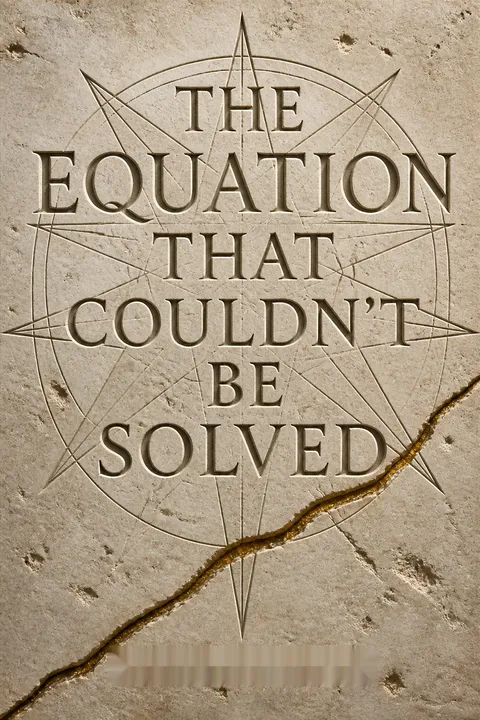
The Equation That Couldn't Be Solved receives mostly positive reviews for its exploration of symmetry, group theory, and the lives of mathematicians Abel and Galois. Readers appreciate the historical context and accessible explanations of complex mathematical concepts. Some find the book's structure disjointed, with tangential chapters on biology and music. The author's passion for the subject and thorough research are praised, particularly regarding Galois' life. While some reviewers struggle with the mathematical content, many find the book engaging and insightful, offering a unique perspective on the development of algebraic theory.
People Also Read





Glossary
Symmetry
invariance under transformationIn the book’s mathematical sense, symmetry means that an object, system, or law remains unchanged under a specified transformation. Examples include reflecting a butterfly, rotating a snowflake, or translating a repeating pattern. The relevant transformation must be stated: a system can be symmetric under one operation and not another.
Group theory
mathematics of structured operationsGroup theory studies sets of elements combined by an operation according to four rules: closure, associativity, an identity element, and inverses. The elements may be numbers, permutations, or symmetry transformations. Because the same rules occur across different subjects, group theory can identify shared structures in problems that otherwise appear unrelated.
Galois group
root-permutation structureThe Galois group of an equation is a group of permutations of its roots that preserves specified relationships among those roots. Galois showed that the group’s structure determines whether the equation can be solved using arithmetic operations and extraction of roots. It lets mathematicians study an equation’s solvability without first calculating every root.
Solvable by radicals
solvable using roots and arithmeticAn equation is solvable by radicals if its solutions can be expressed using its coefficients, the arithmetic operations, and repeated extraction of roots. The general quadratic, cubic, and quartic equations have such formulas. Abel and Galois showed that the general quintic does not, although particular quintic equations can still have radical solutions.
Pragnanz
preference for simple organizationA Gestalt psychology term for the tendency to perceive the simplest, most stable organization available among possible interpretations of a visual pattern. Symmetry can contribute to this perceived simplicity. The principle describes a useful tendency in perception, not an infallible rule that determines how every person will see every figure.
Noether's theorem
symmetry yields conservation lawsEmmy Noether’s theorem connects continuous symmetries of physical laws with conserved quantities. In the examples discussed in the book, invariance under shifts in time corresponds to conservation of energy, invariance under spatial translations to conservation of momentum, and rotational invariance to conservation of angular momentum.
Gauge symmetry
local freedom in physical descriptionGauge symmetry is an invariance of a physical theory under certain transformations that can vary across space or time without changing its observable predictions. In the theories described in the book, these symmetries constrain the interactions and require force-carrier fields, including the photon, the W and Z particles, and gluons.
Erlangen program
geometry defined by transformationsFelix Klein’s proposal that a geometry can be characterized by the group of transformations that preserves its relevant properties. Euclidean geometry, for example, studies properties preserved by rigid motions. The approach unified many different geometries by focusing on their transformation groups rather than treating each geometry as an isolated subject.
Supersymmetry
symmetry linking matter and force particlesA proposed symmetry relating particles of half-integer spin, such as electrons and quarks, to particles of integer spin, such as photons and gluons. Supersymmetric theories predict an additional partner particle for each known particle. The book presents supersymmetry as an unconfirmed feature of certain versions of string theory.
Fluctuating asymmetry
small departures from bilateral symmetryMinor, random differences between corresponding left and right features of an organism, such as the two sides of a face or body. The book discusses fluctuating asymmetry as a possible indicator of developmental stability and genetic condition, and as one proposed cue in animal and human mate selection.
FAQ
1. What is The Equation That Couldn't Be Solved by Mario Livio about?
- Exploration of symmetry: The book investigates the concept of symmetry, its mathematical language, and its influence across art, science, and nature.
- Historical narrative: It traces the quest to solve polynomial equations, focusing on the lives and discoveries of mathematicians like Evariste Galois and Niels Henrik Abel.
- Human side of mathematics: Livio highlights the personal struggles, passions, and tragedies of mathematical geniuses, making abstract concepts relatable.
- Impact on modern science: The narrative connects the development of group theory to foundational advances in physics, biology, and the arts.
2. Why should I read The Equation That Couldn't Be Solved by Mario Livio?
- Interdisciplinary insight: The book reveals how symmetry links diverse fields such as mathematics, art, music, and physics, enriching your understanding of the world.
- Compelling biographies: It humanizes mathematical geniuses, offering inspiring stories of creativity, adversity, and perseverance.
- Accessible mathematics: Livio makes complex ideas like group theory and Galois theory understandable for non-specialists.
- Foundations of modern thought: Readers gain appreciation for the origins of group theory and its profound impact on science and culture.
3. What are the key takeaways from The Equation That Couldn't Be Solved by Mario Livio?
- Symmetry’s universality: Symmetry is a fundamental principle underlying beauty, perception, and the laws of nature.
- Birth of group theory: The quest to solve the quintic equation led to the creation of group theory, revolutionizing mathematics.
- Human element in discovery: The book emphasizes the emotional and social challenges faced by geniuses like Galois and Abel.
- Symmetry’s role in science: Group theory and symmetry are central to modern physics, biology, and even music and art.
4. What is symmetry according to The Equation That Couldn't Be Solved by Mario Livio?
- Ancient and modern definitions: Symmetry originally meant "the same measure" and now refers to "immunity to a possible change," where an object remains unchanged after a transformation.
- Types of symmetry: The book discusses mirror, rotational, translational, glide reflection, and screw symmetries, with examples from nature and art.
- Perception and aesthetics: Symmetry is crucial in how humans perceive beauty and organize visual information, influencing art, music, and even mate selection.
5. How does The Equation That Couldn't Be Solved by Mario Livio explain group theory and its importance?
- Language of symmetry: Group theory is introduced as the mathematical framework for describing and analyzing symmetries.
- Definition and properties: A group is a set with an operation satisfying closure, associativity, identity, and invertibility, allowing for the study of symmetry in various contexts.
- Applications: Group theory explains the structure of algebraic equations, physical laws, and even musical scales, unifying diverse phenomena under a single concept.
- Foundation for modern science: The development of group theory paved the way for advances in physics, chemistry, and other sciences.
6. What is Galois theory, and how does The Equation That Couldn't Be Solved by Mario Livio describe it?
- Linking equations and symmetry: Galois theory connects polynomial equations to groups (Galois groups) that encode the symmetries of their solutions.
- Solvability criterion: The structure of the Galois group determines whether an equation can be solved by radicals, providing a definitive answer to the solvability problem.
- Revolution in algebra: Galois theory shifted the focus from finding formulas to understanding the underlying symmetry, marking the birth of abstract algebra.
- Impact on mathematics: This theory is now central to algebra and has influenced many other fields.
7. Who were Evariste Galois and Niels Henrik Abel, and why are they important in The Equation That Couldn't Be Solved by Mario Livio?
- Abel’s achievements: Abel proved the general quintic equation cannot be solved by radicals, laying the groundwork for modern algebra despite dying young and in poverty.
- Galois’s contributions: Galois invented group theory and Galois theory, linking the solvability of equations to the symmetry of their solutions.
- Tragic lives: Both mathematicians died young under tragic circumstances, with their work initially ignored or misunderstood.
- Legacy: Their discoveries fundamentally changed mathematics and are central to the book’s narrative.
8. How does The Equation That Couldn't Be Solved by Mario Livio connect symmetry and group theory to the laws of nature?
- Symmetry in physics: The book explains that physical laws are invariant under transformations like translations and rotations, a principle central to modern physics.
- Gauge symmetries: It discusses how gauge symmetries in particle physics give rise to fundamental forces and dictate the existence of force-carrying particles.
- From relativity to quantum theory: The narrative shows how group theory underpins Einstein’s relativity and the standard model of particle physics.
- Unifying principle: Symmetry serves as a unifying concept across the sciences, revealing deep connections between mathematics and the universe.
9. What role does symmetry play in human perception, evolutionary psychology, and aesthetics according to The Equation That Couldn't Be Solved by Mario Livio?
- Perceptual organization: Symmetry helps the brain group elements into coherent figures, aiding in object recognition and background separation.
- Evolutionary cues: Bilateral symmetry is a key visual cue for detecting living beings and is linked to survival and mate selection.
- Aesthetic preference: Humans generally prefer symmetrical patterns, associating them with beauty, health, and genetic fitness.
- Neuroscientific evidence: Brain imaging studies show specialized regions respond to symmetry, highlighting its fundamental role in perception.
10. How does The Equation That Couldn't Be Solved by Mario Livio relate group theory to music and art?
- Musical structure: The twelve semitones in an octave form a group under addition modulo 12, explaining musical intervals and harmony.
- Compositional techniques: Concepts like inversion, retrograde, and transposition in music correspond to group operations, especially in twelve-tone serialism.
- Artistic patterns: Group theory provides a language to describe symmetries in visual art, revealing underlying order and structure.
- Broader implications: The book shows how mathematical ideas shape creative expression across disciplines.
11. What is the significance of the classification of finite simple groups in The Equation That Couldn't Be Solved by Mario Livio?
- Building blocks of groups: Finite simple groups are the "prime numbers" of group theory, from which all finite groups are constructed.
- Sporadic groups and the monster: The book highlights the discovery of 26 exceptional sporadic groups, including the massive "monster" group.
- Mathematical achievement: The classification theorem was a monumental collaborative effort, connecting group theory to other areas of mathematics and physics.
- Legacy: This achievement represents a pinnacle in the understanding of symmetry and mathematical structure.
12. What insights does The Equation That Couldn't Be Solved by Mario Livio provide about creativity, genius, and the minds of mathematicians like Galois and Einstein?
- Creativity beyond intelligence: The book argues that creativity involves traits like tolerance for ambiguity, complexity, and independence, not just high IQ.
- Early achievement: Galois, like many mathematicians, made his greatest contributions at a young age, displaying a complex and sometimes troubled personality.
- Genius and mental health: The narrative explores the link between creativity and mental disorders, noting that many geniuses, including Galois, exhibited such traits.
- Scientific curiosity: Studies of Galois’s and Einstein’s brains reflect the enduring fascination with the origins of genius, though no anatomical "smoking gun" was found.
About the Author


Download PDF
Download EPUB
.epub digital book format is ideal for reading ebooks on phones, tablets, and e-readers.








