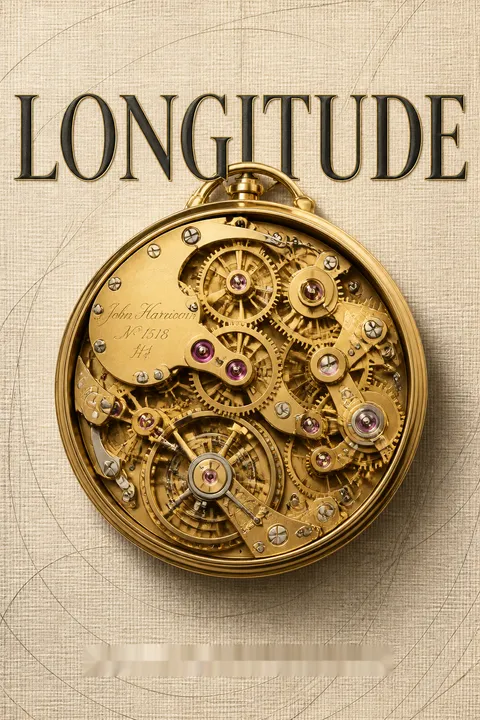


Key Takeaways
Longitude became solvable when sailors could carry home-port time.
Time measures distance. Latitude can be estimated from the sun or stars because its zero line, the Equator, is fixed by nature. Longitude has no natural starting line: mapmakers and governments could choose any meridian as zero. To locate a ship east or west, a navigator needed local time and the time at a known place at the same moment. Earth rotates 360 degrees in 24 hours, so one hour of time difference equals 15 degrees of longitude, and four minutes equals one degree.
A clock at sea. This simple relationship turned an abstract coordinate into a practical measurement. But the clock carrying home-port time had to remain accurate through storms, temperature changes, and a long voyage. For centuries, that requirement defeated the best minds and instruments available.
The key conceptual move is to treat longitude as a comparison between clocks, not as a property visible in the landscape. That shift transforms a geographic puzzle into an engineering problem: preserve a reference signal while moving through an unstable environment. It also reveals why a small timing error mattered so much. A clock can seem impressively precise in isolation yet still misplace a ship by many miles. The distinction between latitude's natural anchor and longitude's chosen reference also shows that measurement systems combine physical facts with human conventions.
Treat navigation errors as human costs, not merely technical inconveniences.
The sea punished uncertainty. Before a dependable longitude method, sailors estimated their east-west position by dead reckoning: tracking speed, direction, and time, then adjusting for currents and wind. Each estimate compounded uncertainty. On October 22, 1707, four British warships ran aground near the Scilly Isles after their position was misjudged; nearly 2,000 men died. In George Anson's Pacific voyage, currents and mistaken longitude prolonged the search for Juan Fernandez Island. Scurvy killed more than half the original crew before the ship reached safety.
Desperation invited absurdity. One proposal imagined a dog wounded before departure, with its bandage treated ashore at noon by a supposed healing powder. The dog would yelp at sea, supposedly signaling London noon. The scheme captures the era's urgent need for a reliable signal, and the thin line between ingenuity and desperation.
These episodes make a technical failure legible as a chain of human consequences: missed landfalls, longer voyages, depleted crews, and lost lives. They also show that navigation was never only a matter of better instruments. Weather, currents, provisioning, and command decisions shaped whether a position estimate could be trusted. The dog proposal is funny because it is grotesque, but its logic is serious: a navigator needed a dependable time cue that crossed distance. Its failure underscores how a clever idea must be tested against the actual conditions of use.
Use the sky as a clock, but account for the observer's limits.
The heavens offered alternatives. Galileo proposed using the regular eclipses of Jupiter's moons as a clock. The method helped surveyors on land, but a telescope's view was too unstable aboard a moving ship, and the satellites were not always visible. Another approach, the lunar distance method, compared the moon's position against the sun or stars with tables predicting those positions at a reference meridian.
Precision required a whole system. A reflecting instrument called Hadley's quadrant, later developed into the sextant, let navigators measure angles between celestial bodies. Tobias Mayer produced improved lunar tables with mathematical help from Leonhard Euler. Even then, observers had to account for refraction and parallax, make several measurements, and perform lengthy calculations. The Nautical Almanac eventually reduced the work from about four hours to roughly half an hour.
The astronomical approach demonstrates that scientific knowledge becomes useful through coordination among theory, instruments, tables, and trained observers. A correct prediction of the moon's position is not enough if a sailor cannot measure it accurately from a rolling deck. Nor does a good measurement help without tables that translate angles into location. This is a powerful systems lesson, not simply a contest between astronomy and clocks. The lunar method remained valuable, but its dependence on clear skies and skilled calculation made it less convenient than a self-contained timekeeper.
Design for the ship's motion and climate, not an ideal workshop.
Land clocks failed at sea. Pendulum clocks could keep excellent time on solid ground, but a ship's pitching and rolling disrupted their swing. Temperature changes also altered metal parts and lubricating oil, changing a clock's rate. Pressure and variations in gravity added further complications. Christiaan Huygens tested pendulum clocks at sea and tried a balance spring instead, but neither approach yielded a dependable marine timekeeper. Even Isaac Newton doubted that a clock could meet the task.
Conditions were part of the problem. A useful instrument had to preserve its rate while moving, warming, cooling, and enduring damp air. Harrison's achievement was not simply to make a clock more precise under favorable conditions. He rethought the mechanism around the disturbances that made ordinary precision useless aboard a vessel.
The story distinguishes laboratory accuracy from operational reliability. A device can perform beautifully in a stable room and fail precisely where it is needed. Harrison's challenge resembles modern engineering problems in which vibration, heat, or moisture cannot be treated as afterthoughts. The environment belongs inside the design brief. At the same time, no instrument can neutralize every source of error; navigation still depended on observation, upkeep, and sound judgment. The achievement lies in reducing the system's vulnerability enough to make dependable use possible.
Turn limited materials into design advantages, as Harrison did with wood.
A carpenter learned mechanics. John Harrison had no formal watchmaking apprenticeship. As a young man, he copied and annotated lectures on mechanics, then built wooden clocks using the skills he had learned from his carpenter father. In his Brocklesby Park tower clock, he avoided oil by using naturally oily lignum vitae for bearings and designed wooden gears for strength. He later developed the grasshopper escapement, which reduced friction, and a gridiron pendulum combining brass and steel so temperature changes would counterbalance one another.
Test, observe, revise. Harrison and his brother compared their precision clocks against the nightly motion of stars. The clocks reportedly varied by no more than a second in a month. These experiments prepared Harrison to attempt a sea clock, even though the pendulum itself would have to be abandoned aboard ship.
Harrison's ingenuity grows from close attention to material behavior. Wood is not merely a cheaper substitute for metal in this account; carefully chosen, it offers strength, low friction, and resistance to corrosion. His work also shows the value of prototypes that reveal principles before the final application. The land clocks did not solve longitude, but they let him study friction, temperature, and precision. The story should not become a myth of solitary genius: his brother, patrons, skilled makers, and later testers all helped turn ideas into working instruments.
Trust a breakthrough only after it survives a voyage.
A sea clock earned its name at sea. Harrison's first marine timekeeper, H-1, reached Lisbon in 1736. On the return journey, it corrected the ship's estimated position by about 60 miles. He then built H-2 and spent 19 years on H-3, but neither became the answer. His decisive design, H-4, was a three-pound watch rather than a large clock, completed in 1759.
The trial made the case. On its 1761-62 voyage to Jamaica, H-4 helped identify the ship's position when the navigator's estimate differed substantially. After the voyage, calculations showed it had kept time closely enough to locate the destination within about ten nautical miles. A second voyage to Barbados confirmed its promise. Harrison's instrument had passed the test that mattered: keeping its reference time across a real ocean crossing.
The voyages supply more than a dramatic proof scene. They test a device amid a network of practical risks, from wet decks to uncertain landfalls and disputes over the correct local time. That makes field trials epistemically powerful: they expose interactions that isolated experiments may miss. Yet a successful voyage does not by itself establish repeatability or affordability. The Board of Longitude was justified in asking whether the result could be reproduced, even as the way it imposed that demand became contentious. Validation and fairness are separate questions.
Let scrutiny test inventions without letting institutions move the goalposts.
A prize created pressure. After the Scilly Isles disaster, Parliament's 1714 Longitude Act offered up to £20,000 for a practical method. The Board of Longitude could fund experiments and judge proposals. Harrison's successful trials did not end the contest. Commissioners demanded further explanations, disclosure of H-4's mechanism, and duplicate watches. After handing over the watch, Harrison saw it tested at Greenwich by Nevil Maskelyne, an advocate of the rival lunar method. Maskelyne judged it unreliable, despite its earlier sea performance.
The king intervened. George III arranged a separate test of Harrison's H-5, which performed accurately. In 1773, Parliament granted Harrison £8,750, but as a special payment rather than the full prize. The book presents a clash between legitimate demands for proof and procedures that repeatedly shifted around an inventor who had already met the original test.
This dispute is not a simple morality play in which one side represents science and the other stubbornness. Requiring replication protects the public from mistaking luck for a dependable method. But credibility suffers when standards change after a result, especially when judges have commitments to competing approaches. The episode anticipates a persistent governance problem: institutions must be skeptical enough to prevent premature adoption, yet consistent enough that innovators can know what counts as success. Harrison's isolation sharpened the conflict, but the underlying issue was structural.
An invention changes navigation when others can build and use it.
A brilliant watch was not enough. Harrison's H-4 was costly and difficult to reproduce. Larcum Kendall made a copy, K-1, which guided Captain James Cook during his second voyage. Cook praised its help, while lunar observations could still check its performance. Other makers, especially John Arnold and Thomas Earnshaw, simplified chronometer construction and produced instruments in greater numbers and at lower cost. By 1815, the world's supply had grown from one marine timekeeper to roughly 5,000.
A shared reference followed. The Nautical Almanac's use of Greenwich observations made that meridian a common reference well before it was formally adopted as the world's prime meridian in 1884. Today, satellite navigation measures position through precise timing signals. The technology has changed radically, but the underlying insight remains: location can be recovered by comparing time against a dependable reference.
The ending broadens the meaning of invention. Harrison made a decisive instrument, but navigation changed through copying, simplification, manufacturing, training, and shared standards. A solution that only one maker can produce is a technical triumph with limited reach. The movement from an individual watch to a widely used chronometer fleet is therefore as important as the original breakthrough. The later GPS comparison is illuminating, though it should not imply that modern positioning is merely a clock in a box. Its scale depends on a distributed network of clocks and signals.
Analysis
Longitude is a story about making an invisible quantity actionable. Latitude had a natural reference in the Equator; longitude required a chosen meridian and a clock that could preserve another place's time while a ship crossed the ocean. The problem therefore joined astronomy, mechanics, mathematics, politics, and the ordinary hazards of life at sea. Its solution was not a sudden flash of insight but a long sequence of partial advances, failed trials, and institutional arguments.
The narrative's strongest tension is between two ways of making knowledge dependable. Astronomers sought a public method grounded in celestial observations and shared tables. Harrison built a portable instrument that encoded the calculation in its mechanism. The first demanded trained observers, clear skies, and extensive computation. The second promised simplicity in use, but raised questions about cost, replication, and the trustworthiness of a single machine. Neither approach was merely an idea. Each required instruments, standards, training, and a route from proof to ordinary practice.
Harrison's craft is memorable because it begins with materials and constraints. His wooden clocks, low-friction mechanisms, and temperature compensation show how close observation can turn apparent limitations into engineering choices. Yet the heroic title risks making the outcome seem more solitary than the account allows. His brother helped build clocks; George Graham offered expertise and financial support; other makers reproduced and improved the design; sailors and astronomers tested competing methods. The breakthrough belonged to a wider community, even when the inventor bore the most conspicuous burden.
The conflict with the Board of Longitude exposes a lasting dilemma in public innovation. Verification is essential when a device could affect lives and national commerce. But testing becomes suspect when requirements shift, evaluators favor a rival approach, or success is recognized only reluctantly. The eventual victory was therefore both technical and institutional. Harrison made reliable time portable, while successors made the chronometer reproducible and affordable. Longitude became solvable not when one clock existed, but when a society could trust, manufacture, and use the method.
Review Summary
Longitude is praised as an engaging and accessible account of John Harrison's quest to solve the longitude problem in the 18th century. Readers appreciate Sobel's ability to make complex scientific concepts understandable, though some find the technical details lacking. The book is commended for its portrayal of Harrison's perseverance against political and scientific obstacles. While most reviewers find it captivating, a few criticize it for being dry or overly dramatized. Overall, it's considered a compelling blend of history, science, and human achievement.
People Also Read





Glossary
dead reckoning
Estimated position by movementA way to estimate a vessel's position by tracking its direction, speed, and time underway from a known point. Sailors adjusted the estimate for currents and winds, but those forces and errors in observation accumulated. Before reliable longitude methods, dead reckoning often left ships badly misplaced relative to their destinations.
lunar distance method
Longitude from the moonA method of finding longitude by measuring the moon's angular distance from the sun or selected stars, then comparing the observation with tables calculated for a reference meridian. The difference in time gives the ship's east-west position. It required precision instruments, astronomical tables, corrections for refraction and parallax, and substantial calculation.
Board of Longitude
Panel judging longitude solutionsThe British body created under the Longitude Act of 1714 to assess proposed ways of finding longitude at sea, fund promising experiments, and administer rewards. Its members included scientists, naval officers, and government officials. The Board supported competing approaches and became central to the dispute over John Harrison's sea clocks and prize money.
grasshopper escapement
Low-friction clock mechanismA clock escapement developed by John Harrison to control the release of a clock's power with very little friction. Its linked components move in a kicking action compared in the book to a grasshopper's hind legs. By reducing friction and wear, it helped Harrison build clocks that kept unusually steady time without frequent lubrication.
gridiron pendulum
Temperature-compensated pendulumA pendulum made from alternating rods of brass and steel, metals that expand and contract at different rates. Harrison arranged the rods so that one metal's movement counteracted the other's, helping keep the pendulum's effective length stable as temperature changed. A stable length meant a more consistent rate for the clock.
Nautical Almanac
Published celestial navigation tablesA yearly publication of astronomical predictions and related information prepared for navigation. Under Nevil Maskelyne's direction, it included lunar distances calculated from Greenwich and supported the lunar distance method by reducing the calculations sailors had to perform. It also helped establish Greenwich as a widely used reference meridian.
chronometer
Precision marine timekeeperA highly accurate timekeeper carried aboard ship to preserve the time at a known reference location. By comparing that time with local time, a navigator could calculate longitude. The term appeared in print in the early eighteenth century but became standard as marine timekeepers were refined, reproduced, and made more affordable.
Download PDF
Download EPUB
.epub digital book format is ideal for reading ebooks on phones, tablets, and e-readers.








