

Key Takeaways
Follow the cod, and the Atlantic world comes into focus
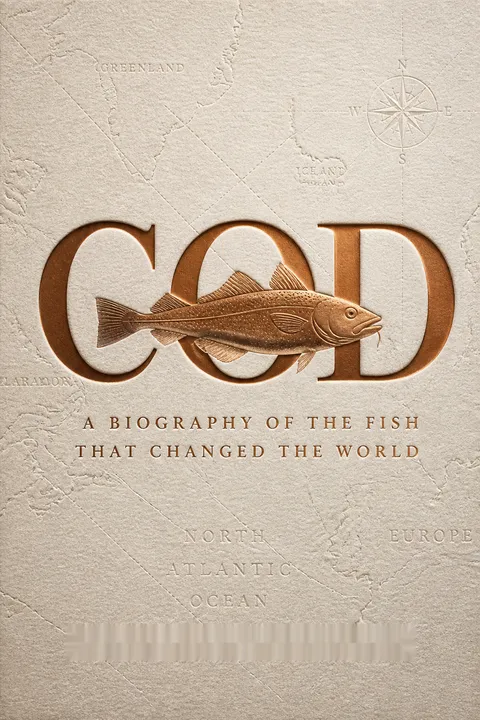
One fish, many histories. Kurlansky follows Atlantic cod from the Viking voyages to the fishing communities of Newfoundland, Iceland, New England, and Spain. A durable food helps explain how people crossed oceans, built ports, traded goods, and shaped national economies. Cod is not merely a recurring meal in this history. It is the thread connecting exploration, commerce, political conflict, and ecological loss.
The book opens in Petty Harbour, Newfoundland, where fishermen measure and tag young cod for scientists. Their catch is scant beside the thousands of pounds they once brought home. That contrast makes the story's central reversal vivid: a fish once treated as virtually limitless has become scarce enough to threaten a way of life.
What's striking is how a microhistory can reveal the infrastructure hidden inside grand historical events. Cod is food, but it is also portable calories, export revenue, and a reason to build ships and ports. This approach resembles network analysis: instead of beginning with kings or wars, it follows a commodity through the relationships it makes possible. The method is powerful precisely because it does not claim the fish explains everything. Cod provides a lens, not a single master cause, for seeing how material conditions shape human choices.
Salt made cod portable, turning a fish into an Atlantic industry
Preservation changed the map. Vikings dried cod in cold air until it became hard and light enough to carry on long voyages. Basque fishers used salt as well as drying, producing a more durable, tradable food. Because cod is lean, properly cured fish could last far longer than fatty fish such as herring. It also supplied concentrated protein to people who could not regularly buy fresh food.
The Catholic calendar helped make this trade enormous. Meat was forbidden on Fridays, during Lent, and on other religious fast days, which together covered close to half the year. Fish counted as permissible food, and salt cod met demand far beyond the fish's northern habitat. A preservation technique became a commercial system, and that system helped support voyages across the Atlantic.
Preservation is often treated as a humble kitchen skill, but here it functions like transport technology. A perishable resource becomes a commodity that can travel, be priced, and connect distant markets. The same logic appears wherever storage extends a product's reach, from grain silos to modern cold chains. The religious demand also shows how institutions can create markets without intending to: church rules helped make cod a staple. Yet durability is not the same as sustainability. Making a resource easier to move can accelerate both its usefulness and its exploitation.
Don't mistake millions of eggs for an inexhaustible fishery
Reproduction has a bottleneck. A large female cod can produce millions of eggs in a spawning, and a still larger fish can produce several million more. That impressive number does not mean the population can absorb unlimited fishing. Eggs float near the surface, where many are eaten or lost; larvae and young cod face further predators, including adult cod. The book explains that a stable population may depend on only a tiny fraction surviving to reproduce.
Cod's abundance also made it easy to underestimate its limits. It feeds on many kinds of prey, tolerates cold, and gathers in shallow waters where fishers can reach it. For centuries, these qualities looked like proof of inexhaustibility. In reality, high reproduction is a response to high early mortality, not a guarantee against a powerful predator equipped with industrial gear.
This is a useful correction to a familiar error: confusing reproductive potential with ecological resilience. Population recovery depends not only on how many offspring are produced, but on whether enough survive, find food, and reach breeding age. The distinction matters in any system where a large output hides a narrow survival bottleneck. The book's account also complicates simple ideas of nature as self-correcting. A population can rebound under favorable conditions, but that possibility does not establish how quickly, or whether, it will do so after severe depletion.
New England's cod wealth fed slavery and fueled rebellion
Commerce carried contradictions. Cod helped transform New England from a struggling settlement into a prosperous trading region. Its fishermen sold high-quality fish in Europe and a cheaper product, called West India cure, to Caribbean plantations. Salt cod supplied protein to enslaved people working sugar fields, while New England merchants also traded in molasses, rum, and, in some cases, enslaved Africans.
This commerce sharpened conflict with Britain. The Crown tried to control colonial trade through measures such as the Molasses Act, while merchants resisted restrictions that threatened their markets. The book presents the American Revolution partly as a struggle over economic self-direction, with cod and molasses among the contested goods. That account does not reduce the Revolution to fish; it shows how a celebrated language of liberty coexisted with wealth built on slavery.
The uncomfortable lesson is that a society's ideals do not automatically govern its supply chains. New England could argue for political liberty while benefiting from a plantation economy maintained by enslavement. This is a classic problem of moral distance: consumers and traders can experience a product as ordinary while its production depends on coercion elsewhere. The book usefully connects food history to political history, though its emphasis on commerce should not obscure the agency and resistance of enslaved people themselves. Economic explanation is strongest when it clarifies complicity without making it sound inevitable.
Industrial gear turned fishing into extraction at ocean scale
Efficiency changed the relationship. For centuries, handlines and sail-powered vessels limited how much cod a crew could catch. Steam engines, bottom-trawling nets, larger ships, and eventually factory ships removed many of those limits. Sonar helped locate schools; freezing allowed catches to travel farther before reaching consumers. Steam trawlers could report catches more than six times those of sailing vessels, and the postwar factory ships could fish and process around the clock.
Bottom trawling also dragged heavy gear across the seabed, capturing fish beyond the target species. Fish with low market value, undersized fish, or fish over quota could be discarded, often dead. Lost gillnets could continue catching for years. Each invention answered a business problem, such as speed or freshness, while increasing the industry's capacity to remove fish faster than stocks could replace them.
The history illustrates technological lock-in: once investment, jobs, and markets depend on a powerful system, its capacity tends to be treated as an asset that must stay busy. Catching more fish can look like progress in the short term, even as it undermines the resource that makes the equipment valuable. This is not an argument that technology is inherently destructive. It is an argument that efficiency needs rules matched to ecological limits. Without those rules, better tools can magnify a mistaken assumption rather than correct it.
Iceland won fishing sovereignty by forcing limits onto foreign fleets
Control became a national question. After Iceland became independent, it expanded the area where foreign fishing was restricted, from four miles offshore to twelve, then fifty, and finally 200 miles. Britain challenged these claims in the conflicts known as the Cod Wars. Iceland's small Coast Guard faced a far larger British fleet, but used tactics including a device that cut trawl cables. The confrontations produced collisions and serious tension, but no deaths.
The outcome mattered beyond Iceland. Once Iceland established its 200-mile zone, other nations followed, and most of the world's major fishing grounds fell within the jurisdiction of a coastal state. Excluding foreign fleets made regulation more feasible, but it did not guarantee recovery. Iceland still had to limit its own fleet and set catch rules as its stocks came under pressure.
The Cod Wars show how environmental governance depends on political power as well as biological knowledge. A state cannot regulate a resource effectively if it lacks authority over the fleets exploiting it. Iceland's claim helped shift the sea from a largely open-access arena toward national jurisdiction. But sovereignty is only an enabling condition, not a conservation policy by itself. Once outside competitors are excluded, domestic interests can still press for excessive catches. The distinction between who controls a fishery and how it is managed is essential.
Take local warnings seriously before rising catches mislead you
More fish landed can mean less fish left. In Newfoundland, inshore fishers warned that offshore trawlers were taking cod before the fish could move toward shore to spawn. Government scientists and officials gave greater weight to rising catches and predictions of abundance. Yet increasingly powerful trawlers could locate the remaining concentrations and remove them efficiently, making landings look healthy even as the wider stock weakened.
In 1992, Canada closed the northern cod fishery, putting about 30,000 people out of work. The closure came after years of warnings from local fishers, who had seen smaller, younger catches. The Sentinel Fishery later paired fishers with scientists to measure and tag cod. In Petty Harbour, the fish were mostly too young to reproduce. Their observations did not replace scientific measurement; they supplied evidence that official assessments had failed to heed.
The episode is a lesson in how institutions handle conflicting evidence. Local knowledge can be rich in repeated observation, while formal science can compare populations across places and time. Treating these as rivals is wasteful. The more productive question is how to test each source and combine them before decisions become irreversible. Rising landings are especially treacherous as a signal because improved effort can conceal declining abundance. The book's point is not that fishers are always right, but that ignoring them removes an important early-warning system.
A closed fishery cannot command nature to restore the old ecosystem
Recovery has no guaranteed timetable. Cod populations can rebound under favorable conditions. The book describes Norway restricting its fishery while its cod stocks were still commercially viable; after several productive years, the population recovered. Newfoundland's northern stock was in a more depleted condition when fishing stopped, and scientists could not predict how many fish, or how much time, recovery would require.
Nor is cod's return a matter of replacing one missing number. Cod eat other fish, while other species eat cod eggs and young. After the Newfoundland collapse, arctic cod, shrimp, and snow crab appeared farther south; rays, skates, and dogfish were also potential competitors. Farmed fish could help production but might weaken wild genetic diversity if escaped fish bred with wild stocks. A fishery closure creates room for recovery, not a promise of the past.
This section offers a more demanding idea of restoration than simply waiting for a population count to rise. Ecosystems contain feedbacks, competitors, and changing conditions, so returning one species to a former level may not recreate the former system. That is a reason for humility, not fatalism. Precaution is valuable precisely because ecological change can be difficult to reverse and hard to predict. The contrast between Norway and Newfoundland also warns against treating one successful recovery as a universal template. Timing, remaining breeding adults, and local ecology all matter.
Fishery rules can protect stocks while dismantling fishing communities
Conservation has human costs. When cod disappeared, the damage reached beyond boat owners. Processing plants closed, local skills lost their market, and fishing towns struggled to replace work tied to the sea. Gloucester had about 400 working fishers in the mid-1990s, down from around 2,000 forty years earlier. In Newfoundland, the government was spending three dollars on fisheries for every dollar they earned, while many fishers depended on public assistance during the moratorium.
The book also shows why simply reopening a fishery is not a full solution. If stocks are too low, a new opening can restart the cycle of depletion. If restrictions are too strict or unevenly applied, small communities may bear the burden while larger companies or distant markets remain insulated. Policy has to address both the biological resource and the transition for people whose knowledge and livelihoods depend on it.
This is where environmental policy becomes a question of distribution, not only aggregate benefit. A fishery can be ecologically protected while its costs fall most heavily on people with few alternatives. That does not justify fishing a depleted stock, but it does make transition support part of conservation rather than an optional add-on. The book's fishermen are not merely economic units; they hold practical knowledge and cultural identity. A policy that removes them without preserving their role in monitoring the sea may save fish while weakening future stewardship.
Read cod recipes as records of trade, scarcity, and belonging
Food preserves the routes of history. Cod appears in many forms: dried stockfish in northern Europe, salt cod in Mediterranean cooking, and shredded saltfish dishes across the Caribbean. The same preserved fish traveled through trading networks and slavery's legacy, then took on local meanings. Jamaican ackee and saltfish became a national dish; Basque cooks built elaborate preparations around prized cuts; New England cooks turned scraps into chowder and fish balls.
Traditional cooks used far more than fillets. Heads, cheeks, tongues, roe, stomachs, skin, and bones all had uses. This economy of the whole fish reflected both thrift and culinary knowledge. Kurlansky's recipes are not decorative extras. They show how preservation, migration, poverty, and regional taste shaped what people ate, and how a food can remain culturally important after it stops being cheap.
Recipes can function as a kind of social archive. Ingredients and techniques record what was available, what was costly, and how communities adapted imported foods to local tastes. The cod's many edible parts also challenge the modern habit of treating a fillet as the whole animal. At the same time, culinary survival does not mean a tradition is unchanged: a dish may retain its name even as its ingredients become expensive or its source shifts overseas. Foodways preserve memory, but they also register economic change.
Analysis
Cod's biography is a history of changing constraints. First, preservation overcame distance: dried and salted fish could provision voyages and feed markets far from the North Atlantic. Then trade and religious rules expanded demand, while colonial commerce connected New England cod to Caribbean sugar and slavery. Finally, engines, nets, freezing, and sonar overcame many of the practical limits that had once slowed fishing. The central pattern is not simply abundance followed by greed. It is a series of institutions and technologies that made extraction easier, while older assumptions about nature's capacity survived evidence of decline.
The book's strongest analytical move is to put political economy beside ecology. Newfoundland's collapse was not just a biological event; it involved decisions about fleet investment, whose observations counted, and which communities benefited from expansion. Iceland's Cod Wars show that rules over access can change who has power, but the later pressure to manage Iceland's own fleet shows why jurisdiction alone cannot conserve a stock. Effective governance has to align incentives, credible measurement, and limits on total extraction.
The narrative also resists a tidy recovery story. Cod's reproductive capacity is remarkable, yet eggs and young fish face severe mortality, and the ecosystem around a depleted stock may change. That uncertainty makes prevention more rational than confidence in an eventual return. Still, ecological caution should not reduce fishing communities to villains. Fishers can be both participants in extraction and witnesses to its consequences, while governments and companies shape the scale and rules of the fishery.
The recipes complete the argument in a different register. Cod is not only a commodity or a population estimate; it is a learned taste, a family meal, and a regional identity. That human attachment explains why depletion creates grief as well as economic loss, and why conservation must preserve both a living ecosystem and a fair future for coastal communities.
Review Summary
Cod: A Biography of the Fish That Changed the World received generally positive reviews. Readers appreciated Kurlansky's engaging writing style and the book's wealth of historical information about cod's impact on economies, cultures, and politics. Many found the recipes and anecdotes interspersed throughout enjoyable. Some criticized the lack of scientific detail about cod biology and questioned certain historical claims. Overall, readers were fascinated by the unexpected significance of cod in shaping human history, though some felt the book's scope was limited to European and North American perspectives.
People Also Read


Glossary
West India cure
Low-grade Caribbean salt codA cheap, lightly valued preparation of salted cod sold to Caribbean markets, especially plantation economies. New England, Nova Scotia, and Newfoundland producers could sell fish unsuitable for more exacting Mediterranean markets this way. Its importance was not only commercial: the fish supplied protein to enslaved laborers on sugar plantations, linking the North Atlantic cod trade to slavery.
stockfish
Air-dried codCod preserved by hanging in cold air until much of its water is removed, leaving a hard, durable product. Unlike salt cod, stockfish is preserved without salting. Vikings carried it on long voyages, and Icelanders used it as a staple food. It typically has to be softened or rehydrated before cooking or eating.
Sentinel Fishery
Fishers monitoring cod stocksA Canadian program created after the 1992 moratorium to have a limited number of fishers catch, tag, measure, and report on cod in their local waters. It was intended to combine fishers' practical knowledge with scientific monitoring. In Petty Harbour, the small and young fish recorded by participants reinforced concerns that the northern stock was not ready for renewed commercial fishing.
Cod Wars
Iceland's fishing-zone conflictsA series of three confrontations between Iceland and Britain over Iceland's expansion of its exclusive fishing waters. Iceland extended its limits from four miles to twelve, then fifty, and finally 200 miles. The conflicts involved naval escorts, collisions, negotiations, and Icelandic Coast Guard tactics such as cutting trawl cables, but no one was killed.
factory ship
Vessel processing catch at seaA large fishing vessel equipped to catch, process, freeze, and store fish onboard. Factory ships combined industrial trawling with preservation, allowing fleets to fish continuously and carry large catches to distant markets. Their scale greatly increased fishing capacity and made it possible to remove fish faster than local stocks could replenish.
Northern stock
Newfoundland and Labrador codThe Atlantic cod population associated with Newfoundland, Labrador, and the Grand Banks. It was the focus of Canada's 1992 fishing moratorium after severe depletion. The fishers' observations of small, young cod and the scientists' uncertainty about recovery illustrate why this population could not be treated as interchangeable with healthier cod populations elsewhere.

Download PDF
Download EPUB
.epub digital book format is ideal for reading ebooks on phones, tablets, and e-readers.








