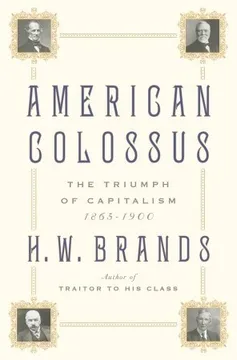


Key Takeaways
See capitalism and democracy as competing systems that need constant balancing
A rivalry at the core. Brands frames the decades after the Civil War as a capitalist revolution: markets and corporations expanded, while democracy’s promise of equal political standing collided with capitalism’s unequal rewards. The war shifted the balance. The federal government backed railroads, raised tariffs, created a national currency, and extended market relations into the former slave states.
Prosperity, unevenly shared. During the war, financier J. P. Morgan reported annual income above $50,000, while an unskilled worker might earn $200. The contrast captures the new scale of private fortunes and power. Yet the revolution also raised living standards, drew millions of immigrants, and transformed a largely rural society into an industrial one. Growth brought gains, but it did not make economic power democratically accountable.
The book’s central tension is not simply rich against poor. It is a conflict between two ways of allocating power: one person, one vote in politics, and unequal influence through money in markets. That distinction helps explain why elections can coexist with private control over jobs, transport, and credit. The tension is not inevitable in exactly the same form everywhere; laws and institutions shape how market rewards become political power. The historical contrast also needs a caveat: the democratic ideal was sharply restricted, especially for women and African Americans.
Build markets through infrastructure, then guard against the power it concentrates
Railroads changed the rules. The transcontinental railroad linked distant regions, but private investors considered construction too risky without public support. Congress offered government bonds and land grants, including ten square miles of land for each mile built. Later changes shifted more of the risk to taxpayers. The railroad companies gained the infrastructure and the valuable land around it.
New corporate powers. Railroads pioneered large administrative systems and the separation of ownership from management. Other firms adopted the model. Carnegie drove down the cost of steel; Rockefeller made Standard Oil dominant through efficiency, rebates, and purchases of competitors. Morgan used financial knowledge and boardroom influence to reorganize railroads. These firms created reliable, lower-cost goods and transport, while concentrating decisions over entire industries in very few hands.
Infrastructure is not merely a collection of useful objects. It sets the routes along which commerce, settlement, and political influence flow. Public subsidies helped create a unified market, but the resulting private companies gained leverage over workers, suppliers, and towns. This is a recurring problem in political economy: investments with broad public benefits can also create private bottlenecks. The history argues for scrutinizing the rules attached to public support, not assuming that either state involvement or private ownership alone guarantees a fair outcome.
Organize workers before a corporation makes bargaining an individual gamble
Scale changed the workplace. In earlier generations, workers sometimes expected to become independent farmers or tradesmen. Industrial corporations made that path less common. In Pennsylvania’s coal region, the Reading Railroad owned mines as well as the rails that carried their coal. Workers faced one dominant employer with the resources to withstand a strike and leave families without wages.
Strikes met force. During the six-month Long Strike of 1875, miners resisted wage cuts but ultimately returned to work on management’s terms. The nationwide Great Strike of 1877 began after railroad pay reductions and spread rapidly by telegraph. Crowds and workers fought, property burned, and federal troops intervened. Later, Carnegie’s Homestead works and the Pullman company town became further tests of labor’s power. Courts and government repeatedly strengthened employers’ position.
A corporation can coordinate thousands of workers through a hierarchy; an individual worker usually negotiates alone. Unions try to correct that imbalance by making workers a collective actor. The book shows why solidarity is difficult: workers differ by skill, ethnicity, race, and access to strike funds, while employers can draw on capital and legal authority. Violence also complicates the moral picture. It can express desperation, but it can alienate potential allies and give authorities a justification for repression.
Freedom without land or bargaining power can preserve old dependencies
Emancipation did not settle labor. General Sherman briefly set aside coastal land for freed families, but the plan collapsed as former owners regained their property and federal authorities stepped back. Southern black codes recognized some civil rights, including marriage and access to courts, while also restricting movement and requiring written proof of employment. Sharecropping, a system in which landowners supplied land and some inputs in return for a share of the crop, often left farmers in debt through crop liens and credit controlled by landowners.
Two paths to advancement. Booker T. Washington emphasized education, skilled labor, and economic independence, building Tuskegee through students’ work and outside donations. Ida B. Wells exposed lynching as a tool of racial terror and economic control. Their different strategies show how limited the options were when courts and local authorities failed to protect Black people.
Legal freedom matters, but the power to refuse a contract or leave an employer matters too. The postwar South illustrates how formal rights can coexist with economic arrangements that sharply constrain choice. Washington’s focus on skills and institutions offered practical tools within those constraints; Wells insisted that safety and equal treatment could not be postponed until after economic progress. Neither approach makes the other unnecessary. Their disagreement points to a larger lesson: opportunity requires both individual capacity and institutions that protect people from coercion.
Treat frontier wealth as an ecological and political cost, not a windfall
Expansion had victims. Railroads and settlers transformed the West into a frontier for mining, ranching, farming, and investment. The Lakota resisted the loss of hunting grounds, but after their victory at Little Bighorn in 1876, military campaigns and the destruction of their food supplies forced many onto reservations. Commercial hunters, aided by rifles and rail transport, killed buffalo on an industrial scale, destroying an essential source of food and materials for Plains communities.
Nature imposed limits. Cattle investors treated open grasslands as nearly free capital until drought and the brutal winter of 1886-87 killed herds and ruined companies. John Wesley Powell warned that much of the West lacked enough rainfall for ordinary farming. He argued for irrigation, larger pasture areas, and shared rules for water and grazing, a vision that boosters and individual land claimants largely ignored.
The western story joins political conquest to ecological overshoot. When resources appear open to everyone, each owner has an incentive to take as much as possible before someone else does. That pattern can destroy the shared resource on which every participant depends. Powell’s advice recognized that arid land demands collective management, not simply more settlement. His analysis also exposes a limit in the book’s image of capitalism as a single national force: local climate, ecology, and Indigenous economies shaped what expansion could actually accomplish.
Immigration powered industrial growth, while exclusion decided who counted as American
People followed opportunity. More than 5.3 million immigrants arrived in the 1880s, and by 1890 immigrants and their children made up nearly one-third of the population. Railroads and factories needed workers; farmers and railway companies also recruited settlers to populate western land. Immigrants brought skills, labor, and businesses, but often met low wages, prejudice, and dangerous working conditions.
Cities made the bargain visible. Chicago rebuilt rapidly after its 1871 fire, growing upward with steel-framed buildings and new transit. In New York, Jacob Riis documented crowded tenements where poor families shared cramped rooms, limited sanitation, and disease. Chinese workers helped build railroads, yet the Chinese Exclusion Act of 1882 largely halted their immigration, while anti-Chinese violence drove people from western towns. The country welcomed labor more readily than it welcomed equal membership.
Migration is both a labor-market story and a story about belonging. Employers could benefit from new workers while established workers feared wage competition; politicians could praise immigration’s contribution and still target particular groups for exclusion. The contradiction was especially stark for Chinese laborers, whose work helped build national infrastructure while law and violence restricted their rights. The book’s city scenes also resist a simple success story: urban growth created jobs and modern services, but housing and public health did not improve automatically for the people who powered it.
Demand public accountability before party machines and corporate money fuse
Private methods entered public life. New York’s Tweed ring combined bribery, vote manipulation, and public services for immigrants who needed jobs or emergency help. Its courthouse project, initially estimated at $250,000, consumed roughly $13 million. National scandals followed: Crédit Mobilier linked railroad profits to members of Congress, and the Whiskey Ring diverted tax revenue through distillers and officials in Grant’s administration.
Trust weakened, but politics endured. The scandals convinced many observers that corporate greed and political graft shared a common faith in money. Yet voters continued to participate heavily in elections, with turnout in presidential contests often near 80 percent. Writers such as Mark Twain, Henry George, and Edward Bellamy questioned whether ordinary citizens could control a system increasingly shaped by wealth. The scandals also had varied sources, from outright theft to legitimate services entangled with patronage.
Tammany’s combination of corruption and practical assistance reveals why political machines could survive public outrage. They filled gaps that formal institutions had not yet filled, especially for newcomers and poor residents. That service did not excuse theft; it helps explain the machine’s loyalty network. The episode suggests that accountability is strongest when public institutions can deliver ordinary services without requiring political allegiance. It also cautions against treating every private interest or public benefit as identical: the crucial question is who decides, who gains, and who can challenge the decision.
When crop prices collapsed, farmers turned money policy into a democratic revolt
Farm economics became political. Falling prices for corn, wheat, and cotton left farmers owing debts that grew harder to repay. Local railroad monopolies and tight credit added pressure. Farmers organized through the Grange and Farmers’ Alliances, then helped create the People’s Party. Its platform proposed government ownership of railroads, a graduated income tax, and the subtreasury plan, which would let farmers store crops in public warehouses and borrow against them in government-issued notes.
The currency fight widened. Free silver meant restoring unlimited coinage of silver and gold at a fixed ratio of 16 to 1, a policy supporters believed would expand money and raise prices. William Jennings Bryan made the cause national in 1896, but Republican Mark Hanna raised vast campaign funds from businesses and banks. Bryan lost to McKinley. The outcome showed that economic distress could mobilize voters without guaranteeing control of the political system.
Farmers correctly saw that prices, credit, and transportation were connected, even when the remedies they proposed were contested. Their coalition turned technical questions about currency into arguments about whose interests government served. This is a striking example of democratic politics making economic systems legible to ordinary voters. The danger is that a simple monetary fix can promise more than it can deliver: commodity prices depend on global supply and demand as well as national policy. Still, the movement’s importance lies partly in making distribution a public question.
A republic can deny democracy to racial minorities and colonized peoples
Rights narrowed at home. After Reconstruction, Southern states used poll taxes, literacy tests, intimidation, and other devices to remove Black voters from politics. In 1896, the Supreme Court upheld Louisiana’s segregated railroad law in Plessy v. Ferguson. Justice John Marshall Harlan dissented, warning that a rule presented as equal separation in practice marked Black citizens as inferior.
Expansion repeated the contradiction abroad. In 1890, U.S. troops killed hundreds of Lakota men, women, and children at Wounded Knee after the Ghost Dance movement alarmed authorities. Eight years later, the United States acquired the Philippines after defeating Spain, then fought Filipino nationalists seeking independence. Critics argued that a country founded on self-government could not claim to liberate people while ruling them without consent. The same democratic ideals met different outcomes depending on whose rights were at stake.
These episodes show why majority rule alone cannot guarantee democracy. A majority may vote to exclude minorities, and a powerful state may claim benevolent motives while denying another people self-rule. Harlan’s dissent identifies a legal mechanism for challenging that danger: equal treatment must be more than symmetrical wording. The comparison between segregation, Indigenous conquest, and colonial rule should not erase their distinct histories. Their connection is narrower and more important: each tests whether democratic principles apply beyond the group that holds power.
Use government to restrain monopolies without mistaking prosperity for justice
Growth was real, and so was concentrated power. From 1870 to 1900, the population grew from 40 million to 76 million, while average income nearly doubled and life expectancy rose. Yet the 1890s showed how dependent prosperity was on fragile finance and private decisions. J. P. Morgan rescued the Treasury’s gold reserve in 1895, then helped combine Carnegie’s steel company and Rockefeller’s iron holdings into U.S. Steel, the largest corporation of its time.
Democratic restraint returned. Theodore Roosevelt’s administration challenged the Northern Securities railroad combination, and the courts ordered it dissolved. Federal action against Standard Oil followed. Under Woodrow Wilson, the Federal Reserve, the Federal Trade Commission, and new antitrust rules expanded public oversight. These reforms did not eliminate capitalism; they sought to keep private firms from becoming unaccountable governments of their own.
The closing arc is not a simple victory of democracy over capitalism. The United States kept the productivity, investment, and scale that generated broad material gains, while creating public institutions to regulate some of their abuses. That distinction matters: regulation can preserve competitive markets rather than abolish them. Yet antitrust and monetary reform cannot by themselves resolve every inequality, particularly where race and labor rights remain unevenly protected. The strongest lesson is institutional: private power needs counterweights capable of acting before crisis makes a single financier seem indispensable.
Analysis
American Colossus is a national history organized around a productive tension: markets can enlarge ordinary life while allowing private wealth to outrun democratic control. Its wide cast of financiers, workers, immigrants, politicians, Indigenous leaders, and reformers makes that tension concrete. Morgan represents the special authority of financial knowledge; Rockefeller and Carnegie show how cost control and consolidation could remake whole industries; farmers and workers reveal who bore the risks when those systems failed.
The book’s strongest explanatory move is to connect regions often treated separately. Railroads did more than link East and West. They made the South investable, brought immigrants to industrial cities, opened western land to commercial use, and gave national firms leverage over local economies. The same infrastructure that lowered transport costs could deepen monopolies, displace Indigenous communities, and expose farmers to distant price shocks. The narrative therefore treats capitalism less as a collection of rich biographies than as a system built through law, technology, labor, and public spending.
The organizing contrast between capitalism and democracy is powerful, but it can make both appear more unified than they were. Business interests disagreed over policy, and democracy was never equally available to women, Black Americans, or Indigenous peoples. Nor does increased income establish that benefits were fairly distributed. The book’s own stories complicate any easy equation of growth with progress: the buffalo economy collapsed, cities concentrated both wealth and disease, and the labor market relied on coercion as well as opportunity.
The final reform movements suggest that the conflict did not end with the rise of trusts. Democratic institutions adapted, sometimes by regulating markets rather than rejecting them. The lasting question is not whether the economy should be large, but whether citizens can hold powerful firms and the state accountable at the same time.
Review Summary
Reviews of American Colossus are generally positive, averaging 3.9/5. Readers appreciate Brands' engaging narrative style and broad coverage of the Gilded Age, praising his balanced portrayal of capitalism's tension with democracy. The book's wide scope—covering robber barons, labor strikes, Native Americans, Reconstruction, and westward expansion—draws both admiration and criticism. Some find it episodic and lacking analytical depth, while others value its accessibility. Common critiques include weak economic analysis and an underdeveloped thesis, though most agree it offers an informative and readable overview of a transformative American era.
People Also Read


Glossary
capitalist revolution
Postwar market transformationBrands’s term for the sweeping changes in American economic and social life after the Civil War. Railroads, finance, industry, and national markets expanded rapidly, with government support. The transformation raised living standards and drew millions of immigrants, while concentrating economic power and intensifying conflict over labor, race, land, and democracy.
sharecropping
Crop-sharing farm laborA post-emancipation farming arrangement in which a landowner supplied land and often seed or tools, while a tenant supplied labor and received an agreed share of the harvest. Crop-lien laws, debt, and landowner-controlled credit often left workers with little income and limited freedom to leave.
New South
Industrializing postwar SouthA label for the South’s post-Civil War integration into national markets through railroads, cotton, mining, steel, lumber, and textiles. The region became more industrial and commercially connected, but remained poorer than the rest of the country. Economic modernization did not end racial subordination or unequal labor conditions.
Jim Crow
Racial segregation systemThe system of laws and practices that separated Black and white people and restricted African Americans’ rights, especially in the South. The book traces its development from railroad segregation laws to the Supreme Court’s 1896 Plessy v. Ferguson decision, which upheld separate accommodations despite their unequal effects.
Ghost Dance
Indigenous renewal movementA religious movement that spread among Indigenous peoples in the late nineteenth century after the Paiute spiritual leader Wovoka described a vision of renewal. Some Sioux believed the movement promised the restoration of the dead and the buffalo. U.S. authorities treated the gatherings as a threat, contributing to the violence at Wounded Knee.
subtreasury plan
Public crop-backed loansA Populist proposal to let farmers store crops in government warehouses and borrow government-issued notes against them. Farmers could avoid selling immediately after harvest, when prices were often low, and rely less on private banks. The notes would also add currency to circulation.
free silver
Unlimited silver coinageA political demand to restore unlimited U.S. coinage of silver and gold at a fixed ratio of 16 to 1, without waiting for other countries to agree. Supporters expected the larger money supply to raise prices and ease debts. Opponents feared it would weaken the dollar and disrupt international finance.
About the Author
Other books by H.W. Brands
Download PDF
Download EPUB
.epub digital book format is ideal for reading ebooks on phones, tablets, and e-readers.








