

Key Takeaways
Read archives for their silences, not only their surviving voices.
The archive is uneven. Columbus’s diary is lost. Taíno accounts survive through Ramón Pané, Guatícabanú, Bartolomé de Las Casas, and successive copies and translations. The surviving version is not a transparent transcript, while the words of most Taíno people who met Columbus vanished. Lepore treats this imbalance as part of history itself: records persist by chance and, more often, because people with power preserve them.
Origins are contested. Beginning in 1492 does not make the United States inevitable. It connects conquest, epidemics, forced labor, wealth, and later arguments over equality, liberty, and self-government. Nineteenth-century historian George Bancroft made Columbus the beginning of national history partly to make expansion look destined. Lepore restores contingency and violence to that origin story.
What's striking is that missing evidence is not merely a technical nuisance. It reflects who had the power to write, copy, collect, and preserve. Historians of archives call attention to this selection process because a record can make one group appear eloquent and another silent. The approach also requires restraint: gaps invite inference, not invention. Reading absence carefully can widen historical understanding without pretending that lost testimony can be recovered intact.
America's liberty was built beside slavery, conquest, and resistance.
Liberty had a double history. Spanish officials debated whether Native peoples owned land and could govern themselves. The Requerimiento turned a Christian origin story into a claim of Spanish authority, followed by threats against anyone who refused it. English settlers later claimed political liberty while taking Native land and building wealth through slavery. In 1619, the Virginia colony created an elected assembly; that same year, enslaved Africans arrived in the colony.
Resistance shaped the argument. Native nations fought dispossession, enslaved people escaped and rebelled, and critics such as Antonio de Montesinos and Bartolomé de Las Casas challenged conquest. The Revolution’s language of liberty emerged in this world of coercion. The Declaration’s antislavery passage was removed, and the Constitution protected slavery through political compromise rather than naming it outright.
The contradiction is not a footnote to the founding; it helped define who could claim its promises. Political theorists describe this as a boundary problem: ideals such as liberty gain meaning partly through deciding who is excluded from them. The book’s account is especially strong when it shows excluded people acting politically, not merely suffering. One caution is that the same history contains distinct systems of conquest and enslavement, whose differences matter even when both expose the limits of liberty.
Treat the Constitution as a contested bargain, not a sacred answer.
A government was made, not found. After independence, states experimented with written constitutions, elected assemblies, and different balances of power. The federal Constitution then created institutions intended to restrain both executive authority and popular majorities. Its compromises included counting enslaved people as three-fifths of a person for representation and postponing federal action against the slave trade. The document avoided the word slavery, but its arrangements protected slaveholding power.
Interpretation remained contested. The Bill of Rights limited federal power, while the courts gradually claimed authority to decide what the Constitution meant. The debates over ratification, slavery, and later federal programs show that the document did not settle political conflict. It organized the struggle. Each generation argued over whether its meaning rested in the words, the original intentions, or the principles those words were meant to serve.
Constitutional stability depends on more than reverence for a text. It also depends on institutions capable of interpreting the text legitimately, and on citizens who can contest those interpretations without treating opponents as enemies. This account usefully resists both extremes: the Constitution is neither an untouchable oracle nor a blank page. Its compromises can enable government while also entrenching injustice, so historical context helps explain a provision without automatically excusing it.
Ask who counts as the people whenever democracy claims to speak.
The electorate kept changing. Jacksonian democracy widened voting rights for white men while the federal government removed Native nations from their homelands. Expansion also enlarged slaveholding states’ political power. After the Civil War, the Fourteenth and Fifteenth Amendments established birthright citizenship, equal protection, and voting rights for Black men, but violence and legal barriers soon undermined those gains. Women still lacked the vote, and Chinese immigrants faced racial exclusion from citizenship.
The language of equality stayed contested. Dred Scott denied Black Americans citizenship; Plessy v. Ferguson later approved segregation under the doctrine of separate but equal. Meanwhile, courts interpreted the Fourteenth Amendment to protect corporations, even as Black citizens struggled to secure its protections. The recurring question is not simply whether a nation is democratic, but whose interests its rules count and whose voices they leave out.
Democracy is not just a method for counting votes. It is also a system for deciding who gets counted, who can participate, and which decisions remain open to challenge. The history here anticipates a core insight of political science: formal inclusion can coexist with practical exclusion when access to ballots, courts, education, or representation is unequal. Counting people is necessary, but the categories and rules behind the count are themselves political choices.
Measure progress by who gains, not by output alone.
Growth concealed unequal costs. Industrial machines increased production and lowered prices, but factories divided skilled work into repetitive tasks and concentrated wealth. Slavery was not an exception to this economy: plantations supplied cotton to industrial mills, while enslaved people were treated as laboring equipment. By 1848, Boston’s richest 1 percent held 37 percent of the city’s wealth, while its poorest 80 percent held only 4 percent.
Reform grew from resistance. Farmers and wage workers organized through groups such as the Grange, the Knights of Labor, and the Populist Party to challenge railroads, banks, and monopolies. Progressives pursued regulation, labor protections, and an income tax. These reforms showed that economic outcomes are shaped by law and public choices, not by technology alone. The promise of a rising standard of living could coexist with insecurity, racial exclusion, and concentrated power.
GDP and productivity measure output, not the distribution of power, risk, or leisure. A society can become richer while workers lose control over their time and families remain one illness away from destitution. This distinction is central to debates about growth today: aggregate gains do not automatically become shared gains. The figures also caution against nostalgia for a fairer past. Earlier economies were not more equal simply because they were less industrial.
Treat media as political infrastructure, not neutral delivery systems.
Each medium changed the argument. Printing multiplied claims and widened the historical record. Newspapers built party networks, while the penny press tried to reach readers beyond partisan subscribers. The telegraph accelerated news; radio let presidents speak directly to households, as Roosevelt did during the Depression. Each advance changed who could address the public and how quickly a message could spread.
Persuasion became an industry. Walter Lippmann worried that citizens asked to judge distant events could be manipulated by mass communication. Political consultants such as Campaigns, Inc. turned campaigns into sales operations, while pollsters treated public opinion as something measurable and manageable. The 1938 War of the Worlds broadcast showed how a staged news format could confuse listeners. New technology widened access, but it also increased the reach of organized persuasion.
Media are not neutral pipes. Their ownership, business model, format, and speed influence which voices are heard and what counts as evidence. Network effects can widen access, as early radio did, while concentrating attention in a small number of outlets. The book’s history also warns against a simple decline narrative: each new medium expands participation for some people and creates fresh opportunities for manipulation by others.
Use state power to protect people, then police its exceptions.
Crisis enlarged government. The New Deal created financial regulation, public works, and Social Security after the Depression exposed the limits of private relief. World War II expanded federal spending, taxation, military organization, and scientific research on a far larger scale. These changes helped defeat fascism and established institutions that supported postwar prosperity. They also made the federal government a much more powerful presence in daily life.
Protection was uneven. New Deal programs often excluded Black workers, and the war effort segregated the military. The federal government imprisoned Japanese Americans during the war, including citizens, while courts upheld restrictions justified as national defense. After 9/11, surveillance and detention again expanded under emergency powers. The same state that can secure rights can also suspend them, so claims of necessity demand scrutiny and enforceable limits.
This history makes a useful distinction between state capacity and state legitimacy. Large public institutions can deliver social insurance, infrastructure, and security, but the ability to act does not guarantee that action is fair. Emergency powers are especially prone to persistence: institutions built for a crisis can outlive it and be redirected toward other groups. Effective government therefore needs both capacity and oversight, especially when the people most affected have little political power.
Make equal citizenship the measure of every reform coalition.
Movements forced the promise into law. Black activists, lawyers, and students challenged segregation through court cases, sit-ins, boycotts, and voter registration. Brown v. Board rejected school segregation, and the Civil Rights Act and Voting Rights Act attacked legal discrimination. Women organized for property rights, suffrage, and equal treatment, while later campaigns pursued contraception, abortion rights, and protection from discrimination based on sexuality.
Coalitions also set limits. New Deal programs and wartime service often excluded Black Americans; political leaders repeatedly postponed equality when it threatened a coalition. The conservative alliance that rose in the 1970s joined opposition to abortion, the ERA, and gay rights to a broader claim that government had overreached. Reform coalitions can widen rights, but they can also trade away someone else’s equality to preserve votes.
Coalition politics is necessary in a plural society, yet coalition-building can turn rights into bargaining chips. The history of civil rights, feminism, and gay rights shows how movements learn from one another while also disagreeing over priorities and tactics. Litigation can establish a powerful rule, but implementation depends on political organization and public pressure. A durable coalition needs a principle that can survive shifts in electoral advantage: equal citizenship cannot be conditional on convenience.
Protect shared evidence from platforms that monetize political division.
The public sphere fragmented. By the 1990s, cable news and political consultants had already weakened the idea that citizens encountered a common set of facts. The Internet accelerated the change. Platforms connected people across distance but also let users inhabit separate political worlds, while algorithms and online publishers rewarded attention and outrage. The 2016 campaign showed how easily false claims, including conspiracy theories about Obama and Clinton, could travel through this system.
Disagreement became a business model. Online misinformation, Russian interference, partisan media, and the campaign’s reliance on social platforms deepened distrust in elections and institutions. This did not make technology the sole cause of polarization: party sorting, economic insecurity, racial conflict, and political strategy mattered too. But the Internet made it easier to target groups with different messages and harder to sustain a shared public argument.
A democracy needs more than access to information; it needs credible ways to test claims and encounter opposing evidence. Platform incentives often reward speed, repetition, and emotional intensity, while the labor of verification is slow and costly. That imbalance does not make online speech worthless, but it does mean that openness alone cannot guarantee a healthy public sphere. The difficult design question is how to increase accountability without handing governments or corporations the power to silence dissent.
Analysis
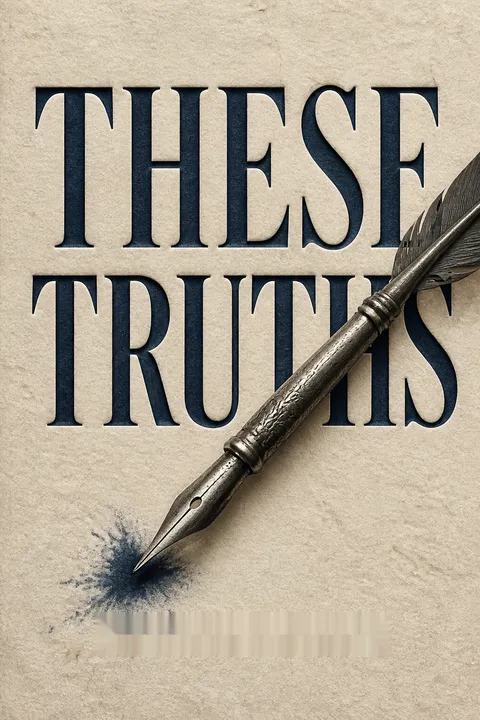
These Truths is a history of America organized around a deceptively difficult question: how can a nation founded on universal principles survive the recurring gap between its ideals and its institutions? Lepore’s answer is not a steady march toward justice. It is a contest over who belongs, what counts as evidence, and which institutions have authority to settle disputes. The story moves from Columbus’s fragmentary record to the Constitution’s compromises, from mass print and radio to polling, television, and the Internet. Across those changes, the central problem persists: political power depends partly on controlling the stories and measurements through which the public understands itself.
The strongest analytical thread is the connection between democratic inclusion and the production of knowledge. Enslaved people, Native nations, women, and racial minorities were not simply omitted from policy. They were often omitted from records, definitions of citizenship, and the public’s picture of who counted as a reasonable political actor. Later, mass media and polling promised to make public opinion visible, yet their commercial incentives and sampling choices could distort whose opinions appeared to matter. The book therefore treats truth as both a moral commitment and an institutional achievement: archives, courts, newspapers, schools, and public agencies shape what can be known and contested.
The account also resists technological determinism. Printing, radio, television, and digital platforms alter the speed and reach of political communication, but people and institutions decide how those tools are used. A platform can widen participation while rewarding manipulation; a court can protect a minority while also weakening democratic accountability. That tension is more useful than a simple story of progress or decline. One limitation of any single-volume national history is that its broad arc can make varied communities appear as evidence in a national argument. The book’s own insistence on uneven records offers a corrective: American history is not one settled story, but a continuing struggle over who gets to tell it, whose evidence is believed, and whether shared institutions can still make disagreement productive.
Review Summary
People Also Read



Glossary
historical record
surviving evidence of the pastThe historical record is the surviving evidence historians use to reconstruct the past, including documents, objects, recordings, buildings, and biological traces. It is incomplete and uneven. Some materials disappear by chance, while others survive because people or institutions chose to preserve them. Its gaps can reveal unequal power, but they must not be filled with invented testimony.
Requerimiento
Spanish claim to ruleA Spanish proclamation used during conquest of the Americas. It presented a Christian account of creation and asserted the authority of the Church, the pope, and the Spanish crown. Indigenous people were ordered to accept that authority. If they refused, Spanish forces claimed the right to wage war and enslave them. The proclamation was often delivered in a language its audience could not understand.
state of nature
life before political governmentA condition before civil government, used by political philosophers to explain where political authority comes from. John Locke described this condition as one of natural freedom and equality, and used America as an example. His account also treated cultivated land and individual property as foundations of government, a theory that could be used to justify taking Indigenous land.
three-fifths clause
enslaved people counted for representationA constitutional rule that counted three-fifths of a state’s enslaved population when allocating representation in the House and direct taxes. Enslaved people had no corresponding political rights. The arrangement increased the power of slaveholding states in Congress and the Electoral College, while allowing the Constitution to avoid explicitly naming slavery.
manifest destiny
divinely favored continental expansionA nineteenth-century belief that the United States was destined, often with divine approval, to spread across the North American continent. The idea framed territorial expansion as progress and national purpose. It obscured the violence of conquest and the removal of Native peoples, while helping political leaders justify the acquisition of land and the extension of slavery.
separate but equal
segregation defended as equalityThe legal doctrine upheld by the Supreme Court in Plessy v. Ferguson in 1896. It allowed state-mandated racial segregation on the claim that separate facilities could still be equal. In practice, segregation entrenched unequal access to public services and denied equal citizenship. The doctrine remained in force until the Court rejected school segregation in Brown v. Board.
Brandeis brief
social evidence in legal argumentAn evidence-based legal brief associated with lawyer Louis Brandeis and the 1908 case Muller v. Oregon. It used social research, public health reports, and other empirical material to argue that long working hours harmed women. The brief helped establish social science evidence as a tool in court, although its reasoning also treated women as a class needing special protection.
New Deal
federal response to the DepressionThe program of reforms, relief, and economic recovery pursued by Franklin D. Roosevelt during the Great Depression. It included financial regulation, public works, labor protections, and social insurance such as Social Security. The New Deal greatly expanded federal authority and helped reduce economic insecurity, but many programs excluded Black Americans and did not establish universal health insurance.
originalism
constitutional meaning fixed at adoptionA method of constitutional interpretation that seeks to limit judges by tying constitutional meaning to the text’s original meaning or the intentions of its framers. In the book, originalism appears as a conservative response to liberal judicial decisions and as a strategy for redirecting constitutional law. Critics argue that historical records are contested and cannot always yield one settled answer.
Great Society
Johnson-era social reform programLyndon B. Johnson’s domestic program, announced in the 1960s, that sought to reduce poverty and racial injustice while expanding federal support for education, health care, and social welfare. Its major achievements included Medicare, Medicaid, and civil rights legislation. The Vietnam War, political backlash, and growing partisan division weakened its program and its broader liberal coalition.
Download PDF
Download EPUB
.epub digital book format is ideal for reading ebooks on phones, tablets, and e-readers.








