Key Takeaways
1. The Founding's Core Contradiction: Liberty and Slavery
Taken together, these triumphal and tragic elements constitute the ingredients for an epic historical narrative that defies all moralistic categories, a story rooted in the coexistence of grandeur and failure, brilliance and blindness, grace and sin.
A paradoxical birth. The American founding, often celebrated for its triumphs in establishing a nation-sized republic based on enlightened values, simultaneously oversaw two horrific tragedies: the perpetuation of slavery and the failure to avoid Indian removal. This inherent contradiction meant that the nation's foundational commitment to human equality was deeply at odds with its social and economic realities. The narrative of the founding is thus a complex tapestry of both unprecedented achievements and profound moral failings.
Demigods and villains. Historians have often presented the founders as either demigods or despicable villains, creating complementary cartoons that obscure the nuanced truth. However, a more realistic view reveals them as pragmatic statesmen, improvising on the edge of catastrophe, trapped in contradictions. This perspective acknowledges that while they shifted Western political thought by asserting power flowed from "the people," they also invented denial mechanisms to avoid facing their own hypocrisy regarding race.
Presentism's fallacy. Judging the founders solely by modern moral standards, a "presentistic fallacy," distorts their historical context. To truly understand their actions, one must inhabit their foreign country of the past, internalizing their values and prevailing assumptions. The founders were neither perfect nor purely evil; their story is one of human complexity, where achievements on one side of the political equation often closed off options on the other.
2. The Atlantic Slave Trade: A Profitable Brutality
If all the crimes which the human race has committed from the creation down to the present day were added together in one vast aggregate…, they would scarcely equal…the amount of guilt which has been incurred by mankind in connection with this diabolical slave trade.
A systematic horror. The Atlantic Slave Trade was a four-century-long program of unspeakable brutality, systematically conducted by otherwise civilized human beings from multiple European nations, including Portugal, Spain, France, the Netherlands, Great Britain, and the United States. This enterprise flourished for one elemental reason: it was the most lucrative investment available for Europe’s merchants, bankers, and landed aristocracy, enjoying long-standing and broad-gauged acceptance.
Demographic transformation. Between 1500 and 1800, five times as many Africans as Europeans were forcibly transported to the New World, fundamentally transforming the destiny of the Western Hemisphere. Of the 12.5 million African captives embarked, 1.8 million died during the notorious Middle Passage. Only about 4% of the survivors were deposited in the future United States, yet this small percentage laid the foundation for a substantial African minority in the Northern Hemisphere.
The Great Silence. For over four centuries, the most important voices of Western civilization, from Plato to Locke and various Catholic popes, remained mute on the morality of slavery and the slave trade. This "Great Silence" indicated a profound moral blindness that made eminent economic sense. It wasn't until the mid-18th century, with the rise of Enlightenment philosophes and religious leaders like Quakers and "New Light" ministers, that a chorus of voices finally condemned slavery as a sin and a medieval anachronism.
3. Revolutionary War: Unveiling the Slavery Dilemma
Why is it that we hear the loudest yelps for liberty from the drivers of negroes?
Hypocrisy exposed. The American resistance to British imperial policy, framed in terms of "freedom against slavery," inadvertently brought the moral perspective on slavery to the center of the political arena. British critics like Samuel Johnson famously highlighted the hypocrisy of American patriots demanding liberty while owning slaves. Patrick Henry, a staunch Virginian patriot, admitted to living a "contradiction" by owning slaves despite lamenting his "want of conformity" to virtue.
Dunmore's proclamation. Lord Dunmore, Virginia's royal governor, issued a proclamation offering freedom to runaway slaves who joined the British cause, creating a powerful incentive for thousands of enslaved African Americans to flee. This act terrified the planter class, exposing slavery as the "Achilles' heel" of The Cause and demonstrating how contagious the urge for freedom was among Blacks. The British, however, were reluctant to fully embrace an antislavery policy, fearing moral backlash and logistical challenges.
Black soldiers' sacrifice. Despite initial reluctance from George Washington, free African Americans served in integrated units of the Continental Army, comprising over 10% of the force by the war's end. Meanwhile, tens of thousands of enslaved African Americans fled to British lines, seeking freedom. Many died from disease, particularly smallpox, in makeshift camps, becoming unacknowledged martyrs to their own compelling version of The Cause, giving new meaning to "give me liberty or give me death!"
4. The Constitution: A Covenant of Compromise
The only way to end slavery at the founding was to create a federal government empowered to make domestic and foreign policy for the states. The only way to assure that a Constitution possessing such powers was ratified was to keep slavery off the agenda.
A necessary evil. The Constitutional Convention, aiming to replace the weak Articles of Confederation with a strong national government, faced an intractable dilemma: any frontal assault on slavery risked alienating the southern states and destroying the fragile union. Consequently, slavery became the "Ghost at the Banquet," a taboo topic that shaped deliberations through unspoken agreements and pragmatic compromises, rather than moral debate.
Four sectional compromises. The Constitution ultimately included four key compromises regarding slavery, which future abolitionists would condemn as a "covenant with death":
- Three-fifths clause: Slaves counted as three-fifths of a person for representation, boosting southern political power.
- Northwest Ordinance: Prohibited slavery in the Northwest Territory, implicitly allowing its expansion in the Southwest.
- Slave trade extension: Allowed the slave trade to continue until 1808, ensuring a fresh supply of enslaved labor for the deep South.
- Fugitive slave clause: Required states to return escaped slaves, making even free states complicit in upholding slavery.
Ambiguity as a solution. Benjamin Franklin, in his final speech, urged delegates to accept the Constitution's imperfections, acknowledging that political perfection or moral purity was unattainable. The document was designed to blur the sovereignty issue and defer the most contested debates, including slavery, to a future political arena. This ambiguity, born of necessity, allowed the union to form, but at the cost of entrenching the "great contradiction" for generations.
5. Indian Removal: A Demographic Inevitability
If we persist in the current policy, any idea of the Indian on this side of the Mississippi will only be found in the pages of the historian.
A post-Revolutionary calamity. For the Native American population, the American victory in 1783 was an "unmitigated calamity." The Treaty of Paris, negotiated without Indian presence, transferred control of vast Indian Country from Britain to the United States, triggering a relentless wave of white migration. This demographic surge into ancestral lands proved unstoppable, making the tragic conclusion of Indian removal east of the Mississippi seem inevitable, despite the Indians' own plausible belief in their impregnable "island."
Federal intentions vs. settler reality. President George Washington, Secretary of State Thomas Jefferson, and Secretary of War Henry Knox initially sought a just Indian policy, defining tribes as "foreign nations" with legitimate rights to their soil, to be dispossessed only through "fair and bona fide purchases." Knox even envisioned Indian enclaves protected by federal law, challenging the prevailing "conquest theory" and demographic removal strategy as violations of republican principles.
Demography trumps diplomacy. Despite these enlightened federal intentions, the sheer numbers of white settlers pouring over the Appalachians overwhelmed any political effort to contain them. Washington lamented that "scarcely anything short of a Chinese wall will restrain the Land jobbers and the encroachment of settlers." The federal government lacked the institutional capacity and military force to enforce treaties against state governments and a relentless tide of migration. Indian removal became an inevitable consequence of unbridled democracy in action, where popular will for land acquisition superseded federal diplomacy and moral considerations.
6. Washington's Regrets: A Personal Struggle with Slavery
I had rather glide gently down the stream of life, leaving it to posterity to think and say what they please of me.
A singular act. George Washington's will, his final "farewell address," stipulated the emancipation of all slaves he owned outright upon his wife's death, a singular act among prominent Virginia planters. He also mandated support for young freed slaves and allowed them to reside in Virginia, challenging the prevailing policy of forced removal. This decision was the culmination of a long, tortured process, driven by a growing awareness that his legacy would be judged by his stance on slavery.
The burden of Mount Vernon. Washington struggled deeply with the moral shadow of slavery, confessing "how to get quit of Negroes" was a constant worry. His path to emancipation was blocked by:
- Family entanglement: His slaves and Martha's dower slaves had intermarried, and he vowed never to split families.
- Financial constraints: He needed to sell western lands to secure his finances, but the land market was capricious.
- Personal identity: His deep-seated identity as a Virginia slaveowner, master of Mount Vernon, made it difficult to relinquish control, as evidenced by his attempts to reclaim runaway Ona Judge.
A legacy obscured. Washington desired Mount Vernon to disappear as a centerpiece of his legacy, precisely because it highlighted his role as a slaveowner. His decision to emancipate his slaves only after his death, and Martha's, reflected his inability to fully reconcile his public ideals with his private realities. Mount Vernon now stands as a poignant tribute to a man and the enslaved workforce he described as both family and property, inherently focusing attention on the "great contradiction" he so wished to obscure.
7. Jefferson's Paradox: Ideals vs. Racial Prejudice
Nothing is more certainly written in the book of fate than that these people are to be free. Nor is it less certain that the two races, equally free, cannot live in the same government.
A bimodal mind. Thomas Jefferson, the eloquent author of the Declaration of Independence, held a deeply paradoxical view on slavery. On one hand, he ardently condemned it as a "perpetual exercise of the most boisterous passions" and trembled for his country, believing "God is just." On the other hand, he firmly believed in the biological and mental inferiority of Blacks, concluding that "Blacks are inferior to whites in the endowments of both mind and body."
Paralysis by expatriation. This bimodal thinking led to Jefferson's self-imposed paralysis: he insisted that emancipation was inevitable but could only occur if the entire freed black population was "removed beyond the reach of mixture" through "expatriation." His own calculations revealed the astronomical, logistically impossible cost of deporting millions of people, effectively making his condition for emancipation a permanent deferral. He chose to wait for history to unfold, rather than lead.
Monticello's hidden truths. The architectural façade of Monticello, with its light-skinned household slaves, many of whom were Jefferson's own children, starkly contrasted with his stated abhorrence of racial mixing. This visible contradiction, coupled with Virginia's economic and cultural decline due to slavery, highlighted the profound disconnect between Jefferson's lofty ideals and his personal actions. His death left a legacy of debt, his slaves sold, and his vision for a free, yet racially segregated, America unrealized.
8. The Closing Window: Abolition's Lost Opportunity
Whatever window of opportunity had existed to complete the most glaring piece of unfinished business in the revolutionary era was now closed.
The "Great Debate" on ratification. The ratification debates for the Constitution, though spirited, were largely state-centric, with delegates viewing the document through the lens of local interests. While a deep sectional divide over slavery existed, the primary conflict was between nationalists and confederationists. The Federalists, led by Madison, Hamilton, and Jay, skillfully navigated this landscape, ensuring ratification by emphasizing the Constitution's deliberate ambiguity on contentious issues like slavery.
Madison's "enlightened obfuscation." In the early years of the new republic, Quaker petitions to Congress to end the slave trade and abolish slavery sparked heated debates. While some northern delegates saw 1808 as a deadline for federal action, southern delegates, particularly from South Carolina and Georgia, vehemently defended slavery as essential to their economies and a condition of their joining the Union. James Madison, though personally acknowledging slavery as a "moral and political evil," employed "enlightened obfuscation" to ensure the issue was taken off the national agenda.
A permanent deferral. Through parliamentary maneuvering, Madison helped pass a House resolution declaring that Congress had "no authority to interfere in the emancipation of slaves, or in Treatment of them within any of the states." This effectively transformed the temporary deferral of the slavery question until 1808 into a permanent federal hands-off policy. The 1790 census confirmed slavery was flourishing, not dying, and the window of opportunity for national abolition was not opening, but closing, setting the stage for the bloodiest war in American history.
9. Demography Trumps Diplomacy: The Limits of Federal Power
Unless we can restrain the turbulence and disorderly conduct of our own borders, it will be in vain to expect peace with the Indians—or that they will govern their own people better than we do ours.
A new Indian policy. Washington, Knox, and Jefferson attempted to establish a new Indian policy based on treating tribes as "foreign nations" and guaranteeing their land rights through federal treaties. The Treaty of New York (1790) with the Creek Nation, led by the astute Alexander McGillivray, was meant to be a model, promising federal protection against white encroachments and encouraging agricultural assimilation. This was a heroic effort to reconcile republican ideals with the reality of westward expansion.
Overwhelmed by numbers. However, this ambitious policy was ultimately doomed by overwhelming demographic forces. The white American population was doubling every twenty-five years, relentlessly pushing into Indian Country, often encouraged by state legislatures like Georgia's, which brazenly sold vast tracts of Native American land. Federal troops, too few in number, were like "stopping a flood with a bucket of sponges," unable to restrain the "lawless set of unprincipled wretches" on the frontier.
The failure of institutions. The federal government, still in its infancy, lacked the institutional power and legal precedents to impose its will on states or control the tide of settlers. Washington's vision of Indian enclaves, protected by a strong federal hand, proved impossible to implement. The tragic outcome of Indian removal was not a failure of leadership or intent, but a testament to the limits of federal authority against the powerful, decentralized will of a rapidly expanding populace seeking land and opportunity.
Last updated:
Review Summary
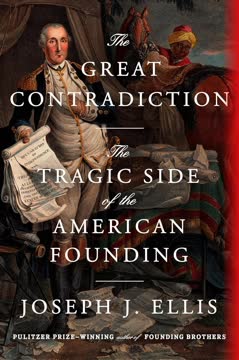
The Great Contradiction by Joseph J. Ellis examines the founding fathers' failure to address slavery and Native American rights despite revolutionary ideals of liberty and equality. Reviewers praise Ellis's balanced, accessible writing that avoids both glorifying and demonizing the founders, presenting them as pragmatic statesmen constrained by political realities. Most appreciate his nuanced exploration of how unity required deferring moral questions. The book focuses heavily on slavery, with critics noting the Native American treatment receives insufficient attention. Readers value Ellis's clear-eyed approach using primary sources, though some criticize excessive moral commentary and lack of bibliography.
Similar Books