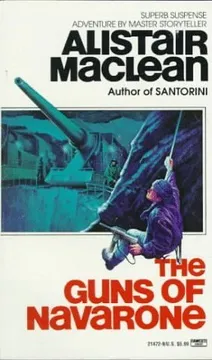


Plot Summary
Guns Block Kheros
A bomber squadron returns battered from Navarone, having failed to reach the guns that command the Aegean channels. Its leader, Squadron Leader Torrance, confirms that another air attack would only sacrifice more men.
Captain James Jensen of British intelligence then explains the stakes to Captain Keith Mallory: German forces will assault Kheros within days, and twelve hundred British troops there cannot be evacuated while Navarone's guns remain active.
Destroyers could use the Maidos Strait, but the guns have already sunk a cruiser and shattered earlier commando attacks. Jensen assigns Mallory to lead a five-man sabotage mission. In Alexandria, exiled Navaronian Eugene Vlachos gives Mallory a detailed island map and warns him not to endanger local villagers.
The mission begins with a collision between strategic arithmetic and human responsibility. Jensen's briefing reduces the danger to channels, timetables, and troop numbers, yet Mallory accepts the task because those numbers represent lives trapped on Kheros. The failed bombing raid also establishes that technological force cannot solve every military problem: the cliff protects the guns from the very aircraft meant to silence them. Mallory's expertise in climbing turns a personal skill into a weapon, but the mission's moral center is already visible in Vlachos's warning. Success must not be purchased by exposing civilians to German retaliation.
Five Against Navarone
Mallory's team brings together very different kinds of competence. Andrea, a Greek veteran and Mallory's trusted companion, is a formidable fighter; American demolitions expert Dusty Miller knows explosives; Petty Officer Casey Brown can repair engines and operate the radio; and young Lieutenant Andy Stevens is a skilled climber and Greek speaker.
They reach Castelrosso by flying boat and torpedo boat, then prepare to sail in a battered fishing caique. Before departure, Andrea catches a laundry worker named Nicolai listening at their door.
Mallory recognizes that the man understands English and presses the local command to confine him, despite Captain Briggs's objections. The team changes uniforms and disguises repeatedly, then sets out with forged papers, climbing gear, weapons, and explosives, hoping their trail will disappear among the islands.
The team is assembled as a system of complementary weaknesses as much as strengths. Mallory can lead and climb, but the mission also depends on Miller's precision, Brown's mechanical patience, Stevens's navigation, and Andrea's judgment under pressure. Their first security breach comes not from a battlefield but from an overlooked worker in a supposedly safe base. Mallory's insistence on containing Nicolai shows that vigilance is not paranoia in this world; it is a form of care for people whose lives depend on secrecy. Their disguises make identity something they must continually construct and defend.
The Deadline Moves Forward
The caique's engine fails after Brown discovers that a corroded exhaust pipe has poisoned him with fumes. While Brown and Miller improvise a repair, Mallory sees a German patrol boat closing in.
An inspection would expose their weapons and explosives, so the team stages a fisherman’s quarrel before striking together. Mallory kills the forward gunner, Brown and Miller plant concealed charges, Stevens throws a grenade, and Andrea overpowers two sailors. The German vessel sinks.
In the storm static that follows, Brown reaches Cairo and learns the invasion of Kheros has been advanced by a day. The team now has barely three days. Their damaged engine and the rising gale leave them little choice but to seek shelter on an island already patrolled by Germans.
The attack makes the mission irreversible. Until this moment the team has been moving through disguises and borrowed identities; now they have killed German sailors and left a sinking ship behind them. Their survival depends on coordinated action rather than individual heroics, and Stevens's convincing performance under inspection marks the first visible challenge to Mallory's doubts about him. The radio update tightens the plot while exposing the fragility of intelligence: plans can be accurate and still become obsolete overnight. The team must act with incomplete information, carrying responsibility forward even when the timetable itself shifts beneath them.
A Creek Beneath the Guns
The caique takes refuge in a narrow creek beneath a German watchtower armed with machine guns. Mallory impersonates a drunken Greek trader, shows forged papers, and persuades a young guard that the boat has official business. When another soldier appears to alert the tower, Mallory and his men pretend to quarrel and drink. Andrea swims around the bend and silently disarms the three guards, avoiding a firefight.
Brown gets the engine running, and the team slips out as darkness falls. Beyond the creek, the gale strikes with full force. Waves batter the old vessel against Navarone's cliffs until its timbers split. Mallory reaches a narrow ledge by climbing, then hauls up his companions and their equipment as the caique sinks beneath them.
Mallory survives this stage by reading other people rather than overpowering them. His performance as a careless trader exploits the guard's assumptions, while the staged quarrel gives Andrea the time to act unseen. Yet the storm strips away the team's control as soon as they leave the creek. Their escape from the watchtower is not a victory over nature, only a brief reprieve from human surveillance. The ledge becomes a precarious substitute for a ship, and the rescue depends on each person trusting the others to keep working while the ground, or water, gives way.
The Cliff Takes Its Price
Mallory begins the climb up Navarone's supposedly impossible south face, with Andrea helping him overcome the most difficult overhangs. At the summit, a German sentry discovers them. Andrea kills him, but the sentry's telephone begins ringing, forcing the climbers to hurry.
A hauling rope slips while Brown climbs, and the food, stove, fuel, and compasses plunge into the darkness. Stevens, already bleeding from a head wound, climbs last. Exhausted and disoriented, he falls near the top and shatters his leg.
Mallory and Andrea get him over the rim before German searchers arrive, then carry him through a snowstorm to a makeshift shelter. The mission has reached the island, but Stevens's injury and the lost supplies turn every mile inland into a crisis.
The climb tests more than Mallory's physical skill. It exposes how quickly a plan can become dependent on a damaged body, a failed knot, or a single misplaced item. Stevens's injury is not a simple consequence of cowardice or incompetence; he has pushed himself beyond his limits while trying to prove he belongs. Mallory's guilt grows because leadership makes every accident feel like a personal verdict. The lost food and heat also transform the team's environment into an antagonist. Their arrival on Navarone is therefore not a clean beginning, but an achievement already burdened by injury, scarcity, and debt to one another.
Louki Opens the Island
German mountain troops comb the slopes, and Andrea draws them away from the shelter so the others can move. Mallory and Miller descend toward Margaritha for supplies, where they meet Louki, the Vlachos family's resourceful steward, and Panayis, a taciturn local fighter.
Louki and Panayis bring food, medicine, bedding, and a stove, while Panayis shares detailed knowledge of Navarone's fortress. Stevens, overhearing Mallory discuss the danger of capture, slips away rather than remain a burden.
Mallory finds him concealed beneath a snowbank and carries him back. The group warms itself in a cave, but the fire gives away their position. German troops surprise them before dawn and capture Mallory, Andrea, Miller, and Brown. Stevens is found separately and taken with them.
Local help gives the mission a route through terrain that maps alone cannot explain, but accepting that help carries moral risk. Vlachos had warned Mallory that German reprisals could destroy whole villages, so Louki and Panayis's decision to assist is an act of deliberate exposure. Stevens's disappearance grows from the same wound as his earlier panic: he believes that being useful is the price of being kept. Mallory's search for him suggests a shift from treating the injured lieutenant as a tactical liability to recognizing him as a person whose choices matter. The cave's warmth offers relief, then becomes the trace that betrays them.
Skoda's Trap Breaks
Oberleutnant Turzig brings the captives to Margaritha, where Hauptmann Skoda interrogates them and demands the location of their explosives. Andrea pretends to be a frightened Greek fisherman who will betray the mission.
His detailed account convinces Turzig, who believes Andrea can be used to extract more information. Louki and Panayis are also brought in, and Skoda cruelly strikes Andrea and threatens the gravely injured Stevens. Andrea suddenly overpowers his guards and shoots Skoda.
Mallory takes control before the remaining Germans can organize, while Turzig refuses to help Skoda's men kill the prisoners. The team binds the guards and escapes the compound with Louki and Panayis. Their freedom is temporary, but Andrea's deception has turned the captors' confidence against them.
Andrea's apparent betrayal is an act of psychological precision. He tells enough truth to make his invented submission credible, using Turzig's knowledge of the mission to anchor the lie. Skoda, by contrast, treats pain as a tool and mistakes brutality for control. When he harms Stevens, the team acts together, but the escape also reveals Turzig's moral boundary: he remains an enemy officer, yet will not sanction a murder disguised as procedure. The episode complicates the idea that military roles determine character. Under pressure, loyalty, restraint, and cruelty emerge through choices rather than uniforms.
Fire Drives Them Uphill
The escaped group reaches a carob grove overlooking Navarone's harbor, where Mallory studies the fortress and its gun cave. The Germans locate their position, and a squadron of Stukas dives on the grove with incendiary bombs.
The trees ignite, forcing the team to flee toward the rocky ravines known as the Devil's Playground. Mallory turns back when Panayis is missing, then staggers through smoke and exploding bombs until Andrea finds and carries him to cover. German mountain troops press after them, guided by aircraft and mortar fire.
Mallory leads the survivors from ravine to ravine, using caves as temporary shelter but never staying long enough for the Germans to close the exits. The air attack destroys their refuge and leaves the group exposed on the open slopes.
The attack takes away the illusion that concealment can last. Mallory's observation point has given him a view of the fortress, but the same visibility allows the Germans to target the grove from the air. His decision to search for Panayis is both a tactical risk and an expression of responsibility: he cannot abandon a teammate simply because the operation is more important than any individual. Andrea's rescue of Mallory reverses their usual roles, making mutual dependence visible. The ravines offer protection only in fragments; the team must keep moving, and survival becomes a question of choosing which danger to meet next.
Stevens Holds the Gorge
German troops advance into the ravines, and Mallory's group ambushes them from cover, stopping the leading soldiers before mortar crews and aircraft force another retreat. The team is exhausted, Brown and Panayis are wounded, and Stevens's gangrene has spread above his knee.
At a dead-end gorge, Louki reveals a cave passage to a valley near the coast, but reaching it means crossing ground exposed to German machine guns. Stevens takes Louki's Bren gun and insists on staying behind to draw the Germans' fire.
He understands that his leg is failing and refuses to let the others risk themselves carrying him farther. Mallory leaves him with ammunition and grenades, then guides the rest through the cave. Stevens's choice gives them the opening to continue toward Navarone.
Stevens's final decision reverses the shame that has governed him since the boat journey. Earlier, he measured himself against other men's apparent fearlessness; now he acts without needing to appear unafraid or to be praised. The injured body that once seemed to disqualify him becomes the means by which he protects the others. Mallory cannot make this choice painless, and his obedience to Stevens's insistence leaves him carrying grief as well as command. The scene refuses an easy consolation: Stevens's courage does not cure his injury or guarantee survival. It gives his companions time, which is the only gift still available.
The Fuse Goes Missing
The survivors emerge from the cave and reach Navarone town in a stolen German vehicle, hiding in an abandoned house close to the fortress. Louki burns the vehicle to draw German searches away, then slips back to help Mallory and Miller.
The team prepares to scale the fortress wall using a hooked bamboo pole and rope, while Mallory memorizes Panayis's account of the interior. When Mallory and Miller cache their equipment on a rooftop, Miller discovers that the slow-burning fuse is missing. Shots and machine-gun fire erupt nearby.
They encounter Panayis, who says German soldiers have attacked Louki and that Andrea and Brown are missing. Mallory believes the report and follows the apparent trail, unaware that the missing fuse and the convenient injuries point toward something worse.
The town offers proximity to the target but not safety. Mallory and Miller hide almost under the fortress wall, turning closeness into both advantage and danger. Louki's burning of the stolen car shows how local knowledge can redirect a search, while the missing fuse undercuts the team's most carefully prepared plan. Panayis's report exploits the group's exhaustion and their trust in him. The clues are concrete but easy to misread because they arrive amid gunfire and separation. Suspicion here is not a gift of intuition; it requires someone willing to inspect the equipment and ask whether the story fits the evidence.
Panayis's Second Face
Miller notices that Panayis's supposed leg wound is false and that the explosives have been tampered with: the clock fuse is disabled and the detonators are empty. He also recognizes that Panayis has repeatedly known more than an innocent guide should.
In an abandoned hut, Miller forces Panayis to reveal the uninjured leg and shoots him when the deception becomes undeniable. Panayis had been a German agent, signaling the team's movements and sabotaging their charges.
Meanwhile, Andrea, Brown, and Louki are prisoners at Castle Vygos. Mallory and Miller reach the keep, free their companions, and learn from Brown's radio report that the destroyers will enter the strait at midnight, not the following night. They have only hours to silence the guns.
Miller's suspicion comes from craft rather than instinct. He tests the fuse, remembers the wind direction when the Germans found their shelter, and notices that Panayis's injuries do not match the evidence. The revelation converts earlier acts of assistance into instruments of surveillance, making betrayal more than a single surprise: it is a revision of the team's entire recent history. Miller's execution of Panayis is grim and personal, but he grounds it in the deaths Panayis caused. The radio deadline strips away the time needed to recover emotionally. The team must turn knowledge of betrayal into action before the destroyers arrive.
The Destroyers Come Early
With the final charges compromised, Miller needs a vehicle battery to build a reliable trigger. The team steals one, then Mallory and Miller enter the fortress in German uniforms while Andrea creates explosions and gunfire elsewhere in town.
Their false alarm sends the gate guards away from their post. Inside, Mallory bluffs past a sentry and takes the keys to the magazine, while Miller prepares a battery-powered charge beside the shell hoist. Its exposed wires will complete the circuit when the hoist moves.
The Germans discover them before they can leave freely and begin cutting through the armored door. Mallory swings across the gap to the nearby house balcony on a rope; Miller and Brown pass the battery and explosives across. The destroyers are already approaching the strait.
The final entry depends on converting ordinary routines into openings. German uniforms, a fabricated emergency, and a battery taken from a truck all exploit the fortress's assumptions about who belongs and what needs guarding. Miller's device is especially telling: he does not need to overpower the gun system, only to understand its machinery well enough to make it destroy itself. Yet the escape route is as improvised as the trigger. Mallory's rope swing places the body back in the role the mission has demanded from the start, while the advancing destroyers make every delay a potential death sentence for people beyond the island.
Navarone Goes Up
The German search closes around the gun cave as Mallory and Miller finish arranging the charge, then escape across the gap to the house. Andrea draws the patrol away from their position, is wounded, and reaches the commandant's launch by swimming.
Mallory, Miller, Brown, and Louki join him and steer out of the harbor. They pass the headland without firing on the fortress, since a shot or searchlight would reveal the destroyers' position. As the Sirdar and the other ships enter the Maidos Strait, the German guns fire.
Their shell hoist moves, completing Miller's circuit. The explosives tear through the fortress and collapse the gun cave into the harbor. The destroyers continue toward Kheros, now free of the weapon that had blocked their passage.
The climax joins mechanical causality to moral consequence. Miller's charge succeeds not because it is a larger weapon, but because it turns the fortress's own loading process against it. The guns fire at the destroyers, the hoist moves, and the German installation triggers its destruction at the moment it is most dangerous. Mallory's refusal to answer with gunfire protects the ships from being located, showing how restraint can be as decisive as attack. The ending resolves the mission's central obligation: Navarone's guns no longer bar the route to Kheros. Relief arrives alongside loss, since Stevens is absent from the escape and the survivors cannot return to the lives they had before the mission.
Analysis
The novel builds suspense by making competence necessary but never sufficient. Mallory's climbing, Miller's engineering, Brown's radio work, Stevens's navigation, and the Greek allies' local knowledge each solve a particular problem, yet every solution exposes the group to a new one. Their equipment fails, weather changes, intelligence becomes outdated, and trust itself proves vulnerable. This structure makes survival feel earned through adaptation rather than guaranteed by heroism.
The mission also tests the limits of military calculation. Mallory repeatedly accepts lethal choices because the alternative threatens twelve hundred soldiers on Kheros, but he resists treating his own companions as disposable. His guilt over Stevens's injury and his reluctance to abandon him complicate the language of necessity. Stevens, in turn, finds a form of courage that does not depend on physical strength or a fearless temperament. He becomes most useful when he stops trying to imitate an ideal soldier and chooses what he can personally give.
Andrea and Turzig offer different kinds of moral counterweight. Andrea's violence is accompanied by grief and self-reproach; Turzig's professionalism restrains him from some of Skoda's brutality without making him less an enemy. Their contrasts prevent the conflict from dividing neatly into good individuals and bad ones. The novel instead asks how people use power when institutions and wartime roles demand obedience.
Finally, Navarone's geography is more than scenery. Cliffs, ravines, caves, channels, and the fortress itself dictate what actions are possible. The decisive sabotage succeeds by turning the enemy's machinery against it, while the destroyers' passage completes the human purpose behind the technical feat. The guns are destroyed not for spectacle, but to open a route through which endangered people may live.
Review Summary
The Guns of Navarone is widely praised as a thrilling World War II adventure novel. Readers appreciate the well-developed characters, intense action scenes, and suspenseful plot. Many consider it one of MacLean's best works, noting its fast pace and vivid descriptions. The story follows a team of commandos on a near-impossible mission to destroy German guns on a Greek island. While some find certain aspects dated, most agree it remains an exciting and engaging read. The 1961 film adaptation is also highly regarded by many readers.
People Also Read

Characters
Keith Mallory
The cliff-born commanderA New Zealand mountaineer serving as an officer and saboteur, Mallory is selected to lead the mission because he can climb the south face of Navarone and work fluently in Greek and German. He combines physical courage with an analytical, often severe style of command. His years of guerrilla warfare have taught him to distrust easy plans, yet he remains acutely responsible for the men and civilians put at risk by his decisions. Mallory's central tension is between the impersonal logic required to complete the mission and his refusal to treat people as expendable pieces. His bond with Andrea gives him a rare source of trust, while Stevens's vulnerability challenges his instinct to judge capability by immediate usefulness.
Andrea
The watchful giantAndrea is a Greek veteran, a powerful fighter, and Mallory's closest companion after eighteen months of guerrilla warfare in Crete. His size and easy humor conceal extraordinary patience, stealth, and discipline. He follows Mallory's lead because he trusts the man, but his judgment is independent and often crucial. Andrea is also deeply troubled by killing: he sees human life as something he has no right to take, even when combat makes violence necessary. His apparent simplicity is misleading. Beneath it lies a highly observant mind shaped by bereavement, war, and a fierce attachment to the people he protects.
Dusty Miller
The patient demolitions expertAn American veteran with an unusual history of mining, tunneling, and dangerous work, Miller is the team's explosives specialist. He is middle-aged, cynical, and comically resistant to boats, bad food, and military ceremony, but those complaints mask a durable courage and a careful eye for detail. He is one of the few people willing to question Mallory's assumptions, and his practical judgment repeatedly protects the group. Miller's skill is not merely destructive: he understands mechanisms, notices when evidence does not fit, and can turn scrap material into a working solution. His loyalty is expressed through work rather than speeches.
Andy Stevens
The fearful young climberStevens is a young naval officer, navigator, accomplished climber, and fluent speaker of Greek. He has spent much of his life feeling diminished by a family that prized athletic confidence, and he fears that others will discover how frightened he is. That insecurity makes him observant of other people's judgments and sometimes too eager to prove himself. Yet fear does not prevent him from acting. Stevens's development depends on learning that courage is not the absence of panic or physical weakness. His competence, loyalty, and desire to be useful become more important than the fearless image he once thought he had to imitate.
Louki
The resourceful local guideLouki is the former steward of the Vlachos family and an experienced guide to Navarone's villages, paths, and hidden passages. Small, lively, and fond of elaborate schemes, he can turn local familiarity into practical advantage, from finding supplies to misleading German search parties. His theatrical confidence contrasts with his tired, melancholy eyes and his awareness of what occupation has cost the island. Louki's help is not abstract patriotism; he knows the land and its people intimately, and he chooses to risk both for the mission. His warmth gives Mallory's group a connection to the civilian world their military task might otherwise erase.
Casey Brown
The engineer on the airwavesBrown is a Scottish petty officer and former yacht-yard engineer whose technical talent has been overlooked by the Navy. He keeps the caique running, maintains the radio link with Cairo, and contributes experience as a veteran of irregular warfare. His reserve and dry complaints conceal a strong sense of duty. Brown tends to approach danger through practical tasks: inspect the engine, repair the transmitter, check the route. This steadiness helps the team endure crises that cannot be solved by daring alone.
James Jensen
The SOE mission architectJensen is the Royal Navy captain who directs subversive operations from Cairo. A practiced master of disguise and organization, he chooses Mallory's team and coordinates the information and equipment behind their mission. His manner is genial, but his decisions carry the weight of strategic calculation: he sends men into extreme danger because conventional attacks have failed and Kheros is threatened. Jensen embodies the distance between command and fieldwork. He understands the larger stakes, while Mallory must live with the immediate consequences of every order.
Eugene Vlachos
The exiled island stewardVlachos is a former owner of Navarone and a Greek official driven from his island by the German occupation. His map gives Mallory a rare, detailed account of the terrain and fortress, while his warnings reveal the danger that resistance poses to local families. He is nostalgic for the land he lost but not sentimental about the risks of returning. Vlachos helps because he believes the mission is necessary, yet he insists that Mallory protect the islanders wherever possible.
Panayis
The shadowed island fighterPanayis is a Navaronian resistance fighter whose knowledge of the fortress and hatred of German rule make him a valuable local contact. He is quiet, secretive, and difficult for the newcomers to read. Louki trusts his familiarity with the island, while Mallory is impressed by his detailed memory of the fortress. Panayis's intensity reflects the particular injuries occupation has inflicted on him and his community. His presence introduces a harsher form of resistance than Louki's sociability, one shaped by isolation, anger, and the habits of clandestine warfare.
Oberleutnant Turzig
The honorable mountain officerTurzig is a German mountain-infantry officer who leads the search for Mallory's team. Skilled, disciplined, and personally familiar with mountaineering, he understands the difficulty of the terrain and respects competence even in an enemy. His conduct remains bounded by military duty, but he resists some of Skoda's cruelty and refuses to authorize murder merely to simplify an interrogation. Turzig represents the unsettling possibility of professional respect across enemy lines, without pretending that such respect can end the conflict.
Hauptmann Skoda
The fortress interrogatorSkoda commands the German detachment in Margaritha and interrogates captured members of Mallory's team. Immaculate in appearance and deliberate in manner, he uses pain and humiliation as instruments of control. His polished manners do not soften his cruelty; they make it more calculated. Skoda stands in sharp contrast to Turzig, showing how the same military hierarchy can contain different relationships to violence and authority.
Squadron Leader Torrance
The failed air commanderTorrance is an Australian bomber pilot who reports the disastrous failure of the air attack on Navarone. His experience establishes that the fortress's guns and terrain make another bombing run nearly suicidal. He is blunt about the cost of sending crews against an impossible target, providing Jensen and Mallory with a field-tested reason to abandon conventional air attack.
Captain Briggs
The obstructive base officerBriggs is an army officer at Castelrosso who resents Mallory's urgent demands and resists the request to confine Nicolai. His concern for his own authority contrasts with Mallory's focus on operational security. He illustrates how complacency and wounded pride can create risks even far from the front.
Nicolai
The base laundry workerNicolai works at the Castelrosso base, where his access to corridors and quarters makes him easy to overlook. His presence tests the team's security before they reach Navarone and reminds Mallory that a mission can be compromised in supposedly safe territory.
Commander Vincent Ryan
The destroyer captainRyan commands the destroyer Sirdar during the passage through the Maidos Strait. He coordinates the evacuation under extreme time pressure and listens to Mallory's warning not to reveal the ships' position by firing. His practical command completes the naval operation that the mission is meant to make possible.
Plot Devices
The south cliff
The impossible entranceNavarone's steep southern precipice is considered unclimbable and is therefore left lightly guarded. Mallory's mountaineering skill gives the team a way onto the island that bypasses the harbor defenses, but the route exacts a severe physical cost. The cliff turns a specialized skill into the mission's point of entry and makes the group's survival depend on ropes, teamwork, and endurance.
Forged identities
Cover under occupationThe team carries forged papers, changes clothing, and adopts roles suited to each encounter. Mallory uses his command of German and Greek to pass checkpoints and misdirect guards. These disguises do not make the team invisible; they give them a few moments in which the enemy's assumptions work in their favor. The device recurs from the Castelrosso base through the fortress entrance.
The local map
A route through enemy groundVlachos's map and Panayis's knowledge of the fortress let Mallory plan movement through Navarone's caves, villages, paths, and defenses. Louki's familiarity with the island fills in what maps cannot show, especially when snow, darkness, and German patrols make ordinary navigation unreliable. Local knowledge repeatedly opens routes toward the target, while the team's dependence on it also makes trust a matter of survival.
The shell-hoist trigger
The guns destroy themselvesAfter the original fuses and detonators are sabotaged, Miller builds a new trigger from a vehicle battery, wire, and explosives. He positions bare contacts beside the shell hoist so its movement completes the electrical circuit. When the German guns fire on the destroyers, the hoist activates the charge inside the magazine. The fortress's own firing routine becomes the mechanism of its destruction.
The radio deadline
A shrinking windowBrown's radio keeps the team connected to Cairo, but each report can change the mission's timetable. The German assault on Kheros is advanced, and the destroyers later begin their passage earlier than expected. These updates prevent the team from treating the operation as a fixed sequence. The radio provides essential information while making the consequences of delay increasingly immediate.
Download PDF
Download EPUB
.epub digital book format is ideal for reading ebooks on phones, tablets, and e-readers.








