

Key Takeaways
Stop expecting conscious reasoning to command every impulse.
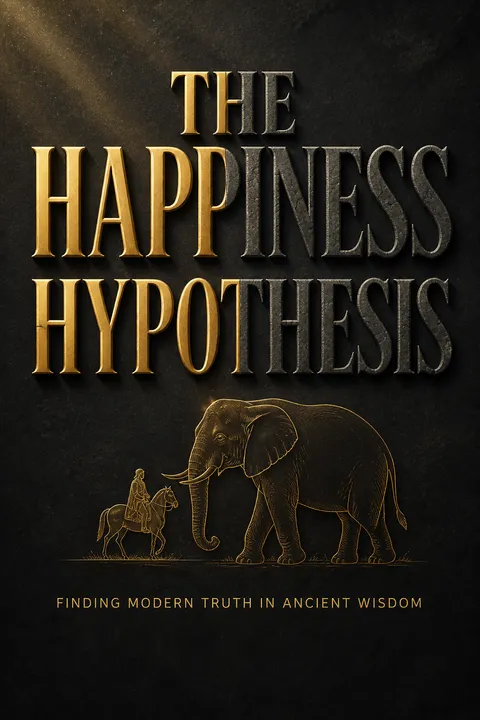
The narrator has limits. Haidt’s rider-and-elephant image describes conscious thought trying to guide the larger, faster machinery of emotion, habit, and intuition. Split-brain experiments made this divide visible: one patient’s left hand chose a shovel after the right hemisphere saw snow, while the speaking hemisphere invented a story about cleaning a chicken shed. The patient’s explanation, called confabulation, sounded convincing but did not reveal the actual cause.
Emotion helps reason. People with damage to emotion-related brain regions could still explain logical rules, yet struggled to make ordinary decisions. Feelings help sort options by importance; without them, deliberation can become endless. The mind is not a rational commander fighting an irrational body. Intelligent action depends on both systems, even when they disagree.
What's striking is that the metaphor replaces moral scolding with a workable account of behavior. A person can recognize a good choice and still fail to carry it out because awareness and motivation are not the same process. Contemporary work on embodied cognition supports the broader point: thinking depends on bodily states, learned routines, and surroundings, not just verbal reasoning. The animal image should remain a guide, not a literal map of two brain regions. Human cognition is distributed and context-sensitive, and the conscious narrator can sometimes redirect behavior, especially when given time, practice, and a supportive setting.
Change your defaults through practice, not louder resolutions.
Insight is not retraining. A person may understand a problem clearly and still return to familiar reactions weeks later. Haidt calls a person’s typical balance of positive and negative emotional reactions an affective style. It is influenced by temperament and life experience, so sheer determination is a poor tool for changing it. The book describes three approaches that can shift automatic responses: meditation, cognitive therapy, and antidepressant medication.
Use a fitting method. Meditation practices attention without chasing every thought. Cognitive therapy teaches people to notice recurring conclusions, test them against evidence, and practise new behaviors. In the book’s account, medication can alter a person’s emotional outlook, but it can also bring unwanted effects and requires clinical judgment. The practical lesson is to work on the system producing the reaction, rather than demand that the conscious mind simply overpower it.
The section usefully distinguishes wanting change from building the conditions that make it possible. Cognitive therapy’s combination of thought-testing and daily action resembles skills training: insight becomes useful when rehearsed in real situations. Meditation offers a different route by changing attention rather than debating each thought. Medication can also be a legitimate treatment, not a character flaw, though the book’s account should not be read as personal medical advice. These methods are not interchangeable, and their value depends on the problem, the person, and professional guidance.
Use reciprocity to build trust, but notice when generosity carries a hook.
Cooperation needs memory. Reciprocity is the practice of returning help, harm, or concessions in response to how others have treated someone. Haidt describes a basic cooperative strategy: begin helpfully, then respond to the other person’s behavior. Gratitude rewards cooperation; retaliation makes exploitation costly; gossip spreads information about who can be trusted. Together, these forces help people cooperate beyond close family ties.
The same reflex can be used. In an ultimatum-game experiment, people often rejected an unfair division of money even though rejection left both players with nothing. Fairness mattered enough to make punishment worthwhile. Salespeople use the opposite side of the reflex by offering samples, gifts, or concessions before asking for a purchase or favor. Reciprocity can deepen friendship, but a gift can also be a tactic. Pausing to ask what the giver expects helps preserve choice.
Reciprocity works because it makes cooperation legible: people can notice generosity, remember it, and respond. This resembles reputation systems in online communities, where visible histories of helpfulness make strangers safer partners. Yet reciprocal justice can become a revenge engine. A slight invites retaliation, which the other person reads as a fresh offense. The useful distinction is between restoring trust and balancing a score. Reciprocity is most constructive when it supports mutual reliability, not when every favor becomes a debt or every injury demands repayment.
Before prosecuting someone else, make your own case less flattering.
The inner lawyer defends. People often reach moral judgments quickly and then recruit reasoning to justify them. Haidt calls this moral hypocrisy when people preserve the appearance of fairness while favoring themselves. In an experiment, subjects asked to divide a reward used a coin toss as a fairness ritual, but most still ended up choosing the better task for themselves. A mirror, which made their own behavior harder to ignore, improved fairness.
Self-knowledge takes effort. People tend to judge others by observable actions but explain away their own actions with private context. Naive realism is the belief that one sees events plainly while opponents are distorted by bias. In conflict, deliberately identifying one’s own contribution can soften certainty and make a limited, specific apology possible. This does not mean every dispute is equally shared. It means that a search for one’s own error is often more productive than another round of self-justification.
The mirror experiment points to a practical principle: accountability improves when attention is directed toward one’s own conduct, not merely toward abstract ideals. That insight is useful in mediation, management, and public debate, where people readily diagnose bias in opponents but rarely apply the same test inward. Still, self-scrutiny must not become false equivalence. Unequal power, coercion, and institutional responsibility remain real even when every individual has blind spots. Owning a specific mistake can open dialogue without requiring a person to accept blame for harms they did not cause.
Invest in progress and chosen activities, not status that quickly feels normal.
Arrival is brief. The progress principle is the idea that people often enjoy moving toward a goal more than reaching it. The adaptation principle describes how a changed circumstance gradually becomes the new normal. A lottery win may bring an initial lift, while a serious injury may bring a severe drop; on average, both groups in studies discussed by Haidt moved substantially toward earlier happiness levels, though adjustment to disability can be incomplete.
Choose what resists habituation. Haidt presents happiness as a combination of biological set point, life conditions, and voluntary activities. Circumstances such as noise, a stressful commute, or chronic conflict can keep affecting well-being, while activities chosen and practised can repeatedly engage attention. Beyond basic needs, wealth and status often disappoint because people adapt and compare themselves with others. Time, relationships, and absorbing pursuits are better bets than purchases made mainly to signal rank.
This account helps explain why a bigger reward can produce less lasting satisfaction than meaningful effort. It also separates conditions that keep imposing costs, such as an uncontrollable noisy environment, from upgrades that quickly become ordinary. The happiness formula is a useful organizer, not a precise calculator: genes, money, relationships, and activity interact rather than contribute fixed portions. Adaptation should not be used to dismiss material hardship or disability. The point is not that circumstances do not matter, but that their effects differ and some conditions deserve practical change.
Build secure bonds; lasting love is steadier than romantic intoxication.
Contact is a need. Harry Harlow’s rhesus-monkey experiments challenged the belief that infants attach mainly to whoever feeds them. Baby monkeys clung to a soft cloth surrogate even when a wire surrogate provided milk. John Bowlby’s attachment theory explains how a trusted caregiver acts as a secure base: a child explores when safe, seeks closeness when frightened, and resumes exploration after comfort.
Love has different rhythms. Researchers found related patterns in adult relationships. Passionate love brings intense longing and excitement, while companionate love grows through shared life, care, and trust. Passion often cools; that change does not prove that a relationship was false. Close relationships remain central to well-being, but attachment is not a promise that every relationship should continue. The useful question is whether trust, care, and commitment are growing, not whether the first rush can be kept at full strength.
The secure-base idea links intimacy with independence: reliable closeness can make exploration safer, rather than smothering it. That pattern has practical relevance beyond romance, including friendship, parenting, and supportive workplaces. The account also corrects a common confusion between intensity and durability. However, attachment styles are tendencies, not permanent diagnoses, and early caregiving does not mechanically determine adult relationships. Economic pressure, cultural expectations, and unequal care responsibilities shape whether people can form and sustain secure bonds.
Hardship can deepen a life, but suffering does not automatically make people stronger.
Growth is possible, not guaranteed. Posttraumatic growth means positive changes some people report after severe adversity. Haidt tells the story of Greg, whose wife disappeared with their children and returned two months later. The crisis left him grieving, but support from family and church helped him recognize his own resilience, value relationships more, and reorder his priorities. These are common reported forms of growth, not proof that the trauma was beneficial overall.
Meaning-making matters. Psychologist James Pennebaker asked participants to write about a painful experience for fifteen minutes on four consecutive days. The health benefits described in the book appeared among people whose writing developed toward greater insight, rather than those who only vented. Severe trauma can cause lasting harm, including posttraumatic stress. Support, time, and a coherent account of what happened may help people adapt, but no one should be told that their suffering is a gift.
The distinction between growth and resilience matters. Returning to functioning is not the same as discovering new priorities, and reported growth does not erase injury. Writing can help organize experience, but it is not a substitute for safety, treatment, or social support. The story also shows that recovery is relational: Greg’s family and community provided practical help as well as a setting in which his changed values could take root. Adversity creates neither wisdom nor compassion on its own; the surrounding conditions shape what can be made of it.
Practise virtues until good judgment becomes easier than explaining it.
Character grows through repetition. Benjamin Franklin tracked thirteen virtues, focusing on one at a time and marking each lapse. He did not reach perfection, but believed the effort improved his life. Haidt connects this practice to ancient moral teaching, which treated virtue as a skill built through habits and role models, not merely a set of rules to recite. A person can reason correctly about a dilemma and still act against that reasoning when habit and desire pull elsewhere.
Build on strengths. Positive psychology grouped character strengths under six broad virtues: wisdom, courage, humanity, justice, temperance, and transcendence. Its practical advice is to develop strengths, not only attack weaknesses. Someone who struggles to forgive, for example, might use a strength of affection to interrupt resentment with memories of care. Moral reasoning matters, but repeated action gives the emotional and behavioral system practice in doing what the person endorses.
The emphasis on practice connects virtue ethics with expertise: good judgment is partly a trained capacity to notice what matters and respond well under pressure. This explains why abstract discussion alone often fails to change behavior. Strength-based work also avoids making self-improvement a permanent inventory of defects. Yet virtue lists reflect cultural choices, and a community’s preferred traits can reinforce conformity or exclude people. Their strongest use is as prompts for reflection and practice, not as a universal ranking of human worth.
Protect wonder and sacred belonging without imposing one group’s purity rules.
People perceive a moral height. Haidt calls divinity the sense that some people, acts, or places are elevated, sacred, or degraded, whether or not God exists. He distinguishes three moral concerns: autonomy protects individuals from harm, community protects groups and obligations, and divinity protects what a culture regards as sacred. Disgust can enforce boundaries around bodies and purity; elevation is the warm, uplifting response some people feel when witnessing moral goodness.
Belonging can uplift or exclude. Awe at nature, art, or shared ritual can make a person feel connected to something larger than the self. Such experiences help explain why religion can provide meaning and social cohesion. But sacred rules can also mark outsiders as impure or inferior. A plural society can take religious and spiritual motives seriously while refusing to let one tradition’s account of purity determine everyone’s rights.
This framework helps explain moral disagreements that cannot be reduced to arguments about individual harm. Some people are defending autonomy; others are trying to preserve loyalty, sacredness, or a shared way of life. Recognizing those motives can make disagreement more intelligible without making every demand legitimate. Awe also has a double edge: it can loosen self-importance and widen concern, but collective devotion can intensify hostility toward outsiders. The civic challenge is to make room for transcendent meaning while protecting equal standing for people who do not share the same sacred map.
Build a life where love, skilled work, and shared purpose reinforce one another.
Meaning grows between people and pursuits. Vital engagement is a lasting relationship with an activity that combines absorbed attention with personal significance. A student Haidt describes began riding horses for pleasure; over time, riding brought skill, friends, history, and a sense of identity. Work can similarly feel like a job, a career, or a calling, depending on whether it offers only income, advancement, or meaningful contribution.
Make the parts fit. Cross-level coherence means that bodily experience, personal aims, and the surrounding culture support one another rather than pull in opposite directions. Haidt argues that happiness does not come solely from changing inner thoughts or external circumstances. It emerges from relationships that work: with loved ones, with worthwhile activity, and with communities or ideals larger than the individual. The book’s final counsel is balance: combine reflection with action, personal freedom with obligations, and scientific evidence with the practical wisdom of traditions.
The strongest conclusion is ecological rather than motivational. A meaningful life is not simply a feeling a person manufactures; it depends on the fit among capacities, relationships, work, and institutions. This connects with research on autonomy, competence, and relatedness, which treats well-being as supported by environments as well as individual choices. The approach also resists one-size-fits-all purpose advice: a calling can be found in ordinary work when it allows contribution and skill. Still, not every worker can redesign a harmful job, so structural conditions matter alongside personal reframing.
Analysis
The book’s central achievement is to turn a collection of old sayings into a connected psychological argument. Its progression matters: first, people are not fully governed by conscious reason; then, their automatic judgments shape cooperation, conflict, happiness, attachment, and moral life. The final image is not an isolated person searching inward for a hidden answer, but a social creature whose well-being depends on how inner tendencies meet relationships, meaningful activity, and shared culture.
The rider-and-elephant metaphor is the book’s most memorable organizing device because it explains why insight often fails to produce change. It also makes the other chapters cohere: reciprocity recruits automatic social motives, virtue requires repeated practice, and adversity becomes formative when a person can interpret and integrate it. Haidt’s strongest practical message is therefore neither “control yourself” nor “accept everything.” It is to understand the systems influencing behavior and shape the conditions in which they operate.
The synthesis has limits. Some findings available in 2006, particularly claims drawn from priming experiments, should not be treated as equally settled as the broad evidence for attachment or social connection. Evolutionary accounts of religion and pair-bonding are explanatory proposals, not historical observations. The happiness formula is a useful map, not a predictive equation, and reported growth after trauma cannot establish that trauma was necessary. The book is most reliable when its claims are treated as lenses for inquiry rather than universal laws.
Its durable contribution is intellectual balance. Ancient traditions preserve observations about desire, discipline, and belonging; science tests mechanisms and exposes error. Neither alone offers a complete guide. The most useful reading is pluralistic but not indiscriminate: honor the need for connection and meaning, examine the evidence behind prescriptions, and remain alert to the moment when a shared moral vision turns into permission to exclude others.
Review Summary
The Happiness Hypothesis explores ancient wisdom and modern psychology to understand human happiness. Reviewers praise Haidt's engaging writing style, comprehensive research, and thought-provoking insights. Many find the book intellectually stimulating and applicable to daily life. Some criticize the self-help tone and overreliance on evolutionary psychology. The book's central metaphor of the rider and elephant resonates with readers, illustrating the struggle between reason and emotion. While not universally loved, most reviewers consider it a valuable contribution to the field of positive psychology.
People Also Read










Glossary
Rider and elephant
Conscious and automatic mindsHaidt’s metaphor for the relationship between deliberate, verbal thought and the larger set of automatic processes, including intuitions, emotions, and habits. The rider can advise and redirect, but does not simply command the elephant. Effective change depends on cooperation between them, not on conscious willpower alone.
Negativity bias
Bad weighs more than goodThe tendency for negative events and information to have stronger, faster, or more lasting effects than comparable positive ones. Haidt applies the idea to such findings as the greater impact of criticism than praise and the greater pain of losses than pleasure from equivalent gains. It helps explain why worry and threat detection can dominate experience.
Affective style
Typical emotional balanceA person’s usual pattern of positive and negative emotional reactions. In Haidt’s account, it reflects the balance between tendencies to approach opportunities and withdraw from possible threats. Temperament contributes to this style, but practices and treatment may influence how it is expressed.
Attachment theory
Security enables explorationJohn Bowlby’s account of how children seek closeness to caregivers when they feel unsafe and explore when they feel secure. A dependable caregiver functions as a secure base and a source of comfort. Haidt connects this account to adult relationships, where close partners can also provide security and support exploration.
Posttraumatic growth
Positive change after traumaPositive changes that some people experience while coping with severe adversity. Haidt describes common reports of greater confidence in one’s capacity to cope, stronger relationships, and changed priorities. The term does not mean trauma is beneficial overall, inevitable growth occurs, or lasting harm has disappeared.
Happiness formula
Set point, conditions, activitiesHaidt’s shorthand for three influences on experienced happiness: a biological set point, the conditions of life, and voluntary activities. It challenges the view that happiness is fixed by temperament alone while recognizing that people adapt to many circumstances. The formula organizes the evidence but is not a precise mathematical prediction.
Flow
Absorbed, well-matched challengeA state of deep involvement in an activity that demands attention and provides immediate feedback. Flow is most likely when a challenge closely matches a person’s skills: a task that is too easy becomes dull, while one that is too difficult becomes frustrating. The experience often feels absorbing and rewarding in itself.
Ethic of divinity
Protecting what is sacredOne of three moral frameworks discussed by Haidt, alongside the ethics of autonomy and community. It focuses on preserving sacredness and avoiding degradation, often through ideas about purity, bodily conduct, and spiritual purpose. People may use this framework whether or not they believe in a deity.
Vital engagement
Meaningful, absorbing involvementA sustained relationship with an activity that combines flow with a sense of personal significance. It develops as initial interest deepens through skill, relationships, traditions, and commitment. The activity is not merely enjoyable in the moment; it becomes an important part of how a person connects with the world.
Cross-level coherence
Life’s levels fit togetherThe alignment of physical experience, personal aims, and the wider social or cultural world. Haidt argues that meaning can emerge when bodily feelings, conscious beliefs, daily practices, and community traditions reinforce one another. Contradictions between these levels can instead produce alienation or a sense that life lacks direction.
Naive realism
My view seems unbiasedThe assumption that one sees the world directly and accurately, while people who disagree are distorted by ignorance, self-interest, or ideology. Haidt links naive realism to moral conflict: each side experiences its own judgment as plain fact and interprets the other side’s disagreement as evidence of bias.
FAQ
What's The Happiness Hypothesis about?
- Exploration of Happiness: The Happiness Hypothesis by Jonathan Haidt delves into the intersection of ancient wisdom and modern psychology to explore happiness and well-being.
- Ten Great Ideas: The book examines ten enduring ideas from various cultures, linking them to contemporary psychological research.
- Divided Self Concept: Haidt uses the "rider and the elephant" metaphor to explain the conflict between rational thought and emotional instincts, highlighting self-control challenges.
- Practical Applications: It offers practical advice on cultivating happiness through relationships, love, and personal growth, emphasizing both internal and external factors.
Why should I read The Happiness Hypothesis?
- Blend of Ancient and Modern: The book combines insights from ancient philosophies like Buddhism and Stoicism with modern psychology, offering a comprehensive view of happiness.
- Practical Strategies: Haidt provides actionable strategies such as meditation and cognitive therapy to improve well-being and navigate life's challenges.
- Engaging Writing: The accessible and often humorous writing style makes complex psychological concepts easy to understand and encourages self-reflection.
What are the key takeaways of The Happiness Hypothesis?
- Dual Nature of Happiness: Happiness is influenced by both internal states and external conditions, suggesting a balance between personal growth and relationships.
- Importance of Relationships: Strong social connections are crucial for happiness, with gratitude and nurturing relationships enhancing well-being.
- Adaptation Principle: People return to baseline happiness after events, emphasizing the importance of focusing on the journey rather than just outcomes.
What are the best quotes from The Happiness Hypothesis and what do they mean?
- “There is nothing either good or bad, but thinking makes it so.”: This highlights the power of perception in shaping experiences and happiness.
- “What doesn’t kill me makes me stronger.”: Reflects the adversity hypothesis, suggesting challenges can lead to personal growth and resilience.
- “Life is what you deem it.”: Emphasizes the role of interpretation in determining happiness, encouraging a positive outlook.
What is the "rider and elephant" metaphor in The Happiness Hypothesis?
- Mind Division: The "rider" is the rational mind, and the "elephant" is the emotional side, illustrating internal conflict in decision-making.
- Self-Control Challenges: The rider has limited control over the elephant, explaining struggles with self-control and impulsive actions.
- Collaboration for Success: Success in self-control and happiness comes from aligning rational thoughts with emotional needs.
How does The Happiness Hypothesis define happiness?
- Complex Definition: Happiness is a mix of pleasure, meaning, and engagement, not just the absence of pain or presence of pleasure.
- Internal and External Factors: Both mindset and life circumstances influence happiness, highlighting the need for balance.
- Dynamic Process: Happiness requires ongoing effort, reflection, and adaptation to life's changes.
What role do relationships play in The Happiness Hypothesis?
- Central to Happiness: Relationships are a major contributor to happiness, providing emotional support and a sense of belonging.
- Reciprocity and Love: Mutual support and kindness in relationships strengthen bonds and enhance life satisfaction.
- Impact on Mental Health: Strong social ties are linked to lower rates of depression and anxiety, significantly influencing happiness.
What is the "adaptation principle" in The Happiness Hypothesis?
- Understanding Adaptation: People return to baseline happiness after events, meaning joy or sadness from events fades over time.
- Implications for Happiness: Focus on the journey and process rather than outcomes to manage expectations and enhance satisfaction.
- Long-Term Strategies: Seek ongoing growth and new experiences to maintain happiness, emphasizing variety and engagement.
How does meditation contribute to happiness according to The Happiness Hypothesis?
- Calming the Mind: Meditation reduces anxiety and increases contentment, fostering mindfulness and emotional regulation.
- Taming the Elephant: It retrains the emotional mind to respond positively to stress, promoting inner peace and acceptance.
- Scientific Support: Research shows regular meditation improves mental health and well-being, offering lasting benefits.
What is the "happiness formula" presented in The Happiness Hypothesis?
- Components of Happiness: H = S + C + V, where H is happiness, S is the biological set point, C is life conditions, and V is voluntary activities.
- Focus on Voluntary Activities: Personal choices and meaningful activities significantly impact happiness, beyond genetics and conditions.
- Practical Application: Identifying areas for action can improve happiness, encouraging a proactive approach to life.
How does The Happiness Hypothesis address the concept of adversity?
- Adversity as Growth: Facing adversity can lead to personal growth and resilience, with challenges strengthening individuals.
- Posttraumatic Growth: Trauma can lead to new meaning and strength, improving relationships and life appreciation.
- Balanced Perspective: Challenges are opportunities for growth, encouraging a constructive mindset in navigating difficulties.
How does The Happiness Hypothesis relate to modern psychology?
- Integration of Disciplines: Combines psychology, philosophy, and cultural studies for a comprehensive understanding of happiness and morality.
- Focus on Positive Psychology: Aligns with positive psychology principles, emphasizing well-being and personal growth.
- Empirical Support: Uses scientific evidence to support claims, providing credibility and a solid foundation for conclusions.
About the Author



Download PDF
Download EPUB
.epub digital book format is ideal for reading ebooks on phones, tablets, and e-readers.








