

Key Takeaways
Your gut reaches the verdict, then reason hires a lawyer
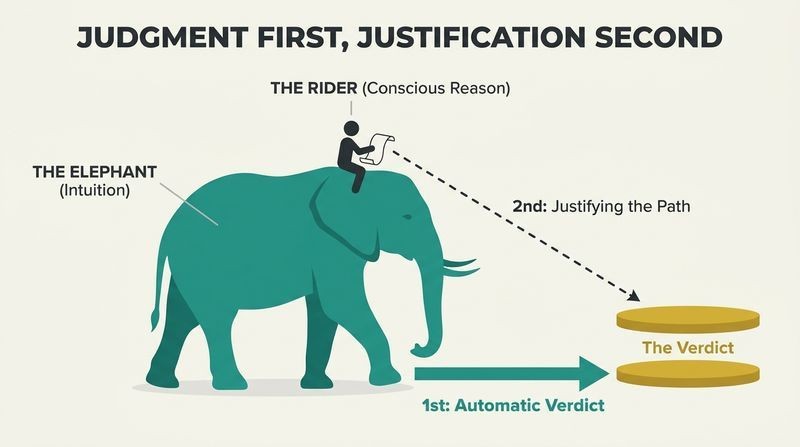
Judgment first, justification second. Haidt's central image is a rider perched atop an elephant. The elephant is intuition, the automatic 99 percent of mental life. The rider is conscious reasoning. The rider looks like the boss but mostly serves the elephant, inventing explanations for wherever it was already leaning. Haidt calls this the social intuitionist model.
Moral dumbfounding proves it. When people hear about a brother and sister who have sex once, safely and secretly, they instantly condemn it, then scramble for reasons. When the interviewer knocks down each reason (birth defects? they used contraception), subjects still refuse to budge, sputtering "I can't explain it, but it's wrong." The feeling came first; the arguments were hired afterward to defend a conclusion already reached.
This inverts Plato's fantasy of reason as charioteer and revives Hume's claim that reason serves the passions. Neuroscience backs Haidt: Damasio's patients with damaged emotional centers retained full IQ yet made catastrophic decisions, showing feeling is not the enemy of good judgment but its precondition. The framing also predicts why fact-checking rarely changes minds. One caution worth noting: dumbfounding was demonstrated with deliberately bizarre taboo scenarios. Everyday moral life includes genuine deliberation, negotiation, and mind-changing through trusted relationships, which Haidt acknowledges through the model's social links. The elephant is steerable, just not by frontal assault.
Reasoning evolved to win arguments, not to find truth

We are intuitive politicians, not scientists. Haidt argues our minds were built to protect reputation and recruit allies, not to reason objectively. The confirmation bias is a feature, not a bug. In Wason's number experiments, people test hypotheses only in ways that confirm them. David Perkins found smarter people generate more arguments, but only for their own side.
The magic word is 'can' versus 'must.' When we want to believe something, we ask "Can I believe it?" and one shred of support suffices. When we dislike a conclusion, we ask "Must I believe it?" and one flaw lets us dismiss it. Notably, moral philosophers who reason about ethics all day are no more honest than other professors, and their ethics books go missing from libraries more often.
Mercier and Sperber's argumentative theory of reasoning, which Haidt draws on, reframes human irrationality as design rather than defect: individual reasoning is lopsided, but groups of people challenging each other can produce truth as an emergent property. This is a powerful argument for viewpoint diversity in newsrooms, juries, science, and legislatures. The implication cuts against the Enlightenment dream of the lone rational thinker. It also explains the replication crisis and motivated reasoning in politics. The uncomfortable corollary: your own certainty is not evidence of your correctness. Intellectual humility becomes not a virtue but a survival skill for anyone who genuinely wants accurate beliefs.
People chase the appearance of virtue more than virtue itself

Glaucon's challenge. In Plato's Republic, Glaucon imagines the ring of Gyges, which makes its wearer invisible. He argues anyone wearing it would lie, steal, and cheat, because people are good only when watched. Haidt sides with Glaucon: the key to an ethical society is not producing better souls but ensuring reputations are always on the line.
The evidence is grim and funny. British MPs treated a hidden expense account like a blank check until a newspaper leaked it. In lab studies, when people can cheat with plausible deniability, most do, but only a little, just enough to keep believing they are honest. When a cashier overpays them, only 20 percent speak up unless directly asked, at which point 60 percent do.
Haidt's Glauconian framing dovetails with behavioral economics, especially Dan Ariely's work showing that most people cheat modestly rather than maximally, policed by an internal need to preserve self-image. It also anticipates the design logic behind transparency laws, open-source accountability, and even social media's reputation dynamics. The darker reading is deterministic: if virtue is just successful reputation management, is anyone truly good? Haidt would answer that reputation systems are precisely what make cooperation possible in societies of unrelated strangers. This is less cynical than it sounds. It treats institutions and accountability as moral technologies, not as insults to human dignity.
Morality has six taste buds, not just harm and fairness
The tongue analogy. Just as cuisines everywhere draw on a handful of taste receptors, moral cultures draw on innate foundations. Haidt's Moral Foundations Theory proposes six, each an evolved solution to an ancient challenge:
1. Care/harm (protecting the vulnerable)
2. Fairness/cheating (reciprocity and proportionality)
3. Loyalty/betrayal (building cohesive coalitions)
4. Authority/subversion (navigating hierarchy)
5. Sanctity/degradation (avoiding contamination, treating some things as sacred)
6. Liberty/oppression (resisting bullies and tyrants)
Innate means organized in advance of experience. Borrowing Gary Marcus's phrase, Haidt says nature writes the first draft of the moral mind, which culture then edits. That is why Indians in Orissa and working-class Brazilians moralized acts (eating your dead dog, a widow eating fish) that WEIRD college students shrugged off as mere personal choice.
Moral Foundations Theory is Haidt's signature contribution and it productively broadens moral psychology beyond the harm-based frameworks of Kohlberg and Turiel. Its explanatory reach across cultures is impressive, and it generated a large body of testable, replicated survey data. Critics in moral psychology have questioned whether these six are truly distinct modules or overlapping clusters, and whether the list is complete (Haidt himself treats it as provisional and open to additions like honesty and ownership). The deeper value is pluralism without relativism: recognizing that people who disagree with you may be responding to real moral concerns you happen to be tone-deaf to.
Conservatives play all six moral notes; the left plays three
A broader palate wins elections. Surveying over 130,000 people, Haidt found liberals rest their morality mainly on Care, Fairness (as equality), and Liberty (for the oppressed). Conservatives use all six roughly equally, giving them extra chords: Loyalty, Authority, and Sanctity. This, Haidt argues, is why Republican messaging (flag, family, faith, patriotism) reaches guts that Democratic policy briefs miss.
Two visions of society. Liberals lean toward John Stuart Mill's open contract of free individuals. Conservatives lean toward Emile Durkheim's vision of nested groups, families, and institutions that restrain selfishness. When Haidt asked partisans to fill out the questionnaire as their opponents would, conservatives and moderates predicted liberal answers accurately. Liberals, especially the very liberal, were worst at simulating conservatives, often assuming conservatives simply don't care about harm.
This finding made Haidt a bridge-builder and a lightning rod. The claim that the left has an empathy or comprehension gap toward the right is empirically supported in his data and echoes work on the "ideological Turing test." It reframes political disagreement as partial moral color-blindness rather than good versus evil. A fair critique: labeling conservative morality "broader" can smuggle in a normative judgment, since more foundations is not obviously better, and the binding foundations can also license exclusion and cruelty. Haidt's genuine contribution is diagnostic humility: if you cannot pass your opponent's Turing test, you do not actually understand what you are fighting.
We are ninety percent chimp and ten percent bee
Humans have a groupish overlay. Haidt argues natural selection worked on two levels. Most of our nature is selfish, forged by individuals competing within groups (the chimp). But a slice was forged by groups competing with groups, favoring team players who sacrifice for the collective (the bee). He defends group selection, long banished from biology, using four exhibits: major evolutionary transitions, shared intentionality, gene-culture coevolution, and the surprising speed of evolution.
The hive switch. Under special conditions (marching in unison, raves, awe in nature, psychedelics, religious ritual) humans can flip a mental switch, dissolve the self, and merge into something larger. Oxytocin and mirror neurons are the likely machinery. Crucially, this bonding is parochial: oxytocin makes people love their in-group, not humanity at large.
The group-selection claim remains contested; many evolutionary biologists argue apparent group adaptations reduce to kin selection and reciprocity, and Haidt honestly flags the debate. Yet the phenomenology of the hive switch is undeniable and undertheorized. Durkheim's "collective effervescence" and William McNeill's "muscular bonding" from synchronized drilling anticipate modern findings that moving in time increases trust and pain tolerance. The practical payoff is large: organizations, armies, and movements that engage our hive nature outperform those built purely on transactional self-interest. The ethical tension is that the same switch powering altruism and belonging also powers nationalism, fascism, and genocide. It is a tool, not a virtue.
Religion is a team sport, not a database of false beliefs
The New Atheists miss the point. Dawkins, Harris, and Dennett treat religion as bad factual beliefs about supernatural agents, a virus of the mind. Haidt counters that studying beliefs is like studying a football game by tracking the ball. What matters is belonging: religions bind people into moral communities through shared practices.
Binding beats believing. Richard Sosis studied 19th-century communes: after 20 years, 39 percent of religious ones survived versus only 6 percent of secular ones, and the key was costly sacrifice (fasting, dress codes) that only worked when sacralized. Putnam and Campbell found frequent worshippers are more generous and civic, but the active ingredient was friendships with co-religionists, not theology. Religions function as moral exoskeletons that suppress cheating and build trust.
Haidt's Durkheimian account (belonging drives believing) aligns with cognitive science of religion showing that ritual, synchrony, and credibility-enhancing displays build cooperation more reliably than doctrine. Sosis's commune data is a striking natural experiment in the economics of commitment: sacrifice screens out free riders. A limitation is that Haidt's functionalism explains what religion does for groups without settling whether it does net good for outsiders, and he concedes religion can be an accessory to atrocity. Robert Pape's research, which Haidt cites, shows suicide terrorism is driven more by military occupation than theology. The reframe is valuable: attack the beliefs and you will never understand the bonds.
Fairness usually means proportionality, not equality
Two very different fairness intuitions. Haidt initially assumed fairness meant equality. Angry emails from conservatives corrected him. Their fairness is the law of karma: people should reap what they sow, and cheaters and free riders should suffer, even if outcomes end up unequal. Get what you deserve, no more, no less.
Punishment sustains cooperation. In the Fehr and Gachter public-goods game, cooperation decayed until players could pay to punish slackers. The moment punishment became possible, contributions shot up and kept climbing, because people will spend their own money to make cheaters "get what's coming." Rick Santelli's on-air rant against bailing out irresponsible mortgage-holders launched the Tea Party. He was not preaching dog-eat-dog cruelty; he was invoking proportionality. Equality, Haidt argues, grows from the Liberty foundation's hatred of oppression, not from reciprocity.
Disentangling proportionality from equality resolves a long-standing confusion in political debate, where each side accuses the other of not caring about fairness while meaning entirely different things. The insight connects to evolutionary work on altruistic punishment and to Trivers's reciprocal altruism: humans are wired to detect and resent cheaters. It also illuminates why welfare politics is so combustible, since aid can read as compassion (Care) to one side and as rewarding free riders (proportionality violated) to the other. A subtle point Haidt makes well: children start as rigid egalitarians and become proportionalists as social intelligence matures, suggesting proportionality is the more cognitively demanding intuition.
Moral capital is the resource the political left keeps overspending
Define the invisible glue. Moral capital, in Haidt's sense, is the web of values, traditions, institutions, and norms that lets a community suppress selfishness and cooperate. Just as social capital is trust between people, moral capital is the whole environment that makes people behave well. High moral capital is fragile and hard to build.
The blind spot. Because liberals prioritize helping victims and dismantling hierarchy, Haidt argues they often fail to see the moral capital their reforms deplete, which is why some well-intentioned changes backfire. Conservatives, valuing Loyalty, Authority, and Sanctity, are better at preserving it, but sometimes protect unjust arrangements and ignore victims. Haidt draws on Mill and Bertrand Russell to cast left and right as yin and yang: order and progress, each correcting the other's excesses.
The moral-capital concept extends Putnam's social capital and Burke's "little platoons" into a coherent argument for institutional humility. It resonates with Chesterton's fence: do not tear down a rule until you understand why it was built. The framing is genuinely even-handed in structure, casting both ideologies as necessary. Still, the concept resists measurement, and "high moral capital" can describe a cult or an authoritarian state as easily as a healthy democracy, which Haidt admits. That ambiguity means moral capital is a lens for weighing tradeoffs, not a trump card. Its best use is as a check on the reformer's overconfidence, not as a defense of any status quo.
To change a mind, speak to the elephant before the rider
Empathy is the antidote to righteousness. Since intuitions come first, hammering someone with logic just makes their rider defend the elephant harder. Haidt invokes Dale Carnegie, whom he calls a brilliant elephant-whisperer: begin warmly, listen, see the issue from the other person's angle, and only then offer reasons. Warmth opens the elephant to new intuitions.
Reduce the tribalism structurally. Haidt argues American politics turned Manichaean partly for procedural reasons. After 1995, congressmen stopped moving their families to Washington, cross-party friendships evaporated, and gang-like hostility rose. We now self-sort into like-minded counties (48 percent lived in landslide counties by 2008). His prescription is not civility pledges, which speak only to riders, but structural changes and genuine relationships that alter the intuitions underneath.
The advice mirrors decades of persuasion research: attitude change flows through trust, similarity, and perceived warmth more than through evidence. It converges with therapy techniques like motivational interviewing, which abandons argument in favor of eliciting a person's own reasons for change. Haidt's structural diagnosis is especially valuable because it resists the moralizing trap of blaming individual bad character for polarization. If the architecture (redistricting, primaries, geographic sorting, money, media incentives) rewards hostility, exhortations to be nicer are futile. The limitation is that not every disagreement should be dissolved through rapport; some moral conflicts reflect real, irreconcilable value tradeoffs that empathy clarifies rather than eliminates.
WEIRD minds see lone objects; most of humanity sees relationships
The strangest people to study. Nearly all psychology research uses subjects who are Western, Educated, Industrialized, Rich, and Democratic (WEIRD), yet they are global outliers. The core peculiarity: the WEIRDer you are, the more you perceive a world of separate objects rather than a web of relationships. Asked to complete "I am," Westerners list traits (happy, curious); East Asians list roles (a son, an employee).
This warps our moral theories. Because WEIRD philosophers see autonomous individuals, they build individualistic, rule-based ethics focused on harm and rights (Mill, Kant). Sociocentric cultures, seeing people embedded in families and institutions, build thicker moralities with duties, hierarchy, and purity. Haidt's Indian fieldwork in Bhubaneswar cracked open his own matrix: honoring elders, guests, and gods began to feel beautiful, not oppressive.
The WEIRD critique, drawn from Henrich, Heine, and Norenzayan, is one of the most consequential methodological warnings in modern social science, since it implies much of what textbooks call human nature is really the psychology of a narrow, unusual slice of humanity. It humbles universal claims and demands cross-cultural replication. Applied to morality, it explains why educated Westerners so often mistake their own thin, autonomy-based ethics for the whole of morality itself. The framing pairs well with anthropology's long insistence on cultural context. One nuance: recognizing WEIRD morality as unusual does not make it wrong, and Haidt is careful to remain a pluralist rather than a relativist who thinks anything goes.
Analysis
The Righteous Mind is a thesis-driven synthesis disguised as an intellectual memoir, and its difficulty lies in its scope: Haidt braids moral philosophy (Hume versus Kant), developmental and social psychology, cultural anthropology, neuroscience, and evolutionary biology into three sequential principles. Summarizing it means preserving both the argument and the narrative arc of Haidt's own conversion from partisan liberal rationalist to pluralist. The book's enduring power is its diagnostic generosity. Rather than asking who is right, Haidt asks why sincere, intelligent people disagree so intractably, and answers with a mechanism: gut intuitions grounded in six evolved foundations, dressed up by post hoc reasoning, and bound into tribes by our hivish nature. This reframes political and religious conflict from a battle of good against evil into a clash of partial moral visions, each blind to what it does not sacralize. That move is both the book's ethical achievement and the source of its critics' unease, since understanding an ideology can feel like excusing it.
Intellectually, Haidt is strongest as a taxonomist and weakest as a metaethicist. Moral Foundations Theory is empirically fertile and cross-culturally robust, and the social intuitionist model is well-supported by dumbfounding, priming, and neuroimaging data. The group-selection and hive-switch arguments are bolder and more contested; Haidt honestly presents them as a case to reopen rather than settled science. His normative move, Durkheimian utilitarianism, is more asserted than defended.
What dates well is the psychology of persuasion and polarization. Written in 2012, the book anticipated the affective tribalism, geographic sorting, and epistemic fragmentation that have since intensified. Its practical wisdom (talk to the elephant, prize viewpoint diversity, respect moral capital, distrust your own certainty) reads as more urgent now than when published. The book ultimately argues that moral truth emerges not from lone reasoners but from institutions that harness our flawed, groupish minds against each other.
Review Summary
The Righteous Mind is a thought-provoking book exploring the psychological foundations of morality and politics. Haidt argues that moral decisions are primarily intuitive, with reasoning serving as post-hoc justification. He proposes six moral foundations, suggesting conservatives utilize all six while liberals focus on only three. The book offers insights into why people hold different political and religious views, and how to bridge ideological divides. While some readers found it enlightening, others criticized Haidt's conclusions about liberal and conservative morality as oversimplified or biased.
People Also Read








Glossary
The rider and the elephant
reasoning serves automatic intuitionHaidt's metaphor for the divided mind. The elephant is intuition and automatic processing (roughly 99 percent of mental life); the rider is conscious reasoning. The rider appears to be in charge but mostly acts as the elephant's servant and spokesman, generating justifications for decisions the elephant has already made.
Social intuitionist model
intuition first, reasoning afterHaidt's theory that moral judgments arise from fast, automatic intuitions, after which reasoning is produced largely to justify those judgments and persuade others. It contrasts with rationalist models where reasoning produces the judgment. Reasoning can still change minds, but usually through social interaction that triggers new intuitions rather than through private logic.
Moral Foundations Theory
six innate bases of moralityHaidt and colleagues' framework proposing that morality is built on six evolved psychological systems: Care/harm, Fairness/cheating, Loyalty/betrayal, Authority/subversion, Sanctity/degradation, and Liberty/oppression. Cultures and political groups emphasize different foundations, producing different moral matrices. Each foundation evolved to solve a recurring adaptive challenge in social life.
WEIRD
Western Educated Industrialized Rich DemocraticAcronym (from Henrich, Heine, and Norenzayan) for Western, Educated, Industrialized, Rich, and Democratic populations, who dominate psychology research yet are global statistical outliers. WEIRD people perceive a world of separate objects rather than relationships and build individualistic, harm-and-rights-based moral systems unusual by world standards.
Hive switch
ability to transcend self into groupHaidt's term for a psychological capacity, likely built from oxytocin and mirror neurons, that lets humans temporarily shut down self-interest and merge into a larger group, feeling part of a whole. It is triggered by synchronized movement, awe, ritual, or psychedelics, and produces parochial love directed at the in-group.
Homo duplex
human as two-level creatureDurkheim's idea, adopted by Haidt, that humans exist at two levels: as self-interested individuals in the ordinary profane world, and as members of something larger in the sacred, collective realm. We spend most life at the lower level but achieve our greatest joys ascending to the higher, group-bonded level.
Moral capital
resources sustaining a cooperative communityThe interlocking set of values, virtues, norms, traditions, and institutions that mesh with human moral psychology to suppress selfishness and make cooperation possible. Haidt argues conservatives are better at preserving it while liberals more readily deplete it through reforms, though high moral capital can also sustain unjust or oppressive communities.
Glauconian
caring about appearance over realityDerived from Glaucon in Plato's Republic, who argued via the ring of Gyges that people are good only when watched. Haidt uses it to describe humans as more concerned with the appearance of virtue and reputation than with genuine goodness, which makes accountability systems essential to ethical societies.
The rationalist delusion
overfaith in reason's moral authorityHaidt's label for the long-standing Western worship of reason as the noblest faculty and the reliable path to moral truth, running from Plato through Kant to Kohlberg. He calls it a delusion because reasoning is largely a servant of intuition and is easily corrupted by bias and self-interest.
Moral dumbfounding
conviction without available reasonsThe state, documented in Haidt's studies using harmless taboo scenarios, in which people are certain something is morally wrong but cannot produce any supporting reason, saying things like "I can't explain it, but it's just wrong." It reveals that the judgment came from intuition, not from the reasoning offered afterward.
FAQ
What's The Righteous Mind about?
- Exploration of Moral Psychology: Jonathan Haidt's The Righteous Mind examines how moral psychology influences political and religious divisions, arguing that morality extends beyond harm and fairness to include a range of intuitions.
- Intuition vs. Reasoning: The book posits that moral judgments are primarily driven by gut feelings, with reasoning often serving to justify these intuitions post hoc.
- Moral Foundations Theory: Haidt introduces Moral Foundations Theory, identifying key moral intuitions like care, fairness, loyalty, authority, and sanctity that shape ethical beliefs and behaviors.
Why should I read The Righteous Mind?
- Understanding Divisive Issues: The book provides insights into the psychological mechanisms behind political and religious polarization, helping readers understand strong beliefs and conflicts.
- Broader Perspective on Morality: It encourages appreciation for diverse moral perspectives across cultures, fostering empathy and constructive dialogue.
- Practical Applications: Haidt offers advice on engaging in productive conversations about contentious issues by understanding others' moral frameworks.
What are the key takeaways of The Righteous Mind?
- Moral Intuitions Matter: Haidt emphasizes that moral intuitions significantly influence reasoning and decision-making, with gut feelings often preceding rational thought.
- Moral Foundations: The book identifies multiple moral foundations, such as care, fairness, loyalty, authority, and sanctity, explaining moral diversity across cultures and ideologies.
- Groupish Nature of Morality: Haidt discusses how morality binds and blinds, creating in-group loyalties and inter-group divisions, and suggests understanding this nature can mitigate conflicts.
What is Moral Foundations Theory in The Righteous Mind?
- Framework for Understanding Morality: Moral Foundations Theory posits several innate moral intuitions that guide ethical beliefs, including care, fairness, loyalty, authority, and sanctity.
- Cultural Variability: Different cultures prioritize these foundations differently, leading to diverse moral systems; for example, Western cultures may emphasize care and fairness.
- Adaptive Challenges: Each foundation corresponds to evolutionary challenges faced by ancestors, explaining the universality of certain moral intuitions.
How does Haidt explain the role of intuition in moral decision-making?
- Intuition as Primary: Haidt argues that moral intuitions are automatic and often precede conscious reasoning, using the metaphor of a rider (reasoning) on an elephant (intuition).
- Post Hoc Justifications: Individuals often use reasoning to justify moral judgments made based on intuition, with reasoning serving moral emotions.
- Empirical Evidence: Haidt supports his claims with studies showing people struggle to articulate reasons for moral judgments, highlighting intuition's power.
How does The Righteous Mind address political polarization?
- Understanding Moral Foundations: Haidt suggests polarization arises from differing emphases on moral foundations, and recognizing these differences can improve understanding.
- Empathy and Dialogue: The book advocates for empathy and constructive dialogue to bridge divides, emphasizing understanding others' moral frameworks.
- Cultural Narratives: Haidt discusses how cultural narratives shape political identities and contribute to polarization, offering insights into underlying values.
What role does culture play in shaping moral beliefs according to The Righteous Mind?
- Cultural Influence on Morality: Haidt emphasizes that culture significantly shapes moral beliefs and values, with different cultures prioritizing different moral foundations.
- Moral Matrices: The book introduces moral matrices, frameworks individuals use to interpret moral issues based on cultural background, creating in-group loyalties.
- Evolutionary Perspective: While moral foundations are innate, their expression is influenced by culture, explaining moral diversity across societies.
How can understanding moral psychology improve interpersonal relationships?
- Empathy and Understanding: Understanding moral foundations driving others' beliefs can cultivate empathy and improve relationships, turning disagreements into dialogue opportunities.
- Effective Communication: The book provides strategies for communicating across moral divides, such as finding common ground and appealing to shared values.
- Reducing Conflict: Recognizing differing moral intuitions can help navigate conflicts more effectively, fostering healthier relationships.
How does The Righteous Mind relate to religion?
- Religion as Social Glue: Haidt argues that religion serves as a moral framework binding communities, enhancing group cohesion and cooperation.
- Moral Communities: Religions create moral communities that help navigate social dynamics, often emphasizing loyalty and authority to strengthen group identity.
- Parochial Altruism: While religions promote altruism, it is often parochial, benefiting in-group members, highlighting religion's dual role in moral behavior.
What is the significance of the "hive switch" in The Righteous Mind?
- Groupishness and Cooperation: The hive switch refers to mechanisms enabling individuals to transcend self-interest for collective good, fostering cooperation.
- Neurobiological Basis: Haidt discusses oxytocin and mirror neurons' roles in group cohesion and empathy, strengthening social ties.
- Cultural Implications: Understanding the hive switch helps explain societal functioning and collective identity formation, suggesting group dynamics can drive positive change.
What methods does Haidt suggest for improving political discourse?
- Fostering Empathy: Haidt emphasizes empathy in bridging divides, engaging with opposing viewpoints to cultivate understanding and reduce polarization.
- Recognizing Moral Foundations: Understanding moral foundations underlying political beliefs facilitates constructive conversations, appreciating others' values.
- Encouraging Civil Dialogue: The book advocates for spaces allowing respectful discussions on contentious issues, promoting civility and open-mindedness.
How does The Righteous Mind address the concept of self-righteousness?
- Self-Righteousness as Human Trait: Haidt argues self-righteousness is common, with individuals seeing their moral views as superior, often overlooking biases.
- Moral Blindness: Self-righteousness can blind individuals to alternative perspectives, leading to moral absolutism and conflict.
- Encouraging Humility: Haidt advocates for humility in moral discussions, recognizing limitations and biases to foster open-minded conversations.
About the Author

Download PDF
Download EPUB
.epub digital book format is ideal for reading ebooks on phones, tablets, and e-readers.








