

Key Takeaways
Treat Emoto's crystal photographs as prompts, not proof that water understands words
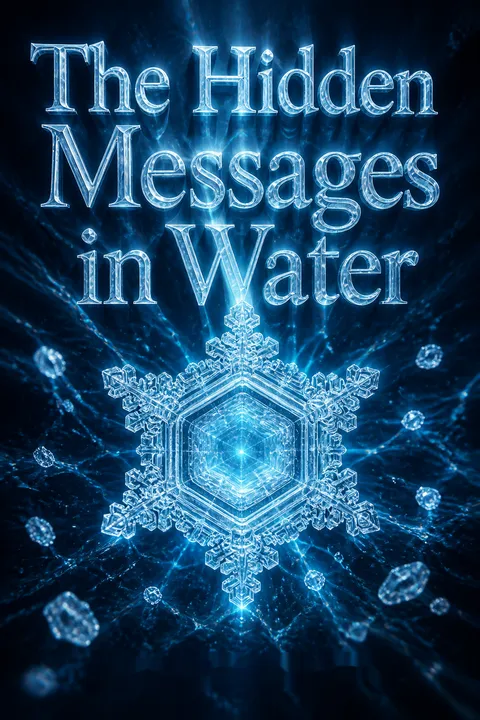
A striking visual claim. Masaru Emoto froze water samples and photographed the crystals that appeared as the ice began to melt. He reported that natural spring water formed more complete shapes than some tap water, and that samples exposed to classical music or words such as expressions of thanks produced different crystals from samples exposed to harsh language. His team used dozens of small dishes, froze them, and selected photographs to represent the results. The images became the book's central evidence and its emotional hook.
A claim to test. Emoto interpreted the patterns as water reflecting human intention. But the photographs do not establish that water reads, understands, or remembers words. Crystal formation can vary with freezing conditions, impurities, and the choice of which images to publish. The book offers a compelling invitation to care, but its visual evidence is not a reliable demonstration of the proposed mechanism.
The images make an abstract question feel immediate: can intention leave a physical trace? That is a powerful prompt for curiosity, but visual persuasiveness is not the same as experimental strength. A convincing test would define crystal categories in advance, keep sample handling consistent, conceal labels from observers, and publish every result rather than a few striking images. These safeguards matter because expectations can influence both what researchers notice and which photographs they select. The most defensible response is neither automatic belief nor ridicule: appreciate the images as art and ask what a well-controlled experiment would show.
Start with water's extraordinary chemistry before assigning it a cosmic memory
Water really is unusual. Emoto points to properties that make water essential to life. Ice is less dense than liquid water, so it floats; liquid water is densest at about 4°C, helping water beneath a lake's ice remain habitable. Water also dissolves and transports many substances, carrying nutrients through environments and living bodies. These ordinary physical facts give the book a sound starting point: water is not a passive backdrop but a central participant in Earth's living systems.
Then comes speculation. Emoto explores the possibility that water arrived from space in icy bodies, and suggests that water carries information from its cosmic journey. He also describes water as recording and transmitting life's history. Such ideas enlarge the story, but the book does not demonstrate that water preserves meaningful memories or that extraterrestrial ice supplied Earth's oceans.
Water's actual chemistry needs no mystical upgrade to inspire awe. Its ability to dissolve substances, move nutrients, and change density with temperature helps explain why aquatic life can persist through winter. The distinction between established properties and proposed cosmic explanations also strengthens the book's best impulse: paying attention to a resource people often take for granted. A useful reader's habit is to ask, for each striking statement, whether it describes a measured physical property, a hypothesis about Earth's history, or a spiritual interpretation. These categories can coexist in a thoughtful conversation, but they are not interchangeable forms of evidence.
Use resonance to think about influence, but don't confuse metaphor with mechanism
A universe of vibrations. Emoto's guiding idea is that everything vibrates at a characteristic frequency. He uses resonance, the amplification or interaction that can occur between related vibrations, to connect sound, matter, emotions, and relationships. A tuning fork sounding one note can set another tuned fork vibrating, making a useful example of resonance in physics. From there, Emoto extends the idea to moods affecting a room, people gravitating toward one another, and words influencing water crystals.
One word, several meanings. The physical example does not establish that written words transmit their meaning to water or that feelings have measurable frequencies that alter bodily fluids. Emoto's seven-note account, his “Do-re-mi-fa-so-la-ti theory,” serves as a broad organizing image, not a standard scientific model of all physical frequencies. The book moves between literal science and analogy without consistently marking the boundary.
The resonance metaphor captures something recognizable about social life: emotions spread through facial expression, tone, attention, and behavior. A tense person can change a meeting without emitting a special frequency that physics can measure. Keeping that distinction clear preserves the insight while avoiding a category error. Scientific words such as frequency and resonance have precise meanings; using them metaphorically can illuminate experience, but it does not automatically validate a proposed physical effect. Readers can ask whether a claim names a measurable mechanism or gives an evocative description of human influence. Both can be useful, provided they are not mistaken for each other.
Give people attention and kind words, even if rice jars prove nothing
Attention carries meaning. Emoto recounts an experiment in which people spoke kindly to one jar of cooked rice, insulted a second, and ignored a third. He says the ignored rice spoiled first, while the rice receiving kind words changed differently from the insulted rice. He treats the story as evidence that attention and language affect matter, then draws a lesson for how adults treat children, plants, and animals.
Keep the human lesson. The rice story is not enough to show that words directly change food. The account does not establish controls for handling, storage, or observers' expectations. But the advice to notice and speak respectfully to people stands on its own: words communicate regard, and neglect can hurt. Emoto's argument is most practical when attention is understood as a human relationship, not as a demonstrated force acting on jars.
The story's strongest implication does not depend on rice having a response to language. In relationships, attention is observable behavior: listening, checking in, and responding rather than leaving someone isolated. Developmental psychology likewise treats responsive interaction as important to children's social and emotional development, though the rice experiment cannot establish that point. There is also a useful caution here: kindness should not become a demand to suppress anger or avoid necessary criticism. Care is not the same as constant praise. The actionable principle is to communicate honestly without contempt, and to recognize that deliberate neglect can be harmful.
Practice gratitude as a counterweight to acquisitive love
Gratitude changes the emphasis. Emoto argues that love alone can focus on possession, loyalty to one's group, or the desire to secure more. Gratitude, by contrast, begins with recognizing what has already been received: life, clean air, water, and the natural world. He presents love and gratitude together as the attitudes most aligned with life, and interprets their balance through water's two hydrogen atoms and one oxygen atom. That comparison is a symbolic analogy, not evidence that human emotions follow molecular proportions.
Make the idea livable. The book asks readers to notice everyday gifts rather than treat the world as an unlimited supply of resources. Its image of gratitude is not mere politeness. It is a discipline of attention that can make consumption, relationships, and environmental choices more deliberate.
Gratitude can redirect attention from scarcity and entitlement toward dependence and reciprocity. That has clear ethical value when the object of gratitude is not only personal good fortune, but the water systems, infrastructure, and labor that make ordinary life possible. The metaphor of balancing gratitude with love is memorable, though the chemical ratio should not be mistaken for a psychological law. Gratitude also has limits: it should not be used to tell people facing injustice or illness to feel thankful instead of seeking change. At its best, it supports care and responsibility without denying hardship.
Protect water through collective habits, not crystal imagery alone
A shared resource. Emoto links polluted water to a culture that prizes convenience and consumption while neglecting the consequences. He describes natural water samples as producing more complete crystals than some treated city supplies, and recounts how pollution in one Japanese city reportedly made crystal formation difficult. He interprets these differences as signs of water's condition. The broader point is more solid: water pollution travels through connected environments, and communities depend on reliable supplies of clean water.
Turn reverence into practice. The book calls for respect for water and collective responsibility for protecting it. Its proposed response is not only personal positivity; it includes caring for water sources and changing the systems that affect them. Crystal appearance, however, is not a dependable measure of water safety. Water quality requires appropriate chemical and biological testing.
The environmental argument is strongest when it shifts from private ritual to public stewardship. Water quality depends on infrastructure, industrial practices, regulation, and local ecosystems, not simply on an individual's state of mind. That makes the book's recurring image of circulating water useful: what enters a watershed can affect people far beyond its source. At the same time, a beautiful-looking sample can still contain harmful contaminants, while ordinary-looking water can meet safety standards. Respect for water therefore needs both an ethical dimension and reliable measurement. Gratitude may motivate protection, but testing and collective policy do the practical work.
Treat consciousness as a source of meaning, not established remote control
From attention to cosmic influence. Emoto proposes that consciousness can change physical reality. He draws on David Bohm's distinction between the visible “explicate order” and a deeper “implicate order,” and on biologist Rupert Sheldrake's “morphic field,” a proposed pattern that might make repeated events more likely. He also recounts a group prayer at Japan's Lake Biwa, after which a seasonal algae problem reportedly did not appear, and describes attempts to make clouds disappear through focused thought.
The evidence does not match the reach. These accounts suggest possibilities to Emoto, but they do not establish that thought or prayer caused the reported changes. Weather and algae have many influences, and an event following a prayer is not proof that the prayer produced it. The book turns spiritual conviction into a claim about physical causation without demonstrating a dependable causal link.
The idea that minds participate in the world is defensible in a grounded sense: attention shapes choices, relationships, and collective action. A group that gathers to pray may also strengthen commitment to caring for a lake. That social pathway deserves attention without requiring a hidden force that directly changes clouds or water. Bohm's philosophical model and Sheldrake's hypothesis do not, by themselves, verify Emoto's experiments. The key question is not whether consciousness matters, but how its effects travel. Separating interpersonal, political, and physical mechanisms lets the reader honor spiritual meaning while remaining careful about claims of remote control.
Demand repeatable tests before trusting crystals to predict earthquakes
A research program, not a result. Emoto says his team tried to improve its procedures by labeling water samples so researchers would not know which had received which words, examining many dishes, and categorizing crystals. He hoped that more controlled work could clarify the effects of music, language, observation, and researchers' expectations. He also imagined that changes in crystals from groundwater might someday provide early warning of earthquakes.
A prediction needs proof. Emoto acknowledges that crystal formation can vary between dishes and that observers may disagree about which shapes count as beautiful or complete. Choosing one photograph to represent a sample also leaves room for selection bias. The book offers no validated earthquake-prediction system or evidence that crystal patterns reliably forecast seismic events. Its strongest scientific lesson is therefore a question: can these observations survive independent, blinded repetition?
The move toward blinding and repeated samples recognizes a real problem: when researchers know which result they hope to see, judgments can drift toward expectation. Yet labels alone cannot solve every issue. Researchers also need prespecified scoring rules, full reporting of results, independent replication, and comparison against a baseline that can show whether a pattern predicts anything beyond chance. Earthquake prediction raises the stakes, since false alarms and missed warnings can both have serious consequences. The proposal is imaginative, but practical trust should follow demonstrated predictive accuracy, not the emotional appeal of a crystal image.
Analysis
The book is best read as a spiritual argument organized around photographs, not as a reliable scientific account of water. Its story begins with Emoto's search for a visible sign that water can respond to its surroundings. A first crystal image becomes a lens through which he interprets music, words, emotion, ecological damage, and the cosmos. That narrative gives the book coherence: water is both a physical substance and a mirror for the moral condition of humanity. Its most durable message is an ethical one. People should speak with care, notice what they depend on, and protect the water that sustains communities.
The difficulty is that the book repeatedly turns metaphor into mechanism. Crystal photographs are visually vivid, but the text does not establish that water recognizes semantic content, stores human emotion, or transmits consciousness. The described experiments leave crucial questions about sampling, freezing conditions, scoring, image selection, and independent replication. The same caution applies to proposed links between prayer and lake conditions, or crystal patterns and earthquake prediction. Scientific vocabulary can make these possibilities sound more settled than the evidence presented warrants.
That distinction need not strip the book of its appeal. It clarifies where its value lies. As a provocation, it invites readers to look closely at water and reconsider habits of neglect. As an ethical parable, it links private conduct to shared environmental responsibility. As empirical proof, it falls short. A thoughtful reader can preserve the book's invitation to gratitude while refusing to treat attractive images or coincidences as causal demonstrations. The strongest synthesis is simple: care for people and water because both matter, and investigate extraordinary physical claims with methods capable of proving them wrong as well as right.
Review Summary
The Hidden Messages in Water received mixed reviews. Many readers found the concept fascinating, praising Emoto's experiments on water crystals and their response to positive and negative stimuli. They appreciated the book's message of love, gratitude, and mindfulness. However, some critics questioned the scientific validity of Emoto's methods and conclusions. Skeptics felt the book lacked rigorous experimental controls and made unsubstantiated claims. Despite these criticisms, many readers found the book thought-provoking and inspiring, emphasizing its potential to change perspectives on the power of thoughts and words.
People Also Read



Glossary
Hado
Water's supposed informationEmoto uses Hado to describe subtle wave fluctuations or vibrations that he believes substances, emotions, and words emit. In his account, water can receive and express this information through changes in ice-crystal form. The book treats Hado as a way to connect physical objects with human consciousness, but does not establish it as a scientifically validated mechanism.
kotodama
Spirit of wordsA Japanese spiritual concept that Emoto describes as the power or spirit residing in spoken words. He uses it to explain how language might affect water and the wider world, especially when words express care or hostility. In the book, kotodama supports a moral claim about speaking responsibly as well as a physical claim that words can influence matter.
Do-re-mi-fa-so-la-ti theory
Seven-part vibration schemeEmoto's simplified account of the universe's frequencies as a repeating seven-part musical scale. He uses the notes do, re, mi, fa, so, la, and ti to imagine frequencies arranged like piano keys, with each octave doubling the frequency. The scheme helps him explain resonance, but it is an analogy rather than a standard scientific classification of all vibrations.
morphic field
Proposed pattern shaping repetitionA concept attributed in the book to Rupert Sheldrake. A morphic field is described as a kind of blueprint or pattern associated with repeated forms or events. Sheldrake's proposed morphic resonance suggests that similarity to an existing pattern may influence later occurrences across space and time. Emoto connects this hypothesis to the spread of ideas and to his own crystal experiments.
implicate order
Hidden underlying orderPhysicist David Bohm's term, as presented by Emoto, for a deeper order that is not directly available to the senses. Bohm contrasts it with the explicate order, the visible world of ordinary experience. Emoto uses the distinction to suggest that each visible moment may express information from a deeper reality, including information about the wider universe.
wise water
Water shaped by its journeyA phrase Emoto attributes to water researcher Joan S. Davis for water that has spent time moving through rivers and underground pathways. The idea is that water encounters minerals and gains qualities through circulation, in contrast with recently fallen “juvenile water.” The book uses the terms to emphasize water's history, though they are not presented as formal scientific categories.
FAQ
What's "The Hidden Messages in Water" about?
- Exploration of Water's Properties: The book explores the idea that water can reflect the consciousness and emotions of humans through the formation of ice crystals.
- Photographic Evidence: Masaru Emoto presents photographs of water crystals that change in response to different stimuli, such as words, music, and thoughts.
- Connection to Human Life: Emoto suggests that since humans are largely made of water, our thoughts and emotions can influence our health and the world around us.
- Spiritual and Scientific Inquiry: The book combines elements of spirituality and science to propose that water holds the key to understanding the universe and human consciousness.
Why should I read "The Hidden Messages in Water"?
- Unique Perspective: The book offers a unique perspective on the relationship between water, human consciousness, and the environment.
- Visual Impact: Emoto's photographs provide a visual representation of abstract concepts, making the ideas more tangible and impactful.
- Holistic Approach: It encourages readers to consider the interconnectedness of all life and the potential impact of positive and negative thoughts.
- Inspiration for Change: The book inspires readers to adopt a more mindful and grateful approach to life, suggesting that this can lead to personal and global transformation.
What are the key takeaways of "The Hidden Messages in Water"?
- Water's Sensitivity: Water is sensitive to external influences, including words, music, and thoughts, which can alter its structure.
- Human Impact: Since humans are mostly water, our emotions and consciousness can affect our physical health and the environment.
- Power of Positivity: Positive words and emotions like love and gratitude can create beautiful water crystals, suggesting a harmonious life.
- Global Implications: The book implies that collective human consciousness can influence global events and environmental conditions.
How does Masaru Emoto's method of photographing water crystals work?
- Freezing Process: Emoto freezes water samples and photographs the resulting ice crystals under a microscope.
- Exposure to Stimuli: Before freezing, water is exposed to various stimuli, such as words, music, or images, to observe changes in crystal formation.
- Observation of Patterns: The resulting crystal patterns are analyzed to determine the impact of the stimuli, with positive influences creating more harmonious structures.
- Scientific and Artistic Approach: The method combines scientific observation with artistic interpretation to convey the messages of water.
What is the significance of words like "love" and "gratitude" in Emoto's research?
- Positive Influence: Words like "love" and "gratitude" are shown to create well-formed, beautiful crystals, indicating a positive influence on water.
- Emotional Resonance: These words resonate with positive emotions, suggesting that they can enhance well-being and harmony.
- Universal Language: Emoto suggests that these concepts are fundamental principles of nature, transcending language and culture.
- Practical Application: The research implies that using positive language can improve personal health and relationships.
What are the best quotes from "The Hidden Messages in Water" and what do they mean?
- "Water is the mirror of the soul." This quote suggests that water reflects the state of human consciousness and emotions.
- "Love and gratitude are fundamental principles of nature." Emoto emphasizes the importance of these emotions in creating harmony and balance in life.
- "The life you live and the world you live in are up to you." This quote highlights the power of individual choice and consciousness in shaping reality.
- "To understand water is to understand the cosmos, the marvels of nature, and life itself." Emoto implies that water holds the key to unlocking the mysteries of the universe.
How does "The Hidden Messages in Water" connect to spirituality?
- Interconnectedness: The book suggests that all life is interconnected through water, which carries spiritual and emotional information.
- Consciousness and Creation: Emoto proposes that human consciousness can influence the physical world, aligning with spiritual beliefs about creation and manifestation.
- Healing and Transformation: The book explores the idea that positive emotions and thoughts can lead to healing and transformation, both personally and globally.
- Universal Principles: Concepts like love and gratitude are presented as universal spiritual principles that can guide human behavior and development.
What scientific criticisms exist regarding Emoto's research?
- Lack of Rigorous Methodology: Critics argue that Emoto's experiments lack scientific rigor and repeatability, making the results difficult to verify.
- Subjectivity in Interpretation: The interpretation of crystal patterns is seen as subjective, with no standardized criteria for evaluation.
- Absence of Peer Review: Emoto's work has not been widely published in peer-reviewed scientific journals, limiting its acceptance in the scientific community.
- Skepticism of Claims: Many scientists remain skeptical of the claims that water can store and transmit information in the way Emoto suggests.
How does "The Hidden Messages in Water" propose to change the world?
- Shift in Consciousness: Emoto advocates for a shift in human consciousness towards positivity, love, and gratitude to create a better world.
- Environmental Awareness: The book encourages readers to respect and protect water as a vital resource for life and health.
- Collective Impact: Emoto suggests that collective positive thoughts and emotions can influence global events and environmental conditions.
- Personal Responsibility: Readers are urged to take personal responsibility for their thoughts and actions, recognizing their impact on the world.
What role does music play in Emoto's experiments?
- Influence on Crystals: Music is shown to influence the formation of water crystals, with harmonious music creating beautiful patterns.
- Emotional Resonance: Different types of music resonate with different emotions, affecting the water's structure accordingly.
- Cultural Reflection: Emoto's experiments include music from various cultures, suggesting that music is a universal language that can impact water.
- Healing Potential: The book implies that music has the potential to heal and transform by influencing the water within us.
How does "The Hidden Messages in Water" relate to health and well-being?
- Mind-Body Connection: Emoto emphasizes the connection between thoughts, emotions, and physical health, suggesting that positive emotions can improve well-being.
- Water's Role in Health: Since the human body is mostly water, the quality of water we consume and the emotions we experience can affect our health.
- Holistic Approach: The book advocates for a holistic approach to health, considering the impact of consciousness and emotions on the body.
- Practical Advice: Emoto encourages readers to cultivate positive emotions and gratitude to enhance their health and quality of life.
What future research does Masaru Emoto envision for water crystals?
- Scientific Validation: Emoto hopes for further scientific validation of his findings, with more rigorous experiments and methodologies.
- Technological Advancements: He envisions the development of new technologies to make crystal photography more accessible and reliable.
- Predictive Applications: Emoto suggests that water crystals could be used to predict natural disasters and other significant events.
- Global Collaboration: He advocates for global collaboration in water research to better understand its properties and potential benefits.
About the Author
Other books by Masaru Emoto
Download PDF
Download EPUB
.epub digital book format is ideal for reading ebooks on phones, tablets, and e-readers.








