

Plot Summary
A Pizza Before the Storm
By April 1999, English teacher Caelum Quirk and his wife, Maureen, have moved from Connecticut to Colorado hoping to repair their marriage. Her affair with Paul Hay had driven Caelum to smash Hay’s windows with a pipe wrench, bringing an arrest, anger management classes, and a year apart.
They reconciled after their dog nearly died from eating Halloween candy, then moved west for a fresh start. Now, at Blackjack Pizza, Caelum chats with two former students, Eric Harris and Dylan Klebold.
One had written a violent revenge story; Caelum dismissed it as adolescent posturing. On the night he buys their pizza, Maureen lights the candle they use to ask for closeness. Caelum stays downstairs, distracted by television and music, unaware that the boys’ final preparations are nearly complete.
The opening makes ordinary behavior carry a frightening double meaning. Caelum reads the boys through familiar school categories, creative writing, prom plans, college or military service, and misses the lethal coherence of their preparations. At home, his failure to answer Maureen’s candle signal repeats the same pattern in private: he notices distress but keeps himself insulated from it. The novel’s first catastrophe is thus preceded by two acts of misreading, one institutional and one intimate. Neither makes Caelum responsible for the massacre, but both establish his later obsession with what attention might have changed.
The Call From Home
The next morning, Caelum learns that his aunt Lolly has suffered a stroke at the Connecticut farm. He resists flying back at first, citing school obligations, then accepts when Maureen reminds him that Lolly is asking for him.
Before his early flight, he chaperones Columbine’s post-prom party and serves sundaes to Eric and Dylan, even overlooking their Nazi salute after a raffle win. In Connecticut, he visits Lolly in hospital, then returns to the farmhouse, where the family’s history presses against him.
Lolly dies overnight from a second stroke. Caelum is left with the knowledge that he had delayed visiting her for years and missed Hennie’s funeral. On the day Columbine is attacked, he is still far from Colorado, carrying grief and regret into a crisis he cannot yet see.
Lolly’s stroke turns Caelum’s old guilt into an immediate obligation, but even his return begins compromised by delay. His decision to chaperone the party after arranging a flight exposes his habit of accepting punishment instead of rest. The Nazi salute matters because it is visible, specific, and easy to dismiss as a joke, much like the boys’ earlier violent writing. Meanwhile, Lolly’s death forces Caelum to confront the cost of emotional distance before he knows that a much larger catastrophe is unfolding. The personal and public crises converge through timing, not through any neat moral design.
The Cabinet in the Library
A call from Connecticut finally reaches Caelum: Columbine is under attack, and Maureen is missing. He races home with help from his friend Alphonse, calling hospitals and leaving messages from the plane. At Leawood Elementary, he finds Maureen alive, wrapped in a blanket and barely able to speak.
She had gone to the library with Velvet Hoon, the troubled student she had been helping reenroll, when Eric and Dylan entered firing. Maureen hid for hours inside a low cabinet while students were killed around her.
Velvet is not on the first list of the dead, but no one can confirm that she escaped. Maureen cannot leave without knowing what happened to the girl she calls her daughter. The attack has ended; for the Quirks, uncertainty and terror are only beginning.
Maureen’s survival is not a clean escape. She emerges from confinement physically alive but psychologically fixed inside the moment of danger, while Velvet’s uncertain fate makes survival feel incomplete. Caelum reaches her only after a long journey, so their reunion is shaped by what he could not witness and cannot repair. The cabinet also gives the story a concrete image of trauma: protection becomes enclosure, and the survivor must crawl back into the world through the same narrow opening. The unresolved question of Velvet keeps care, rather than mere escape, at the center of the aftermath.
A Marriage After Columbine
In the days after the attack, Maureen cannot sleep, eat, or tolerate sudden sounds. Caelum attends funerals and the crowded memorial while trying to shield her from reporters and from the memories she cannot yet bear to describe.
Velvet eventually calls from Louisiana, alive but leaving again, and asks Maureen to forgive her. The couple moves back to Connecticut, hoping distance from Colorado will help. Instead, Maureen withdraws from work, suffers flashbacks, and turns to prescribed tranquilizers for relief.
Caelum tries to manage her recovery, but his hovering feels like another demand, and his own exhaustion drives him back to drinking. Therapy with Dr. Patel helps them speak more honestly, yet the damage remains. Maureen gradually returns to nursing, but the strain of caring for patients will reopen the wound.
The relocation offers practical safety without psychological escape. Maureen’s symptoms travel with her, while Caelum’s attempts to protect her often become control, a familiar response from a man who fears helplessness. His drinking and emotional retreat echo his father’s history, though Caelum insists he can keep his behavior contained. Therapy briefly gives the couple a language for requests and boundaries, but recovery is not linear. Their renewed marriage depends on fragile routines rather than resolution, leaving Maureen vulnerable when professional stress and sensory reminders collide.
Morgan on Route 32
When Maureen returns to nursing at Rivercrest, she finds purpose but also renewed exposure to distress. A drunken intruder at the nursing home triggers memories of Columbine; she begins secretly injecting medication intended for patients, then obtains sedatives from several doctors.
On October 9, 2005, after a night shift, she injects herself and drives toward home. Near a Connecticut motel, her car strikes seventeen-year-old Morgan Seaberry as he crosses Route 32 on his way to McDonald’s. Morgan dies.
His mother, Carole, sees a gifted, loving son stolen from his future; his older brother, Jesse, carries his own guilt and addiction. Police uncover Maureen’s drug use, and she admits she injected herself before driving. Caelum’s attempt to help his wife now confronts the irreversible harm she caused.
Morgan’s death is a moral rupture that cannot be absorbed into the earlier trauma as an excuse. Maureen’s suffering helps explain her dependence, but it does not erase the danger she created or the family’s loss. The narrative gives Carole’s grief real weight while also showing Jesse’s complicated love for a brother he believed was nearly perfect. Caelum’s loyalty is tested by the difference between standing beside Maureen and denying what she did. His earlier assault of Paul Hay returns as a warning: pain can explain an action without absolving it.
Five Years at Quirk
Facing a strong prosecution case, Maureen accepts an Alford plea to a reduced charge of misconduct with a motor vehicle. Her lawyers expect a sentence suspended after three years, but Carole Alderman asks the judge to impose the full five.
Jesse surprises the courtroom by speaking for leniency without pretending Morgan was flawless; he says his brother’s death pushed him toward sobriety and reconciliation with their father. The judge grants Carole’s request. As Maureen is led away, Velvet breaks past the sheriffs to defend the woman she calls Mom and promise she will visit.
Caelum remains outside with Maureen’s wedding ring in his hand. At Quirk Correctional Institution, Maureen must learn the prison’s humiliating routines, manage her fear, and rebuild a reason to endure each day.
The courtroom refuses an easy division between victim and offender. Jesse’s speech recognizes both Morgan’s value and his own recovery, while Carole’s demand insists that Maureen’s suffering cannot be the only suffering considered. Velvet’s intervention gives Maureen a chosen family, but it cannot alter the sentence. Caelum’s ring becomes a small, physical remainder of a marriage now separated by institutional rules. The prison’s name links the present punishment to the Quirk family’s history, though the institution has drifted far from its founder’s stated commitment to women’s dignity.
Katrina Brings New Tenants
While Maureen adjusts to prison, Caelum struggles to keep the Connecticut farm and pay her legal bills. After Hurricane Katrina destroys Moses and Janis Mick’s home in New Orleans, he offers them rooms in the farmhouse.
Moses repairs the building in exchange for rent relief and sets up a sculpture business in the barn; Janis, a graduate student in women’s studies, explores the boxes and filing cabinets Lolly left behind. Her discoveries draw Caelum into the family past he once ignored.
Lonely and angry, he kisses Janis while Moses is away, then retreats from the intimacy rather than pursue an affair. The archive offers more than historical curiosity: old clippings, diaries, and photographs begin to expose the identity Maureen’s family history has concealed from Caelum.
The Micks’ arrival gives the farmhouse a new life while making its history impossible to ignore. Janis approaches the stored papers as scholarship; Caelum encounters them as evidence of everything he failed to ask Lolly. Their brief kiss arises from grief and isolation, but Caelum recognizes that intimacy with Janis could repeat the betrayals that have already shaped both marriages. The house becomes a shared archive, not a private refuge. Katrina’s displacement and Caelum’s inherited displacement meet in a space where strangers help uncover what relatives kept buried.
The Name Jinx Dixon
Janis’s research turns up a 1950 Rheingold advertisement featuring Jinx Dixon, the woman Caelum remembers from childhood as his father’s disheveled companion. Former Rheingold driver Peppy Schissel explains that Jinx won the public vote for Miss Rheingold, but company executives replaced her after learning she was involved with a Black baseball player and a married executive.
The scandal ruined her prospects. Caelum then finds a second birth certificate listing Mary Agnes Dank, not Rosemary Sullivan, as his mother. He learns that Mary Agnes used Jinx Dixon as her stage name and that the Quirks had concealed her identity.
A DNA test on saved childhood hair confirms Alden Quirk was Caelum’s father. The discovery gives him a biological history, but not yet an explanation for the secrets surrounding his birth.
The reveal destabilizes Caelum’s identity by making family resemblance, official documents, and remembered affection seem unreliable at once. Jinx’s public erasure mirrors the private erasure of Mary Agnes from his birth record, while Peppy’s account shows how racism and corporate reputation shaped her fate. Yet Caelum’s DNA test restores one connection even as it deepens another mystery. The search is not simply for a hidden parent; it is an effort to distinguish biological truth from the care Rosemary and Lolly actually provided.
Two Babies Beneath the Floor
Ulysses returns to the farm and offers to demolish the unsafe apple house. When Caelum agrees, they break its concrete floor and uncover a buried footlocker. Inside a suitcase bearing Jinx Dixon’s name sits a small iron chest containing two infant remains: one partly mummified, the other a tiny skeleton.
A torn letter from baseball player Calvin Sparks shows he paid Mary Agnes money connected to an unwanted pregnancy. Ulysses explains that Caelum’s father helped Mary Agnes through a dangerous attempt to end that pregnancy, then hid the dead baby in the attic before leaving for Korea.
Years later, he and Ulysses buried it beside an older infant already hidden there. The records suggest the older child may have been Pansy, abused within the Popper household, though they cannot settle every detail.
The buried remains make private family secrecy material and unavoidable. Caelum can no longer treat ancestry as a set of stories whose emotional force fades with time; the dead children demand recognition as people. Ulysses’s recollection complicates Alden’s legacy, revealing care and concealment in the same act. The older infant’s uncertain identity also exposes the limits of historical reconstruction: documents can indicate abuse and silence without restoring a complete account. Caelum’s impulse to honor the children begins where his family’s effort to hide them ends.
Kareem’s Last Visit
Back teaching at Oceanside, Caelum gives a student essay assignment about myths and personal experience. Among his students is Kareem Kendricks, an Iraq veteran whose prosthetic hand and restless movements unsettle the class.
After a tense exchange with classmates, Kareem comes to Caelum’s office and describes his war injuries, family estrangement, and restricted access to his daughter. Caelum hears distress but fails to grasp its urgency, offering only vague encouragement to seek counseling. The next day, Kareem shoots his wife and a social worker in a parking lot, then kills himself.
Caelum learns of the attack through a student’s anguished phone call. He imagines that a more direct response might have mattered, though he cannot know. Another family is left with a wounded survivor and a child without her father.
Kareem’s visit tests Caelum’s belief that listening is enough. He recognizes the veteran’s pain but keeps the encounter within the safe boundaries of a teacher’s office, missing how urgently Kareem needs intervention. The tragedy does not prove that Caelum could have prevented the shooting; it shows how uncertainty can leave helpers frozen between care and overreach. The classroom’s jokes about Kareem’s missing hand become especially cruel in retrospect. His death also makes the novel’s repeating pattern explicit: war’s damage enters homes and schools long after the battlefield is left behind.
A Mass Without Maureen
Maureen begins hospice work inside Quirk CI, comforting dying inmates and finding meaning in care again. At a special family Mass, she reads a passage about the apostle Peter escaping prison, then joins Caelum and Velvet for the communal meal.
She has been looking forward to sharing the rare, unhurried time together. While waiting in the food line, Maureen suddenly loses her sight, cries out in pain, and collapses. A cerebral aneurysm kills her before the ambulance reaches the hospital.
Guards keep Caelum from riding with her, leaving him to watch the vehicle take his wife away. The ceremony that briefly brought their family together becomes the final place he sees her alive, and the prison corridor resumes its hard, impersonal order around his shock.
The family Mass briefly suspends the prison’s separation rituals, allowing Maureen to stand publicly as a reader, nurse, and loved one rather than only as an inmate. Her collapse destroys that temporary restoration without warning or moral explanation. Caelum’s inability to accompany her repeats earlier helplessness, but this time there is no return journey that can repair the separation. Her hospice work has brought mercy into the institution, and the death occurs just as she is sharing it with her family. The contrast refuses the idea that recovery guarantees safety or reward.
Letting the Farm Go
After Maureen’s death, Caelum withdraws, avoids friends, and initially refuses even to share photographs with Velvet. He eventually gives her the pictures and attends Maureen’s prison memorial, where inmates and staff recall the care she offered them.
He also follows through on the legal dispute with the Seaberrys, but rather than keep exhausting himself defending the farm, he accepts the outcome and chooses to leave. The house, once a burden of inherited secrets, no longer has to anchor his identity.
Caelum moves to a condo near the rivers, returns to recovery meetings with Jesse as his sponsor, and takes a teaching job at Quirk CI. There he teaches GED English and creative writing, turning the skills he once used to keep distance into a way to help incarcerated women tell their own stories.
Caelum’s grief first appears as refusal: he shuts out the living because every relationship now seems to demand another loss. Letting Velvet make a collage from Maureen’s photographs begins to change that refusal into shared mourning. Giving up the farm is not a repudiation of his ancestors; it is a decision to stop confusing inheritance with obligation. Teaching inside Quirk CI reverses the novel’s earlier pattern of avoidance. Caelum chooses presence in a place where the institution has repeatedly reduced people to cases, and invites them to narrate themselves.
A Name for Tomorrow
Velvet and Jesse grow sober, fall in love, and prepare for a child. During a drive to Vermont, Velvet finally tells Caelum what happened to her in Columbine: Eric Klebold approached her hiding place, threatened her, and then walked away to kill another student.
She wonders whether surviving was necessary for the child she carries. At Hope Cemetery, she touches a sculpture made by her grandfather, and Caelum sees her as a future mother rather than only the injured girl he once tried to help.
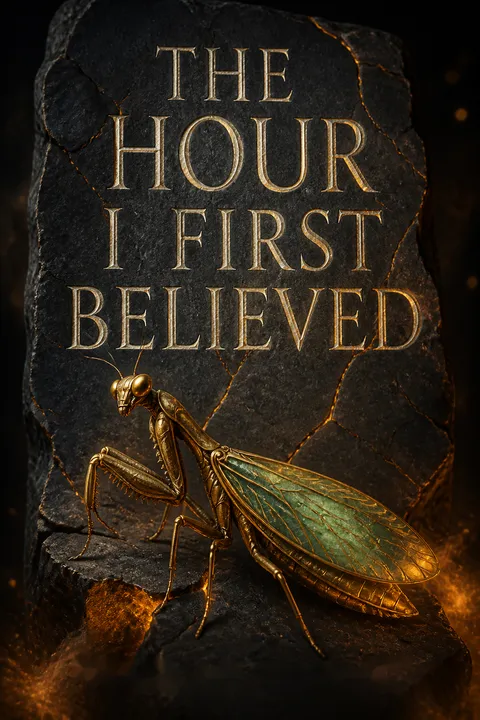
Their son is named Caelum Morgan Seaberry, joining Caelum’s name to the brother Jesse lost. Caelum also tattoos a praying mantis on his calf, honoring the creature that has accompanied his memories of childhood and survival. At last, he allows hope to mean responsibility toward the living.
Velvet’s confession turns survival from a private mystery into something she can carry forward, though she does not claim to know why she lived. Her pregnancy does not erase Columbine, Jesse’s grief, or Maureen’s death; instead, the child’s name binds those losses to an act of care. Caelum’s grandfatherhood is earned through repeated presence, not biology alone. The cemetery links Velvet’s grandfather’s craft to the family’s future, while the mantis tattoo gives Caelum a chosen mark rather than an imposed family label. Belief arrives as commitment, not certainty.
Analysis
The novel treats trauma as both event and aftermath. Columbine is not confined to the school: it alters Maureen’s work, Caelum’s marriage, Morgan’s death, the farm’s finances, and the way a classroom hears a student’s restlessness. Yet the story resists turning every later harm into a direct consequence of one catastrophe. Maureen’s drug use contributes to Morgan’s death; Caelum’s failures of attention matter, but they do not make him omnipotent. The distinction between explanation and absolution is essential to the book’s moral seriousness.
Family history works similarly. Documents and DNA correct Caelum’s account of his birth, but biological truth alone cannot determine who loved him or what he owes the dead. Rosemary’s imperfect maternal care, Lolly’s loyalty, and Alden’s damage coexist with the family’s silences. The archive is therefore not a courtroom that produces a final verdict. It is a contested inheritance that Caelum must learn to carry without repeating its evasions.
The novel also scrutinizes institutions that claim to restore order. Schools overlook warning signs, prisons regulate bodies while failing to protect dignity, and military care cannot automatically repair what war damages. Against those systems, the book sets small acts of chosen attention: Maureen holding a dying inmate, Velvet speaking at her mother’s memorial, Caelum teaching incarcerated women, and Jesse sustaining his sobriety. These acts do not undo violence. They make another response possible.
Belief arrives not as certainty about divine design, but as a decision to remain answerable to other people. Caelum cannot solve every mystery or rescue everyone. He can listen, tell the truth, teach, and make room for a child whose name carries grief as well as possibility. The ending offers hope without calling the suffering necessary.
Review Summary
Reviews for The Hour I First Believed are mixed, averaging 3.84/5. Praise focuses on Lamb's powerful portrayal of Columbine's aftermath, PTSD, and emotionally rich character development. Many readers found the novel deeply moving and ambitious in scope. However, common criticisms cite excessive length (700+ pages), an overabundance of plot lines, a tedious doctoral dissertation excerpt, an unlikable narrator, and a lack of editorial restraint. Readers frequently note the novel's potential greatness is undermined by its sprawling, unfocused structure.
People Also Read




Characters
Caelum Quirk
Wounded, searching teacherCaelum is a middle-aged English teacher whose wit and cultural references often protect him from direct feeling. Raised among a troubled father, a rigid grandfather, and the dependable Aunt Lolly, he learns early to keep family pain private. His failed marriages and assault on Paul Hay deepen his suspicion that vulnerability invites humiliation. He cares intensely but often expresses care through advice, anger, or belated action rather than tenderness. His work with students, his fascination with family records, and his attempts to support Maureen reveal a man trying to understand how much responsibility one person can bear for another. His defining struggle is not finding a perfect explanation for catastrophe, but deciding whether to remain emotionally present despite uncertainty.
Maureen Quirk
Nurse carrying old woundsMaureen is a trained nurse whose instinct is to notice vulnerability and respond with practical care. Her childhood was unsettled by her parents’ separation and her father’s sexually confusing behavior, experiences she rarely discusses. In adulthood, she helps needy students, especially Velvet, and works among elderly patients, often giving more than her job requires. Her marriage to Caelum is shaped by an earlier affair and his difficulty trusting her, but she wants genuine closeness rather than surveillance or management. Maureen’s compassion coexists with a need to control painful memories, and she sometimes hides distress behind professional competence. Her relationship with Caelum becomes a struggle to accept help without surrendering her independence.
Velvet Hoon
Defiant, gifted survivorVelvet is an emancipated teenager whose abrasive clothes, tattoos, and sharp language keep adults at a distance. Her history includes neglect, abuse, foster care, and repeated abandonment, so distrust serves as both armor and test: she pushes people away to see whether they will leave. Caelum recognizes her talent when he reads her writing, and Maureen offers her a form of maternal attention she has rarely known. Velvet’s stories first arrive as violent fantasies, then begin to draw on lived experience. She is funny, resourceful, and fiercely self-protective, but her offers of sex and sudden disappearances reveal how early exploitation has distorted her ideas of affection and safety.
Aunt Lolly Quirk
Farm keeper and family anchorLolly is Caelum’s aunt, a practical farmer and longtime correctional officer shaped by her grandmother’s reforming ideals. She is blunt, funny, and more comfortable showing love through work than sentimental declarations. After her mother died giving birth to her twin brother, Alden, Lolly helped hold the family together and became a steady presence for Caelum when his father could not be one. She is loyal to the women in her care and resists a prison system that increasingly values control over dignity. Her attachment to the farm and its history is not mere nostalgia: it is a way of preserving the people and principles she believes others are ready to discard.
Janis Mick
Scholar uncovering buried historyJanis is a women’s studies graduate student displaced from New Orleans by Hurricane Katrina. She is intellectually energetic, politically engaged, and alert to the ways institutions punish women while calling the punishment reform. The farmhouse archives give her a chance to resume scholarly work after losing her university, home, and community. She and Caelum develop an emotionally charged closeness, but both understand that their loneliness does not make their choices harmless. Janis’s ambition and her marriage to Moses pull in different directions, especially around career and motherhood. Her research helps make an overlooked female reformer legible, while her presence pushes Caelum to see family history as an active force rather than a box of old papers.
Mary Agnes Dank
Restless woman in the marginsMary Agnes is a charismatic, volatile young woman whose life is marked by poverty, unstable relationships, and a talent for reinvention. Under the stage name Jinx Dixon, she enters the world of modeling and the Miss Rheingold promotion, where powerful men and corporate respectability shape her options. Her relationship with Alden Quirk is intense and repeatedly interrupted by family opposition and circumstance. She can be impulsive and manipulative, but she is also a woman denied security in an era that offered few protections to an unmarried mother. The records surrounding her are incomplete, leaving her motives partly obscured and challenging Caelum’s tendency to divide people into heroes and failures.
Alden Quirk
Troubled son and fatherAlden is Lolly’s twin brother and Caelum’s father, a capable farm worker whose return from military service leaves him emotionally altered. He drinks heavily and struggles under the judgment of his own father, while remaining attached to Mary Agnes despite their turbulent history. Alden is neither simply a victim nor simply a failure: his actions reveal tenderness, secrecy, and damaging choices side by side. He is often more articulate than his family remembers, but he rarely explains himself while alive. His silence leaves later generations to reconstruct the consequences.
Ulysses Pappanikou
Old friend with buried truthsUlysses is a longtime friend of Alden and a farm handyman whose life, like Alden’s, is damaged by alcohol and military service. He is unreliable in practical matters but remembers people and events with surprising tenderness. His loyalty to Lolly and Caelum is genuine, though it does not prevent him from making mistakes or hiding what he knows. Ulysses carries the burden of a shared secret for decades, then tries to make amends through the only means he understands: returning to the place where the secret was buried and finally speaking.
Elizabeth Hutchinson Popper
Relentless prison reformerElizabeth, known as Lizzy, is a nineteenth-century abolitionist, nurse, and advocate for incarcerated women. Her letters show a formidable public reformer whose private life includes grief, marital conflict, and failures of protection. She believes women who have been imprisoned can regain dignity, but her ideals are tested by the people she takes into her own home. She is neither a flawless saint nor a simple hypocrite; she can fight injustice in public while failing to recognize harm in her family. Her writing becomes a vital record of the distance between a reformer’s principles and the complicated reality of care.
Lydia Popper Quirk
Matron with a reforming legacyLydia is Lizzy’s granddaughter and the inaugural superintendent of the women’s prison built on Quirk land. As a young woman, she is observant, proud, and often frustrated by her grandmother’s emotional reserve. She grows up amid tangled loyalties, difficult relatives, and a household where painful truths are managed through silence. In adulthood she carries Lizzy’s reforming vision into prison administration, though the full record of her private choices remains incomplete. Her diaries preserve both the promise and the limitations of her family’s ideals.
Moses Mick
Displaced sculptor rebuilding homeMoses is a New Orleans sculptor whose house and studio are devastated by Hurricane Katrina. Resourceful and skilled in construction, he helps turn the farmhouse into a workable home while restarting his business. His easy humor conceals deep grief for his neighborhood and the people he cannot save. Moses loves Janis but differs with her over the future she wants, especially her academic career and the possibility of another child. He is a practical man who tries to repair what can be repaired, even as displacement exposes the limits of work and will.
Jesse Seaberry
Brother seeking sobrietyJesse is Morgan’s older brother, a young man whose addiction and resentment have strained his relationships with his family. He loves Morgan but also envies the praise and apparent ease that surround him. Jesse carries guilt about his brother’s death and knows that his own threats and behavior played a part in the chain of events, though they did not cause the fatal collision. His recovery is fragile and uneven, but he is capable of honesty, loyalty, and change. His relationship with Caelum grows through shared grief and a commitment to sobriety.
Morgan Seaberry
Promising younger brotherMorgan is an accomplished, generous teenager whose mother sees him as her family’s great hope. He is funny and considerate, but the pressure to remain perfect leaves parts of his identity hidden even from those closest to him. His affection for Jesse survives their conflict, and he refuses to reduce his troubled brother to his worst choices. Morgan’s life is presented through other people’s memories, each partial and loving in a different way. The contrast between his public promise and private struggle warns against mistaking achievement for complete knowledge of a person.
Kareem Kendricks
Veteran student in distressKareem is an Iraq veteran returning to college with a prosthetic hand, disrupted family life, and memories he cannot fully control. His restless movement is a survival habit carried into classrooms where others read it as strangeness. He is thoughtful and capable of connecting myth to lived experience, yet he resists the idea that he needs help. His relationship with his father is wounded by abandonment and incompatible expectations. Kareem’s story exposes how a person can appear functional while carrying injuries that family, teachers, and institutions may not know how to recognize.
Alphonse Buzzi
Bakery friend and loyal comicAlphonse is Caelum’s old friend and the proprietor of the Mama Mia bakery. He is insecure around women, devoted to his parents, and capable of turning even grief into a joke without losing his affection for people. His long search for a particular Mustang gives him a harmless private obsession, while his generosity shows itself in practical acts: food, transport, and help when Caelum is overwhelmed. Beneath his teasing persona is a loyal friend who repeatedly offers Caelum companionship when the latter is most inclined to refuse it.
Dr. Beena Patel
Marriage therapist and guideDr. Patel is a direct, perceptive therapist who refuses to let Caelum and Maureen make one person solely responsible for their marriage. She gives them private signals for asking to be heard or comforted, then challenges Caelum’s sarcasm and Maureen’s guardedness. Her influence extends beyond couples counseling as she later helps Caelum recognize fear beneath his anger. Patel is compassionate without pretending that insight can eliminate pain. She offers tools, not rescue, and expects her clients to do the difficult work of using them.
Roswell Hutchinson
Damaged uncle in the archiveRoswell is Lizzy Popper’s troubled brother, a man damaged by violence and addiction. He returns to her household in need of care, but the records hint that his presence places a vulnerable girl at risk. His history shows how someone harmed by earlier circumstances can also become a source of harm.
Father Ralph Brazicki
Priest and former teammateRalph was one of Caelum’s high-school track teammates before he became a priest and prison chaplain. His warm, inclusive services give Maureen and other inmates a rare communal space. He is practical as well as spiritual, arranging a family Mass that allows prisoners to share a meal with visitors.
Peppy Schissel
Rheingold driver with memoriesPeppy is a former Rheingold chauffeur whose long memory reveals how the company managed the Miss Rheingold contest. He is proud of the brewery’s history and loyal to the people who employed him, loyalties that shape what he first withholds and later explains. His recollections give Caelum a human route into a public scandal.
Plot Devices
Bride Lake Corn Maze
A family-shaped labyrinthCaelum’s father designs the corn maze on the Quirk farm, and its yearly visitors are meant to lose their way before reaching the center. For Caelum, the maze holds memories of childhood, his father’s secret visits, stolen food, and the family he believed himself to belong to. Its paths give the novel a physical model for how inherited secrets confuse cause and consequence. Later, Caelum walks the abandoned field while trying to understand his mother and his own anger. The maze is not a puzzle with one clean solution; its meaning changes as Caelum gains new information and sees the family members inside it more fully.
The Candle Signal
A fragile request for closenessIn couples therapy, Caelum and Maureen create private, nonverbal signals for needs they find difficult to voice. A lit candle means Maureen wants him to come upstairs and be with her. On the night before Columbine, she lights one while Caelum stays downstairs. The signal makes their emotional distance concrete, then becomes a measure of how hard it is for him to respond to vulnerability. It also contrasts with the impersonal signals around them: school alarms, prison rules, and the noises that trigger Maureen’s memories. The candle asks for intimacy without guaranteeing that either partner knows how to give it.
The Family Archives
Documents that reopen the pastLolly’s stored letters, diaries, birth records, newspaper clippings, photographs, and saved locks of hair gradually connect Caelum’s present to several generations of family choices. Janis reads the documents as a scholar; Caelum encounters them as evidence about the people who raised him and the mother he was told he had. The papers do not provide a perfect record. Some are incomplete, deceptive, or difficult to interpret, so each discovery raises new questions as well as answering old ones. Their importance lies in making silence legible: the archive preserves both the reformers’ public ideals and the private harms they did not know how to confront.
The Praying Mantis
A recurring emblem of attentionThe praying mantis enters Caelum’s life through childhood stories, a classroom egg case, and a small encounter in an airport. It links his memory of a murdered janitor’s lesson about another culture’s sacred insect to moments when he is tempted to dismiss what he does not understand. The creature reappears in the history of Caelum’s own childhood, in the discovery of his mother’s past, and finally as a tattoo he chooses to carry. Its recurrence does not prove a supernatural plan. Instead, it offers Caelum a modest emblem of attention, patience, and the possibility that life may emerge from what seemed dormant.
Chaos and Bifurcation
Small disturbances, altered livesA chaos theorist Caelum meets on a plane gives him a vocabulary for sudden changes in complex systems. The concept returns as he considers how one event can redirect many lives: a missed warning, an assault, a gunshot, a missed visit, a collision on a road. Caelum is drawn to the theory because it promises a pattern, but the story never lets it excuse human choices or turn tragedy into destiny. It becomes useful only when he accepts both truths at once: small events matter, and no one can know every outcome in advance. The idea shapes his questions without supplying a final answer.
About the Author


Download PDF
Download EPUB
.epub digital book format is ideal for reading ebooks on phones, tablets, and e-readers.








