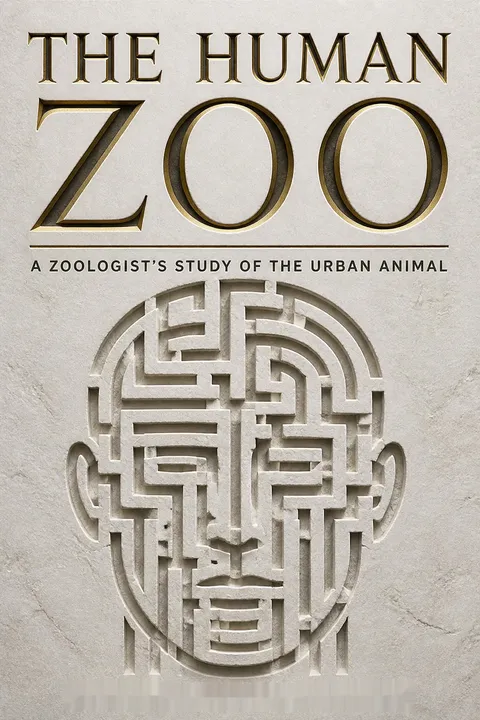


Key Takeaways
Treat the city as a human zoo, not a natural habitat
Security has a price. Morris’s central analogy is that modern cities resemble captivity more than the wild: they provide food, shelter, and protection, while crowding people into conditions their bodies and social instincts did not evolve for. He contrasts a small ancestral band with a city of millions occupying the same space. Human beings, he argues, have not biologically caught up with urban life; they manage it through learning and adaptability.
Comfort can frustrate. The city also gives people time and safety to explore, invent, and specialize. But density, noise, monotony, and social isolation can strain those same people. The point is not to abandon civilization. It is to recognize that material comfort alone does not meet every human need.
The analogy is useful because it shifts attention from individual weakness to environmental design. A person who struggles in a crowded, monotonous setting may be responding normally to conditions that demand constant adaptation. That insight connects with modern environmental psychology, which studies how noise, density, and access to restorative spaces shape wellbeing. The zoo comparison has limits, however: people also build relationships, alter institutions, and choose among environments in ways captive animals cannot. It works best as a warning against assuming that technological comfort automatically equals psychological fit.
Farming's surplus turned personal tribes into vast societies of strangers
Surplus changed the social scale. Morris traces urban life to farming. Once cultivated crops and domesticated animals provided reliable extra food, some people could specialize instead of spending all their time finding food. Villages and towns grew, then connected into larger political societies. In the author’s account, this shift happened far faster than biological evolution could reshape people for mass society.
Strangers needed glue. In a small band, members know one another personally. In a large society, most neighbors are unknown, so customs, law, language, religion, and public ceremonies help people feel part of a shared group. These bonds can unite a community, but they can also distinguish it from outsiders. Morris sees a lasting tension between the security of belonging and the impersonality of scale.
The transition from face-to-face groups to large institutions remains a powerful way to think about social trust. Shared rituals can create belonging among people who will never meet, much as civic ceremonies and common symbols do today. Yet cohesion is not always benign: the same boundary that builds solidarity can exclude minorities or dissenters. The argument is strongest when treated as a description of competing social functions, not as proof that humans can only cooperate in small groups. Institutions can support trust across distance, even if they cannot make every relationship intimate.
Give status-seeking smaller, constructive arenas before it becomes destructive
Rank never disappears. Morris compares human status competition with dominance behavior among baboons. Leaders display authority, enforce rules, reward allies, protect weaker members, and confront outside threats. In a large society, few people can reach the top, so many seek rank in smaller circles such as professions, sports, hobbies, and local communities.
Badges can imitate power. Morris calls a genuine sign of achieved rank a status symbol, and a costly display of rank one hopes to attain a dominance mimic. Someone stretching their finances for an impressive car, in his example, may be signaling aspiration rather than actual influence. Frustrated ambition can also be redirected toward safer targets, such as family members, pets, or subordinates. Smaller groups may give that ambition an outlet, though they do not erase the underlying competition.
This account anticipates the idea of costly signaling: visible possessions can communicate not only wealth, but a claim to social standing. It also explains why hobbies and clubs can matter far beyond their stated activities. Still, not every purchase is a bid for rank, and not every hierarchy is a disguised dominance contest. Status can reflect expertise, service, or earned trust. The practical distinction is whether an arena rewards contribution and skill, or mainly encourages people to perform superiority through consumption and control.
Treat sex as bonding, pleasure, relief, and rank signaling, not reproduction alone
One behavior, many jobs. Morris organizes human sexual behavior into ten functions. He groups together reproductive purposes, forming and maintaining a pair bond, and easing physiological tension. He also describes sex as exploration, pleasure, a response to boredom or stress, a commercial exchange, and a way of displaying dominance. One encounter can serve more than one purpose, and these purposes can pull against each other.
Bonds complicate novelty. Morris emphasizes that sexual activity can strengthen a pair bond even when neither partner intends that result. He argues that casual encounters may therefore create mismatched attachment, while novelty pursued outside a relationship can unsettle family life. His wider point is that urban societies have expanded sexual possibilities without removing the emotional and parental demands that relationships can carry.
Separating behavior from function is a useful move: the same act can express affection, seek reassurance, relieve tension, or signal power. That makes simplistic moral categories less informative than asking what a behavior is doing in a particular relationship. The caution is that Morris treats pair bonding and gender roles as more biologically uniform than contemporary understanding supports. Sexual relationships vary across individuals and cultures. A functional lens should widen interpretation, not turn one historical model of family life into a universal rule.
Interrupt group prejudice before labels turn strangers into legitimate targets
A visible difference can become a boundary. Morris argues that groups often treat a conspicuous trait as evidence that its owners belong to a hostile out-group. He illustrates the process with an imaginary green-haired person: one person’s bad act becomes a stereotype about everyone with green hair, and later hostility seems to confirm the stereotype when targets defend themselves.
Crowding sharpens conflict. In an experiment Morris describes, two territorial sticklebacks threatened one another peacefully when their nesting areas were far apart. As the nests were moved closer, the fish escalated into fighting; when space increased, calm returned. Morris connects this to intergroup violence and argues that personal contact can weaken false assumptions. His discussion of racism stresses that appearance is not evidence of a person’s character or ability.
The green-hair sequence captures how stereotypes become self-reinforcing: a group is treated as dangerous, responds defensively, and then gets blamed for the reaction. Social psychology likewise finds that categories can shape perception before people know much about one another. Personal contact can help, especially when people meet as equals around shared goals, but contact alone cannot undo laws, unequal resources, or organized discrimination. The book’s central warning remains valuable: explain hostility through history and incentives, rather than treating a visible trait as its cause.
Take early attachment seriously, but do not mistake one imprint for destiny
Some learning happens fast. Morris defines imprinting as a rapid, durable attachment formed through exposure during a sensitive period, rather than through repeated rewards. His clearest example is the newly hatched bird that follows the first large moving object it sees. In a well-known type of experiment described in the book, that object can be an orange balloon, which the chick later prefers to its unseen biological mother.
Human bonds are more complex. Morris applies the idea to attachment between infants and caregivers, adult pair bonds, and mistaken attachments to objects or substitute partners. He argues that early experience can shape later relationships. But his extension of imprinting to human sexuality, including fetishism and homosexuality, reflects dated assumptions and should not be treated as established explanation. The broader lesson is that early relationships matter, not that a single experience fixes a person’s future.
The bird example makes a subtle point memorable: early attachment is not simply a transaction in which care is repaid with closeness. Modern attachment research also recognizes that early caregiving can influence later expectations about safety and relationships. Human development, however, is not a one-time imprinting event. It remains responsive to later relationships and circumstances. Morris’s metaphor helps explain the strength of early bonds, but his proposed explanations for adult sexuality overreach what that metaphor can establish.
Give restless minds meaningful stimulation, not endless novelty or empty comfort
Both extremes cause strain. Morris calls the effort to find a workable level of stimulation the Stimulus Struggle. Too little input can lead people or captive animals to invent tasks, repeat unhelpful habits, or seek stimulation from substitutes. Too much can provoke withdrawal and repetitive behaviors that help block out the surroundings.
The zoo supplies examples. One elephant Morris observed consumed more than 1,700 peanuts offered by visitors in a single day, despite already receiving adequate food. Other captive animals invented ways to provoke visitors or repeatedly groomed themselves. Morris sees human parallels in compulsive eating, restless busyness, creative work, and attempts to switch off through alcohol or drugs. His model offers a useful question: is an activity meeting a real need, or filling an uncomfortable gap?
The framework resembles the broader idea that people function best within a workable range of arousal, though the ideal level depends on the person and the task. It also treats boredom as an active problem rather than simple laziness, which helps explain why people sometimes choose unwise stimulation over none at all. Yet not all restlessness is caused by under-stimulation, and not all high stimulation is harmful. Social isolation, illness, or financial pressure may matter more than the sensory environment. The model is a prompt for inquiry, not a diagnosis.
Protect childhood curiosity from institutions that reward answers over discovery
Creativity begins with exploration. Morris describes children and young chimpanzees investigating familiar objects in new ways. A chimpanzee given a chair might test its shape, climb over it, and turn it into something like gym equipment. Creativity, in this account, comes from exploring, learning, and combining what has been learned to solve a new problem.
Security gives curiosity room. Morris distinguishes exploration prompted by crisis from exploration made possible by safety. He argues that schools and other authorities often encourage originality in principle while punishing it when it challenges established rules. Exams and initiation-like school rituals may build group identity, he suggests, but they do not necessarily nurture invention. Adults who want creative learners must allow questions and experiments to have consequences, not merely decorate lessons with the word creativity.
The account connects play with learning through experimentation: curiosity gathers material, while reflection and recombination turn it into an idea. Contemporary education research similarly emphasizes the value of autonomy and psychologically safe classrooms, where mistakes do not automatically bring humiliation. Structure still matters; children also need knowledge, guidance, and practice. The tension is not between rules and creativity, but between rules that make exploration possible and rules that protect authority from being questioned.
Build cities with landmarks, variation, and places for real social contact
A city is more than shelter. Morris argues that dense urban life offers the stimulation and opportunity people seek, but can also reduce privacy, movement, and personal connection. He criticizes repetitive housing and planned spaces that feel interchangeable, arguing that people need recognizable routes, distinctive features, and chances to encounter others.
Design for lived experience. A straight path may be efficient on a drawing board yet monotonous to walk. Morris contrasts geometric layouts with environments that reveal changing views and memorable landmarks. He also notes that city residents seek relief through parks and trips to the countryside, though these cannot fully restore the space of ancestral life. His recommendation is not to retreat from cities, but to make urban environments more varied and navigable for the people who use them.
This is a strong reminder that people experience architecture in motion, through routes, thresholds, views, and encounters, rather than as an image viewed from above. Environmental psychology and urban design both attend to legibility, public space, and the quality of everyday pedestrian experience. Still, visual variety alone cannot solve housing inequality or replace reliable transit, accessible streets, and safe public spaces. The best version of Morris’s challenge asks planners to measure a city not only by density and cost, but by how it feels to inhabit.
Analysis
The Human Zoo is a sweeping biological interpretation of modern society. Its narrative runs from farming’s food surplus to cities, social rank, sexuality, group conflict, childhood attachment, stimulation, and creativity. Across these subjects, Morris returns to one provocation: people carry instincts shaped in small, face-to-face groups into environments built for millions. Zoo animals serve as a recurring comparison, making abstract stress visible through pacing, overfeeding, isolation, and disturbed social behavior.
The book’s strongest contribution is its insistence that behavior is shaped by environments, not just by individual character. It links crowded settings to status competition, anonymous group boundaries, and the search for stimulation. The analogies are memorable, and sometimes illuminating, but they do not by themselves establish that urban behavior has the same cause as animal behavior in captivity. The biological lens can also make historically produced arrangements, including inequality and institutional power, appear more inevitable than they are.
The text needs to be read as a 1969 work, not a current scientific reference. Its racial categories and population estimates are outdated, and its claims about gender, sexuality, and the causes of particular sexual behaviors reflect assumptions that are not reliable guides to present understanding. Its warnings about population growth and social breakdown are likewise predictions, not evidence of a settled biological law. These limitations matter because the book often moves quickly from a plausible animal comparison to a broad claim about human nature.
Its durable value lies less in treating humans as captive animals than in asking what modern settings demand of people. Do institutions provide belonging without scapegoats? Does urban design allow contact and variety? Can education protect curiosity while teaching knowledge? Those questions preserve Morris’s most useful insight while leaving room for history, culture, and individual difference to shape the answers.
Review Summary
The Human Zoo explores human behavior in cities, comparing it to animals in captivity. Morris argues that urban life creates unnatural conditions leading to violence, sexual deviance, and psychological issues. While some praise its insights, others criticize its outdated views on gender and sexuality. The book discusses topics like status-seeking, tribalism, and overstimulation in urban environments. Readers find it thought-provoking but note its 1960s perspective limits its relevance today. Overall, it remains a controversial but influential work on human nature and society.
People Also Read








Glossary
Human Zoo
Urban life as captivityMorris’s central metaphor for modern city life. Like a zoo, the city supplies food, shelter, and protection, but confines people in crowded, artificial surroundings unlike those in which their ancestors evolved. The metaphor highlights the psychological costs of density and monotony, as well as the stimulation and security that make urban life attractive.
Super-tribe
Large, impersonal societyMorris’s term for a society larger than the small, personal groups in which human social behavior evolved. In a super-tribe, most members are strangers, and shared laws, customs, language, and institutions help create unity. The term describes both the benefits of large-scale cooperation and the strains of living among people one does not know personally.
Super-status
Status competition at scaleMorris’s term for the enlarged status struggle produced when small social groups grow into vast, impersonal societies. People retain a desire for rank, but only a few can reach the top of the whole society. Individuals therefore seek standing in smaller professional, local, social, and recreational groups.
Dominance mimicry
Imitating rank through displayMorris’s term for displaying possessions or behaviors that suggest a higher social rank than the person has achieved. He distinguishes this from a status symbol, which reflects a level of standing already attained. In his account, expensive purchases beyond one’s means can function as dominance mimics, though they do not guarantee greater power or influence.
Status Sex
Sexual signals of rankMorris’s term for sexual behaviors or symbols used to communicate dominance, submission, or social power rather than to reproduce or form a pair bond. He describes examples ranging from animal displays to human gestures, sexual boasting, and phallic imagery. The concept is part of his broader argument that behavior can take on functions beyond its original biological role.
Imprinting
Rapid, lasting attachmentMorris uses this term for a form of learning in which exposure during a sensitive period creates a strong attachment that may persist without repeated rewards. His clearest examples come from young birds that follow an early moving object as though it were their mother. He extends the idea to human attachment, while treating human development more simply than current evidence warrants.
Mal-imprinting
Attachment to an unsuitable targetMorris’s term for imprinting directed toward the wrong parent, species, partner, or object. He describes young animals raised by another species and some human sexual fixations as examples. The concept captures how early experience may shape later attachment, but the book’s explanations of adult sexuality through mal-imprinting should not be treated as established science.
Stimulus Struggle
Seeking a workable stimulation levelMorris’s name for the effort to find an adequate level and variety of input from the environment. Too little stimulation, in his account, can lead to invented activity, repetition, or the use of substitutes. Too much can prompt withdrawal or repetitive behaviors that reduce exposure. He applies the model to both captive animals and city dwellers.
Super-normal stimuli
Exaggerated signals that attractMorris uses this term for artificially heightened versions of cues that naturally attract attention or trigger behavior. He discusses animal experiments in which exaggerated eggs or bright markings draw stronger responses than ordinary ones, then applies the idea to human cosmetics, fashion, advertising, and design. The concept also helps explain why amplified cues can compete for attention.
Childlike adult
Adult who preserves curiosityMorris’s term for a person who carries childhood exploration and inventiveness into adult work. The child investigates and tests; the childlike adult combines experience with continued curiosity to produce new ideas. Morris contrasts this with adults who rely on familiar routines and argues that education and authority can either encourage or suppress this exploratory disposition.
FAQ
What's The Human Zoo about?
- Study of Urban Life: The Human Zoo by Desmond Morris examines the behavior of humans in urban settings, comparing them to animals in captivity. It explores how city life impacts aggressive, sexual, and parental behaviors.
- Human vs. Animal Behavior: Morris argues that behaviors in city life, such as violence and sexual deviance, mirror those of captive animals. He suggests cities are "human zoos" rather than "concrete jungles."
- Zoological Perspective: The book uses a zoologist's lens to understand human behavior, emphasizing the importance of recognizing our biological roots to navigate urban complexities.
Why should I read The Human Zoo?
- Insight into Urban Behavior: The book offers a unique perspective on the stresses and behaviors of city life, relevant to anyone living in urban environments.
- Understanding Human Nature: It delves into the biological and evolutionary aspects of human behavior, explaining why we act as we do in crowded settings.
- Cultural Relevance: Morris's observations apply globally, not just to Western cultures, making it a universal read.
What are the key takeaways of The Human Zoo?
- Human Zoo Concept: Cities function as "human zoos," where individuals exhibit stress-induced behaviors similar to captive animals, challenging the notion of urban life as a natural evolution.
- Impact of Overcrowding: Overcrowding leads to increased aggression and social dysfunction, paralleling captive animal behavior.
- Need for Understanding: Understanding our biological heritage is crucial for coping with urban challenges and fostering healthier social interactions.
What are the best quotes from The Human Zoo and what do they mean?
- "The city is not a concrete jungle, it is a human zoo.": This encapsulates the book's thesis, suggesting urban environments lead to abnormal behaviors akin to those in captive animals.
- "The modern human animal is no longer living in conditions natural for his species.": Highlights the disconnect between our evolutionary past and urban life, emphasizing adaptation needs.
- "The stakes are rising higher all the time, the game becoming more risky.": Reflects the increasing pressures of urban living and the consequences of ignoring biological instincts.
How does Desmond Morris compare city dwellers to zoo animals?
- Behavioral Parallels: Morris draws comparisons between city dwellers and zoo animals, particularly in aggression and social interactions under stress.
- Captivity Effects: He argues that city dwellers experience psychological strains similar to those of animals in captivity.
- Need for Adaptation: The comparison highlights the need for humans to adapt behaviors to cope with urban environments, much like animals in captivity.
What is the significance of "tribes and super-tribes" in The Human Zoo?
- Evolutionary Context: Humans evolved as tribal animals in small groups, contrasting with modern super-tribes of large cities.
- Social Dynamics: The shift from tribes to super-tribes leads to impersonal relationships and increased competition for status, causing social dysfunction.
- Coping Mechanisms: Understanding this shift is crucial for developing coping mechanisms for modern urban life.
How does The Human Zoo address the concept of status and super-status?
- Status Struggles: Status struggles are inherent in social groups but become more complex in super-tribes due to larger populations.
- Dominance Displays: Individuals display status through aggression and sexual behavior, leading to conflict.
- Psychological Impact: The pressure to maintain or improve status can lead to mental health issues in urban life.
What role does sexual behavior play in the context of urban living according to The Human Zoo?
- Multi-functional Sexuality: Sexual behavior in urban settings serves functions beyond reproduction, including stress relief and social bonding.
- Impact of Overpopulation: Overcrowding can lead to sexual dysfunction and confusion, complicating relationships.
- Cultural Influences: Societal norms significantly shape sexual behavior, often leading to misunderstandings in relationships.
How does Desmond Morris suggest we cope with the challenges of urban living?
- Understanding Biological Roots: Morris advocates understanding our biological heritage to navigate urban stresses effectively.
- Adapting Behaviors: He encourages adapting behaviors to fit urban environments, recognizing the unnatural conditions imposed by city living.
- Fostering Community: Fostering community and connection can mitigate isolation and stress in large cities.
How does Morris define the concept of "in-groups" and "out-groups" in The Human Zoo?
- Social Categorization: In-groups are those with which individuals identify, while out-groups are perceived as different, leading to biases.
- Physical Badges of Identity: Visible traits serve as "badges" leading to discrimination, perpetuating stereotypes.
- Self-Fulfilling Prophecy: Treatment of out-group members can lead to behaviors confirming negative expectations, creating a cycle of prejudice.
What is the "Stimulus Struggle" as described in The Human Zoo?
- Need for Stimulation: The "Stimulus Struggle" refers to the human drive for stimulation in environments lacking ancestral challenges.
- Balancing Act: Finding a balance between under-stimulation and over-stimulation is crucial for well-being.
- Creative Exploration: Engaging in creative activities fulfills the need for stimulation, leading to personal growth and innovation.
How does The Human Zoo relate to contemporary social issues?
- Racial Tensions: In-group/out-group dynamics provide a framework for understanding racial and social tensions.
- Urbanization and Isolation: The book addresses urban living challenges, including isolation in crowded environments.
- Mental Health: The "Stimulus Struggle" concept is relevant to mental health discussions, informing approaches to well-being.
About the Author

Download PDF
Download EPUB
.epub digital book format is ideal for reading ebooks on phones, tablets, and e-readers.








