Key Takeaways
1. Newton's Universal Order Established a Mathematical Cosmos
The theory that corresponds exactly to so nonuniform a motion through the greatest part of the heavens, and that observes the same laws as the theory of the planets, and that agrees exactly with exact astronomical observations cannot fail to be true.
Foundational triumph. Isaac Newton's Philosophiae Naturalis Principia Mathematica (1687) laid the groundwork for modern physics, establishing universal laws of motion and gravitation. His inverse square law, which stated that gravitational force weakens with the square of distance, explained why celestial objects moved in observed paths. This mathematical framework was a decisive climax in the Scientific Revolution, replacing qualitative explanations with rigorous quantitative laws.
Halley's catalyst. Edmond Halley, a friend and colleague, played a crucial role in bringing Newton's work to light. After a challenge from Sir Christopher Wren, Halley pressed Newton on the inverse square law's implications for planetary orbits. Newton's instant reply—"An ellipse"—and subsequent, more rigorous calculations, spurred him to write Principia, a monumental work that Halley personally financed and edited.
Cosmic proof. Newton's theory not only explained known planetary orbits but also successfully predicted the parabolic path of the Great Comet of 1680. This demonstrated that the same laws governing an apple's fall on Earth applied throughout the cosmos, from Jupiter's moons to distant comets. Halley's poetic assessment, "We know the immovable order of the world," captured the profound sense of understanding Newton had bestowed upon humanity.
2. Laplace's Celestial Mechanics Solidified Deterministic Prediction
We may regard the present state of the universe as the effect of its past and the cause of its future.
Expanding Newton's vision. Pierre-Simon Laplace, a brilliant French mathematician, dedicated his life to extending Newton's foundational program. His monumental Celestial Mechanics (five volumes, 1,500 pages) aimed to provide a comprehensive, mathematically precise account of the solar system's interactions, demonstrating that universal gravitation could explain all celestial phenomena.
Resolving anomalies. By the late 18th century, some planetary motions, like Jupiter's acceleration and Saturn's deceleration, seemed to defy simple Newtonian analysis. Laplace, through virtuoso mathematical skill, showed these were not flaws in Newton's laws but rather long-period gravitational resonances, unfolding over 929-year cycles. This confirmed that the solar system was stable and self-regulating, needing no divine intervention.
The "demon" of determinism. Laplace's work led him to the concept of determinism, famously articulated through his "demon" thought experiment. An intellect knowing all forces and positions at one moment could predict the entire future and past of the universe. This vision, while not denying God's existence, rendered a deity superfluous to the universe's ongoing operation, a stark contrast to Newton's own views.
3. Neptune's Discovery Validated Newtonian Science's Predictive Power
The discovery of Neptune—driven by the mathematical interpretation of fundamental laws, so exactly as to reveal itself within hours of the start of the search—was recognized at once as both a stunning display of individual genius and a triumph for a whole way of knowing the world.
Uranus's misbehavior. William Herschel's accidental discovery of Uranus in 1781 expanded the known solar system, but the new planet soon proved problematic. Its observed orbit deviated from predictions, especially when historical "star" sightings were included. This anomaly threatened the perceived perfection of Newton's laws, prompting some to question the universality of gravity itself.
Le Verrier's challenge. Urbain-Jean-Joseph Le Verrier, a rising French mathematical astronomer, took on the task of resolving Uranus's orbital discrepancies. He meticulously recalculated all known gravitational influences, systematically eliminating other explanations like resisting ether or giant moons. His conclusion: an unknown, more distant planet must be perturbing Uranus.
A triumph of the pen. In 1846, Le Verrier published precise predictions for the new planet's location, mass, and appearance. He sent his findings to Johann Gottfried Galle in Berlin, who, on September 23, 1846, pointed his telescope to the specified patch of sky. Within hours, Galle found a new planet, later named Neptune, exactly where Le Verrier had predicted. This stunning validation cemented Newtonian science as an unparalleled engine of discovery.
4. Mercury's Orbit Presented a Stubborn, Unexplained Anomaly
A century and a half later, the one irreducibly extraordinary fact of this work remains how incredibly small an “error” Le Verrier uncovered.
Le Verrier's grand project. Emboldened by Neptune's success, Le Verrier embarked on a monumental project: to recalculate the entire solar system's dynamics with unprecedented precision. He aimed to reconcile all observations with Newtonian gravitation, identifying any remaining anomalies as clues to undiscovered phenomena. This ambitious undertaking would take over a decade.
The Mercury problem. Le Verrier's meticulous re-examination of Mercury's orbit, using centuries of transit observations, revealed a persistent discrepancy. The planet's perihelion (the point closest to the sun) was advancing faster than predicted by the gravitational tugs of all known planets. This "precession of the perihelion" was a tiny but undeniable error.
Thirty-eight arcseconds. Le Verrier calculated that Mercury's perihelion advanced at a rate of 565 arcseconds per century. After accounting for the gravitational influence of Venus, Jupiter, Earth, and other known bodies (totaling 526.7 arcseconds), a residual 38 arcseconds per century remained unexplained. This minuscule but significant deviation, far exceeding observational error, indicated a fundamental gap in the understanding of the solar system.
5. The Hypothetical Planet Vulcan Emerged as the Logical Solution
According to this hypothesis, the mass sought should exist inside the orbit of Mercury.
A familiar solution. For Le Verrier and his contemporaries, the solution to Mercury's anomaly seemed obvious, following the precedent of Neptune. If an unexplained gravitational tug existed, it must be caused by an unseen mass. Le Verrier proposed either a new planet, or a belt of smaller asteroids, orbiting inside Mercury's orbit, hidden by the sun's glare.
Lescarbault's "discovery." In December 1859, just months after Le Verrier's announcement, an amateur astronomer, Dr. Edmond Modeste Lescarbault, wrote to Le Verrier claiming to have observed a small, dark spot transiting the sun in March of that year. Le Verrier, despite initial skepticism, personally visited Lescarbault, meticulously interrogated him, and ultimately validated his observation.
The birth of Vulcan. Le Verrier swiftly calculated a preliminary orbit for Lescarbault's object, suggesting it completed a revolution in just under twenty days. This "discovery," amplified by Le Verrier's immense reputation, ignited planet fever. The new intra-Mercurian body was named Vulcan, after the Roman god of the forge, fitting its fiery proximity to the sun. It seemed Newtonian science had triumphed again.
6. Despite Repeated Searches, Vulcan Remained Elusively Unseen
The planet Vulcan, after so long eluding the hunters, showing them from time to time only uncertain traces and signs, appears at last to have been fair run down and captured.
Initial enthusiasm and false positives. Vulcan's "discovery" spurred a flurry of excitement and claims of prior sightings, much like Uranus and Neptune. Rupert Wolf, a sunspot expert, compiled a list of 21 potential Vulcan transits from old records. Radau used some of these to predict new transits, but systematic searches in the Southern Hemisphere yielded no results.
Eclipse expeditions and null findings. Solar eclipses offered the best chance to spot Vulcan, as the sun's glare would be temporarily blocked. Benjamin Apthorp Gould, a pioneering astrophotographer, extensively photographed the 1869 eclipse, finding nothing. William Denning organized systematic searches in 1869, 1870, and 1871, recruiting dozens of observers, but Vulcan stubbornly refused to appear.
The 1878 eclipse and Watson's claim. The 1878 total solar eclipse in Wyoming became a major event for Vulcan hunters. James Craig Watson, a respected asteroid discoverer, claimed to have seen two new objects near the sun. His "discovery" was widely reported, but other prominent astronomers, including Simon Newcomb, found nothing. C.F.H. Peters later debunked Watson's sighting, arguing he had simply misidentified known stars. By the 1880s, the astronomical community largely abandoned the idea of a substantial intra-Mercurian planet.
7. Persistent Anomalies Challenged the Scientific Method's Ideals
No matter how elegant a theory is, its predictions must agree with experimental results if we are to believe that it is a valid description of nature.
The dilemma of absence. Vulcan's repeated failure to appear, despite its logical necessity within the Newtonian framework, created a profound scientific dilemma. The "scientific method" dictates that theories must be modified or discarded if their predictions are incompatible with observation. Yet, Newton's theory was overwhelmingly successful everywhere else.
Ad hoc explanations. Rather than abandoning Newton, scientists proposed various ad hoc solutions for Mercury's anomaly:
- An oblate (bulging) sun, which was disproven by observation.
- Rings of matter or dust near the sun, which would have been visible or affected other planets.
- Minor tweaks to Newton's inverse square law (e.g., 2.0000001574 power), which were deemed inelegant and failed to explain other phenomena like the moon's orbit.
The limits of certainty. By the turn of the 20th century, Mercury's precession remained unexplained, but the search for Vulcan had largely ceased. The scientific community, while acknowledging the anomaly, chose to live with it rather than question the bedrock of Newtonian gravity. This demonstrated that even in science, deeply entrenched, successful ideas are not easily relinquished without a compelling alternative.
8. Einstein's "Happiest Thought" Sparked a Relativistic Revolution
If a man falls freely he will not feel his own weight.
Miracle year foundations. Albert Einstein's annus mirabilis in 1905 revolutionized physics with papers on the photoelectric effect, Brownian motion, and special relativity (including E=mc²). Special relativity established that space and time are relative to an observer's motion, challenging Newton's absolute space and time, but it only applied to constant velocity.
The equivalence principle. In 1907, while working at the patent office, Einstein had his "happiest thought": a man in free fall feels no weight. This insight, formalized as the equivalence principle, stated that acceleration and gravity are indistinguishable. It meant that the experience of standing on Earth's surface (feeling weight due to gravity) is equivalent to being in an accelerating rocket in empty space.
Gravity's new context. This principle provided the crucial link to extend special relativity to include acceleration and, by extension, gravity. Einstein realized that if acceleration could bend light and affect the flow of time (as his thought experiments showed), then gravity must do the same. This conceptual leap set him on an eight-year quest to develop a new theory of gravity, one that he privately hoped would explain Mercury's perihelion.
9. Gravity Was Reimagined as the Curvature of Space-Time
The foundations of geometry have physical significance.
Minkowski's space-time. Einstein initially dismissed his former teacher Hermann Minkowski's concept of "space-time"—a four-dimensional union of space and time—as "superfluous erudition." However, as Einstein grappled with extending relativity to gravity, he realized Minkowski's mathematical framework was essential. Space-time was not just a container but an active, dynamic entity.
Gravity bends time and space. Einstein's work in Prague (1911-1912) revealed that gravity must bend light and slow down time. This led to the profound realization that space-time itself must be curved by the presence of mass and energy. Gravity, therefore, was not a mysterious force acting at a distance, but a manifestation of this local curvature.
Riemannian geometry. Marcel Grossman, Einstein's mathematician friend, introduced him to Bernhard Riemann's non-Euclidean geometry, which could describe measurements on curved surfaces. This provided the mathematical tools to express Einstein's physical insight:
- Mass and energy dictate the shape of space-time.
- Objects (like planets) simply follow the shortest paths (geodesics) through this curved space-time.
- What we perceive as gravitational force is merely the sensation of moving along these curved paths, like a hiker climbing an unseen hill.
By 1913, Einstein had a clear physical picture and the mathematical language to describe gravity as the geometry of space-time, a radical departure from Newton's force-based view.
10. Einstein's General Relativity Explained Mercury and Erased Vulcan
The calculation for the planet Mercury yields a perihelion advance of 43 arc seconds per century, while the astronomers assign 45″ +/- 5″ per century as the unexplained difference between observations and the Newtonian theory.
The final push. After years of intense struggle and false starts, including a flawed "draft" theory in 1913-1914 that only accounted for 18 of Mercury's 43 arcseconds, Einstein made a final, furious effort in late 1915. Working in isolation in wartime Berlin, he corrected fundamental errors in his equations, driven by the logical necessity of his vision and the parallel work of mathematician David Hilbert.
A perfect match. In November 1915, Einstein presented his completed field equations of general relativity to the Prussian Academy of Sciences. He then applied them to the problem of Mercury's orbit. The equations, without any ad hoc adjustments, precisely predicted a perihelion advance of 43 arcseconds per century. This number perfectly matched the unexplained anomaly that Le Verrier had identified decades earlier.
Vulcan's demise and a new cosmos. This stunning agreement between theory and observation was a triumph. It meant that no undiscovered planet, no asteroid belt, no other hidden mass was needed to explain Mercury's motion. Vulcan, the logical Newtonian solution, was rendered utterly superfluous—a ghost planet finally laid to rest. Einstein's general theory of relativity not only solved a long-standing astronomical mystery but also fundamentally reimagined the cosmos, replacing Newton's force with the elegant curvature of space-time.
Last updated:
Review Summary
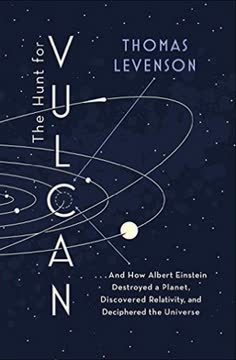
The Hunt for Vulcan explores how 19th-century astronomers, emboldened by Newton's successful theories, spent fifty years searching for a planet between Mercury and the Sun that didn't exist. Reviews praise Thomas Levenson's accessible writing style, making complex physics understandable for lay readers. The book chronicles the journey from Newton through Einstein, who solved Mercury's orbital anomaly with relativity theory, eliminating the need for Vulcan. Readers appreciated the human stories behind scientific discovery and the illustration of how science self-corrects, though some found the content familiar or occasionally dry.
Similar Books