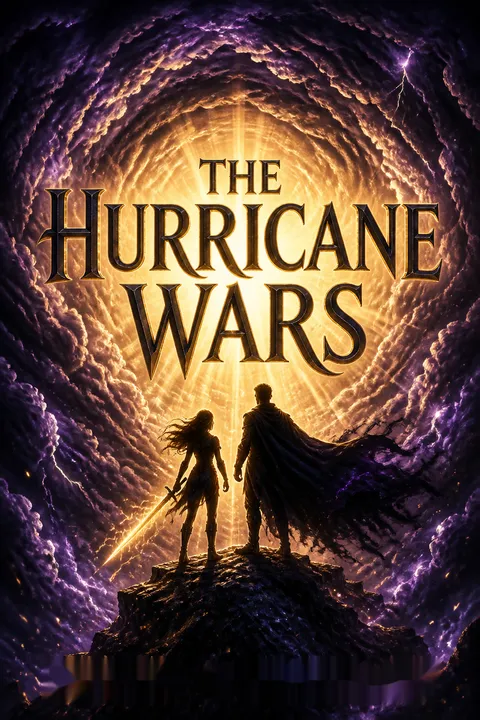


Plot Summary
Prologue
During a winter battle, Alaric, heir to the Night Empire and commander of its Shadowforged, hears unfamiliar magic cutting through the din. On a frozen lake, he finds Talasyn, a Sardovian pilot, wielding light over a fallen soldier.
He blocks her next strike, and their eyes meet across the weapons they have raised. The moment frames their first encounter as the beginning of a conflict neither yet understands.
The opening makes recognition precede explanation. Alaric does not first encounter Talasyn as a princess, a political asset, or even a named enemy; he sees a young fighter whose power should not exist. His interruption turns a battlefield exchange into a personal one, while the frozen lake gives their meeting a precarious quality: neither can advance without risking a fall. By beginning at this charged instant, the story establishes that their bond will grow inside violence, not outside it. Their later intimacy does not erase that origin; it has to contend with it.
Wedding Under Warning Gongs
At a wartime wedding in Frostplum, Talasyn, a twenty-year-old Sardovian helmsman, hears the warning gongs before she can speak with her commander, Ideth Vela. The Night Empire attacks while soldiers and civilians scramble for shelter. Talasyn climbs into her small airship and joins the defense, dodging the heavier enemy craft as she tries to keep them from the city walls.
Her friend Khaede, newly married and secretly pregnant, takes to the air despite Talasyn's alarm. A vastly larger enemy ship appears above the mountains, and the battle turns against Sardovia. Iron shots tear through Talasyn's craft, sending it spinning across the frozen lake and leaving her alone among the ice.
The attack destroys the fragile boundary between private happiness and public danger. Khaede and Sol's wedding is not merely interrupted; it demonstrates that the soldiers' lives have no protected interval in which to imagine a future. Talasyn's immediate response is practical courage, but the crash strips away the structure that makes her feel useful: her regiment, her craft, and the familiar chain of command. The scene begins her movement from competent pilot toward a different kind of fighter. It also gives Khaede's pregnancy emotional weight before grief and separation make that future uncertain.
Gold Against the Shadowgate
Talasyn wakes amid the wreckage and crosses the ice toward Frostplum, only to find a living wall of enemy darkness trapping the fleeing soldiers. When a towering Shadowforged attacks her, terror and rage unlock the light magic she has concealed since childhood. She blasts the armored warrior down and forms a radiant blade, but Alaric steps between them before she can finish him.
The prince forces her into a duel across shifting ice, testing her with shadow weapons while she scrambles to keep pace. Talasyn traps his weapon with a chain of light, headbutts him, and drives a dagger into his shoulder. Then she escapes into the forest, leaving Alaric injured and with proof that Sardovia has a Lightweaver.
Talasyn's power emerges not as a chosen gift but as the body's refusal to be extinguished. Her first use of it is uncontrolled, shaped by immediate threat, and therefore inseparable from survival. Alaric's decision to engage rather than simply kill her gives their relationship its first ambiguity: he is dangerous, yet he does not take the easiest route to victory. Talasyn's escape is a genuine achievement, but it also exposes her to the political machinery that has hunted Lightweavers before. Her hidden identity becomes both a weapon and a liability.
A Wedding Ends in Blood
A retreating carrack brings Talasyn back to the regiment, where she finds Khaede holding Sol's body after a crossbow bolt killed him at the boarding ladder. Talasyn closes his eyes and performs the burial rite because the cleric who married them is dead too. Khaede refuses to leave active service, despite her pregnancy.
In the debrief, Vela explains that Alaric now knows Talasyn is a Lightweaver and will report her to Emperor Gaheris. General Bieshimma describes a light-filled rupture near the Nenavar Dominion, a possible source of power that could strengthen her magic. With the Highlands under threat and diplomatic appeals failing, Vela orders Talasyn to reach the distant Sever alone.
Sol's death turns a shared celebration into a permanent wound for Khaede and gives Talasyn a concrete measure of what the war takes. Talasyn's numbness troubles her because she believes grief should be visible, yet the battlefield has trained her to keep functioning when others die. The mission converts that discipline into a burden: she must leave the friend who is grieving and travel into a country that has repeatedly refused Sardovia's appeals. Vela's order is both military necessity and an act of trust in Talasyn's resourcefulness, even though the risks are greater than her training can prepare her for.
The Highlands Go Dark
During two weeks of intensive instruction, Vela and the Blademaster teach Talasyn to control her light magic and fight more deliberately. Khaede returns from the front alive, but the Highland cities have begun surrendering, and the King on the Mountain is executed by the Shadowforged. The news leaves the Sardovian officers divided between resolve and despair.
Before dawn, Talasyn leaves in an unmarked airship, threading the dangerous Shipsbane ravine and flying low through the forest to avoid enemy patrols. She sees a distant Shadow Sever erupt across the border but keeps moving toward the Eversea. The mission is no longer a speculative advantage: Sardovia is running out of territory, time, and people who believe victory remains possible.
Training gives Talasyn greater control, but it cannot solve the political and material imbalance surrounding her. The fall of the Highlands exposes the limits of individual competence: she can become a better fighter while the country loses ground faster than she can learn. Darius's despair, which Talasyn has already glimpsed, shadows her departure even before its significance is clear. Her choice to leave is therefore not a confident adventure. It is a commitment made because every alternative has narrowed. The sequence makes duty both sustaining and dangerous, since it repeatedly asks Talasyn to abandon the relationships that make survival meaningful.
Nenavar Calls Her Home
Alaric receives a map from an unnamed Sardovian informer and abandons his orders to stop Talasyn reaching the Nenavarene Light Sever. Talasyn arrives first, stunned by the island chain's beauty and by a violet flare unlike any magic she has seen. Hiking inland, she experiences fragments of childhood memory: a golden city, a woman's hands, and a promise of reunion.
The sensations make Nenavar feel less like foreign territory than a place her body recognizes. Alaric reaches the ruined shrine ahead of her final approach. Their fight begins again among the overgrown stones, and the Sever's power suddenly disappears from both of them. Nenavarene soldiers surround the disarmed pair and stun them with violet weapons.
The journey changes the meaning of Talasyn's attraction to Nenavar. What she had dismissed as an orphan's longing becomes a bodily recognition that precedes conscious memory. The unfamiliar violet Sever suggests that the world contains forms of magic outside the war's familiar light and shadow, expanding the story's political and cosmological map at once. Alaric's pursuit makes the two characters collide before Talasyn can interpret what the land is revealing. Their mutual loss of magic also places them on equal ground in a country whose technology can restrain powers both sides assumed to be unstoppable.
The Daughter in Chains
At the Belian garrison, Kaptan Yanme Rapat interrogates Talasyn and explains that the Nenavarene use sariman cages to suppress aethermancy. His questions about her parents unsettle him; when Prince Elagbi arrives, he recognizes Talasyn as his missing daughter. Elagbi names her Alunsina Ivralis, heir to the Dragon Throne, but Talasyn rejects the revelation because it cannot explain why a royal family let her grow up an orphan.
He tells her that a civil war forced her evacuation as an infant and that her mother, Hanan, died before the ship carrying her vanished. Before he can explain more, guards report that Alaric has escaped. Talasyn runs toward the alarms, desperate to return to Sardovia.
The reunion delivers the answer Talasyn has imagined for years in the least comforting form possible: she learns her identity while restrained, among strangers, and in the middle of a crisis. Her first reaction is not joy but suspicion, because a title cannot repair the history of abandonment she has lived. Elagbi's grief establishes that the separation was not a simple rejection, yet it does not immediately create trust. The revelation also complicates Talasyn's sense of home. She has found a family and a homeland, but she remains emotionally bound to the soldiers who raised her as one of their own.
A Shield of Both
Talasyn reaches the garrison grid just as Alaric fights his way past the guards. A Nenavarene soldier fires violet death magic, and Talasyn's light dagger touches Alaric's shadow shield. Their powers merge into a black-and-gold sphere that turns the lethal blast aside. Alaric steals a Nenavarene craft and escapes; Talasyn follows briefly, then abandons the chase to warn her commanders.
Back in the Wildermarch, she tells Vela that Darius has defected, recognizing him as the informer who exposed her mission. Kesath's forces are already massing, and Darius has vanished. Talasyn's warning cannot prevent the next assault, but it reveals that the impending defeat is being aided from within Sardovia's own command.
The shield is the story's first evidence that Talasyn and Alaric can create something neither can produce alone. Its function is protective, a striking contrast to the weapons they have used against one another. The discovery offers hope, but it arrives inside an escape and fails to settle their relationship; Alaric still flees and Talasyn still has to choose her own people. Darius's betrayal changes the military crisis from a problem of enemy strength into a failure of trust within Sardovia. Talasyn's ability to connect the clues gives her agency, even as she arrives too late to reverse the larger momentum.
The Continent Is Lost
Within a month, Kesath's full assault overruns the Coast and Heartland, and Lasthaven falls beneath stormship fire. Talasyn helps the wounded Vela escape a giant Shadowforged, then holds off Alaric's companions while the Sardovians retreat. In their duel, Alaric protects her from a collapsing column with the same joined shield and refuses to kill her, though the Allfold is collapsing around them.
Talasyn reaches the evacuation route, where she discovers that Khaede is missing. The surviving fleet gathers only a handful of damaged ships and leaves the Continent behind, carrying the injured, the grieving, and no clear destination. With Sardovia defeated, Talasyn turns to the only distant country connected to her: Nenavar.
The fall of Lasthaven makes the military stakes brutally concrete: the institutions Talasyn fought for are gone, but her comrades remain scattered and vulnerable. Alaric's refusal to kill her is a consequential break in his role as enemy, though he frames it as a response to a defeated opponent rather than mercy. Talasyn cannot yet trust that gesture, especially while Khaede is missing and the retreat costs more lives. The flight across the Eversea marks a transition from a war for territory to a struggle for refuge. Talasyn's decision to seek Nenavar is both strategic and deeply personal.
Dragons at the Harbor
The battered Sardovian convoy approaches Nenavar with dwindling food and no answer to its request for contact. The Dominion eventually summons a small delegation to the floating castle W'taida, where Talasyn meets Elagbi again and faces his mother, Queen Urduja. Two dragons appear over the fleet, proving that the island kingdom's legendary guardians are real.
Urduja agrees to let Sardovian ships enter the remote Storm God's Eye, but only for a limited period and on the condition that Talasyn stay in the capital as heir to the Dragon Throne. Talasyn accepts because the fleet has nowhere else to go. Her return to family thus secures refuge for her comrades while placing her under the control of a queen she barely knows.
The dragons make Nenavar's isolation understandable: the Dominion possesses defenses that could have altered the war, yet its sovereignty has depended on refusing outside entanglements. Their arrival inspires wonder and anger in Talasyn, who sees how much earlier intervention might have spared. Urduja's offer is not unconditional compassion; it is a calculated exchange of sanctuary for the presence of an heir. Talasyn accepts from obligation to the refugees, not because she has resolved her own feelings about her family. The choice begins her education in a court where protection and control often arrive in the same bargain.
A Crown Offers Marriage
Four months later, Talasyn is learning the customs of Eskaya while remaining cut off from the hidden Sardovian fleet. Alaric, now Night Emperor with Gaheris as regent, arrives with a small Kesathese force and newly developed violet cannons.
The weapons wound a dragon sent to challenge the fleet, proving that Kesath has copied Nenavar's death magic. Alaric demands the Dominion's surrender. Instead, Queen Urduja sends an envoy with a marriage proposal: Alaric will wed Talasyn, the missing heir, preserving Nenavar's formal autonomy while drawing the two powers into alliance.
Gaheris orders his son to accept the political advantage. Talasyn has little choice: the marriage could protect both her new homeland and the refugees hiding beyond the islands.
The threat changes from a remote military danger to an assault on Nenavar's defining defense. The wounded dragon demonstrates that Kesath learns quickly from whatever it conquers, so isolation alone can no longer guarantee safety. Urduja's proposal turns Talasyn into the hinge between two states, but neither her lineage nor her consent gives her full control over the arrangement. Alaric is also constrained by Gaheris, despite wearing the imperial crown. Their coming marriage therefore begins not as romance but as a transaction shaped by unequal power, shared danger, and the need to prevent another war.
Enemies at the Altar Table
When Alaric arrives at the Roof of Heaven for negotiations, the veiled heir steps forward and he recognizes Talasyn beneath her court dress. She makes clear that the treaty has not made them friends, while he suspects the Dominion may be concealing Sardovian forces. Urduja outlines the old conflict between the realms, and Talasyn struggles to reconcile her mother's history with the facts she has only just learned.
The negotiators debate sovereignty, trade, and the bride's treatment. Talasyn's anger repeatedly interrupts the effort to present a united front, while Alaric insists that cooperation must be real. They leave the first meeting without settled terms, each newly trapped in an alliance with the enemy they know best.
The bride reveal fuses the romantic and political plots without resolving either. Alaric is forced to see the woman he failed to kill as the person whose marriage could stabilize his empire; Talasyn must regard the conqueror as a prospective partner in ruling. Their hostility is sincere, but it is also a form of familiarity in a court where nearly everyone else is performing. The argument over Hanan's past shows how inherited histories can become present-day weapons. Talasyn's struggle is not simply to be polite; it is to act politically without allowing her anger to erase her leverage.
The World-Eater's Price
Urduja reveals that the Voidfell Sever, whose violet flares have long troubled Nenavar, will erupt during the next sevenfold eclipse and devastate the islands before spreading across the Eversea to the Continent. Her Enchanters believe the light-and-shadow shield Talasyn and Alaric once formed may stop it, so the marriage alliance must include months of joint training.
Their first controlled test fails: a void bolt consumes their weapons before they can form a barrier. Alaric tackles Talasyn clear of its path. He then offers to teach her defensive magic, while both struggle to set aside their suspicion and the hurt of being kept ignorant. A deadline now binds their private conflict to the survival of both realms.
The revelation reframes the treaty as a response to a catastrophe rather than a simple bid for territory. Urduja's secrecy has protected her bargaining position, but it has also treated Talasyn as an instrument whose consent can be managed. The failed test prevents the alliance from becoming an easy solution: the pair must develop a power they do not yet understand. Alaric's instinctive rescue supplies a small counterweight to their hostility, though it cannot erase the empire he serves. Their cooperation becomes practical before it becomes trusting, and the approaching eclipse makes every delay ethically consequential.
Steel in the Banquet Hall
At the engagement banquet, Surakwel Mantes, a noble who opposes the alliance, challenges Alaric to a duel without bounds. Alaric fights with ordinary steel while Nenavar's cages suppress his shadow magic. When Surakwel reaches for a crossbow, a stray shot damages a cage and restores Alaric's power.
Talasyn sees him prepare a lethal strike and steps between the men, taking a shallow wound when he diverts his spear. Alaric rebukes Urduja for denying Talasyn access to the Belian Sever and insists that they train there. He also demands a search of Dominion territory for Sardovian forces. The duel ends, but Talasyn's intervention exposes how quickly personal pride could undo the treaty.
Surakwel voices a real political objection, but his chosen method nearly turns dissent into international violence. Talasyn's intervention is not a declaration of affection; she understands that Alaric's death could shatter the alliance and doom both countries. Still, her willingness to protect him complicates the clean division between enemy and ally. Alaric's response is significant because he uses his power to demand training access for Talasyn, not simply to punish the court. The event also reminds everyone that institutions built to contain magic can fail suddenly, turning ceremony into a battlefield.
The Fleet Beneath the Mangroves
While Kesath searches the islands, Talasyn calls in Surakwel's debt of honor and has him carry her to Sigwad. There she finds Vela and the Sardovian refugees concealed among mangroves, their damaged ships under repair. Vela urges Talasyn to stop behaving as a powerless pawn and use her coming position as Night Empress to gather intelligence in Kesath.
The Dominion's Enchanters demonstrate a way to hide vessels by combining spectral creatures' ability to vanish with treated sariman blood, allowing Kesath's search to pass over the refuge. Talasyn agrees to keep the fleet's location secret and help plan for the future. Vela also sets a more dangerous objective: discover how to reach Gaheris and end his rule.
This visit changes Talasyn's role from protected heir to active conspirator. Vela does not offer comfort so much as a political interpretation: marriage may give Talasyn access to the power she needs to challenge the empire. The invisibility technology is a concrete answer to the immediate danger of Kesath's search, but it cannot shelter the fleet forever. Surakwel becomes useful because his commitment to Nenavar can be redirected toward a cause larger than his public protest. Talasyn's strategy now requires her to conceal not only the refugees but also the extent of her own allegiance.
The Shrine Between Them
Alaric and Talasyn travel without their entourages to the ruined Lightweaver shrine on Belian. A swamp buffalo knocks Alaric into a pond, then chases them through the jungle until they escape together, muddy and breathless.
Their shared danger eases the hostility enough for Alaric to apologize for his behavior and Talasyn to admit she will try to cooperate. During a sparring lesson, their closeness turns into a kiss. Soon afterward, the Light Sever erupts, and Talasyn enters its column of magic.
Inside, she recovers vivid fragments of her childhood, including her mother's lullaby and memories of the war. The Sever helps her form a real shield, but returning to Alaric also brings the knowledge that she has crossed an emotional line she cannot safely pursue.
The swamp episode lowers the characters from imperial and military symbols to two exhausted people who can be frightened, muddy, and briefly amused. That ordinary vulnerability creates room for apology, but the kiss that follows does not dissolve their political conflict. Talasyn's entry into the Sever then expands her access to memory and skill at once. The recovered fragments offer belonging without a complete explanation; her past becomes more vivid but not fully legible. The moment is therefore double-edged: she gains the defensive ability her allies need while discovering a desire that threatens her discipline and her mission.
A Shield Under Eclipse
Back in Eskaya, Talasyn and Alaric attempt a joint barrier beneath a lunar eclipse. Nenavarene Enchanters use sariman blood and rain magic to amplify the pair's combined power. The black-and-gold sphere expands across the atrium and withstands a volley of violet shots, lasting nearly six minutes.
The demonstration proves that the shield can be strengthened, though it remains far too small to protect the entire Dominion during the coming catastrophe. Talasyn and Alaric avoid discussing their kiss, but the successful test gives them a shared task they can trust more than their own feelings. The court moves the wedding forward as the deadline approaches, while Talasyn continues to worry about Khaede and the hidden Sardovians.
The test transforms an intimate, accidental phenomenon into a repeatable collective project. Enchanters, equipment, and precise timing matter alongside the two protagonists' abilities, shifting the solution away from a fantasy of solitary heroism. The barrier works, but its brief duration preserves the scale of the crisis: proof of possibility is not yet proof of safety. Talasyn and Alaric can cooperate effectively while remaining emotionally guarded. Their shared success makes that guardedness more difficult, since trust is beginning to emerge through action even when neither is ready to name it.
Vows Made Under Watch
At the Starlight Tower, Talasyn and Alaric marry before the Nenavarene court and Kesathese officers, exchanging vows beneath an altar shaped like a dragon. Their first dance reveals how naturally they can move together when Talasyn leads, as Nenavarene custom requires. Later, after a tense argument about their forced union, the two stop pretending their attraction is only a battle reflex.
They share an intimate night, reaching sexual release without intercourse. Once the moment passes, Talasyn recoils from what their closeness might mean and sends Alaric away from the bed. The marriage is now legally binding, but neither knows whether desire can coexist with the betrayals and loyalties waiting beyond the bedroom.
The ceremony places two states inside a marriage, but the dance offers a more revealing image than the vows: Alaric must let Talasyn lead, and their movement improves when he does. Their intimacy grows out of conflict and physical recognition rather than a settled promise of love. That makes it emotionally potent but ethically unstable. Talasyn's withdrawal afterward is not a rejection of the experience so much as an attempt to restore the boundaries that their political situation requires. The scene leaves both characters changed, yet does not mistake sexual closeness for reconciliation.
The Cage in Kesath
The morning after the wedding, Urduja tells Talasyn that the Sardovians cannot remain hidden indefinitely. Talasyn answers by asserting that, as future Night Empress and Nenavar's heir, she deserves freedom to travel, study the Belian Sever, and continue training. Urduja agrees, while Talasyn keeps the fleet's refuge secret.
Before leaving for Kesath, Alaric promises to investigate whether Khaede is imprisoned there and help bring her to Nenavar. He departs without looking back. At the Citadel, Gaheris greets his son with a captured sariman in a cage that suppresses aethermancy. He intends to use the creature to strip Talasyn of her Lightweaving and bring Nenavar under his control, turning the new marriage into a trap.
Talasyn's first major act as a royal is not obedience but negotiation. She recognizes that the alliance gives her leverage and uses it to secure movement, training, and access to the magic on which her future depends. Her concession not to visit Sigwad protects the fleet but leaves her responsible for maintaining a lie. Alaric's promise about Khaede creates a small channel of cooperation that neither can safely call trust. The final image of the captured sariman makes the threat immediate: Gaheris intends to use Nenavar's own technology against the people his son has just married into.
Analysis
The novel makes political conflict intimate without suggesting that intimacy cancels political responsibility. Talasyn and Alaric are not separated from the war by romance; they are drawn toward each other while embodying its opposing claims. Their attraction complicates judgment because both are capable of tenderness and both remain implicated in systems that destroy lives. The story refuses the easy comfort of making one side innocent. Talasyn's loyalty to Sardovia is rooted in the comrades who gave her a place, even as she recognizes that the Allfold failed the poor. Alaric's faith in Kesath grows from family history and the fear of vulnerability, but the empire's promise of order cannot excuse its devastation. Nenavar offers a third political model, technologically inventive and fiercely independent, yet Urduja also uses family and refuge as instruments of statecraft. The recurring magic systems sharpen these tensions. Light and shadow are not simple moral opposites; their combination creates a shield, suggesting that difference can become protective when neither force erases the other. But the barrier is temporary and requires training, equipment, and collective knowledge. It cannot be sustained by desire alone. Talasyn's recovered memories deepen her identity without resolving it, while her growing political leverage forces her to exchange impulsive defiance for deliberate strategy. The final sariman cage warns that discovery can be turned into domination. The book ends not with a settled peace but with a fragile alliance, a hidden refugee force, an approaching catastrophe, and a husband who may be learning to resist his father's rule. Its central question is therefore practical as well as romantic: can people who inherit violence build something different before the systems around them make that choice impossible?
Review Summary
The Hurricane Wars received mixed reviews, with ratings ranging from 1 to 5 stars. Positive reviews praised the enemies-to-lovers romance, world-building, and character chemistry. Criticisms included slow pacing, info-dumping, and underdeveloped characters. Some readers found the writing style overly flowery, while others enjoyed the lyrical prose. Many noted the book's origins as Reylo fanfiction. The arranged marriage trope and slow-burn romance were highlights for some readers. Overall, opinions varied widely, with some calling it a masterpiece and others struggling to finish.
People Also Read








Characters
Talasyn
The unyielding LightweaverTalasyn is a Sardovian soldier who grew up without a family, learned to survive on the Great Steppe, and joined the war as a skilled airship pilot. Her fierce independence is partly armor: she expects that needing someone will expose her to loss or disappointment. She is quick-witted, stubborn, and more compassionate than she likes to admit, especially when comrades are in danger. Her newly discovered light magic gives her military importance, but it also forces her into choices shaped by other people's plans. At her core, she wants a place to belong without surrendering the right to decide who she is.
Alaric Ossinast
The shadow-forged emperorAlaric is the Night Empire's heir, a formidable Shadowforged warrior trained from childhood to command and conquer. He is disciplined, guarded, and accustomed to treating emotion as a weakness that can be used against him. His loyalty to his father and his nation's official history gives him purpose, but it also limits what he is willing to question. Beneath his severe bearing is a lonely man with little experience of honest intimacy or ordinary life. Talasyn unsettles him because she meets his strength without deference and refuses to treat his authority as proof that he is right.
Ideth Vela
Sardovia's iron commanderVela is the Amirante, the highest commander of Sardovia's armed forces and a former Kesathese officer who defected with a fleet. She is exacting, controlled, and accustomed to carrying other people's survival on her decisions. Her restraint is not a lack of feeling; it is how she keeps grief and fear from disrupting command. She trains Talasyn in the little time available and understands the limits of what she can teach her. Vela values resistance because she knows the cost of empire, yet she is pragmatic enough to recognize that survival sometimes requires alliances she cannot welcome.
Urduja Silim
The calculating Dragon QueenUrduja rules the Nenavar Dominion as its Zahiya-lachis, a sovereign regarded as the vessel of her people's ancestors. She is formidable, politically shrewd, and devoted to keeping the islands independent. Rather than mistake compassion for good government, she measures decisions by the dangers they avert and the power they preserve. This can make her appear cold, particularly to the granddaughter she hopes will inherit her throne. Urduja sees political bargains as instruments of survival, and her skill lies in anticipating how others will respond before they understand the game she is playing.
Elagbi
The gentle Nenavarene princeElagbi is a prince of the Nenavar Dominion, a devoted husband in memory and a tender father by temperament. Compared with his mother, Urduja, he is less calculating and less comfortable with the hard edges of court politics. He values affection, family stories, and the possibility that people can choose one another outside political necessity. His warmth gives Talasyn a first glimpse of the family she has spent her life imagining, though his loyalty to the throne can leave him unable to protect her from its decisions. He is sincere, but sincerity alone does not make him powerful.
Khaede
Talasyn's sharp-tongued friendKhaede is Talasyn's closest friend in the Sardovian regiment, a gifted helmsman with a caustic manner and a stubborn streak. She and Sol build a loving partnership amid the war, while her friendship with Talasyn is made of frank challenges and dependable loyalty. Khaede rarely seeks pity and prefers to keep moving even when grief or fear would give her reason to stop. Her relationship with Talasyn offers a model of belonging formed through choice rather than blood, making their separation especially difficult for her friend.
Sol
The warm-hearted helmsmanSol is a calm, kind Sardovian pilot and Khaede's husband. His gentle humor steadies the regiment, and his affection makes room for Khaede's sharper nature without trying to change it. Their wedding briefly gives their comrades a reason to imagine a life beyond battle. Sol's quiet warmth is a counterpoint to the military world around him, where tenderness can be mistaken for fragility even though it takes courage to keep offering it.
Coxswain Darius
The weary old campaignerDarius is an experienced Sardovian officer who has known Vela for years and helped guide Talasyn from childhood into military service. His dry humor and steadiness make him seem almost immovable, especially to younger soldiers. He carries the accumulated exhaustion of a war in which Sardovia continually loses ground. His long history with Vela gives their professional relationship an intimacy that needs no display, and his presence anchors the regiment's past to its increasingly uncertain present.
Gaheris
The empire's aging architectGaheris is the Night Emperor's father and the architect of Kesath's expansion. He rose to power during the Cataclysm and built his rule around the conviction that strength is the only reliable defense against enemies. He is intelligent, ambitious, and willing to pursue knowledge at a personal cost, but he expects obedience from those closest to him. His relationship with Alaric mixes paternal approval with control, teaching his son to treat affection as conditional on usefulness. Gaheris's political vision shapes the empire even when he is not personally on the battlefield.
Sevraim
Alaric's irreverent lieutenantSevraim is Alaric's longtime friend and a capable Shadowforged fighter. He offsets Alaric's severity with humor, social ease, and a willingness to challenge him more directly than most courtiers or soldiers would dare. His loyalty is practical as well as personal: he watches Alaric closely and often recognizes emotional trouble before Alaric does. Sevraim's teasing exposes the loneliness inside the imperial household without making him naïve about its danger.
General Bieshimma
The unsuccessful envoyBieshimma is a Sardovian general and former political adviser sent to seek an alliance with Nenavar. His failed mission nevertheless brings back a crucial map and news of the Light Sever. He is blunt, resourceful, and more willing than the cautious command staff to venture into uncertain territory.
Mara Kasdar
The regiment's BlademasterKasdar trains Sardovian recruits in weapons and close combat. Demanding and unsentimental, she expects Talasyn to improve rather than seek reassurance. Her instruction gives Talasyn practical skills that remain useful when magic is unavailable.
Yanme Rapat
The Belian garrison captainRapat is a Nenavarene patrol captain responsible for the Belian garrison and the ruins of its old shrine. He is dutiful, observant, and cautious about outsiders, especially those who trespass on protected territory. His questions about Talasyn's family make him an important link between her unexplained resemblance and Nenavar's royal history.
Niamha Langsoune
The poised royal envoyNiamha is a young Nenavarene noble and skilled negotiator whose composure often exceeds that of older political figures. Her polished manners do not make her passive; she understands how to turn the expectations of a diplomatic encounter to her advantage. Her personal ties to Surakwel add a private vulnerability to her public confidence.
Surakwel Mantes
The outspoken young lordSurakwel is a Nenavarene noble who has long argued against isolation and warned that the Night Empire would threaten the Dominion. He is passionate, impulsive, and convinced that political caution can become complicity. His readiness to confront power makes him dangerous to his own cause as well as useful to it. Beneath his theatrical defiance is a sincere commitment to what he believes is right for Nenavar.
Ishan Vaikar
The inventive EnchanterIshan is a Nenavarene Enchanter and the Daya of Ahimsa, the Dominion's center of magical engineering. Curious and inventive, she can become absorbed in explaining the mechanisms she develops. Her work joins living creatures, aether magic, and careful engineering, revealing what a society can create when it is not spending all its resources on war.
Commodore Mathire
Kesath's hard-line commanderMathire is a senior Kesathese officer, an experienced commander from the era of the Cataclysm. She favors strength and direct pressure in negotiations, trusting military advantage more than diplomatic reassurance. Her confidence can make her effective and politically reckless at the same time. As one of Alaric's senior officers, she represents the old guard's expectations of the new emperor.
Jie
The lively lady-in-waitingJie is Talasyn's young lady-in-waiting, a noblewoman learning court life while helping the new heir navigate it. She is chatty, cheerful, and interested in romance, fashion, and gossip. Her easy confidence contrasts with Talasyn's suspicion of courtly life, though her good intentions do not always mean she understands how trapped her charge feels.
Brann
The towering ShadowforgedBrann is a massive Shadowforged soldier in Alaric's Legion. His size and armor make him a terrifying opponent on the battlefield, and his presence shows the physical force Alaric commands.
Ileis and Nisene
The explosive Legion twinsIleis and Nisene are twin Shadowforged in Alaric's Legion. Bold, sharp-tongued, and fond of solving problems with explosives, they test his patience while remaining experienced members of his fighting unit.
Plot Devices
Lightweave and Shadowgate
Opposed magic, shared defenseLightweavers draw on the Lightweave to shape radiant weapons, while Shadowforged use the Shadowgate to form blades, shields, and barriers. The two forms of magic reflect the political division between Sardovia and Kesath, but Talasyn and Alaric discover that their powers can merge into a protective sphere. This shared effect first saves them from Nenavar's violet weaponry and later becomes the possible defense against the Voidfell. The magic therefore operates as both a combat system and a measure of their changing relationship. The rules do not make them natural allies; they make cooperation possible and leave the choice to them.
The Severs
Nexus points for magicSevers are places where aetherspace opens into the material world, allowing particular kinds of magic to surface with unusual force. The Continent has known sources for light, shadow, wind, rain, fire, and storm magic. Nenavar's rare violet Void Sever provides a different, lethal power, while the ruined Belian shrine contains a Light Sever that can strengthen Talasyn's abilities and recover memories. Their locations shape military strategy, personal development, and the approaching disaster. A Sever is not a simple power supply: access requires skill, and the Voidfell's periodic eruption threatens anyone living within its widening reach.
Stormships and Aether Hearts
Empire powered by weaponsAether hearts contain magical energy and power the airships used by both sides. The Night Empire's much larger stormships hold hundreds of hearts, allowing them to unleash lightning, wind, and rain across cities. Their scale changes the balance of warfare, making ordinary defenses and smaller craft vulnerable. The need for more hearts drives Kesath's expansion and helps explain why Sardovia has been invaded. Nenavar's distinct technology, including compact violet weapons and advanced craft, shows that magical engineering can develop along paths other than the stormship's destructive model.
Sariman Cages
Magic suppressed or amplifiedSarimans are aether-touched creatures whose presence suppresses aethermancy within a limited radius. Nenavar uses them in cages to restrain Lightweavers and Shadowforged, placing a technological boundary around powers that the Continent treats as difficult to contain. Enchanters also learn to use treated sariman blood in a configuration that amplifies Talasyn and Alaric's combined barrier. The same creature can therefore serve as restraint or support depending on how it is handled. Its final appearance in Kesath signals that Gaheris intends to adapt Nenavar's science for coercion.
The Royal Marriage
Treaty under coercionThe marriage between Talasyn and Alaric is proposed as a way to prevent war between Kesath and Nenavar. It links the Night Emperor to Nenavar's heir, gives the two governments a framework for trade and defense, and places Talasyn in a position to influence both courts. Yet it begins under military threat and requires Talasyn to leave the Sardovian refugee fleet's location concealed. The marriage is thus neither only a romantic trope nor a simple diplomatic solution. It is an unstable political mechanism whose survival depends on cooperation, deception, and the ability of both spouses to resist being used by their elders.
The Hurricane Wars Series


About the Author


Download PDF
Download EPUB
.epub digital book format is ideal for reading ebooks on phones, tablets, and e-readers.








