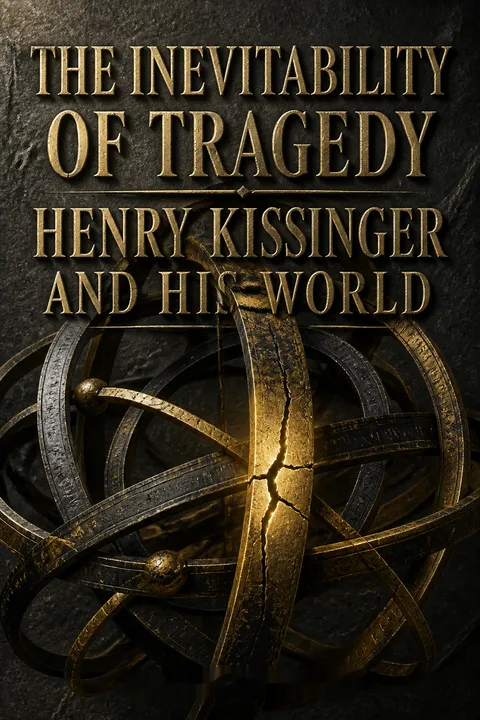


Key Takeaways
Treat tragedy as foreign policy's starting condition, not an exception
A tragic baseline. Barry Gewen's portrait of Henry Kissinger turns on a hard premise: nations act amid uncertainty, competing interests, and human fallibility. History offers no reliable march toward justice. Even a well-intended policy can cause suffering, and refusing to act can also carry grave costs. Kissinger's Jewish family fled Nazi Germany in 1938; many relatives who stayed were murdered. The experience made the fragility of order more than an academic idea.
Choose without guarantees. Kissinger's mentor Hans Morgenthau argued that statesmen usually face choices between harmful options, not a clean choice between good and evil. History can sharpen judgment, but it cannot supply a formula. Gewen's title names the resulting condition: tragedy is not proof that action is pointless, but a reminder that consequences exceed intentions.
What's valuable here is the distinction between pessimism and fatalism. A tragic outlook can encourage humility about prediction while still demanding action and accountability. That resembles decision-making under uncertainty in fields such as medicine: clinicians cannot guarantee outcomes, but they can compare risks, explain trade-offs, and learn from harm. The danger is that tragedy can become a ready-made excuse for leaders. Uncertainty does not make every choice equally defensible, and the language of necessity should invite scrutiny of who bears the cost.
A free election can empower leaders who dismantle freedom
Democracy's vulnerability. Gewen stresses that Hitler did not take power in a simple coup. The Nazis built a mass party, campaigned continuously, and became Germany's largest political force. Hitler never won a majority in a free election, but President Hindenburg appointed him chancellor in January 1933 after conservative leaders believed they could contain him. The Nazis then used legal authority to destroy democratic constraints, including through the Enabling Act.
Votes are not enough. The story is not that democracy inevitably produces tyranny. It is that elections alone cannot protect a republic when institutions are weak, political opponents reject compromise, and leaders mistake popularity for a mandate without limits. Hitler's appeal drew on grievance, national restoration, and spectacle, not simply force. His rise made Kissinger distrust claims that democratic procedures automatically secure freedom or peace.
The chapter's strongest democratic lesson is institutional: elections confer authority, but rights, courts, and constraints determine whether authority remains accountable. Contemporary scholarship on democratic backsliding similarly distinguishes electoral competition from liberal protections. Yet Hitler's rise should not become an argument against democracy. The decisive choices also involved conservative elites who underestimated him, institutional breakdown, and organized violence. Treating voters as the sole cause can obscure the strategic failures of those who had power to defend the system.
Judge intervention by both the threat feared and the damage caused
Chile's impossible choice. In 1970 Salvador Allende won Chile's presidency with 36.2 percent of the vote, leading a three-candidate race. Nixon and Kissinger feared his ties to Castro and the Soviet Union, while critics saw a democratically elected government targeted by Washington. The United States had already covertly supported Allende's opponents in 1964. In 1970 it tried to block his accession, including through a coup plot that became entangled with the killing of Chilean general Rene Schneider.
Separate the episodes. Gewen argues that Washington aided Allende's opponents and weakened his government, but did not directly plan the successful 1973 coup. The Church committee and CIA found no evidence of direct U.S. involvement in that overthrow. Allende's centralizing ambitions, economic crisis, and political conflict also mattered. None of this erases the Pinochet dictatorship's repression or makes U.S. interference harmless.
This case forces security reasoning to meet democratic legitimacy rather than letting either disappear. The distinction between helping create instability and directly organizing a coup is historically important, but it can also become a narrow defense if indirect effects are treated as morally irrelevant. A sound assessment asks what threat was evidenced, what alternatives existed, and whether the response was proportionate. The Chilean record also shows why covert action needs serious oversight: secrecy can make intervention easier while making responsibility harder to assign.
Use exile's memory as a warning, not a universal template
A refugee's education. Kissinger's family had been secure and assimilated in Fürth until the Nazis stripped his father of his teaching job, isolated the family, and made ordinary public life dangerous. They escaped to the United States in 1938, shortly before Kristallnacht. Kissinger's father had trusted that Germany remained home; the collapse of that trust shaped his son's suspicion of historical optimism and his attention to power.
Related outsiders. Gewen links Kissinger to Leo Strauss and Hannah Arendt, German-Jewish refugees who valued America yet distrusted majority rule as a guarantee of liberty. They were not simply opponents of democracy. They asked how free institutions survive when a majority turns against minorities, and how thought can proceed without inherited certainties. Arendt's phrase for that difficult independence was thinking without a banister.
Personal history can reveal political risks that comfortable observers miss. The refugee's vantage point makes democratic complacency look less like confidence than a failure of historical imagination. But trauma can also magnify the most threatening analogy: Weimar Germany and the United States differ in institutions, history, and social conditions. The value of exile's memory is therefore diagnostic, not predictive. It can expose blind spots, but it should be tested against the specific evidence of each society rather than treated as a universal forecast.
Treat morality as a constraint on power, not a foreign-policy blueprint
Morgenthau's Realism. Kissinger's intellectual mentor argued that foreign policy must begin with the world as it is, not with a picture of how it ought to be. His Realism treats power and national interest as unavoidable facts, while insisting that political power is more than violence: it also depends on influence and legitimacy. History matters because each conflict has its own actors and conditions, and no calculation can remove uncertainty.
Limits still matter. Morgenthau did not claim that force makes policy moral or that law and public opinion are useless. He saw international law, shared norms, and morality as restraints, but not reliable guarantees against conflict. The statesman's task is to weigh interests, anticipate consequences, and avoid excess. His standard is not moral innocence, which action makes impossible, but doing less harm in a dangerous world.
Realism is most persuasive as a discipline of attention: it asks whose interests are at stake, what power can achieve, and what costs an idealistic policy may conceal. It becomes less persuasive when power is treated as the only durable fact. International norms can shape expectations, and institutions can help states coordinate even without a world sovereign. The useful question is not whether morality or power wins, but how moral limits can be made effective when enforcement is incomplete.
In Vietnam, every exit carried costs that slogans concealed
A false map. U.S. leaders treated communism as a single expansionist force and Vietnam as a domino whose fall threatened the world. Morgenthau argued early that Vietnamese nationalism, local history, and divisions among Communist states mattered more than this simple map allowed. He opposed escalation while many officials and journalists supported it. His warning was that military power could not substitute for understanding the society the United States was trying to shape.
No clean departure. Nixon and Kissinger sought withdrawal, but paired troop reductions with bombing and pressure on Hanoi. The 1973 agreement enabled U.S. withdrawal, while leaving South Vietnam vulnerable. The Christmas bombing killed civilians and helped force negotiations. The war cost 58,022 American lives overall, with 20,552 deaths during Nixon's years. Gewen presents the choices as tragic, not automatically justified: reputation, alliance commitments, and human costs collided without a risk-free solution.
Vietnam illustrates how a mistaken theory can harden into policy through institutional momentum. Once leaders define withdrawal as a threat to credibility, each additional sacrifice can appear to demand further sacrifice, a pattern related to sunk-cost reasoning. Yet the opposite slogan, leave immediately, also sidesteps risks to allies and the domestic consequences of defeat. The harder question is whether credibility was being protected for concrete strategic reasons or for its own sake. The record leaves room for disagreement, but not for pretending the available choices were costless.
Build peace by balancing rival interests, not promising final victory
Détente as method. For Kissinger, détente meant managing competition with the Soviet Union through negotiation, not trusting it or ending the rivalry. The policy produced agreements on Berlin and strategic arms, and opened relations with China. It rested on a balance of power: no state could expect security by making every rival weaker or by imposing its preferred system everywhere.
The American resistance. Gewen contrasts this approach with Wilsonianism, the belief that U.S. foreign policy should advance universal democracy and values. Kissinger thought such moral purpose could become a crusade, encouraging overreach and turning adversaries into absolute enemies. His alternative sought order among states with different systems. It did not promise justice or permanent peace, and it could preserve authoritarian rule, but he saw it as safer than demanding total victory in a nuclear age.
The insight is that accommodation need not mean approval. Negotiation can reduce the danger of miscalculation even when governments remain rivals. This logic is especially compelling when escalation risks catastrophe. Still, stability is not a neutral good: a balance can protect vulnerable states, or entrench repression and unequal power. The moral question is how to pursue cooperation without converting temporary restraint into permanent indifference to abuses. The book clarifies the trade-off, though it cannot supply a universal rule for where that boundary lies.
Enter government to shape policy, but measure what compromise costs
The intellectual inside. Kissinger believed scholars could contribute to government by supplying historical perspective and a larger design. He also warned that bureaucracies fragment policy into separate tasks, while public officials face urgent problems that leave little time for reflection. When Nixon offered him the national security adviser post, Kissinger hesitated despite his ambition and earlier harsh judgment of Nixon. In office, he used back channels and fought for control over foreign policy.
Access has a price. Kissinger's service brought major diplomatic achievements, but also compromises, personal deference to Nixon, wiretapping controversy, and responsibility for contested policies. Morgenthau defended the difficulty of the insider's role while warning that intellectuals can become propagandists for power. The question is not simply whether to serve or criticize from outside. It is whether access improves decisions enough to justify the risks to independence and judgment.
This is a durable problem in policy professions, from government science to corporate ethics: proximity can make advice consequential, but it can also normalize the institution's assumptions. The distinction between influence and complicity cannot be settled by an insider's good intentions. It requires transparent standards, records of dissent, and accountability to people affected by decisions. Kissinger's case demonstrates the reach of individual expertise, but also why charismatic access is a poor substitute for institutional checks.
Treat China as a rival with interests, not a replayed Soviet Union
A different adversary. Kissinger's China diplomacy began from the judgment that Beijing pursued national interests distinct from Moscow's. Mao's China was Communist, yet its rivalry with the Soviet Union made an opening to Washington possible. Nixon and Kissinger used that split to alter the balance of power. After the Soviet collapse, Kissinger warned against rebuilding a simple two-camp Cold War with China placed in the old Soviet role.
Order without domination. China and the United States both have histories of exceptionalism, but neither can now withdraw from the world or rule it alone. Kissinger urged mutual recognition of lasting differences, especially over human rights and political order, while seeking cooperation on shared risks. His vision of a stable order is not a claim that China is benign. It is a warning that treating every disagreement as an existential contest can make conflict more likely.
The book's warning against historical replay is a useful antidote to analogy by reflex. Strategic competition can resemble an earlier rivalry without having the same causes, alliances, or limits. Yet recognizing a rival's interests does not require accepting its account of them, and dialogue alone cannot guarantee restraint. A robust approach pairs engagement with clear deterrence and consultation with affected allies. The central analytical habit is to test the analogy, not merely inherit it.
Make human judgment outrank data when consequences remain unknowable
Information is not wisdom. In his later writing, Kissinger warned that digital systems reward the accumulation of information while shrinking historical perspective and reflection. Foreign policy cannot be reduced to data collection because leaders must interpret facts, imagine consequences, and accept responsibility for choices that no model can settle. His argument echoes Strauss's defense of close reading and Morgenthau's resistance to treating politics as a measurable science.
Judgment remains accountable. Kissinger does not reject evidence or technical expertise. He argues that facts need context, and that history and philosophy help leaders recognize patterns without assuming the present is identical to the past. The point is not to replace analysis with intuition. It is to keep quantitative tools subordinate to judgment, especially when choices involve moral costs, rival interpretations, and outcomes that cannot be predicted with confidence.
The warning is timely because automated systems can create an appearance of neutrality while concealing choices about what gets measured. Human judgment makes those choices visible, but intuition is also vulnerable to bias, overconfidence, and personal interest. The strongest approach combines quantitative evidence with historical reasoning, ethical review, and open disagreement. That preserves the value of data without letting a model assume responsibility that belongs to decision-makers.
Analysis
Gewen's book is best read as an argument about how to judge statesmanship under conditions where neither morality nor power provides a complete guide. Its unusual structure follows intellectual problems rather than a full chronological biography. Chile tests the clash between elected legitimacy and security; Hitler's rise reveals democracy's vulnerability; Strauss, Arendt, and Morgenthau illuminate the refugee intellectual's suspicion of progress; Vietnam shows how strategic assumptions can turn a limited commitment into a prolonged trap. Kissinger's career then becomes both evidence for Realism and a test of its moral claims. The book's great strength is its refusal to flatten Kissinger into either villain or master strategist. It carefully distinguishes the failed 1970 coup efforts in Chile from the 1973 military overthrow, and explains why a policy that looks indefensible in retrospect could appear rational amid Cold War fears. Its account of Morgenthau's opposition to Vietnam is especially useful because it demonstrates that Realism can criticize militarism from within, rather than simply defend power.
The argument is not neutral. Gewen foregrounds Kissinger's intellectual seriousness and the constraints on policymakers, often giving less weight to victims' perspectives and to how covert intervention itself reshapes political possibilities. The language of tragedy can clarify unavoidable trade-offs, but it can also make contingent decisions sound inevitable. Similarly, the claim that U.S. interests require Realist restraint depends on who defines those interests and whose security counts.
The most durable contribution is therefore methodological, not an endorsement of every Kissinger policy. History should complicate moral certainty, but not extinguish moral judgment. Democratic legitimacy matters, yet elections alone do not protect rights. Power is real, yet not the only force shaping international conduct. The book asks readers to hold those truths together, examine alternatives rather than intentions alone, and judge leaders by the costs they choose to impose, not merely the outcomes they hoped to secure.
Review Summary
The Inevitability of Tragedy explores Henry Kissinger's worldview through the lens of German-Jewish émigré intellectuals like Leo Strauss, Hannah Arendt, and Hans Morgenthau. It examines Kissinger's realpolitik approach, shaped by witnessing Hitler's rise and skepticism of democracy. The book offers insights into Kissinger's foreign policy decisions, particularly during the Vietnam War. Reviewers appreciate the intellectual history and context provided, though some find the structure disjointed. Overall, it's seen as a thought-provoking exploration of Kissinger's philosophy and its roots in 20th-century political thought.
People Also Read






Glossary
Realpolitik
Power-centered statecraftA way of making foreign policy that begins with actual power relations, national interests, and historical conditions rather than assuming that abstract moral ideals can dictate workable outcomes. In Gewen's account, Realpolitik favors strategic restraint and negotiation, while recognizing that it can require morally troubling compromises.
balance of power
Power checked by rivalsAn arrangement in which states prevent any one government from dominating by balancing its power against that of other states. It does not remove conflict or guarantee justice. Kissinger and Morgenthau regard it as a means of limiting conflict through negotiation and deterrence when no effective world authority exists.
Wilsonianism
Democracy as global missionThe American foreign-policy tradition associated with Woodrow Wilson, which treats democracy, self-determination, and universal values as central aims of U.S. action abroad. Kissinger argues that this outlook can inspire admirable efforts, but may also encourage crusades, overreach, and the assumption that other societies share American political goals.
polycentrism
Communist powers act independentlyMorgenthau's term for the reality that Communist states did not form a single bloc directed from Moscow. China, the Soviet Union, Yugoslavia, and Vietnam could pursue distinct national interests and compete with one another. Recognizing this diversity undermined the American assumption that every Communist government served one unified expansionist project.
decent interval
Face-saving delayed withdrawalThe unofficial strategy Kissinger and Nixon pursued in Vietnam: withdraw U.S. forces under an agreement that could preserve American credibility for a period, even if South Vietnam might eventually fall. The term captures the moral and political dispute over whether the policy was an honorable exit or a delayed abandonment of an ally.
Westphalian system
Order among sovereign statesAn international order based on sovereign states governing themselves within their own borders, without a universal authority imposing one political or religious system. Gewen presents Kissinger's use of the concept as a defense of pluralism among states and a rejection of both global domination and expectations of universal agreement.
thinking without a banister
Judgment without fixed guidepostsHannah Arendt's phrase for thinking without relying on inherited ideologies or settled rules as automatic guides. Gewen connects it to the experience of Kissinger, Arendt, and Strauss, who valued independent judgment after witnessing democratic and moral certainties fail under Nazism. It describes intellectual independence, not the absence of standards.
nationalistic universalism
National aims framed as universalMorgenthau's term for the tendency of nations to present their particular interests and values as if they expressed universal moral principles. The language can help rally public support, but it may disguise a struggle for power and make compromise appear immoral or treasonous.
Download PDF
Download EPUB
.epub digital book format is ideal for reading ebooks on phones, tablets, and e-readers.








