

Key Takeaways
Pause before reacting when probability matters
A pause can prevent catastrophe. In 1983, Soviet officer Stanislav Petrov received a warning that five American missiles were incoming. Rather than immediately report an attack, he considered whether a real first strike would involve so few missiles and noted that ground radar offered no confirmation. The warning was a malfunction, triggered by sunlight reflecting off clouds. In 1962, Soviet submarine commander Vasili Arkhipov likewise resisted launching a nuclear torpedo when his crew could not know whether war had begun. His insistence on surfacing instead of striking helped avert escalation.
Reasoning is practical protection. Both men faced intense pressure to act quickly. Their stories frame critical thinking as more than an academic skill: when evidence is incomplete and consequences are enormous, checking probabilities can matter more than obeying fear or impulse.
What's striking is that these episodes make good judgment look less like certainty than disciplined hesitation. In high-stakes settings, decision science often distinguishes reversible choices from irreversible ones: a short delay to gather confirming evidence can be especially valuable when the cost of a false alarm is catastrophic. Yet delay is not always wise; emergencies can also punish indecision. The practical lesson is to match the amount of scrutiny to the stakes, and to ask what evidence would justify acting now rather than waiting.
Test the bridge between evidence and conclusion
A convincing sound can hide a broken argument. Pope Stephen VI condemned his dead predecessor Formosus because he did not defend himself. The reasoning was invalid: silence does not establish guilt, and a dead defendant plainly cannot answer. This illustrates a formal fallacy, an error in an argument's logical structure. An argument is sound only when its structure works and its premises are true. Even valid-looking reasoning can fail when it reverses cause and effect, treats shared traits as proof of identity, or assumes only two choices exist.
Inspect the premises, too. The author shows how strawman arguments replace a real position with an easier target, while reductive explanations squeeze complex events into a single cause. The postwar German myth that internal traitors caused defeat helped turn national humiliation into scapegoating and political hatred.
Logic offers a useful diagnostic, but spotting a fallacy does not settle whether the conclusion is true. The conclusion might be correct for unrelated reasons, while a flawless argument can still start from false premises. This distinction matters in public debate, where fallacy-spotting can become a performance of superiority rather than an effort to evaluate a claim. A stronger practice is to reconstruct the argument fairly, test each premise, and then assess the conclusion independently.
Treat vivid anecdotes as clues, not population data
A memorable case is not a typical case. Testimonials helped sell Lipitor even though its celebrity spokesperson, Robert Jarvik, had not practiced medicine and had not taken the drug before appearing in its advertisements. Psychic performers likewise showcase successful-sounding predictions while ignoring their many misses. Such selective presentation can make coincidence look like proof.
Look for the missing comparison. After the vaccine researcher Andrew Wakefield publicly linked the MMR vaccine to autism, parents noticed that signs of autism often appeared after vaccination. But sequence alone cannot show cause. Autism typically becomes noticeable in early childhood, around the period children receive vaccines, and broader diagnostic criteria also contributed to rising diagnoses. The book also describes survivorship bias: Abraham Wald realized that planes missing from damage reports may have been the ones hit in vital areas and lost.
Stories are powerful because they help people imagine what a statistic means, not because they reliably reveal how common an outcome is. Good communication therefore need not discard anecdotes; it can pair them with denominators, comparison groups, and a clear account of uncertainty. That combination preserves human relevance without letting a dramatic exception stand in for a population. The danger lies less in storytelling itself than in allowing the most emotionally available story to answer a question it cannot resolve.
Remember that memory and conviction can both be edited
The mind reconstructs as it recalls. Psychologist Elizabeth Loftus's Lost in the Mall experiments showed that some participants came to accept a fabricated childhood event after hearing it among genuine memories. In a notorious preschool abuse case, suggestive interviews encouraged children to report events they had not originally described, helping fuel years of accusations without corroborating physical evidence. Such examples show why confident recollection is not automatically reliable testimony.
Belief can steer perception, too. The book connects motivated reasoning, which interprets evidence to protect existing beliefs, with cognitive dissonance, the discomfort of holding conflicting ideas. It also explains how expectation can change reported symptoms: placebo effects may ease perceived discomfort, while nocebo effects can produce distress when people expect harm. These experiences can feel genuine even when the presumed cause is absent.
This account is especially useful in separating sincerity from accuracy. A person can remember honestly and still be mistaken, a distinction with consequences for therapy, journalism, and justice. At the same time, fallible memory should not be used as a blanket reason to dismiss testimony, especially where independent evidence is scarce. The sounder response is procedural: avoid leading questions, preserve early accounts, seek corroboration where possible, and describe uncertainty without turning it into either automatic belief or automatic disbelief.
Put statistical claims back into their proper denominator
Numbers need a reference class. A highly accurate HIV test can still produce many false positives when given to a population where infection is rare. The result depends on the starting probability as well as the test's accuracy. Bayes' theorem formalizes this relationship. The case of Sally Clark shows the human cost of ignoring it: an expert wrongly treated two infant deaths as independent and presented their combined probability as evidence of murder. The court later overturned her conviction.
Ask what the percentage compares. A reported 18 percent rise in bowel cancer risk from processed meat sounded alarming, but the cited figures represented an absolute difference of about 1 percentage point over a lifetime. The book also explains Simpson's paradox, in which a trend within separate groups can reverse when the groups are combined, as well as why statistical significance alone does not establish a meaningful effect.
A denominator is not mathematical decoration; it determines what a risk claim means for a particular person or group. Natural frequencies, such as one expected false positive among a given number of people, often make conditional probabilities easier to reason about. Still, clear arithmetic cannot repair biased sampling or poor study design. Statistical literacy therefore requires two checks: whether the calculation is sound, and whether the data and comparison actually fit the question being asked.
Refuse false balance, and audit the sources shaping your feed
Equal airtime can distort evidence. False balance presents opposing claims as equally credible when their evidence is not comparable. The book traces this tactic from tobacco companies, which manufactured doubt about smoking, to media coverage that treated vaccine misinformation or climate denial as equivalent to scientific consensus. In each case, the appearance of neutrality could lend unsupported claims undeserved standing.
Your information diet is partly self-selected. Social platforms and search systems tailor what people encounter, but users also choose like-minded sources and remove disagreeable voices. That combination can create echo chambers, where repetition feels like independent confirmation. The Literary Digest learned a related lesson in 1936: its huge election poll failed because its respondents were disproportionately affluent and self-selected, while George Gallup predicted the result using a much smaller, better-targeted sample.
Impartiality is not the same as refusing to weigh evidence. A fair account can explain why a minority disputes a finding while also making clear how much support each position has. The challenge is that editorial judgment itself can be wrong, and established institutions can have blind spots or conflicts. Transparency helps: identify sources, distinguish reporting from opinion, and show readers why some claims receive more weight than others instead of hiding that judgment behind a formula of equal time.
Trust science's correction process, not its impressive costume
Science is a method, not a badge. Jacques Benveniste's homeopathy experiment appeared to show that water retained a memory of substances diluted out of it. When independent investigators repeated the test under blinded conditions, the striking result disappeared. The episode shows how expectation can influence an experiment, even without deliberate fraud. The book also recounts how FBI hair comparisons were presented as rigorous forensic science despite lacking the population data needed to support claims of a rare match, helping convict innocent people.
Demand a way to be wrong. Karl Popper's idea of falsifiability asks whether a claim could, in principle, be contradicted by evidence. Reproducibility, transparent methods, and the total body of evidence matter more than impressive jargon or a prestigious name. A lone study is one piece of evidence, not a final verdict.
Falsifiability is a helpful starting test, not a complete definition of trustworthy science. Some valuable research is exploratory, and complex fields may not yield a decisive test for every question. Strong evaluation also considers measurement quality, replication, competing explanations, and whether a finding fits other well-supported results. The broader strength here is institutional: independent scrutiny and correction make scientific knowledge more dependable than any individual expert, while leaving room for genuine revision.
Pair rigorous evidence with humane stories and intellectual humility
Facts need a human route in. When misinformation about the HPV vaccine reduced uptake in Ireland, public-health officials faced not only a factual dispute but a crisis of fear and trust. Laura Brennan, diagnosed with cervical cancer at 25, shared her experience and urged parents to protect their children. Her story helped make the vaccine's purpose concrete, while medical evidence addressed safety and effectiveness. The book reports that uptake rose during her campaign.
Keep claims provisional and conversations open. A practical check is to examine the reasoning, premises, possible biases, sources, statistical context, and whether a scientific claim can be tested. Skepticism means asking for clarity and evidence, not reflexively rejecting everything. The author also urges discussion over adversarial debate, and charity in interpreting another person's argument, while recognizing that good-faith engagement has limits when people deliberately spread falsehoods or deny others' rights.
Brennan's example shows that evidence and emotion are not rival forms of persuasion. A personal account can make a preventable loss salient, while population data establishes whether an intervention works. Used together, they address both understanding and motivation. There is a boundary to this approach: a moving story cannot substitute for evidence, and emotional narratives can mislead as readily as they can clarify. The best communication keeps the story connected to verifiable claims and treats uncertainty honestly.
Analysis
The book's central argument is that human intelligence does not automatically produce good judgment. Fast heuristics helped people respond to immediate danger, but modern problems often require probability, causal reasoning, and the ability to tolerate uncertainty. Grimes makes this case through a deliberately broad sequence of failures: a state campaign that ignored ecological expertise, a legal prosecution distorted by statistical error, a manufactured medical scare, and propaganda that turns distrust into a political instrument. The stories matter because they show how faulty inference moves from private belief to public consequence.
The book's most useful distinction is between skepticism as a method and denial as a motive. Skepticism asks what evidence would change a conclusion; denial protects a conclusion from evidence. Its companion lesson is institutional: reliable knowledge is not guaranteed by experts, journals, courts, or media organizations. Reliability comes from practices that make error visible, including replication, transparent methods, source scrutiny, and correction. These safeguards are imperfect, but they are better than replacing them with anecdote or confidence.
A tension remains. Critical thinking is presented as a personal defense, yet many errors are reinforced by incentives and systems: sensational content spreads, political actors benefit from polarization, and organizations may resist admitting mistakes. Individuals can improve their reasoning, but they cannot alone repair those structures. The book's own examples imply a broader remedy: better public habits must be supported by responsible journalism, accountable institutions, sound research practices, and education that teaches people to evaluate claims rather than merely collect facts. Its final vision is neither perfect rationality nor permanent suspicion. It is a society more willing to revise beliefs before bad reasoning becomes policy, persecution, or preventable harm.
Review Summary
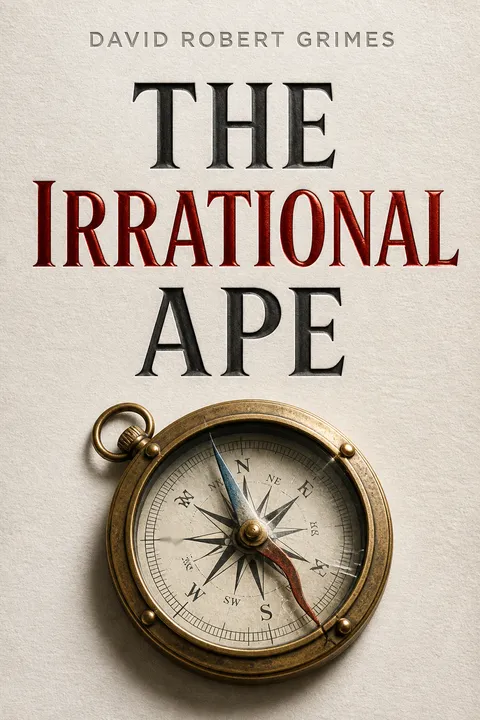
The Irrational Ape receives mostly positive reviews for its comprehensive exploration of critical thinking, logical fallacies, and cognitive biases. Readers appreciate Grimes' clear writing style, use of anecdotes, and scientific approach. The book is praised for its relevance in today's world of misinformation and conspiracy theories. Some criticisms include repetitiveness and occasional perceived political bias. Overall, reviewers find the book insightful, thought-provoking, and essential reading for understanding human irrationality and developing critical thinking skills.
People Also Read






Glossary
Heuristics
Fast mental shortcutsHeuristics are quick rules of thumb used to make judgments without exhaustive analysis. They conserve mental effort and can be useful when speed matters, such as reacting to a possible threat. But because they substitute an easier judgment for a harder one, they can produce systematic mistakes when a decision requires careful comparison or probability.
Formal fallacies
Errors in argument structureFormal fallacies are mistakes in the logical structure of an argument. Even if the premises sound plausible, the conclusion does not validly follow from them. Examples include reversing an implication or treating a shared characteristic as proof that two things belong to the same category. A valid argument also needs true premises to be sound.
Motivated reasoning
Reasoning shaped by desired beliefsMotivated reasoning occurs when people interpret evidence in ways that protect beliefs or identities they already value. Evidence that supports those beliefs may be accepted with little scrutiny, while conflicting information faces unusually demanding tests or is dismissed. It can happen without conscious deception and helps explain why facts alone do not always change minds.
Cognitive dissonance
Discomfort from conflicting beliefsCognitive dissonance is the unease experienced when a person holds incompatible beliefs or encounters information that clashes with an existing conviction. People may reduce this tension by revising their views, but they may instead reinterpret or reject the challenging evidence. The term is associated with psychologist Leon Festinger's account of how people respond to inconsistency.
Availability heuristic
Judging by easy recallThe availability heuristic is a mental shortcut in which people estimate how common or important something is by how easily examples come to mind. Recent, vivid, or emotionally charged events are especially easy to recall, so they can seem more representative than they are. This can distort judgments about risks, causes, and public issues.
Base-rate fallacy
Ignoring background frequencyThe base-rate fallacy is the mistake of judging a case without considering how common the relevant event is in the wider population. A vivid individual example may seem compelling, but its meaning depends partly on the background frequency of similar cases. Ignoring that context can lead to exaggerated conclusions about likelihood or risk.
Bayes' theorem
Updates probability with evidenceBayes' theorem describes how a prior probability should change when new evidence arrives. The meaning of a test result depends not only on the test's accuracy but also on how likely the condition was before testing. This explains why a positive result can be uncertain when a condition is rare, yet much more informative in a high-risk group.
Simpson's paradox
Combined data reverses a trendSimpson's paradox occurs when a pattern found within separate groups changes or reverses after those groups are combined. A hidden factor, such as differing group sizes or characteristics, can alter the overall comparison. It warns against drawing conclusions from aggregate data without checking how the observations are distributed across relevant subgroups.
Falsifiability
Capacity to be disprovedFalsifiability is the possibility that evidence could show a claim to be wrong. A falsifiable hypothesis makes specific predictions that can be tested; if those predictions fail, the claim must be reconsidered. Falsifiability does not mean a claim is false. It helps distinguish testable scientific proposals from assertions that can be endlessly reinterpreted.
Cargo-cult science
Science's appearance without rigorCargo-cult science imitates the appearance of scientific work, such as its technical language, citations, or experimental rituals, without practicing its essential standards. It lacks the honesty, critical testing, and willingness to report weaknesses that make research reliable. The term draws on rituals that copied the visible features of wartime supply operations without reproducing their underlying technology.
False balance
Unequal evidence treated equallyFalse balance occurs when competing claims are presented as equally credible despite a major difference in the strength of evidence supporting them. It can arise from a mistaken idea of impartiality or be deliberately exploited to manufacture uncertainty. The result is that weak or discredited claims gain legitimacy simply by being placed beside well-supported conclusions.
Nocebo effect
Expected harm shapes symptomsThe nocebo effect describes harmful symptoms or perceived worsening that arise when someone expects a treatment or exposure to cause harm, even when the suspected agent is absent or inactive. The distress is real, but the expected cause may be mistaken. The concept is important when separating a person's experience from claims about what produced it.
FAQ
What's The Irrational Ape about?
- Exploration of Human Reasoning: The book examines the flaws in human reasoning and how these can lead to negative outcomes. It uses historical and contemporary examples to show the impact of irrational thinking on decision-making.
- Critical Thinking Importance: David Robert Grimes highlights the necessity of critical thinking to combat misinformation and flawed logic. The book argues for enhancing reasoning skills to better navigate societal issues.
- Role of Statistics and Probability: Grimes discusses how understanding statistics and probability can help discern reality from illusion, especially in an age of rampant misinformation.
Why should I read The Irrational Ape?
- Enhance Critical Thinking: The book provides tools to improve analytical skills and recognize logical fallacies in everyday life. It encourages a skeptical approach to media and political claims.
- Relevance to Contemporary Issues: Grimes addresses current topics like climate change and public health, making the book timely and relevant in today's world of misinformation.
- Engaging Writing Style: Grimes combines storytelling with scientific research, making complex ideas accessible and engaging for a wide audience.
What are the key takeaways of The Irrational Ape?
- Flawed Logic Risks: The book illustrates how flawed logic can lead to significant personal and societal risks. Recognizing these flaws is crucial for informed decision-making.
- Importance of Evidence: Grimes advocates for evidence-based reasoning, urging readers to question their beliefs and information sources, especially in the age of fake news.
- Role of Emotion in Reasoning: The author discusses how emotions can cloud judgment, emphasizing the need to understand the interplay between emotion and logic.
How does The Irrational Ape define critical thinking?
- Objective Analysis: Critical thinking is defined as the objective analysis and evaluation of an issue to form a judgment, highlighting the need to detach personal biases.
- Evidence-Based Approach: It involves relying on evidence and logic rather than intuition or emotion, essential for sound decision-making.
- Continuous Learning: Grimes suggests that critical thinking is a skill developed over time, requiring engagement with diverse perspectives and challenging one's beliefs.
What are some examples of flawed reasoning discussed in The Irrational Ape?
- Cadaver Synod Incident: The bizarre trial of Pope Formosus' corpse illustrates how absurd reasoning can lead to illogical conclusions, serving as a cautionary tale.
- Vitamin C Myth: Linus Pauling's promotion of high doses of vitamin C, despite lacking scientific evidence, highlights how respected figures can propagate flawed ideas.
- 9/11 Conspiracy Theories: The rise of conspiracy theories post-9/11 showcases how emotional responses can lead to irrational beliefs, emphasizing the need for critical thinking.
What is the gambler's fallacy as discussed in The Irrational Ape?
- Misunderstanding of Probability: The gambler's fallacy is the belief that past random events influence future outcomes, such as expecting a coin to land on tails after several heads.
- Real-World Implications: This fallacy can lead to poor decision-making in gambling and financial investments, highlighting the need for rational choices based on actual probabilities.
- Cognitive Bias at Play: It underscores a broader cognitive bias where humans struggle to grasp randomness, essential for improving reasoning skills.
How does The Irrational Ape explain Bayes' theorem?
- Framework for Conditional Probabilities: Bayes' theorem helps update the probability of a hypothesis based on new evidence, illustrating how prior knowledge influences understanding.
- Example of HIV Testing: Grimes uses HIV testing to show how a highly accurate test can yield misleading results if disease prevalence is low, emphasizing context in interpreting data.
- Application in Various Fields: The theorem is applicable in medicine, finance, and decision-making, enhancing the ability to evaluate risks and make informed choices.
What is the significance of the Sally Clark case in The Irrational Ape?
- Tragic Miscarriage of Justice: Sally Clark's wrongful conviction for murdering her children, due to flawed statistical reasoning, serves as a cautionary tale.
- Impact on Public Perception: The case highlights how misinterpretation of statistics can have devastating consequences, underscoring the need for statistical literacy.
- Call for Reform: Grimes advocates for reforms in presenting and interpreting statistical evidence in court, emphasizing context and understanding.
How does The Irrational Ape address the impact of media on our reasoning?
- Media Influence: Grimes discusses how media shapes perceptions and can distort reality, affecting understanding of issues.
- Echo Chambers: The book highlights echo chambers, where individuals are exposed only to information reinforcing existing beliefs, hindering critical thinking.
- Misinformation Spread: Grimes warns about misinformation's rapid spread, urging readers to be discerning consumers of information and evaluate sources critically.
What role does confirmation bias play in our decision-making, according to The Irrational Ape?
- Definition of Confirmation Bias: It's the tendency to seek information confirming preexisting beliefs while ignoring contradictory evidence, distorting reality.
- Impact on Critical Thinking: Confirmation bias hinders critical thinking and rational decision-making, reinforcing false beliefs and dismissing valid arguments.
- Strategies to Mitigate Bias: Awareness of biases and seeking diverse perspectives can counteract confirmation bias, improving reasoning through open-minded discussions.
How does The Irrational Ape illustrate the dangers of pseudoscience?
- Definition of Pseudoscience: Pseudoscience claims to be scientific but lacks empirical evidence and rigorous methodology, often relying on anecdotal evidence.
- Examples of Pseudoscientific Claims: Grimes discusses homeopathy and anti-vaccine rhetoric, highlighting their lack of scientific support and potential harm.
- Importance of Scientific Literacy: The book advocates for scientific literacy to discern legitimate science from pseudoscience, crucial for informed decisions.
What strategies does The Irrational Ape suggest for improving reasoning skills?
- Embrace Skepticism: Grimes emphasizes healthy skepticism in evaluating claims and information sources, questioning validity and seeking evidence.
- Learn from Mistakes: Viewing mistakes as growth opportunities allows individuals to refine thought processes and improve decision-making skills.
- Cultivate Open-Mindedness: Being open to new ideas and willing to change beliefs in light of new evidence is crucial for strong reasoning skills and critical thinking.
About the Author
Other books by David Robert Grimes
Download PDF
Download EPUB
.epub digital book format is ideal for reading ebooks on phones, tablets, and e-readers.








