

Key Takeaways
Train yourself to be less wrong before errors become public policy
Pause before acting. In 1983, Soviet officer Stanislav Petrov received an alarm that five American missiles were on their way. Rather than trigger a retaliatory chain, he judged that a real attack would likely involve a much larger strike and that the alarm lacked confirmation from ground radar. The warning was a sensor error caused by sunlight reflecting off clouds. His restraint helped prevent catastrophe.
Good intentions need scrutiny. During China’s Great Sparrow Campaign, officials killed roughly a billion sparrows, ignoring warnings that the birds controlled insects. Locusts then devastated crops, contributing to famine alongside other disastrous policies. Both stories show why urgent action should follow careful assessment, not replace it. Critical thinking means testing a claim against evidence, consequences, and plausible alternatives, including when delay feels uncomfortable.
The Petrov story is often treated as a triumph of individual judgment, but it also points to a design question: how should institutions behave when signals are alarming and incomplete? Multiple independent checks, clear authority to pause, and plans for reversible decisions can make sound judgment less dependent on one unusually calm person. The sparrow campaign offers the complementary lesson that expertise must be heard before policy hardens. Still, reflection is not a universal argument for delay. In emergencies, waiting can also cause harm, so good decision-making needs explicit thresholds for action as well as for doubt.
Check how an argument works, not merely whether its conclusion sounds right
Separate form from truth. A valid argument has a structure in which its conclusion follows from its premises. A sound argument also has premises that are true. Pope Stephen VI accused his dead predecessor Formosus of guilt because, he claimed, an innocent person would defend himself. The reasoning failed: silence does not establish guilt, and Formosus could not speak because he was dead.
Look for missing links. A different error, the undistributed middle, treats a broad shared category as if it proved a specific connection. The claim that some electromagnetic radiation can damage cells does not establish that low-energy radio waves from phones cause cancer. The conclusion may happen to be true in another case, but a faulty argument does not settle it. Assess the claim itself, then inspect the reasoning offered for it.
This distinction resembles software debugging: an output can look plausible even when the process that generated it is broken. Checking the reasoning is therefore useful even when the conclusion seems familiar or morally appealing. Yet logic alone cannot determine which premises deserve trust; that requires evidence and domain knowledge. A technically valid argument built on false assumptions remains misleading. The practical benefit is not learning a catalogue of fallacy names, but pausing at each step to ask what is being assumed, what follows, and what has not been shown.
Treat vivid personal stories as clues, not proof of a general rule
Stories need denominators. A moving testimonial can show that someone reports feeling better after a treatment, but it cannot establish how often the treatment works or whether it caused the improvement. Psychics illustrate the problem: they emphasize successful predictions, while misses fade from view. Their apparent accuracy can be built from vague statements, selective memory, and many attempts, not paranormal knowledge.
Notice who is missing. During the Second World War, analysts examined bullet damage on planes that returned from combat and planned to reinforce the most-hit areas. Statistician Abraham Wald pointed out that the missing evidence mattered: planes struck in vital areas often never returned. This is survivorship bias, the mistake of drawing conclusions from visible cases while overlooking those that disappeared. Anecdotes can suggest a question, but systematic comparisons are needed to answer it.
Personal accounts are not useless. They can reveal experiences that formal studies have missed, expose unexpected side effects, and help researchers decide what to investigate. Their limitation is that they rarely show the counterfactual: what would have happened to the same person without the treatment or event? That gap is why comparison groups and complete records matter. Wald’s insight also generalizes beyond research: success stories omit failed attempts, while public testimony may omit people who could not speak. The disciplined response is neither to dismiss testimony nor to let vividness substitute for comparison.
Ask what your identity is protecting when evidence suddenly feels unacceptable
Beliefs can steer reasoning. Motivated reasoning occurs when people interpret evidence in ways that defend a prior commitment, accepting weak support for a favored view while demanding unusually strong proof from its critics. In the Soviet Union, agronomist Trofim Lysenko’s claims suited political doctrine. With Stalin’s backing, he helped ban genetics, purge scientists, and replace scrutiny with loyalty. The damage shows how ideology can distort not just private judgment but entire institutions.
Contradiction can intensify commitment. Psychologist Leon Festinger studied a group that expected the world to end in 1954. When the predicted rescue did not arrive, members reinterpreted the failure as proof that their faith had saved the world. Such belief-preserving explanations ease cognitive dissonance, the discomfort of holding a belief that conflicts with new evidence. Before rejecting an inconvenient result, ask whether the same standard would be applied to evidence supporting your side.
When a belief is tied to belonging, a factual correction can feel like a social threat rather than a neutral update. This helps explain why simply providing more information may fail: the cost of changing a view can include losing trust, status, or community. A more productive environment makes revision honorable, not humiliating, and separates a person’s dignity from the accuracy of a particular claim. The caution is that not all disagreement is motivated by identity. People can reject evidence because it is weak, confusing, or poorly communicated, so diagnosing bias should not become a way to avoid answering objections.
Put numbers back in context before deciding what they mean
Start with the base rate. Bayes’s theorem describes how a new result changes the probability of a claim when prior likelihood is considered. A highly accurate HIV test can still produce a positive result that is only about 50 percent likely to be true in a very low-risk group, because false positives can rival the rare true cases. The same result means something different in a higher-risk group.
Beware courtroom arithmetic. Pediatrician Roy Meadow told a jury that two infant deaths in one family had odds of roughly 1 in 73 million, multiplying probabilities as if the deaths were independent. But sudden infant death can cluster within families, so the calculation was unsound. The error helped convict Sally Clark, whose conviction was later overturned. In health reporting, the same care matters: an 18 percent relative increase in bowel cancer risk from processed meat corresponded to about a 1 percentage point absolute increase.
Numbers feel impartial, but their meaning depends on choices about comparison groups, baselines, and assumptions. Natural frequencies, such as explaining how many people out of 10,000 would test positive, often make conditional probabilities easier to grasp than percentages alone. The Clark case also shows that quantitative confidence can magnify harm when an expert’s assumptions go unchallenged. Statistical literacy is not just arithmetic; it includes asking who was counted, what else could explain the pattern, and whether the comparison is fair. A precise number can still answer the wrong question.
Do not confuse equal airtime with equal evidence
Balance evidence, not appearances. False balance occurs when opposing claims are presented as equally supported despite a major difference in evidence. In debates about climate change and vaccines, treating a small group of denialists as equivalent to a broad scientific consensus can make settled evidence seem uncertain. Tobacco companies used a related tactic, deliberately amplifying doubt about smoking and cancer to delay public acceptance of the evidence.
Online repetition is not verification. A study of 126,000 disputed news stories found that false stories spread farther and faster than true ones. Social platforms can also tailor feeds to existing interests, while outrage-driven posts invite rapid sharing. After the Sandy Hook school shooting, conspiracy claims that victims’ families were actors led to harassment of grieving parents. Before sharing a striking claim, check its source, evidence, and context.
Fair reporting does not require pretending every position has equal evidential weight. It requires making the strength and limits of evidence visible, while distinguishing factual disputes from genuine disagreements about values or policy. Online, the same claim appearing repeatedly can feel like independent confirmation even when it traces back to one source or coordinated campaign. That makes source checking more than a personal habit: newsrooms, platforms, and public institutions all shape what people encounter. Still, consensus should not be used as a substitute for explanation. Readers need to see why evidence is strong, not merely be told that experts agree.
Demand testable claims and independent checks, not the costume of science
Science risks being wrong. Falsifiability means a claim makes predictions that could, in principle, be shown false. In 1988, French researcher Jacques Benveniste reported that extremely diluted antibodies still affected cells, suggesting water retained a memory of substances it once contained. When investigators repeated the experiment under blinded conditions, the remarkable result disappeared. The original work had not adequately guarded against bias and selective interpretation.
Correction is a strength. Lord Kelvin’s calculations made Earth seem far younger than geology suggested. Physicist John Perry identified a neglected heat-transfer process, convection, that could change the estimate; later discoveries established Earth’s age at about 4.54 billion years. Scientific findings are provisional, and confidence should follow the total evidence, reproducibility, and quality of methods. A convincing title, technical vocabulary, or famous advocate cannot replace those checks.
A testable prediction creates a public standard that can outlast the authority or confidence of its advocate. Independent replication matters because researchers can share blind spots, incentives, or expectations. The Benveniste episode shows the value of blinding; Kelvin and Perry show that correcting assumptions can expand understanding rather than merely discard an old answer. Falsifiability is a powerful guide, but it is not a complete test of every form of knowledge. Historical and social claims may require different methods. The deeper standard is transparent reasoning, evidence suited to the question, and openness to correction.
Pair strong evidence with human stories, and leave room to revise
Skepticism is a practice. It means examining claims carefully, asking for evidence, and withholding judgment when the evidence is inadequate. It is not automatic disbelief. In Ireland, concern about HPV vaccine safety drove vaccination rates down to about 50 percent. Scientific reassurance mattered, but so did the testimony of Laura Brennan, who was terminally ill with cervical cancer and urged families to protect their children. During her campaign, vaccination rose by more than 20 percentage points, and later exceeded 80 percent nationally.
Keep compassion in the method. A story can explain why a decision matters, but it cannot establish that a treatment works. Combine testimony with independent evidence, ask what would change your mind, and apply the same standard to your favored claims as to your opponents’. There is no disgrace in uncertainty or in correcting an error. The danger lies in treating beliefs as untouchable when evidence points elsewhere.
Brennan’s story illustrates that communication is not a choice between data and emotion. Evidence establishes what is likely to work; a carefully chosen personal account can make the stakes understandable. The distinction matters because an emotionally powerful story can also mislead when it is treated as proof of cause. Good public communication connects narrative to evidence and leaves the reasoning open to inspection. The same principle applies in disagreement: respectful conversation can reduce the social cost of changing one’s mind, though it cannot guarantee persuasion. Sometimes the honest endpoint is a provisional judgment, not certainty.
Analysis
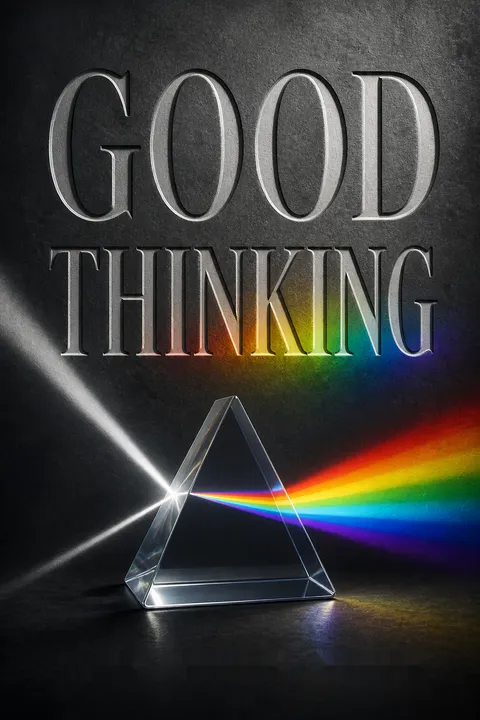
Good Thinking is a story-led guide to reasoning, organized around a central warning: human intelligence does not automatically produce rational judgment. Its strongest move is to connect small cognitive errors to large consequences. Petrov’s restraint during a missile alarm, the political destruction of genetics under Lysenko, and the false statistical case against Sally Clark make reasoning feel less like a classroom exercise and more like public infrastructure. The book also resists the easy division between rational experts and irrational outsiders. Scientists, journalists, judges, and politicians all appear capable of error, and scientific authority is trustworthy only insofar as methods and evidence remain open to scrutiny.
The practical framework is cumulative. Inspect an argument’s structure and premises. Treat anecdotes as prompts for investigation rather than proof. Account for base rates, confounders, and the difference between relative and absolute risk. Notice how identity, memory, expectation, and media selection bend perception. Then ask whether a claim can be tested, independently reproduced, and reconciled with the total evidence. This is more useful than memorizing fallacy names because it turns skepticism into a repeatable process.
The book’s scientific perspective is also a limitation worth keeping in view. Many examples concern health and science misinformation, while political disputes often involve genuine value conflicts that evidence alone cannot resolve. Reliable data can clarify likely consequences, but it cannot decide how a society should distribute risks, costs, or rights. Nor should consensus be accepted as a bare appeal to authority. The book’s own emphasis on transparent methods supplies the right safeguard: distinguish what is known, how it is known, and what remains uncertain. Its most durable lesson is not that every hard question has a scientific answer, but that confident conclusions should earn their confidence through accountable reasoning, and that people must remain free to revise them.
Review Summary
Good Thinking receives mostly positive reviews for its accessible explanation of critical thinking, logical fallacies, and cognitive biases. Readers appreciate the real-world examples and historical anecdotes used to illustrate concepts. Many find it eye-opening and valuable for improving reasoning skills. Some criticize the book's length and occasional repetitiveness. Overall, reviewers recommend it as an important read for understanding how to evaluate information and avoid flawed thinking in today's information-rich world.
People Also Read









Glossary
Motivated reasoning
Reasoning that protects prior beliefsA pattern in which people interpret evidence in ways that support beliefs or commitments they already hold. Favorable evidence may be accepted with little scrutiny, while contradictory evidence faces unusually demanding tests or is rejected. It can operate without conscious deception and is especially influential when beliefs are tied to identity or group membership.
Cognitive dissonance
Discomfort from conflicting beliefsThe mental discomfort that can arise when a person encounters information or behavior that conflicts with existing beliefs. People may reduce that discomfort by changing their view, but they may also reinterpret or dismiss the conflicting information. In the book, this helps explain why a failed prediction can sometimes strengthen rather than weaken a group’s conviction.
Availability heuristic
Judging by easy-to-recall examplesA mental shortcut in which people estimate how common or important something is by how readily examples come to mind. Recent, vivid, or emotionally charged events can therefore seem more representative than they are. The book uses vaccine fears to show how memorable stories can outweigh less vivid evidence about the risks a vaccine prevents.
Bayes’s theorem
Updating probability with prior oddsA mathematical rule for updating the probability of a hypothesis when new evidence appears. The result depends both on how informative the evidence is and on how likely the hypothesis was beforehand. This explains why a positive test can have different meanings in low-risk and high-risk groups, even when the test itself has the same accuracy.
False balance
Equal weight for unequal evidenceA presentation error that treats opposing claims as equally credible when the evidence supporting them is markedly unequal. It often arises from a desire to appear impartial. The result can make a strong scientific consensus appear genuinely disputed, giving weak or discredited claims undeserved legitimacy.
Forer effect
Generic descriptions feel personalThe tendency to judge a broad, vague personality description as uniquely accurate when it is presented as an individualized assessment. In Forer’s classroom demonstration, students rated a horoscope-based description as highly accurate, unaware that everyone had received the same text. The effect helps explain the appeal of horoscopes and psychic readings.
Nocebo effect
Expectation produces perceived harmA negative response that occurs when a person expects a harmless treatment or exposure to cause harm. The symptoms are experienced as real, even when the suspected cause is absent. The book discusses controlled tests of electromagnetic sensitivity in which participants reported symptoms in response to sham exposure when they believed it was genuine.
Falsifiability
A claim can be tested against evidenceA claim is falsifiable when it makes predictions that could, in principle, be contradicted by observation or experiment. Falsifiability does not mean a claim is false; it means there is a way to test it. The concept helps distinguish testable scientific hypotheses from claims that can be endlessly reinterpreted to avoid disconfirmation.
Cargo-cult science
Scientific appearance without scientific integrityWork that imitates the visible rituals of science, such as technical language or formal publication, while neglecting the underlying standards of honesty, methodological rigor, and openness to error. The term, drawn from Richard Feynman’s discussion, describes research or claims that look scientific but do not reliably test or support their conclusions.
Survivorship bias
Learning only from visible survivorsAn error that occurs when conclusions are drawn from cases that remain visible while missing those that disappeared or failed. During the Second World War, analysts initially focused on bullet damage to planes that returned, overlooking that aircraft hit in vital areas often did not return. The missing cases changed which parts needed protection.
FAQ
What's Good Thinking about?
- Exploration of Flawed Logic: Good Thinking by David Robert Grimes examines how flawed logic and reasoning can lead to dangerous societal consequences. It highlights the impact of cognitive biases and fallacies on decision-making.
- Critical Thinking Importance: The book emphasizes the necessity of critical thinking to combat misinformation and irrational beliefs. Grimes argues that understanding logical fallacies can improve personal and public decision-making.
- Real-World Examples: Grimes uses historical and contemporary examples, such as conspiracy theories and pseudoscience, to illustrate the impact of poor reasoning, making the book relatable and applicable to everyday situations.
Why should I read Good Thinking?
- Enhance Critical Thinking Skills: The book equips readers with tools to identify and counteract flawed reasoning in arguments. Grimes provides practical advice on thinking critically in an age of information overload.
- Understand Misinformation: Grimes offers tools to discern credible information from fallacies, making it a timely read for navigating today’s complex information landscape.
- Engaging and Accessible: Written in an engaging style, Grimes makes complex topics accessible to a broad audience, using anecdotes and humor to keep readers interested.
What are the key takeaways of Good Thinking?
- Recognizing Fallacies: A key takeaway is the ability to identify common logical fallacies, such as the post hoc fallacy and straw man argument, to critically evaluate arguments and claims.
- Importance of Evidence: Grimes stresses the significance of relying on evidence rather than anecdotes when forming opinions or making decisions, as anecdotes can be misleading.
- Role of Media: The book discusses how media can perpetuate bad thinking through sensationalism and misinformation, encouraging readers to be discerning consumers of information.
What are the best quotes from Good Thinking and what do they mean?
- “The road to hell is paved with good intentions.”: This quote highlights that actions without careful consideration can lead to disastrous outcomes, reminding readers to think critically about consequences.
- “If our leaders were forced to read this book, the world would be a safer place.”: This underscores the urgency of improving critical thinking skills in leadership for more rational and effective decision-making.
- “Extraordinary claims require extraordinary evidence.”: Quoting Carl Sagan, this emphasizes the principle of skepticism in evaluating claims, urging readers to demand robust evidence for implausible assertions.
How does Good Thinking address the role of media in shaping public opinion?
- Media Sensationalism: Grimes discusses how sensationalist media can distort facts and create panic, leading to widespread misinformation and poor public understanding.
- Echo Chambers: The book highlights the dangers of echo chambers, where individuals are only exposed to information that reinforces their existing beliefs, and encourages seeking diverse perspectives.
- Critical Consumption: Grimes advocates for critical consumption of media, urging readers to question the sources and motivations behind the information they encounter.
What methods does Grimes suggest for improving critical thinking?
- Awareness of Cognitive Biases: Grimes emphasizes recognizing cognitive biases that cloud judgment, enabling more rational decision-making.
- Evaluating Evidence: The book encourages prioritizing evidence over anecdotes when forming opinions, providing strategies for assessing evidence quality and relevance.
- Engaging in Reflective Thinking: Grimes advocates for reflective thinking, where individuals consider their beliefs and reasoning, leading to more informed conclusions.
What is circular reasoning as explained in Good Thinking?
- Definition of Circular Reasoning: Circular reasoning is a logical fallacy where the conclusion is included in its premises, making the argument tautological and providing no real evidence.
- Historical Context: Grimes discusses its use in theological arguments, where scripture is deemed true because it is written in scripture, reinforcing belief systems without substantive evidence.
- Impact on Belief Systems: This reasoning can reinforce belief systems without providing substantive evidence, posing a barrier to critical thinking and rational discourse.
What is motivated reasoning in Good Thinking?
- Definition of Motivated Reasoning: Motivated reasoning is the cognitive process where individuals interpret information to align with preexisting beliefs, often disregarding contradictory evidence.
- Cognitive Dissonance: Grimes connects motivated reasoning to cognitive dissonance, where conflicting information prompts rationalization rather than reevaluation of beliefs.
- Real-World Examples: The book illustrates motivated reasoning through issues like climate change denial, showing how deeply held beliefs can distort fact interpretation.
How does Good Thinking address the issue of echo chambers?
- Definition of Echo Chambers: Grimes defines echo chambers as environments where individuals are exposed only to information that reinforces their beliefs, leading to a skewed perception of reality.
- Impact on Society: Echo chambers contribute to societal polarization and hinder constructive dialogue, with dire consequences for public health and political discourse.
- Strategies to Overcome Echo Chambers: Grimes suggests seeking diverse perspectives and engaging with conflicting information to break out of echo chambers.
How does Good Thinking use real-world examples to illustrate its points?
- Sandy Hook Conspiracy Theories: Grimes examines these theories to highlight how misinformation spreads rapidly in echo chambers, illustrating real-world consequences of flawed reasoning.
- Anti-Vaccine Movement: The book discusses this movement as a case study in how misinformation can lead to public health crises, emphasizing the importance of scientific evidence.
- Historical Context: Grimes provides historical examples, such as Soviet disinformation campaigns, to show how misinformation manipulates public perception, underscoring the relevance of critical thinking.
How does Good Thinking address the impact of social media on misinformation?
- Amplification of Misinformation: Grimes discusses how social media platforms can amplify misinformation and create echo chambers, leading to widespread misconceptions.
- Role of Algorithms: Algorithms prioritize sensational content, entrenching users in their beliefs and creating a feedback loop that reinforces misinformation.
- Strategies for Responsible Sharing: Grimes encourages verifying sources and considering the impact of sharing unverified claims on social media.
How can I apply the lessons from Good Thinking in my daily life?
- Practice Critical Thinking: Engage in critical thinking when confronted with new information, questioning sources and seeking evidence before forming conclusions.
- Engage with Diverse Perspectives: Seek out diverse viewpoints to challenge beliefs, fostering understanding and reducing polarization.
- Stay Informed and Skeptical: Stay informed about current events and scientific developments, maintaining a skeptical mindset to discern reliable information from misinformation.
About the Author
Other books by David Robert Grimes
Download PDF
Download EPUB
.epub digital book format is ideal for reading ebooks on phones, tablets, and e-readers.








