

Key Takeaways
A closed regime can look stable until openness drops it into the J curve's trough.
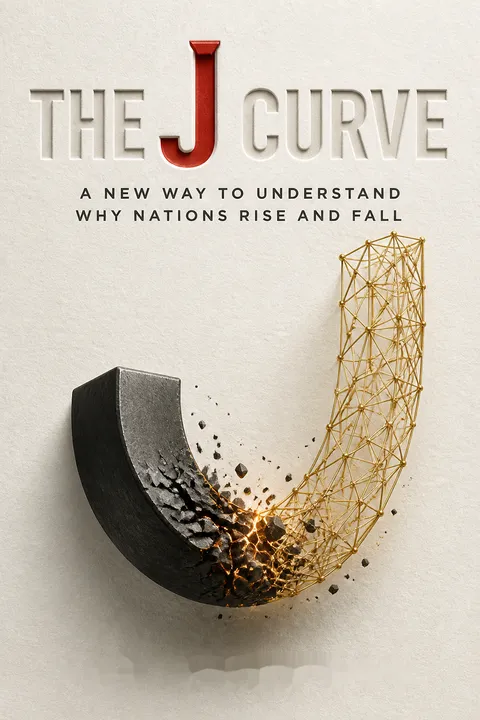
Two routes to stability. Bremmer’s J curve maps a country’s openness on the horizontal axis and stability on the vertical. Closed authoritarian states can be stable because rulers tightly control information, wealth, and political activity. Open states can be stable because trusted institutions absorb conflict and resolve it peacefully. Between these two peaks lies a dangerous trough: opening a closed society weakens old controls before legitimate institutions are ready to replace them.
There is no easy bypass. Information crossing borders, or citizens communicating with one another, can expose government failures and help opposition organize. But repression can also push a country toward the closed end of the curve. The framework treats political change as movement, not a one-way march toward democracy.
The curve’s strength is that it separates openness from stability, two qualities often treated as if they rise together automatically. It also makes transition costs visible: removing a coercive system is not the same as building a trusted replacement. The image can, however, imply a single path and a predictable shape where political development is contingent. Its best use is as a warning about vulnerability, not as a formula that forecasts exactly when a regime will fall.
Measure stability by shock absorption, not by whether a country holds elections.
Stability has two parts. A state is stable when it can withstand shocks and when it avoids generating crises of its own. An election dispute illustrates the difference. Taiwan’s contested 2003 presidential result and Ukraine’s 2004 crisis brought protests and uncertainty; the disputed 2000 U.S. election did not threaten the American state or its markets to the same degree. Institutions and public acceptance of their authority helped contain the shock.
Democracy is not a guarantee. A rigged election in authoritarian Turkmenistan produced little visible upheaval, while a young democracy can be more vulnerable. Bremmer distinguishes stable authoritarian governments from poorly functioning states that cannot implement policy. Stability is a measure of resilience, not a certificate of fairness, legitimacy, or good government.
This distinction is useful because it prevents a common analytical mistake: treating a peaceful surface as proof of institutional health. A government may absorb a crisis through force, while another absorbs it through procedures citizens accept. Those mechanisms can produce similar short-term calm but very different political costs. The book’s examples also caution against equating elections with resilience. A fuller assessment must ask who can challenge decisions, who accepts the referee, and what happens when the ruling group loses.
Treat succession as a stress test when authority belongs to one ruler.
Personal rule has a weak handover. In closed regimes, stability often rests on a leader rather than institutions capable of transferring power. Saddam Hussein built a system centered on his family and loyalists; Fidel Castro’s authority was similarly bound to his person. When such a ruler leaves, successors must rebuild the consent and loyalty that had been attached to him. The danger is not simply a leadership change, but the absence of accepted rules for settling elite disputes.
Institutions outlast personalities. The former Yugoslavia depended heavily on Josip Broz Tito’s authority, and its rotating presidency could not replace the unifying role he had played. By contrast, stable open states rely more on courts, legislatures, and other bodies that continue to function when leaders change. Some authoritarian handovers succeed, but that success does not make succession automatic or secure.
Succession reveals where a political system stores its legitimacy. When legitimacy is concentrated in one person, a successor inherits offices but may not inherit the trust that made those offices powerful. This resembles a key-person risk in organizations: apparent efficiency can conceal a fragile transfer plan. Yet personalized leadership is not the only source of volatility, and institutional systems can also suffer contested transitions. The diagnostic question is whether competing elites have an accepted way to resolve disputes without dismantling the state.
Spend reform capital carefully, and watch what shifts the whole curve.
Reform spends consent. Political capital is the public approval or acquiescence leaders can draw on to enact unpopular changes. Economic reform can also consume a government’s resources by closing inefficient firms, raising unemployment, and lowering living standards. Putin’s pension changes risked protests despite his popularity; Brazil’s Lula used his standing to defend debt repayment rather than spend all available revenue on popular programs. Leaders who have support must decide which changes are worth spending it on.
Shocks change the baseline. Oil revenue can raise stability across levels of openness by giving governments more money to fund services, jobs, or repression. A disaster, falling commodity prices, or economic crisis can lower it. A country dependent on one export is especially exposed: when that revenue falls, its whole political system has less room to absorb pressure.
The capital metaphor makes reform’s political cost concrete: approval is not an inexhaustible resource, and timing matters. The curve-shift idea adds a useful distinction between changing a country’s openness and changing the conditions under which it operates. Still, leaders do not control all the consequences of spending political support, and revenue can postpone rather than resolve conflict. Oil wealth may buy capacity, but whether it builds durable services or entrenches patronage depends on political choices.
Do not assume sanctions weaken dictators; isolation can be their strongest tool.
Punishment can reinforce control. Bremmer argues that sanctions often help rulers who want to isolate their societies. U.S. sanctions on Cuba restricted ordinary Cubans’ contact and commerce while allowing Castro to portray hardship as foreign aggression. Remittances also flowed through government-run stores, giving the regime access to much of the money sent to families.
Iraq shows the same reversal. After the 1991 Gulf War, sanctions and the Oil-for-Food Program left Saddam in control of vital revenue. The no-fly zones, designed to protect Kurdish and Shiite populations, also limited threats to his rule. North Korea’s leaders likewise benefit when outside pressure makes the country more cut off. Bremmer’s alternative is to expand contact and economic independence while containing dangerous weapons trade.
The argument shifts attention from a policy’s stated intention to the political incentives it creates. A sanction can harm a population while strengthening the government’s claim that outsiders are the enemy. That does not mean sanctions never work: South Africa offers a contrasting case, where pressure interacted with internal opposition and a credible alternative government. The practical test is not whether a measure looks tough, but who controls the remaining resources, who bears the cost, and whether citizens gain more or fewer channels for independent action.
Transitions survive when former enemies share a stake in the same state.
South Africa found a negotiated route. As apartheid weakened, Nelson Mandela and F. W. de Klerk helped create a transition in which black South Africans could claim political power while the white minority retained a reason to remain and contribute. Mandela’s authority helped secure compromise, and a truth and reconciliation process offered a path to address past crimes without making mass retaliation the organizing principle of the new state.
Yugoslavia lacked that bargain. After Tito’s death, economic decline and nationalist leaders intensified rivalries among the republics. Slobodan Milosevic used Serbian nationalism to seize influence, and other groups increasingly saw separation as safer than remaining in the federation. South Africa had a broadly accepted leader and shared interest in preserving the state; Yugoslavia did not. The comparison shows why a transition’s political destination cannot be separated from its coalition and leadership.
The comparison makes legitimacy a practical resource, not a decorative virtue. A transition is more resilient when groups that fear one another can identify something worth preserving together. South Africa’s settlement did not erase inequality, and its economic choices left many black citizens waiting for benefits. That qualification matters: a peaceful handover can be a genuine achievement without completing the work of justice. The case also warns against treating national unity as inherently desirable when some groups experience the shared state as domination.
Give citizens political outlets before economic growth turns frustration explosive.
India and China offer a contrast. India remained politically open even when its economy was heavily controlled. Citizens could protest, criticize officials, and vote governments out. Its many parties and diverse communities forced compromise, although they also made economic reform slower. China opened its economy dramatically while keeping political power monopolized by the Communist Party. Growth created prosperity, but also widened disparities and left many grievances without recognized channels for resolution.
Connectivity magnifies the pressure. In China, phones and online communication helped people share information and organize protests. The book reports 87,000 demonstrations in 2005. Bremmer’s point is not that economic growth causes unrest by itself. It is that economic opening can raise expectations and expose inequality; without political outlets, complaints can accumulate until they emerge as disruptive shocks.
The comparison highlights a crucial difference between prosperity and voice. Growth can improve material conditions, but it does not automatically give people a legitimate way to contest decisions or distribute gains. Political channels can act as pressure valves, although they do not eliminate conflict and may sometimes intensify it. The deeper lesson is that economic modernization changes expectations as well as incomes. A government that measures success only by production may miss whether citizens have any credible means to influence the rules governing that production.
Prepare institutions and alternatives before demanding a sudden democratic opening.
An election cannot create a moderate opposition overnight. In Algeria in 1991, the military canceled elections when an Islamist party appeared likely to win, and the country then endured a devastating conflict. Bremmer argues that opposition groups in authoritarian states are often suppressed or driven toward extremes, while moderate alternatives lack the resources to organize. A rapid vote can therefore put groups with incompatible goals into a winner-take-all contest.
Build readiness without postponing freedom forever. The book recommends preparing education, civil society, and credible political alternatives before a society reaches its most unstable transition. For Saudi Arabia, it emphasizes education and economic opportunity before full-scale democratization, alongside incremental political reforms. This sequencing may reduce the risk of collapse, but it is not a justification for indefinite autocratic rule or for treating citizens as unready by default.
The case for preparation is strongest when it means building organizations that can compete peacefully, not asking rulers to certify that their opponents are sufficiently responsible. The Algeria example shows how elections can be destabilizing when losers expect exclusion or violence. But gradualism has its own danger: incumbents can use the language of readiness to protect privilege indefinitely. The distinction between sequencing and stalling lies in whether reforms create measurable new rights, independent institutions, and genuine routes to power.
China cannot indefinitely fund closed politics with an open economy.
Economic integration did not equal political openness. China attracted large-scale foreign investment, joined the World Trade Organization, and became deeply connected to global markets. Yet the Communist Party retained control of the press, courts, and political organization. The book describes older controls, including residence permits and work-unit oversight, giving way in part to censorship and restrictions on independent groups.
The contradiction creates risk. The party depends on economic growth to support its legitimacy, while growth brings new communications, expectations, and social disruption. The book points to protests over wages, land, corruption, and environmental damage, alongside a widening wealth gap. Its central warning is that economic integration can raise a society’s capacity without giving it peaceful political mechanisms to manage conflict. China’s dilemma is the attempt to separate economic modernization from political change.
China’s case tests whether markets can be treated as a technical system insulated from political life. The account suggests not: investment, mobility, and information alter who has resources and what citizens expect from government. The model also leaves room for uncertainty. Economic integration can strengthen state capacity as well as social demands, and political control may adapt rather than simply collapse. The useful question is not whether growth inevitably produces democracy, but whether the governing system can absorb the conflicts that growth itself helps create.
Build demand for openness, not just pressure against authoritarian rulers.
Pressure alone can backfire. The book recommends policies that help people inside closed societies gain information, communicate, organize, and build economic independence. Trade, investment, broadcasting, and support for local civic groups can create links that rulers cannot fully control. During the Cold War, Western support for labor unions, dissidents, and independent media helped strengthen internal forces for change without relying on military invasion.
Address both sides of authoritarianism. Bremmer compares authoritarian rule to a supply that persists when citizens demand order and protection. If reforms produce unemployment, insecurity, or state collapse, people may prefer a strong ruler to disorder. External policy should therefore limit threats such as weapons proliferation while improving the conditions that let citizens seek change safely. The goal is not to engineer a foreign society from outside, but to make peaceful change more possible from within.
This approach is more sophisticated than simply maximizing pressure because it asks what social needs make authoritarian control acceptable. It also treats outside influence as a tool with limits: foreign sponsorship can discredit local reformers, so the source and visibility of support matter. The Cold War analogy is instructive, though no two transitions are identical. The strategy succeeds only if engagement expands citizens’ agency rather than merely enriching ruling elites or creating new dependencies.
Analysis
The J curve is a compact way to correct two errors in foreign-policy thinking: that authoritarian calm means durable stability, and that greater openness immediately produces better governance. Its central contribution is temporal. It asks not only what a state looks like now, but what pressures its current arrangement can absorb and what happens when its supports are removed. The distinction between stability based on coercive control and stability based on institutions also explains why identical shocks can produce radically different outcomes.
The framework is most persuasive as a comparative diagnostic, not a law of political development. Openness and stability are difficult to measure consistently, and the curve risks making diverse transitions look more uniform than they are. Countries may move in several directions at once: an economy can open while media close, or institutions can strengthen in one region while state authority weakens in another. The book recognizes this movement, but its single curve cannot fully represent such internal variation.
Its policy argument is valuable because it judges interventions by their effects on domestic power, not by their moral packaging. Sanctions intended to punish can consolidate a ruler’s control; rapid elections can empower the only organized opposition; external pressure can help reformers or make them appear foreign agents. Yet the framework also carries a political tension: gradual reform may be prudent, but advice to delay democracy can serve incumbents who benefit from delay. The model therefore needs a normative check. Stability is important because it protects people and enables change, but stability alone cannot justify repression.
The strongest practical use is to ask three questions before intervention: what holds the regime together, what capabilities and institutions could replace it, and how will the proposed action change the resources and incentives of citizens, rulers, and opposition groups? The J curve does not answer these questions automatically. It makes them harder to ignore.
Review Summary
The J Curve received mixed reviews, with an average rating of 3.74 out of 5. Readers appreciated Bremmer's analysis of the relationship between stability and openness in nations, finding it insightful and applicable to current events. Many found the concept intriguing, though some criticized it as overly simplistic. The book's historical narratives and country-specific examples were valued, but some readers found them repetitive. Overall, reviewers praised the book for offering a fresh perspective on geopolitics and foreign policy, despite its occasionally dry content.
People Also Read









Glossary
J curve
Openness and stability modelA framework that plots a country’s openness against its stability. Closed authoritarian states may be stable through control, while open states may be stable through trusted institutions. The transition between them can bring a dangerous period in which old controls weaken before new institutions gain legitimacy. Each country’s curve can also shift as resources or shocks change its stability.
political capital
Consent available for reformThe public approval or acquiescence a government can draw on to implement difficult policies. Leaders spend political capital when they pursue unpopular reforms or ask citizens to accept short-term costs. A popular leader may have more room to act, but support can decline as people experience the effects of policy.
iron triangle
Three tools of social controlBremmer’s label for three mechanisms used by China’s Communist Party to manage citizens: the hukou residence permit, the secret dangan personnel file, and the danwei work unit. Together, they restricted where people could live, recorded political reliability, and linked daily services to state supervision. Economic change weakened these controls, while censorship and restrictions on independent groups took on greater importance.
juche
North Korean self-reliance doctrineNorth Korea’s official principle of self-reliance, used to justify minimizing outside influence. In Bremmer’s account, the doctrine supports the regime’s effort to keep the country closed and avoid reforms that could loosen its control. The country’s economic dependence on foreign assistance and its need for outside resources expose a contradiction between the ideal and its practical needs.
special economic zones
Designated areas for managed capitalismAreas established by China beginning in 1980 to attract foreign investment and test market-oriented policies under Communist rule. Businesses in these zones received incentives and greater freedom to manage operations and trade internationally. They helped expand China’s economic openness without requiring equivalent political liberalization.
Proliferation Security Initiative
Multinational weapons interdiction effortA multinational initiative described in the book as a framework for inspecting shipments suspected of carrying weapons or weapons technology. Bremmer presents it as a way to limit North Korea’s ability to sell dangerous materials while pursuing broader engagement with its population. Its effectiveness depends on cooperation from countries with influence over transit and trade.
demand-side geopolitical strategy
Reduce demand for authoritarian ruleBremmer’s policy approach to authoritarianism that addresses why citizens may accept or seek strong, closed government, rather than focusing only on weakening rulers. It emphasizes security, economic opportunity, information, and channels for peaceful political participation. The aim is to make openness more attractive and viable to a society, while still containing immediate threats.
town square test
Test of freedom to dissentA test associated in the book with Natan Sharansky: can a person publicly criticize the government without fearing arrest or assault? Bremmer uses it to distinguish economic openness from political freedom. China’s integration with global markets does not pass the test because public dissent remains tightly restricted.
FAQ
What's The J Curve: A New Way to Understand Why Nations Rise and Fall about?
- Framework for Analysis: Ian Bremmer's The J Curve introduces a framework to understand the rise and fall of nations, focusing on the relationship between political stability and openness.
- Graphical Representation: The J curve graphically represents how countries transition from authoritarianism to democracy, highlighting the risks involved.
- Case Studies: The book examines various countries, such as North Korea and South Africa, to illustrate the dynamics of stability and openness.
- Policy Implications: Bremmer discusses how the J curve can aid policymakers in crafting effective foreign policies by understanding each nation's unique circumstances.
Why should I read The J Curve by Ian Bremmer?
- Global Politics Insight: The book offers a fresh perspective on international relations, crucial for understanding global political complexities.
- Practical Framework: The J curve serves as a tool for investors and policymakers to assess political risk and make informed decisions.
- Engaging Case Studies: Real-world examples make the concepts accessible, enhancing understanding of political dynamics.
What are the key takeaways of The J Curve?
- Stability vs. Openness: Stability often comes at the cost of openness, especially in authoritarian regimes, which may face instability when opening up.
- Transitional Instability: Nations moving from authoritarianism to democracy often experience dangerous instability, crucial for understanding political reform risks.
- External Influences: Globalization and external influences can impact a nation's stability, with resistant countries at greater risk of collapse.
What is the J curve model in The J Curve?
- Graphical Representation: The J curve graph measures stability on the vertical axis and political/economic openness on the horizontal axis.
- Left vs. Right Side: Nations on the left are less open and more stable due to authoritarian control, while those on the right are more open and stable.
- Policy Implications: The model helps policymakers understand the risks and rewards of political reform, suggesting a period of instability during transitions.
How does The J Curve explain the fall of authoritarian regimes?
- Isolation Breeds Instability: Authoritarian regimes maintain stability through isolation, risking collapse when external influences penetrate.
- Historical Examples: The fall of the Soviet Union and the Arab Spring illustrate how authoritarian regimes can quickly lose control.
- Need for Reform: Without reform, authoritarian regimes face instability, as failure to adapt can lead to downfall.
What role does globalization play in The J Curve?
- Double-Edged Sword: Globalization can enhance stability in open societies but threaten closed regimes by exposing them to external pressures.
- Impact on Dynamics: Increased openness can lead to demands for political reform as citizens become aware of global standards.
- Examples: Countries like South Africa and Turkey show how globalization influences political landscapes, illustrating the complex relationship with stability.
How does The J Curve address the concept of political capital?
- Definition: Political capital is the trust, goodwill, and influence a leader has with constituents, crucial for reforms and stability.
- Spending Political Capital: Leaders must spend political capital to enact reforms; failure can lead to loss of legitimacy and instability.
- Examples: Successful leaders leverage political capital for reforms, highlighting the importance of timing and public support.
What lessons does The J Curve offer for U.S. foreign policy?
- Understanding Contexts: U.S. policymakers should understand each country's unique circumstances for effective foreign policy.
- Supporting Gradual Reform: Supporting gradual reforms in authoritarian regimes can stabilize countries during transitions.
- Engagement Over Isolation: Engagement with closed regimes can be more beneficial than isolation, promoting stability and reform.
How does The J Curve explain the relationship between democracy and stability?
- Democracy Not Always Stable: Democracy doesn't automatically equate to stability; some democracies can be fragile, while some authoritarian regimes are stable.
- Institutional vs. Personal Stability: Stability based on institutions is more resilient than that based on individual leaders.
- Democratic Transitions: Without strong institutions, democratic movements can lead to instability rather than lasting change.
How does The J Curve explain the fall of Yugoslavia?
- Ethnic Tensions: Diverse ethnic groups struggled for power, leading to conflict and disintegration due to lack of a unifying identity.
- Leadership Failure: Leaders like Slobodan Milosevic exploited nationalism, exacerbating divisions and leading to conflict.
- International Isolation: Slow and ineffective international response, with sanctions and isolation failing to address underlying issues.
What role did Nelson Mandela play in South Africa's transition according to The J Curve?
- Visionary Leadership: Mandela guided South Africa from apartheid to democracy, negotiating a peaceful transition and fostering reconciliation.
- Political Capital: His significant political capital allowed him to ask for sacrifices, inspiring trust and cooperation.
- Building Institutions: Mandela focused on establishing democratic institutions, securing South Africa's place on the right side of the J curve.
What are the best quotes from The J Curve and what do they mean?
- Openness and Globalization: "Openness is a measure of the extent to which a nation is in harmony with the crosscurrents of globalization," highlighting the importance of global influences for stability.
- Transition Risks: "Movement from left to right along the J curve demonstrates that a country that is stable because it’s closed must go through a period of dangerous instability as it opens to the outside world," cautioning about reform challenges.
- Policy Tool: "The J curve is a tool designed to help policymakers develop more insightful and effective foreign policies," emphasizing its practical application in shaping foreign policy.
Download PDF
Download EPUB
.epub digital book format is ideal for reading ebooks on phones, tablets, and e-readers.








