

Plot Summary
Prologue
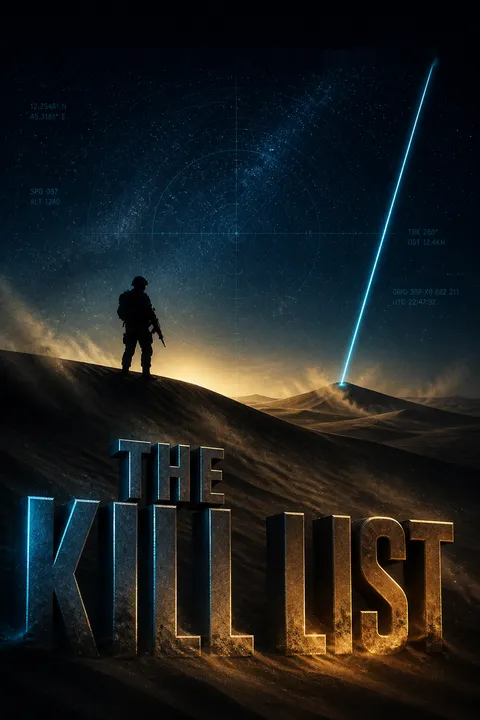
Each Tuesday, the President and a small circle of officials review a secret list of people marked for death without trial. A new name has no face and no confirmed identity: the Preacher, an English-speaking radical whose online sermons have inspired isolated converts to kill.
The President assigns TOSA, a covert manhunting unit, to identify and locate him, then destroy him. Its senior investigator, Marine lieutenant colonel Kit Carson, receives the order under the name Tracker.
The opening makes the machinery of state violence part of the story’s moral problem. A signature turns suspicion into an authorized hunt, but the target is still only a voice and a title. The absence of a face does not soften the order. It sharpens the central tension: Carson must produce certainty from fragments before a sanctioned killing can be carried out. The secret list also mirrors the Preacher’s private online pulpit. Both men exercise power beyond ordinary public scrutiny, though with radically different aims and reach.
Sermons Become Kill Orders
A student in Boise shoots Congressman Jerry Dermott outside the statehouse, then dies under a policeman’s fire. Investigators find sermons on his laptop, delivered by a masked speaker in fluent English and urging private acts of violence. In England, Iraqi refugee Freddy stabs Mayor Giles Matravers at a public opening; in Florida, a Somali sanitation worker kills a senior police officer.
Each attacker has recently withdrawn from ordinary life and listened to the same sermons. The FBI connects the American cases with similar British killings, but neither side can identify the preacher or locate his broadcasts. As the murders accumulate, the Preacher enters the President’s secret target process, and TOSA receives the hunt.
The killings are designed as small, local eruptions rather than coordinated attacks. That makes the Preacher’s influence difficult to classify: investigators face separate murder scenes, not a visible organization. The victims are public figures, but the killers are socially embedded workers and students whose transformations occur in private. The sermons offer each one a script that replaces community, deliberation, and accountability with a solitary act. This structure gives the antagonist reach without requiring him to be physically present, while making ordinary routines, a commute or a civic ceremony, suddenly vulnerable.
A Marine Learns Arabic
Raised in a Marine family, Kit Carson enters the Corps and distinguishes himself in the Gulf War. Rather than follow the expected command path, he studies Arabic, spending two years in Cairo and learning from a scholar who separates Islam from the violent readings used by extremists.
After the September 11 attacks, the CIA recruits Carson because few officers combine language skill, combat experience, and familiarity with the region. He insists on leaving analysis work for Afghanistan.
At Shah-i-Kot, he finds a wounded Ranger, Dale Curtis, whose foot has been nearly severed by a rocket fragment, and carries him across snowbound rocks to evacuation. Curtis survives, though he loses the foot; the rescue binds their careers to a debt neither man forgets.
Carson’s expertise grows from choices that depart from institutional expectation. Arabic is not merely a tool for decoding speech; it gives him access to distinctions that colleagues often flatten into a single hostile category. His rescue of Curtis makes that intellectual preparation bodily and costly. He carries another man through terrain where both could die, an act that later becomes the basis of professional trust. The story’s hunter is therefore not introduced as instinct alone. His methods depend on study, patience, and a willingness to cross boundaries that other officers treat as distractions.
The Golf Course Ambush
After years in the Marines and a transfer through the Naval Criminal Investigative Service, Carson returns to service following the death of his wife, Susan, in a car crash. Curtis, now commanding TOSA as Gray Fox, recruits him as the unit’s senior manhunter and gives him the name Tracker.
Then Mohammed Barre, a Somali American student radicalized by the Preacher’s sermons, shoots a state senator and retired General Alvin Carson during a golf round. The general reaches hospital alive but dies overnight while his son sits beside him.
Police find the same online sermons in Barre’s room. Carson’s work is no longer an abstract pursuit: the preacher’s distant influence has entered his family, and grief hardens his resolve to finish the assignment.
The father’s death turns professional commitment into personal exposure, but it does not simply make Carson more determined. It places him at risk of confusing justice with repayment. The timing matters: he has already lost his wife and built a life around disciplined work, so the hospital vigil strips away the emotional distance that has made his role sustainable. His father’s final connection with him offers a private inheritance of service, yet it also tempts Carson to use public authority for private grief. The narrative keeps those motives close enough to remain uneasy.
Ariel Finds the First Trace
The Tracker asks an NSA computer specialist who might outmatch the elusive Troll, the technician hiding the Preacher’s broadcasts. The specialist points him to Roger Kendrick, an agoraphobic teenager who rarely leaves his attic.
Carson approaches Roger without treating him as a child and offers him better equipment and a hard problem. Roger, soon code-named Ariel, studies the hidden network and slips malware into its system. When the Troll moves his followers to a new site, the transfer briefly exposes a genuine Internet address.
Ariel traces it to France Télécom and then to Kismayo, Somalia. Separately, British officer Chris Hawkins reports that an Afghan veteran, Mahmud Gul, recognized the Preacher’s voice from a meeting years earlier. Two unlikely witnesses give Carson the first geographic and historical leads.
Ariel’s contribution unsettles the usual hierarchy of intelligence work. The teenager is physically constrained but technologically expansive, and Carson succeeds by recognizing ability without demanding conventional social performance. Mahmud Gul supplies the opposite kind of evidence: memory held in the body, not a database. One can locate a machine; the other recognizes a voice across language and time. Their combined knowledge shows that surveillance systems do not create certainty by themselves. Information becomes useful only when someone can interpret the anomaly, whether it is a fleeting address or the remembered cadence of a speaker.
The Mother's Photograph
Disguised as journalist Daniel Priest, Carson visits Colonel Musharraf Ali Shah in Islamabad. The officer denies having a son, but his wife secretly shows Carson a school photograph of Zulfiqar, the gifted boy who left home for extremist groups after embracing Jihadism.
Mahmud Gul’s memory and the photograph identify the Preacher as that same man, now known among militants as Abu Azzam. Carson’s digital investigation adds another connection: the Kismayo warehouse is part of Masala Pickles, owned by Mustafa Dardari, Zulfiqar’s childhood friend in London.
Dardari’s social access and research on Western counterterrorism make him more than a businessman. Carson now has a name, a network, and a likely outside source, but the Preacher himself remains hidden in Somalia.
The photograph converts an intelligence file into a family history. Zulfiqar’s parents are not simply background to the target: his mother preserves an image that contradicts her husband’s denial and exposes the cost of ideological rupture inside a household. Carson’s discovery also depends on refusing the convenient fiction that a radical appears from nowhere. A childhood friendship survives as infrastructure, linking the hidden preacher to a polished London financier. The revelation makes the threat more intimate and more legible, but it does not make it simpler. Knowing who someone was is not the same as knowing where he is now.
The Fish Carries a Secret
With no Western source inside southern Somalia, Carson negotiates for help from Mossad, which has an informant in Kismayo’s fish market. Messages travel inside a frozen kingfish, then through a concealed radio link.
The informant, Opal, watches the warehouse and follows a pickup north to Marka, where he sees a guarded compound. Israeli commandos stage a roadside accident that kills the Troll and give Opal papers to explain his possession of the dead man’s documents.
Entering the compound as an Ethiopian job seeker, Opal convinces the Preacher that he is honest, useful, and harmless. The preacher hires him as a secretary. When Opal looks up toward the surveillance drone, he confirms to Carson that the target is inside, but civilians nearby prevent a missile strike.
The fish relay is an answer to a landscape where modern communications can betray their users. Information moves through a chain of ordinary labor, food, and human trust, each link chosen because it looks unremarkable. Opal’s success depends not on technological superiority but on performing a credible need for work and belonging. The Preacher’s paranoia protects him from obvious threats, yet it also narrows his judgment: he trusts the recruit because the recruit appears to fit the role he needs. The compound’s civilian surroundings impose a limit on Carson’s power, making restraint part of the operational problem rather than a distant ethical principle.
A Ship Becomes Bait
The Swedish freighter Malmö is captured by Somali pirates, along with its crew and cadet Ove Carlsson, who is travelling under an assumed name. Ove is secretly the only son of shipping magnate Harry Andersson.
The pirate chief al-Afrit singles him out, and his negotiator, Ali Abdi, begins bargaining with Gareth Evans, a veteran hostage negotiator working for the ship’s owners and insurers. Meanwhile, Carson’s team connects Dardari to the Preacher and arranges covert surveillance of his London home and computer.
The ship’s capture creates a separate crisis, but its hostage becomes valuable to the hunt: the Preacher learns Ove’s identity and offers al-Afrit a million dollars for the young man. A ransom negotiation now gives Carson a possible way to draw the target into open country.
The maritime plot introduces a second economy of coercion, one governed by delay, insurance losses, and the price of a living hostage. Evans understands that urgency raises the ransom, while al-Afrit uses time as leverage. Ove’s hidden identity changes the scale of the bargain: he is both a vulnerable young sailor and an enormous financial prize. The plot’s convergence is not accidental convenience. Carson’s pursuit and the pirate negotiation share an interest in movement, money, and exposure. A hostage can be a person to rescue, a bargaining chip, and a route toward a target, though those functions carry sharply different moral costs.
Apostasy on Every Screen
Carson has a film crew use actor Tony Suárez, makeup, a beard, and amber contact lenses to create a convincing double of the Preacher. The false broadcast appears on the preacher’s own channel and presents a public rejection of violent Jihadism.
Because apostasy is unforgivable to the extremists he commands, the message threatens his standing. He breaks his rule against contacting Dardari from his own residence and sends an urgent e-mail. British and American listeners trace the exchange to the Marka compound and confirm Dardari’s role.
Carson asks for a strike, but officials refuse because civilians surround the site and Opal is inside. Carson then helps British intelligence bug Dardari’s house and copy his computer, seeking a safer way to make the Preacher leave his refuge.
The counterfeit sermon attacks authority through the very medium that built it. The Preacher’s influence depends on a stable public persona, so Carson turns that persona into a weapon against its maker. The tactic does not expose a theological debate so much as exploit the rigid social logic of the group: a public recantation can make the leader more vulnerable to his own followers than to foreign enemies. Yet Carson’s success produces a dangerous practical problem. The target’s location is known, but civilians and Opal make immediate force unacceptable. The story treats restraint as operational intelligence, not indecision.
One Million in the Desert
When British officials reject Carson’s request to seize Dardari openly, former Royal Marine Brian Weller and his team abduct the businessman and hide him in a remote Scottish lodge.
Ariel uses Dardari’s copied computer identity to send convincing messages to the Preacher, then moves a million dollars through the businessman’s accounts and the Somali transfer network Dahabshiil. The Preacher sends Jamma to Garacad with an offer: al-Afrit will release Ove for the money, and the exchange will take place away from the compound.
Carson learns the meeting is drawing the Preacher into the desert. As the target’s convoy leaves Marka with Opal and the Swedish hostage, Carson secures British Pathfinder support. The hunt now depends on choosing the right vehicle among deliberate decoys.
Carson’s plan is a chain of impersonations: a stolen computer identity, a simulated financial transfer, and an apparent bargain between men who believe they are acting freely. Its ingenuity rests on reproducing habits precisely enough that deception feels ordinary. But the scheme also carries a disturbing resemblance to the Preacher’s own manipulation of isolated followers. Carson deploys fraud for a protective end, yet he does so by treating Dardari’s identity and Ove’s captivity as instruments. The moral distinction rests on the expected consequences, not on innocence of method. The convoy’s departure converts that ethical gamble into a physical race.
Seven Chutes Before Dawn
With presidential and British approval, Carson joins six Pathfinders in a high-altitude parachute drop from a C-130. They cross the desert on foot, guided by the Global Hawk, and approach the hamlet where the convoy has stopped.
Carson feeds sedatives to the village dogs, then the team breaches the Preacher’s house and kills his guards. The northern pirates mistake the attack for betrayal and charge across the square; the Pathfinders kill them, while Barry rescues Ove from al-Afrit and another guard.
The Preacher escapes onto a roof disguised among drying clothes and attacks Carson with a knife. Carson’s pistol misfires, but he blocks the blade and kills the Preacher with his combat knife. Opal survives, Ove is recovered, and the team escapes toward Ethiopia.
The climax compresses the novel’s competing forms of knowledge into action. The drone sees heat and movement, but cannot identify the correct truck without Opal’s red cap; the operation succeeds through cooperation between machine vision and human recognition. Carson’s final fight is intimate after a story dominated by networks and distance. A failed pistol leaves him with training, timing, and a knife, reducing the state’s immense apparatus to one body against another. The rescue is not clean: armed men die, and civilians remain near the violence. Still, the outcome depends on choosing a narrow intervention over a broad strike.
Epilogue
News of al-Afrit’s death frees the Malmö’s crew, and the ship sails before the ransom can be paid. Ove recovers but never returns to sea. Abdi retires to Tunisia, where he is later killed by burglars; Dardari is released and deported.
The Pathfinders return to service, while Ariel’s cybersecurity work makes him prosperous without changing his reclusive habits. Carson leaves the Marines, builds a private security business, and does not return to Somalia.
The aftermath distributes consequences unevenly. Ove’s survival costs him the career he had chosen, while Ariel gains recognition in the only world where he feels at ease. Carson’s retirement is less a cure for grief than a change in the scale of his work: he leaves state operations but continues protecting people for pay. Dardari’s deportation and Abdi’s later death sit beside the cleaner closure of the rescue, reminding readers that covert action does not resolve every life it touches. The ending closes the mission, not the wider systems that enabled it.
Analysis
The novel builds its thriller around competing systems of influence. The Preacher’s sermons turn private resentment into a repeatable public method: one isolated person, one chosen victim, one promised reward beyond death. TOSA answers with an equally far-reaching system of surveillance, covert authority, and targeted force. The moral distinction between them is substantial, but not effortless. Carson’s methods include impersonation, illegal detention, hacked accounts, and a killing authorized without trial. The story’s pressure comes from the gap between the urgency of preventing another murder and the safeguards that disappear when the state decides urgency is enough.
Carson’s Arabic studies and his conversations with scholars complicate the easy equation of religious identity with violence. The Preacher’s authority depends on stripping away context and presenting rage as sacred certainty. Mahmud Gul’s memory and Carson’s linguistic knowledge restore context, while the victims and converts show how rhetoric travels into ordinary rooms and routines. The book repeatedly contrasts public ideology with private motives: a student’s alienation, a father’s shame, a mother’s preserved photograph, a pirate negotiator’s wish to escape danger. Those details prevent the antagonist’s network from becoming purely abstract, even as the book’s operational viewpoint sometimes compresses diverse communities into security problems. The most revealing tension is Carson’s own. His professional discipline is challenged by a father’s death, and the hunt risks becoming personal just as it gains the means to succeed. He still has to decide whether precision means only hitting the intended target or also limiting harm to everyone nearby. The final operation answers with a constrained assault rather than a missile strike, but it does not make violence clean. The novel’s strongest insight is that technology can extend perception without supplying judgment. A drone can follow a heat source, a computer can expose a message, and an order can grant authority. Human beings must still decide what those discoveries permit them to do.
Review Summary
The Kill List received mixed reviews, with an average rating of 3.88 out of 5. Readers praised Forsyth's meticulous research, realistic portrayal of anti-terrorism operations, and compelling plot. Many found it an engaging thriller with well-crafted suspense. However, some critics noted underdeveloped characters and a lack of emotional depth. The book's focus on technical details and procedural aspects of counterterrorism appealed to some readers while others found it dry. Overall, fans of Forsyth's earlier works generally enjoyed the novel, though some felt it didn't quite reach the heights of his classics.
People Also Read

Characters
Kit Carson
The Arabic-speaking trackerA Marine officer shaped by military inheritance but distinguished by intellectual curiosity, Carson studies Arabic and seeks assignments that take him beyond a desk. He combines physical endurance with close observation, and his work depends on understanding people as well as terrain. His rescue of Dale Curtis creates a lasting bond that later redirects his career. Carson also carries private grief, which complicates the discipline he brings to dangerous work. He is not a detached instrument of policy: he believes in service, but he must keep asking where duty ends and personal vengeance begins.
The Preacher
The masked online radicalAn elusive English-speaking preacher, he turns the internet into a pulpit for a violent and simplified form of religious certainty. His instructions favor solitary attacks, discouraging converts from confiding in anyone who might restrain or expose them. He is careful about technology, identity, and physical security, relying on intermediaries to separate himself from his broadcasts. His persuasive force comes partly from making a complicated world feel answerable through one decisive act. The contrast between his secrecy and his command of public attention defines his power.
Roger Kendrick
The reclusive cyber expertRoger lives largely in his parents’ attic, constrained by agoraphobia and profound social anxiety. In cyberspace, however, he is inventive, focused, and confident enough to challenge specialists who have failed. Carson approaches him as a capable collaborator rather than a problem to be managed, and Roger responds to the chance to work on a consequential puzzle. His story questions the assumption that competence must look socially conventional. The digital world is not a refuge from ability for him; it is the place where his ability can finally be seen.
Dale Curtis
The rescued Ranger commanderA Ranger officer wounded during the fighting in Shah-i-Kot, Curtis survives because Carson carries him across dangerous terrain to evacuation. After losing a foot, he adapts to a prosthetic and finds a new path in a field that might otherwise have excluded him. His later authority at TOSA reflects the same persistence that marked his military service. Curtis values loyalty between soldiers, but his recruitment of Carson also shows how personal obligation can shape the machinery of covert government.
Gray Fox
TOSA's steady commanderGray Fox is Dale Curtis’s operational identity as head of TOSA. He selects Carson for the hunt because he trusts the officer’s rare combination of language, field experience, and analytical patience. He manages a secretive organization whose authority comes from the highest levels of government, yet he must still work within political limits. Curtis’s relationship with Carson is built on remembered courage, but he remains a commander responsible for decisions larger than one man’s grief.
Opal
The embedded Kismayo assetOpal is a patient operative working under cover in a dangerous Somali environment. He watches the warehouse, follows its visitors, and survives by making himself seem ordinary and useful. His success depends on nerve, language, and the ability to inhabit a role without drawing attention. He is not simply a source of information: his presence inside the Preacher’s circle changes which options Carson can safely consider. Opal’s exposure would risk both his life and the possibility of a precise operation.
Mustafa Dardari
The polished outside allyA wealthy businessman with homes in London and Karachi, Dardari moves easily among diplomats and influential guests. His public manner suggests cosmopolitan respectability, while his research and private contacts give him access to information useful to the Preacher. His connection to the preacher reaches back to boyhood, making their alliance personal as well as practical. Dardari represents the kind of intermediary whose social ease can conceal how intelligence and money travel between distant worlds.
Ove Carlsson
The young Swedish cadetOve is a nineteen-year-old cadet on his first long voyage aboard a Swedish freighter. He travels under another name because his father wants him treated as an ordinary trainee rather than a privileged heir. Ove’s youth and inexperience make him especially vulnerable when the ship is taken, but he is not merely a symbol of wealth: he has chosen a demanding life at sea and is beginning to define himself apart from his family.
Gareth Evans
The seasoned hostage negotiatorEvans negotiates with Somali pirates for the release of ships, cargo, and crews. He understands that visible urgency can raise a ransom and that patience is part of his work, even when the hostages endure brutal conditions. His relationship with Ali Abdi rests on repeated bargaining and cautious respect, not trust. When the crisis becomes personal for Ove’s father, Evans must keep the negotiation from being driven by panic.
Ali Abdi
The pirate negotiatorAbdi is an educated Somali negotiator who works for al-Afrit while privately disliking the warlord’s cruelty. He understands the ransom business as a system of leverage, delay, and self-interest. His dealings with Evans show both his skill and his desire to secure a future away from danger. Abdi’s loyalty is practical rather than ideological, shaped by the competing demands of survival, wealth, and the powerful men who employ him.
Al-Afrit
The pirate warlordKnown as the Devil, al-Afrit commands a pirate clan from a fortified base and treats captives as leverage. His cruelty makes him feared even by those who negotiate for him. Unlike the Preacher, he is driven less by religious doctrine than by appetite for power and control. His presence gives the hostage story a threat distinct from the preacher’s ideological violence.
Mahmud Gul
The veteran who remembersAn aging Afghan commander, Gul has spent years fighting in the mountains and is weary of loss. His recognition of the Preacher’s voice comes from an encounter long before the present hunt. He is a practical man who wants a peaceful old age with his family, and his memory helps connect a distant sermon to a specific history.
Musharraf Ali Shah
The estranged army fatherA conventional Pakistani officer, Shah expects his son to follow a respectable military or engineering path. He is devoted to order and career advancement, which makes his son’s radical turn an incomprehensible rupture. His refusal to acknowledge the missing boy reveals shame and grief held under rigid self-control. His wife’s private remembrance offers a gentler counterpoint to his silence.
Plot Devices
The Presidential kill list
Authorizes a covert huntThe list gathers people judged too dangerous for ordinary arrest and trial. Once the Preacher is added, the President’s executive order gives TOSA broad authority to identify, locate, and destroy him. The device establishes the political framework of the novel: Carson is not merely solving murders but carrying out a state-sanctioned lethal mission. It also creates an ongoing tension between speed and proof, since the order is clear even when the target’s identity and whereabouts are not.
The false IP maze
Conceals the broadcast sourceThe Troll routes the Preacher’s sermons through proxy servers, malware, and compromised computers, making each transmission appear to originate somewhere different. That system defeats conventional tracking and forces Carson’s team to look for a moment when the network changes. Ariel finds the brief exposure of a genuine address during a transfer between websites. The device makes cyberspace a physical geography that must be read indirectly, while showing how one small imperfection can undo an elaborate system.
The fish relay
Moves messages past surveillanceMossad uses an ordinary fish-market chain to pass instructions into Kismayo. A message travels from an Israeli handler through a local contact, sealed inside a tube hidden in a frozen fish, then carried south by a fisherman. Opal retrieves the information and sends reports through a concealed transceiver. The relay depends on routines that attract little notice, not on a magical device. It makes the informant’s access possible in a place where electronic messages could reveal him and surveillance can make even a phone call dangerous.
The counterfeit confession
Turns the Preacher's image against himCarson uses an actor, facial makeup, contact lenses, and a voice imitation to create a convincing copy of the Preacher. The fabricated broadcast publicly rejects the ideology the real preacher has spent years promoting. Its purpose is not simply to mislead viewers: it pressures the Preacher to defend his authority and communicate from his hidden residence. Later, Carson’s team also reproduces Dardari’s digital identity to manipulate the flow of money and messages. The paired deceptions show the hunt relying on intimate knowledge of how its targets communicate.
About the Author
Other books by Frederick Forsyth
Download PDF
Download EPUB
.epub digital book format is ideal for reading ebooks on phones, tablets, and e-readers.








